A good espresso demands a fine, even grind, and that’s exactly where hand grinders earn their keep. The five options below cover the range: budget-friendly starters, precision-focused upgrades, and travel-sized companions. Each one uses a conical burr set, the two ridged steel rings that crush beans to a consistent size, which matters far more than motor power ever will in this category.
The Essentials At A Glance

TIMEMORE Chestnut C2S Manual Coffee Grinder (Black)

KINGrinder K6 Manual Coffee Grinder Stainless Burr

HEIHOX Manual Coffee Grinder 30g CNC Conical Burr

Alpaca Ventures Premium Manual Espresso Hand Grinder
Vivaant Manual Coffee Grinder Hand Crank
A Deeper Look At The Lineup
The C2S is the upgraded version of one of the most popular entry-level hand grinders around, and the headline change is structural: TIMEMORE moved to a full metal unibody, which addresses the cracked-lid complaints that followed earlier models. For anyone pulling shots every morning before work, that durability shift is the difference between a two-year tool and a five-year one.
Inside sits a 38mm stainless steel conical burr machined by CNC, paired with a double-bearing central shaft. That bearing arrangement keeps the burr centered under load, which translates into more uniform particle sizes and fewer stray fines clogging your espresso puck.
Strengths Worth Knowing
- All-metal body construction removes the fragile plastic lid issue reported on the older C2.
- Double-bearing shaft alignment supports consistent grind quality shot after shot.
- The 38mm burr cuts through a dose quickly, so your morning routine stays short.
- 25g capacity covers a double shot plus a small pour-over without refilling.
Things To Consider
- Adjustment happens internally, so changing between brew methods means opening the unit and counting steps rather than reading an external dial.
- Metal bodies can feel cold and slightly heavier in hand than plastic alternatives during long grinding sessions.
Who It Suits Best
Daily espresso drinkers who want a proven, durable design without stepping up to premium pricing.
A Better Fit Elsewhere
Shoppers who love tweaking settings between brew methods will get more from the KINGrinder K6’s external adjustment system.
Where the TIMEMORE hides its settings inside the body, the K6 puts them right where you can see them. The external adjustment nut moves in 16-micron increments per click, with 60 clicks per rotation and up to four full rotations of range. Microns are millionths of a meter; at espresso fineness, a single click genuinely changes extraction speed, so that granularity is not marketing fluff.
In practice, you’ll find this design forgiving when dialing in a new bag of beans. Overshot too fine and the shot runs slow? Two clicks back and you’re retesting in seconds, no disassembly required. The straight handle and all-metal housing give it a workshop-tool feel that suits people who treat coffee as a hobby.
Everyday Wins
- 16-micron per-click adjustment makes fine-tuning espresso repeatable instead of guesswork.
- External dial means switching from espresso to pour-over takes moments, not minutes.
- Stainless steel burr set and aluminum body point toward years of heavy use.
- Wide adjustment range handles everything from Turkish-fine to French press coarse.
Small Caveats
- The sheer number of clicks can overwhelm newcomers; writing down your recipe helps.
- Owners commonly note the metal body shows fingerprints and needs occasional wiping to stay presentable on an open shelf.
Quick Facts
Made For
Home baristas who enjoy dialing in recipes and want laboratory-level repeatability from a hand grinder.
Where A Sibling Pick Shines
Anyone wanting a simpler, lower-cost first grinder will be happier with the HEIHOX below.
The honest pitch here is capacity plus price. At 30 grams per load, the HEIHOX holds more beans than either the TIMEMORE or the KINGrinder, enough for a large pour-over or back-to-back espresso doses without stopping to refill. That makes it a practical shared-household grinder rather than a solo-shot machine.
It runs a CNC-machined 420 stainless steel conical burr, a grade chosen for hardness and edge retention, supported by the same double-bearing centering approach as the pricier picks above. Internal adjustment spans espresso through coarse, so one unit can serve the office kitchen, the campsite, and the home counter alike.
Well-Handled Touches
- 30g hopper handles bigger brew sessions with fewer interruptions.
- 420 stainless burrs are built to hold their cutting edges over years of use.
- Double-bearing positioning promotes even particles across the dose.
- Internal settings span the full range from espresso-fine to coarse.
Points To Note
- Like the TIMEMORE, adjustments live inside the body, so recording your step count per brew method saves real frustration.
- Some owners report the grind feels slower at very fine espresso settings compared with larger-burred competitors.
Feature Snapshot
Right Fit For
Budget-minded households that brew several styles of coffee and want one capable grinder for all of them.
Swap It Out When
Espresso obsessives chasing micro-adjustments should look at the KINGrinder K6 instead.
This is the pick that disappears into a backpack. Alpaca Ventures built it explicitly compact, targeting travelers who refuse to drink hotel coffee, and the lengthened stainless steel handle is the detail that sells the concept: extra leverage means less wrist effort per dose, which you’ll appreciate grinding at a campsite table or a cramped Airbnb counter.
A built-in bearing reduces the force needed to turn the crank, and since nothing here depends on batteries or outlets, it works anywhere beans do. Adjustment is precise enough for espresso while still reaching French press territory, giving one small device a surprisingly wide brewing range.
Everyday Perks
- Compact size slips into luggage or a daypack without eating space.
- Lengthened handle cuts down the effort per grind noticeably.
- Bearing-assisted cranking feels smoother than basic friction designs.
- No power dependency makes it genuinely usable off-grid.
Worth Bearing In Mind
- Smaller bodies mean smaller bean capacity, so big-batch brewing involves multiple loads.
- Travel gear takes knocks; packing it wrapped in a cloth protects the handle and burr alignment over time.
Who Will Love This
Campers, commuters, and frequent travelers who want café-quality grounds far from their own kitchen.
Another Choice May Suit
Counter-space-first users who never leave home will prefer the sturdier TIMEMORE Chestnut C2S.
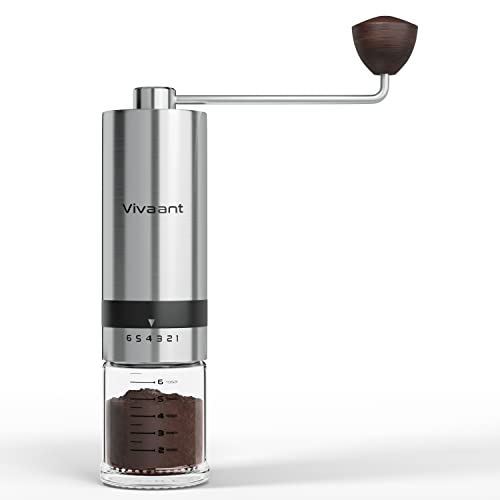
Not everyone wants to research burr metallurgy before their first hand grinder, and the Vivaant respects that. It arrives as a complete set: grinder body, crank handle, glass catch jar, and lid, so there’s nothing extra to buy before your first cup. The glass jar doubles as storage, keeping grounds contained between brews.
The stainless steel conical burr carries what the brand calls a Dragon Tooth cut pattern, designed to move through beans faster than standard burr geometry. Compared with the more technical KINGrinder K6, this one trades adjustment finesse for simplicity, which is exactly the right trade for a first grinder.
What Makes Sense
- Complete kit includes jar and lid, ready to use out of the box.
- Glass catch container stores grounds cleanly and doesn’t hold odors like plastic.
- Tooth-patterned burr geometry speeds up grinding versus conventional designs.
- Hand-sized form factor suits small kitchens and quick single servings.
A Few Limitations
- Coarser adjustment steps make true espresso dialing harder than with the K6 or C2S.
- Glass adds fragility; owners commonly recommend hand-washing rather than tossing it in a crowded sink.
Core Details
Whose Shelf It Belongs On
First-time manual grinder owners who value a simple, complete setup over granular adjustment control.
Skip It When
Dedicated espresso enthusiasts needing click-by-click precision belong with the KINGrinder K6.
What Matters Most Before Choosing Espresso Hand Grinders
Burr Size And Material
Burr diameter drives grinding speed. A 38mm burr like the TIMEMORE’s chews through a dose faster than smaller sets, which matters when you’re making three drinks before leaving the house. Material matters just as much: hardened stainless steels such as 420 hold their edges longer, protecting consistency over years of daily use.
Adjustment Style
External dials, like the K6’s 60-click nut, let you change settings in seconds and record exact recipes. Internal systems require opening the grinder and counting steps, which works fine once you’ve memorized your numbers but slows down experimentation. Match the mechanism to how often you switch brew methods.
Capacity And Portability
Capacity shapes your routine more than most shoppers expect. A 25g hopper suits solo espresso drinkers; 30g units serve households with mixed preferences. Frequent travelers should prioritize compact bodies and protected handles, since a grinder rattling around in luggage takes abuse no countertop model ever sees.
Key Considerations Across These Picks
Traps First Timers Fall Into
The most common mistake is buying on looks alone. A sleek body with undersized burrs turns every morning into an arm workout. Second trap: ignoring adjustment type until after purchase, then discovering internal settings don’t suit a household that rotates between espresso and French press weekly.
What Separates Premium From Basic
Higher-tier grinders spend their budget on tighter machining tolerances, better bearings, and finer adjustment increments. Those details show up as faster grinding and more repeatable shots. Casual drinkers won’t notice; anyone pulling espresso daily will feel the difference within a week.
Frequently Asked Questions
Are hand grinders actually good enough for espresso?
Yes, provided they use quality conical burrs and offer fine adjustment. All five picks here meet that baseline.
How long does grinding a dose take?
Most doses take 30 to 90 seconds depending on burr size and fineness. Larger burrs finish faster.
Do manual grinders need cleaning?
Occasional brushing out of residual oils and dust keeps performance steady. Avoid water unless the manufacturer says parts are washable.
Can one grinder handle both espresso and French press?
Models with wide adjustment ranges can. The KINGrinder K6 and HEIHOX both span that full spectrum.
Is a hand grinder worth it over an electric one?
For single doses, yes: quieter, cheaper, and portable. High-volume households will still prefer electric convenience.
Closing Thoughts
Every grinder here solves the same problem differently. The TIMEMORE Chestnut C2S is the dependable everyday choice, the KINGrinder K6 rewards tinkerers, the HEIHOX stretches a budget furthest, the Alpaca Ventures travels light, and the Vivaant welcomes beginners. Match the tool to your routine, write down your favorite settings, and your shots will thank you.