Storm season doesn’t check your schedule. When the grid drops, a hand crank radio becomes your lifeline to weather alerts, a flashlight, and a way to charge a dying phone, all without an outlet in sight. This roundup covers five solid options built around NOAA reception, crank generators, and solar panels, from compact budget units to heavy-battery workhorses.
A Snapshot Of The Selections

Mesqool Solar Emergency Hand Crank Radio 12000mAh
Vokida Hand Crank Solar Emergency Weather Radio 10000mAh

Rychi 10000mAh Emergency Solar Crank Radio with SOS Alarm

Aivica Hand Crank Emergency Radio 20000mAh Battery

Roxicosly Emergency Weather Radio Large Solar Panel 12000mAh
Taking A Closer Look At The Options
Signal quality is where this Mesqool unit earns its spot. A high-sensitivity receiver chip paired with noise-reduction circuitry and a long antenna pulls in NOAA weather band, AM, and FM stations cleanly, which matters most when you’re huddled indoors during a storm and every word of a broadcast counts.
The 12000mAh battery sits near the top of this list for capacity, enough to top up a phone several times before you ever touch the crank. Campers going off-grid get the same benefit, since solar input keeps the unit topped up through daylight hours. Compared with the Vokida below, you’re paying for noticeably stronger reception hardware rather than raw battery numbers alone.
Practical Advantages
- Noise-reduction circuitry keeps broadcasts intelligible even in marginal coverage areas
- Extended antenna improves pull on distant NOAA transmitters
- 12000mAh cell doubles as a serious emergency phone charger
- Three power paths: crank, solar, and internal lithium-ion storage
Things To Consider
- Larger battery capacity adds weight, so pocketability suffers versus smaller units
- Owners commonly report solar charging is a trickle, not a fast refill, in cloudy conditions
Who It Suits Best
Households in storm-prone regions who want dependable weather-band audio above all else.
A Better Fit Elsewhere
Shoppers prioritizing a lower entry cost will find the Vokida Hand Crank Solar Emergency Weather Radio 10000mAh covers the basics well.
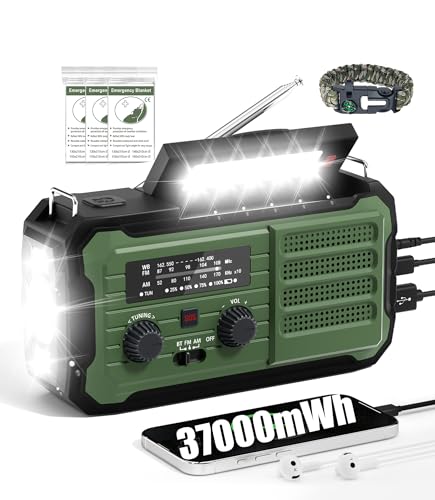
Not everyone wants to spend heavily on gear that mostly sits in a drawer. The Vokida answers that with a 37000mWh rechargeable pack, three charging routes (hand crank, solar panel, and its internal lithium-ion cell), and multiple kit configurations including 5000mAh and 10000mAh variants depending on how much backup capacity suits your household.
In practice, that makes it a sensible first emergency radio: cheap enough to buy two, one for the car and one for the kitchen shelf. Reception covers the standard weather and broadcast bands you’d expect. Against the Mesqool, expect slightly less refined audio, though most listeners won’t notice during short alert bulletins.
A Few Highlights
- Choice of 5000mAh or 10000mAh configurations lets you match capacity to budget
- Hand crank generator works anywhere, no sun required
- Compact footprint stores easily in a glovebox or go-bag
Worth Noting
- Smaller-capacity versions deplete faster under heavy phone-charging loads
- Build materials lean lighter, so treat the unit gently in a packed bag
Right Fit For
First-time preppers and students who want credible backup power without a big outlay.
Swap It Out When
Frequent blackout sufferers needing longer runtime are better served by the Rychi 10000mAh model’s extended playback figures.
This Rychi packs the longest feature sheet here, and the details show real thought. Its 3-watt flashlight is genuinely bright for the category, a separate LED reading lamp handles close-up tasks without draining the main beam, and a press-and-hold SOS button fires both a loud siren and flashing lights to flag down help.
Tuning is unusually user-friendly thanks to a bright band display and a seven-section telescopic antenna spanning AM, FM, and WB frequencies. Runtime figures look strong too: up to 25 hours of radio playback, 30 hours of reading lamp, or 40 hours of flashlight per charge, assuming medium volume. Four charging methods round out the package.
Strengths Worth Knowing
- Dedicated SOS alarm with flashing strobe draws attention fast in a crisis
- Seven-section antenna sharpens reception across all three bands
- Illuminated tuning display stays legible in a dark room
- 40-hour flashlight runtime outlasts most rivals’ lighting modes
Small Caveats
- More buttons and modes mean a steeper learning curve under stress
- Telescopic antennas are the part owners most often report bending or snapping, so extend it carefully
Feature Snapshot
Made For
Families who want one device handling alerts, lighting, signaling, and phone charging during prolonged blackouts.
Where A Sibling Pick Shines
Minimalists who find multi-mode devices fussy will prefer the simpler Vokida layout.
Battery capacity is the headline here: 20000mAh, double what most radios in this class carry. Translation for real life, that’s several full phone refills plus days of radio playback between charges, which is exactly what remote campers and cabin owners want when outlets are a memory.
Reception hardware backs it up. A long 20.5-inch telescopic antenna reaches NOAA, AM, FM, and SW (shortwave, the band that carries international broadcasts) stations, and a noise-reduction chip cleans up weak signals. The trade-off shows up in bulk; this is the heaviest-feeling unit on the list, closer to a small power bank than a pocket radio.
A Strong Showing
- 20000mAh reserve powers phones repeatedly through extended outages
- SW band opens up international and distant broadcasts
- Long telescopic antenna aids reception in valleys and remote terrain
- Noise-reduction processing keeps weak-station audio usable
Points To Keep In Mind
- Size and weight make it a poor fit for ultralight packs
- Extra capacity means longer full recharge times via solar alone
Who Will Love This
Off-grid campers, boaters, and rural residents treating the radio as a primary backup power source.
Reach For A Different Pick When
Backpackers counting ounces will find the Roxicosly large-solar model a better balance of capacity and portability.
Most emergency radios treat solar as an afterthought, slapping a token panel on the back. Roxicosly went the other direction with an oversized monocrystalline panel (monocrystalline means single-crystal silicon cells, which convert sunlight to power more efficiently than cheaper polycrystalline types), harvesting meaningfully more energy per hour of daylight.
Pair that with a 12000mAh battery and a hand crank the maker rates about twice as efficient as standard designs, and you have a unit that refills quickly in sunny climates. Sunbelt residents and desert campers get the most from that design; in overcast regions, the advantage shrinks and the crank does heavier lifting.
A Favorable Mix
- Oversized monocrystalline panel converts sunlight faster than typical small panels
- Efficient crank generator tops up power in about a minute of turning
- 12000mAh capacity supports phone charging and long listening sessions
Honest Caveats
- Solar gains depend heavily on local sun exposure; cloudy climates see slower recovery
- Panel surface collects dust outdoors, so wipe it periodically to maintain output
Quick Facts
Built With In Mind
Outdoor enthusiasts in sunny regions who want solar to carry most of the charging workload.
Consider Something Else When
Users needing maximum stored capacity regardless of sunshine should step up to the Aivica 20000mAh model.
What Matters Most Before Choosing Hand Crank Radios
Battery Capacity And Charging Paths
Capacity determines how long the unit runs between charges. A 5000mAh cell covers a night of alerts and one phone top-up; 12000mAh or more stretches across a multi-day outage. Just as important is how many ways the battery refills. Three methods (crank, solar, USB) beat two, because cloudy weather can stall solar-only recovery.
Reception Quality
The whole point is hearing alerts, so antenna length and receiver sensitivity deserve attention. Longer telescopic antennas generally pull weaker NOAA and AM stations more reliably, and noise-reduction circuitry helps in fringe coverage zones. Shortwave adds international broadcasts, useful mainly for travelers and rural listeners far from urban transmitters.
Lighting And Signaling Extras
A flashlight and reading lamp sound like garnish until the power has been out for three nights. Look for a dedicated bright beam plus a low-draw lamp mode. An SOS siren with flashing lights is worth having in any household near wilderness or flood zones.
Size Versus Staying Power
Bigger batteries mean bigger bodies. Match the unit to where it lives: a glovebox favors compact models, while a home emergency kit can absorb a heavier, higher-capacity build without complaint.
Key Considerations Across These Picks
Traps First Timers Fall Into
The classic mistake is buying on battery number alone and ignoring antenna quality, then wondering why stations fade. Another common slip is storing the radio uncharged for years; lithium cells degrade when left empty, so top it up every few months. Skipping a test run before storm season leaves you learning the buttons in the dark.
Why Top Tier Costs More
Higher-priced models spend their extra cost on receiver chips, larger solar surfaces, and bigger cells. That translates into clearer audio at the edge of coverage and fewer crank sessions. Casual users gain little from those upgrades; anyone facing frequent outages usually finds the difference pays off within a season.
Frequently Asked Questions
How long should I crank a hand crank radio?
Most models generate meaningful charge within one to three minutes of steady cranking. Expect a few minutes of radio playback per session rather than a full battery refill.
Do these radios receive official weather alerts?
Units covering the NOAA weather band tune the seven government broadcast channels used for severe weather updates. Reception depends on your distance from a transmitter and terrain.
Can a hand crank radio really charge a smartphone?
Yes, though slowly. The built-in battery charges your phone like any power bank, and the crank or solar panel refills that battery gradually.
Where should I store my emergency radio?
Keep it somewhere cool, dry, and easy to grab, such as a kitchen shelf or go-bag. Recharge it every two to three months to protect the lithium cell.
Is shortwave worth having?
For most suburban households, no. It earns its keep for rural users, travelers, and hobbyists who enjoy international broadcasts.
Closing Remarks
Any of these five will keep weather alerts, light, and phone power within reach when the outlet goes quiet. Start with your likely scenario, a glovebox spare, a storm-shelf staple, or a camping companion, and let battery size and reception quality narrow the field. Whichever you choose, charge it fully today and tuck it somewhere you’ll remember tomorrow.