A hand grinder is the quiet workhorse of a serious coffee setup. No motor noise before sunrise, no batteries dying mid-camp-trip, and burr quality that rivals machines costing far more. The catch is that not all cranks are equal: adjustment style, burr material, and body construction separate a joyful daily ritual from a wrist-aching chore. This roundup covers five grinders that handle everything from fine espresso to coarse French press, so you can match one to your brew routine and your budget.
A Closer Look At The Lineup

TIMEMORE Chestnut C2S Manual Coffee Grinder (Black)

KINGrinder K6 Manual Coffee Grinder Stainless Burr

HEIHOX 30g Manual Coffee Grinder CNC Conical Burr

Alpaca Ventures Compact Travel Hand Grinder
Vivaant Manual Coffee Grinder Hand Crank
More Details On Our Top Picks
The C2S is the upgraded take on TIMEMORE’s popular Chestnut line, and the headline change is structural: the whole body is now a single machined metal unit, which addresses the cracked-lid complaints that followed earlier versions around. Inside sits a 38mm stainless steel conical burr, cut by CNC machining for tight tolerances.
In practice, that combination suits anyone pulling daily shots at home. A conical burr is the cone-shaped cutting pair inside; it shears beans into uniform particles rather than shattering them, and uniformity is what keeps espresso extraction even. Double bearings hold the central shaft steady under load, so the grind stays consistent shot after shot.
What Makes Sense
- Full metal unibody construction removes the fragile top-cover weak point of older models.
- The 38mm burr cuts through a 25g dose efficiently, so morning espresso takes less elbow time.
- Double-bearing shaft positioning keeps particle size even, which translates to more balanced extraction in the cup.
- CNC-machined stainless steel burrs tend to hold their edge through years of daily grinding.
Things To Consider
- Adjustment is internal, meaning you open the grinder and count clicks from zero when switching between brew styles.
- Owners commonly report that fine metal bodies show fingerprints and need an occasional wipe-down to stay presentable.
Key Specs
Made For
Home baristas who pull espresso most mornings and want a durable, no-drama grinder that lives on the counter.
A Better Fit Elsewhere
If dialing in espresso with click-level precision matters more than body refinement, the KINGrinder K6’s external adjustment will suit you better.
Where the TIMEMORE wins on build polish, the K6 wins on adjustment finesse. Its external adjustment ring sits at the top of the grinder, so changing grind size takes seconds without disassembly. Each click moves the burrs just 16 microns apart, a micron being a millionth of a meter, and that granularity is exactly what espresso dialing demands.
The range is generous too: 60 clicks per rotation across up to four full turns, stretching from Turkish-fine to coarse enough for cold brew. For anyone who bounces between a morning shot and an afternoon pour-over, that flexibility is the whole point. The straight handle and full aluminum-and-stainless construction keep it feeling planted during long fine-grind sessions, though you may notice the extra heft in a packed bag.
What Earns Its Place
- 16-micron-per-click external adjustment makes repeatable espresso settings genuinely easy to log and return to.
- A wide adjustment range covers every major brewing method from fine to coarse.
- All-metal housing and stainless burrs point toward a long service life with basic care.
- No tools or disassembly needed to switch grind sizes between brews.
Small Caveats
- The metal body adds weight compared with lighter travel-oriented options like the Alpaca Ventures grinder.
- Beginners may find the sheer number of clicks intimidating before they learn their sweet spot.
Who Will Love This
Espresso enthusiasts who enjoy dialing in recipes and want laboratory-grade repeatability without paying electric-grinder prices.
Skip It When
Ultralight backpackers should reach for the Alpaca Ventures compact model instead, since every ounce counts on trail.
The HEIHOX earns its spot by doing the fundamentals well at a friendlier entry point. Its 420-grade stainless steel conical burr is CNC-machined, the same manufacturing approach as pricier picks here, and the 30g hopper holds roughly two more grams of beans per load than the TIMEMORE C2S. That is enough for a large pour-over or a shared office round without refilling.
Double bearing positioning mirrors what the bigger names do, keeping the shaft aligned so grounds stay consistent from espresso-fine to French press coarse. Internal adjustment means fewer exposed parts to snag in a bag, though it does add a step when you switch brew methods. In our view, this is the sensible first serious grinder for someone who wants real burr quality without overspending while figuring out their preferences.
Positive Takeaways
- 30g capacity handles bigger batches, handy for office rounds or two-person mornings.
- CNC stainless conical burrs deliver consistency usually associated with costlier models.
- Internal adjustment keeps the exterior clean and pocket-friendly for travel.
Worth Noting
- Changing between espresso and filter settings requires opening the grinder and re-zeroing, which slows multi-method households.
- As with any internal-adjust design, losing track of your click count means re-dialing from scratch.
Quick Facts
Right Fit For
Budget-conscious coffee drinkers who split time between home, office, and campsite brewing.
Where A Sibling Pick Shines
Anyone chasing micro-adjusted espresso precision will get more mileage from the KINGrinder K6’s 16-micron clicks.
This one is built around a simple promise: grinding should not wear out your arm. A built-in bearing reduces the force needed per rotation, and the lengthened stainless steel handle adds leverage, so a dose comes together with noticeably less effort than short-crank designs. There is no battery, no cord, nothing to charge at a campsite or in a hotel room.
The precision adjustment spans espresso through French press, and the compact footprint slips into a carry-on side pocket. Compared with the HEIHOX, you give up some hopper capacity, but gain a lighter pack weight. Frequent flyers who refuse to drink bad hotel coffee are the obvious audience here, and honestly, that is who it was drawn up for.
What Helps Most
- Bearing-assisted crank plus a longer handle cuts grinding effort on tough fine settings.
- Compact travel size fits easily into luggage or a daypack.
- Adjustable range covers espresso, pour-over, and French press in one tool.
- No power source needed, which removes charging anxiety on longer trips.
Points To Note
- Smaller capacity means more refill cycles when brewing for several people.
- Some users report the adjustment ring needs occasional checking to stay locked after rough transit.
Who Should Grab It
Travelers, van lifers, and commuters who want café-quality grounds anywhere without hauling bulk.
Another Choice May Suit
Home-first brewers who value a sturdier counter presence will prefer the all-metal TIMEMORE Chestnut C2S.
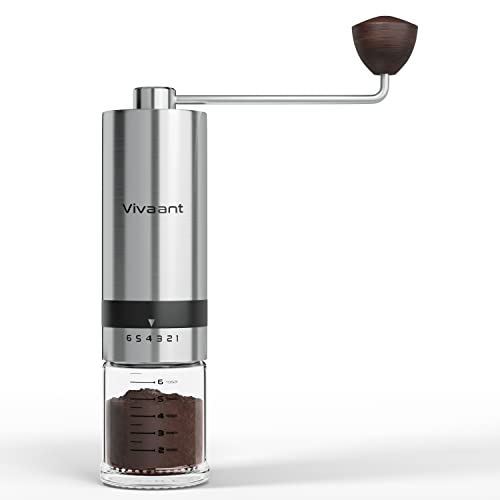
The Vivaant arrives as a complete kit rather than a bare grinder: crank, glass jar, and lid all included, so grounds collect straight into a storage vessel ready for the kettle. That packaging makes it the least intimidating entry point on this list for someone upgrading from pre-ground beans or a blade grinder.
Its stainless steel conical burr uses an aggressive tooth profile the brand markets for speed, and the pitch is real: coarser teeth bite through beans faster than finely machined surfaces, though the trade-off is slightly less particle uniformity than the TIMEMORE or KINGrinder deliver. For drip coffee, French press, and casual pour-over, most people will never notice. Espresso purists chasing dialed-in shots should look higher up this list instead.
Everyday Advantages
- Glass jar doubles as both catch cup and airtight storage, cutting down on countertop clutter.
- Tooth-profiled burr grinds a dose noticeably faster than standard fine-cut designs.
- Everything ships together, so there is nothing extra to buy before your first brew.
Honest Caveats
- Coarser tooth geometry sacrifices some grind uniformity, which matters most for espresso.
- The glass jar needs careful packing for travel since it can break where metal bodies would not.
Feature Snapshot
Whose Shelf It Belongs On
First-time manual grinder owners and casual brewers who want a tidy, all-in-one kit for daily drip and press pots.
Consider Something Else When
Serious espresso hobbyists will be better served by the KINGrinder K6’s finer adjustment granularity.
What Matters Most Before Choosing Hand Espresso Grinders
Burr Quality Comes First
The burrs do the actual cutting, so their material and machining decide everything downstream. CNC-machined stainless steel conical burrs, found on all five picks here, shear beans into even particles that extract predictably. Cheaper stamped blades crush rather than cut, leaving a mix of dust and boulders that tastes muddy no matter your technique.
Adjustment Style Shapes Daily Use
External adjustment lets you change grind size in seconds and log exact settings, which espresso drinkers will appreciate daily. Internal adjustment hides the mechanism for a cleaner, more travel-proof body but costs you time every time you switch brew methods. Match the style to how often you actually change recipes.
Capacity And Effort
A 25g hopper covers a double shot; 30g stretches to a larger pour-over. Longer handles and bearing-supported axles reduce wrist strain, a detail that matters enormously on fine espresso settings where resistance peaks.
Where You Will Grind
Counter-bound home baristas can prioritize heft and stability. Campers and commuters should weigh size, protected internals, and whether the catch container survives being tossed in a bag.
Key Considerations Across These Picks
Traps First Timers Fall Into
Chasing the finest possible grind number is the classic error; the right setting depends on your beans, roast, and machine, not a universal chart. Another common slip is ignoring adjustment style entirely, then discovering mid-routine that opening the grinder twice a day gets old fast.
What The Higher Tier Buys
Pricier models spend their budget on tighter burr tolerances, finer click resolution, and full-metal bodies. Those upgrades pay off for espresso drinkers who re-dial weekly. Filter-only brewers rarely feel the difference, so spending less on a solid conical burr design is a reasonable call.
Frequently Asked Questions
Can a hand grinder really handle espresso?
Yes, provided it has a quality conical burr and fine adjustment steps. Models like the KINGrinder K6 offer 16-micron clicks specifically for dialing shots.
How long does grinding by hand take?
A typical dose takes 30 seconds to two minutes depending on fineness and burr size. Larger burrs and bearing assistance shorten that considerably.
Are manual grinders better than blade grinders?
For flavor, clearly yes. Burrs produce uniform particles that extract evenly, while blades chop unevenly and generate heat that dulls aroma.
How do I clean a hand coffee grinder?
Brush out residual grounds after each session and do a deeper cleaning with grinder-safe tablets or dry rice occasionally. Avoid washing burrs with water unless the manufacturer says it is safe.
Is a glass catch jar a downside?
It stores grounds neatly but adds breakage risk in transit. Metal-bodied grinders travel with less worry.
Closing Thoughts
Every grinder here produces fresher, better-tasting coffee than pre-ground beans ever will. Pick the TIMEMORE C2S for refined daily durability, the KINGrinder K6 for espresso precision, the HEIHOX for value and capacity, the Alpaca Ventures for life on the move, or the Vivaant for a friendly all-in-one start. Whichever fits your routine, your morning cup will thank you.