A dead phone tower during a storm leaves most people guessing. A hand radio doesn’t care whether the grid is up, the batteries are fresh, or you’re ten miles past the last cell bar. This roundup covers five options built for different lives: storm-prep households, backpackers, joggers, worksite crews, and licensed ham operators. Each one earns its spot on real attributes like battery chemistry, band coverage, and carry weight, not marketing gloss. Match the radio to your routine and it’ll earn its drawer space.
A Quick View Of The Lineup

Mesqool Emergency Hand Crank Solar Radio 12000mAh

PRUNUS J161 NOAA Weather Radio AM FM AA Battery

SWDSTP Personal Portable AM FM Mini Radio Rechargeable

pxton Long Range Walkie Talkies with Earpiece 6 Pack
Baofeng UV-5RM Handheld Ham Radio Dual Band
Inside Each Recommended Option
The Mesqool is the unit you want sitting on a shelf before hurricane season starts. Its headline number, a 12000mAh internal battery, means roughly several full phone recharges banked inside the chassis, so one device covers light, communication, and weather alerts when the wall outlet goes quiet.
Hand crank and solar inputs back that capacity up, which matters because a big battery is useless once it drains. The manufacturer also offers optional damage protection covering drops, spills, and post-warranty breakdowns, with claims handled online around the clock. That safety net suits anyone who plans to toss this in a truck bed or garage bin.
Strong Points
- A 12000mAh cell can top up a smartphone multiple times during an extended outage.
- Crank and solar charging mean you’re never dependent on finding an outlet.
- Optional protection plan covers accidental drops and spills at no per-repair cost, parts and labor included.
- Claims can be filed online any hour of the day, often approved within minutes.
Honest Caveats
- Crank charging replenishes slowly; treat it as a lifeline rather than a fast refill.
- Solar input depends heavily on window placement and cloud cover, so owners commonly report trickle-level gains indoors.
Who Should Grab It
Families building a serious storm kit who want one box handling alerts, lighting, and phone power.
A Better Fit Elsewhere
Anyone counting grams in a go-bag will find the PRUNUS J161’s quarter-pound frame far easier to carry.
Where the Mesqool banks energy, the PRUNUS J161 strips things down to essentials. At 4.7 by 2.8 by 1.2 inches and roughly 0.24 pounds without cells, it’s about the size of a large phone and disappears into a jacket pocket or emergency pouch.
NOAA weather bands are the point here: these government frequencies broadcast forecasts and hazard warnings continuously, and having them on a dedicated receiver beats scrolling a dying phone. Two AA batteries run the whole thing, and spares cost pennies and keep for years on a shelf.
The Value In It
- Runs on two standard AA batteries, so a fresh pair from any corner store keeps it alive indefinitely.
- NOAA weather band reception delivers official warnings even when cellular networks fail.
- Included lanyard lets you wear it hands-free while working or evacuating.
Things To Consider
- No built-in rechargeable cell, so budget for periodic battery replacement.
- Small speakers in this size class tend to sound thin at higher volume, based on what owners commonly note.
At A Glance
Made For
Minimalists assembling a lean emergency kit who value simplicity over gadget stacking.
Swap It Out When
Phone-charging capability tops your list; the Mesqool’s 12000mAh reserve handles that job instead.
This SWDSTP shifts the category from emergency prep to daily companionship. The body measures just 3.5 x 1.5 x 0.3 inches and weighs about 1.14 ounces, credit-card territory, so it rides along on runs, garden sessions, and commutes without a second thought.
A DSP chip, short for digital signal processing, cleans up weak stations electronically instead of relying purely on antenna length. Cleverly, the earphone cord doubles as the antenna itself, which is why reception holds steady through headphones even where bare antennas struggle.
Useful Touches
- Stores 70 presets, 50 FM plus 20 AM, so favorite stations are one press away mid-jog.
- Earphone-wire antenna design keeps signal stable while the unit sits in a pocket.
- Detachable back clip mounts it on a waistband or shirt collar for hands-free listening.
- Rechargeable internals skip disposable batteries entirely for everyday use.
Small Caveats
- No weather-band tuning, unlike the PRUNUS J161 earlier in this list.
- The featherweight shell feels less rugged than larger sets; a padded pocket is kinder to it than a tool bag.
Feature Snapshot
Right Fit For
Joggers, cyclists, and travelers who listen daily through earbuds and prize featherlight gear.
Where A Sibling Pick Shines
Storm readiness calls for the PRUNUS J161 instead, since this model skips NOAA alert bands altogether.
Everything so far has been one-way listening. The pxton six-pack flips the script with push-to-talk two-way radios aimed at crews: think festival volunteers, warehouse staff, or a family spread across a campground. Six units arrive together, each paired with an upgraded earpiece.
The standout hardware piece is the six-bay gang charger, which refills every handset simultaneously and carries safeguards against overvoltage, overheating, and overcurrent. Sixteen preset channels keep groups organized without fiddly programming, and the FCC registration on file signals compliance with US radio rules.
A Few Strong Suits
- Six handsets in one purchase outfit an entire team out of the box.
- Six-way charging stand powers all radios at once, saving counter space and time.
- Built-in charging protections guard against overcharge and heat damage overnight.
- Sixteen preset channels let separate groups talk without cross-talk confusion.
Points To Note
- Advertised range shrinks sharply among buildings and dense terrain, as is true of all handheld two-way radios.
- You may find the earpieces need gentle cable handling over months of repeated clipping and unclipping.
Built With In Mind
Event organizers, site supervisors, and group leaders coordinating four to six people in the field.
Reach For A Different Pick When
Solo listeners wanting broadcast music should look back at the SWDSTP mini radio; these pxtons only do voice.
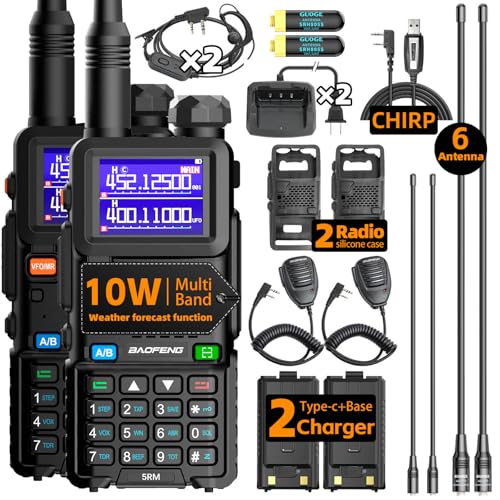
The Baofeng UV-5RM sits at the enthusiast end of this list, and it asks something of you first: transmitting on ham bands legally requires an amateur radio license. Once that’s sorted, the hardware rewards the effort with dual-band operation on 144-148MHz and 420-450MHz, the workhorse VHF and UHF ranges local repeaters use.
Reception stretches far wider, spanning aviation, marine, and general UHF segments across five bands. A 1.77-inch color display and 999 memory channels tame that flexibility, letting you organize everything from weather scans to club nets.
The Case For It
- Dual-band transmission covers both VHF and UHF amateur allocations with one handset.
- Wide receive range adds airband, marine, and utility listening beyond ham traffic.
- 999 memory channels handle years of programmed repeaters and scan lists.
- Color display makes menu navigation noticeably easier than monochrome predecessors.
- FCC ID on record confirms the unit meets regulatory requirements for sale.
Trade-Offs To Weigh
- An amateur license is mandatory before transmitting; receive-only use needs none.
- Programming depth carries a learning curve, and newcomers commonly lean on community guides and software.
Quick Facts
Who Will Love This
Licensed amateurs and preparedness-minded hobbyists ready to program and grow into a capable transceiver.
Consider Something Else When
License-free simplicity wins for casual users, and the pxton six-pack delivers instant group talk with zero study time.
What Matters Most Before Choosing Hand Radios
Power Source First
Decide how the radio stays alive before anything else. Rechargeable packs suit daily listeners, AA-cell models shine in emergencies because spares store for years, and crank-plus-solar designs hedge against every scenario at once. Mixing one of each across your kit covers more ground than doubling up.
Bands And Coverage
Bands determine what you’ll actually hear. NOAA weather frequencies deliver official alerts, AM/FM brings music and news, and two-way operation requires matching channel sets between units. Ham transceivers add licensed transmit privileges but demand study time first, so match ambition to willingness.
Carry Reality
Weight decides usage more than specs do. A 1.14-ounce clip radio gets taken along daily; a heavier emergency unit lives on a shelf until needed. Neither is wrong, but be honest about where yours will spend its life before committing.
Group Versus Solo Use
Coordinating people changes the math entirely. Multi-packs with shared charging docks beat buying singles piecemeal, and preset channels matter more than raw range once several radios share the same airspace.
Key Considerations Across These Picks
Where Shoppers Go Wrong
The classic error is buying on advertised range alone; buildings and hills cut those figures dramatically. Another slip is ignoring battery format, then discovering proprietary packs are hard to replace mid-outage. Check band support against your actual needs too, since a music-only pocket radio won’t pick up weather alerts.
What The Higher Tier Buys
Spending up generally buys transmit capability, wider receive coverage, and memory depth. Enthusiast models like the Baofeng justify their tier through dual-band operation and hundreds of programmable channels. Casual listeners rarely touch those features, which is why honest self-assessment saves money here.
Frequently Asked Questions
Do hand radios work when cell towers are down?
Yes, because they rely on radio waves and their own power rather than network infrastructure. Broadcast receivers pull signals from transmitter towers, and two-way units communicate directly between handsets.
What does NOAA weather band mean?
It refers to government-run frequencies broadcasting continuous forecasts and hazard warnings in the United States. A radio tuned to these bands receives official alerts even during widespread power failures.
Can I transmit on a ham radio without a license?
No, US regulations require passing an amateur radio exam before transmitting on those bands. Listening is unrestricted, so many people start there while studying.
How long do AA batteries last in a small radio?
It varies with volume and usage, though simple analog sets typically run for many hours per pair. Keeping sealed spares in your kit removes the guesswork entirely.
Are walkie-talkies and ham radios the same thing?
No, consumer walkie-talkies operate license-free on fixed shared channels. Ham transceivers offer programmable bands and greater range but require certification to transmit.
Closing Remarks
Five radios, five very different jobs. The Mesqool anchors a home emergency setup, the PRUNUS J161 trims that idea to pocket size, and the SWDSTP turns listening into a daily habit. Crew coordination points toward the pxton set, while licensed operators will get the most mileage from the Baofeng UV-5RM. Start with your actual routine, not the spec sheet, and the right choice tends to make itself.