


A tape measure is the tool you grab most and think about least, until the markings fade or the lock gives up mid-measurement. The five options below cover the full range of cheap-but-decent measuring: steel blades for DIY work, soft fabric tapes for sewing and body measurements, and multi-packs that keep a spare in every bag. Each pick solves a specific everyday problem without asking much of your wallet.
A Side-By-Side Look

Yekepal 25-Ft Self-Locking Steel Tape Measure

MUZHI Retractable Body Measuring Tape, 10 Pack 60 Inch

RoxRulie 16-Ft Fractional Tape Measure

ALLWIN 25 Ft Metal Retractable Tape Measure with Fractions
Benchmark 3 Pack 25 Ft Magnetic Tip Tape Measures
The Picks, Examined More Closely
The self-locking mechanism is the whole story here. Pull the steel blade out and it stays put until you press the release button, so solo measuring around furniture or door frames stops being a two-hand juggling act.
That matters most when you’re marking a wall for shelves or checking a window opening with your other hand already holding a pencil. The 25-foot reach covers most room-scale jobs, and dual imperial/metric graduations suit anyone working from plans written either way.
Points In Its Favor
- Self-locking blade holds position one-handed, freeing your other hand for marking or steadying material
- 25 feet of reach handles interior rooms, closets, and most furniture without an extension
- Imperial and metric scales on one blade suit mixed-unit project plans
- Retracts smoothly on button release rather than snapping back uncontrolled
Small Caveats
- Lock buttons are a common wear point on budget tapes; owners commonly report sticky locks after heavy seasonal use, so store it dry to slow corrosion
Key Specs
Who Will Love This
Renters and first-time DIYers who mostly measure rooms, furniture, and walls alone and want a lock that behaves predictably.
A Better Fit Elsewhere
Sewists and tailors should look instead at the MUZHI 10-pack, whose flexible fabric tapes curve around bodies and garments far more naturally than any steel blade can.
Where the Yekepal above is built for rigid surfaces, this MUZHI set is built for curves. Ten retractable fabric tapes, each 60 inches long and marked in inches and centimeters on both sides, arrive in assorted colors so you can dedicate one to the sewing kit, one to the gym bag, and one to the craft drawer.
Fabric tape, sometimes called a tailor’s tape, bends around waists, sleeves, and hem lines where a steel blade would bridge and misread. A push-button retractor fixes the extended length, which helps when you’re pinning a garment alone. For anyone who loses small tools constantly, ten spares change the game entirely.
What Helps Most
- Double-sided inch and centimeter markings let you follow either pattern notation directly
- Flexible ribbon conforms to body contours for accurate bust, waist, and hip readings
- Ten distinct colors make it easy to assign tapes to different bags or family members
- Button-controlled retraction holds your chosen length while you work
Things To Weigh Up
- A 60-inch span won’t handle room dimensions, so it complements rather than replaces a steel tape
- Fabric ribbons can stretch over years of tight wrapping; check against a ruler occasionally if precision matters
Right Fit For
Sewists, knitters, and anyone tracking body or garment measurements who wants several tapes scattered where they’ll actually be needed.
Another Choice May Suit
Home renovators measuring drywall or flooring will get far more use from the ALLWIN 25-foot steel tape, which offers rigidity and reach this soft ribbon simply can’t provide.
This one trades reach for portability. At roughly 2.5 by 2.5 by 1.5 inches, it disappears into a jacket pocket or kitchen drawer, yet the 16-foot blade still spans most furniture and appliance placements. The fractional markings down to 1/8 inch are printed right on the blade, so there’s no counting tick marks between numbers.
That fraction labeling is the feature worth understanding: instead of reading “between 22 and 23,” you read “22 and 5/8,” which cuts transcription errors when you’re cutting trim or ordering cut-to-size shelving. In our view, the shorter blade is a fair trade for anyone whose projects live indoors.
Benefits That Matter
- Fractions to 1/8 inch printed on the blade speed up accurate reads and reduce mistakes
- Palm-size housing fits pockets, aprons, and glove boxes without snagging
- Wide 1-inch (25mm) blade resists twisting during single-handed extension
Points To Note
- At 16 feet, outdoor fencing, deck boards, and long walls will need a second measurement pass; step up to a 25-footer like the Benchmark pack below for those jobs
Feature Snapshot
Built With In Mind
Apartment dwellers and casual fixer-uppers whose projects rarely exceed a single room and who want a tape that lives in a coat pocket.
Swap It Out When
Anyone framing walls or working lumber regularly should reach for the ALLWIN 25-footer, whose longer thickened blade handles construction-scale spans without repositioning.
Think of this as the dependable middle ground of the list. Compared with the compact RoxRulie, the ALLWIN doubles the reach to 25 feet and pairs it with a full 1-inch-wide blade made of thickened steel and finished with a wear-resistant coating, a combination that keeps the tape straight when extended across a workshop floor.
The coating detail deserves attention because it’s what slows the scuffing that eventually makes budget-blade numbers unreadable. Fractional markings appear along the length, and the metal housing shrugs off the drops that come with garage and job-site use. You may find it slightly bulkier in a pocket than the smaller picks here; that’s the cost of the sturdier build.
What Pays Off
- Thickened 1-inch steel blade extends straighter for accurate long-span reads
- Wear-resistant coating protects printed graduations from early fading
- 25-foot reach suits flooring, fencing layout, and furniture-scale carpentry
- Metal case tolerates drops and rough toolbox storage
- Fractional markings support quick, confident cuts
Less Ideal Details
- No magnetic tip listed, so solo steel-to-steel measuring takes a helper or a clamp
- Larger housing takes up more pocket and pouch space than compact models
The Right Fit
Weekend woodworkers and homeowners tackling renovations who need one sturdy tape that survives years of toolbox life.
Look Elsewhere When
Pros running multiple simultaneous jobs get better economics from the Benchmark three-pack, which supplies identical capability times three for shared toolboxes.
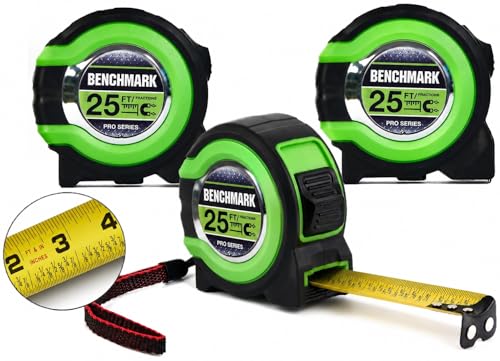
The magnetic tip changes how you measure metal. Hook the end onto a stud edge, steel post, or saw table and the tape holds itself while you walk the blade out, something neither the Yekepal nor the ALLWIN offers. Each of the three green-cased tapes also carries a thumb lock plus a quick-lock, giving you both fine control and instant freeze mid-extension.
The shell is ABS rubber, a hard plastic wrapped in grippy rubber that dampens drops and stops the case skating across smooth surfaces. Autowind retraction pulls the blade back cleanly, and a belt clip keeps it at your hip. Three units mean one for the truck, one for the bench, one for the junk drawer.
Positive Points
- Magnetic end hook grips steel surfaces for true solo measuring
- Dual locking, thumb and quick-lock, balances precision with speed
- Rubber-coated ABS shell absorbs impact and improves grip in cold weather
- Belt clip and autowind keep daily carry and cleanup effortless
- Three-pack spreads spare capacity across vehicles, shops, and sites
Worth Bearing In Mind
- Rubber coatings attract sawdust and lint; a quick wipe-down after dusty sessions keeps the case and lock button clean
- You’re paying for three units, so a lone-tape shopper gets no benefit from the bundle format
The Numbers That Matter
Whose Shelf It Belongs On
Handymen, contractors, and serious hobbyists who move between a truck, a shop, and job sites and want a capable tape always within arm’s reach.
Consider Something Else When
Occasional users who only measure once a month are better served by the single RoxRulie 16-footer, which costs less and stores smaller without sacrificing indoor usefulness.
What To Check Before Choosing A Budget Tape Measure
Match The Blade To Your Work
Steel blades hold their shape over distance, which makes them the only sensible choice for rooms, lumber, and anything structural. Fabric tapes bend, and bending is exactly what you want against a waistline or a curved seam. Decide your primary surface first; everything else follows from it.
Readability Beats Raw Length
Fractional printing down to 1/8 inch saves real time and prevents the classic error of counting tick marks wrong. Wide blades, typically 1 inch, stay rigid farther before flopping, which matters when you measure alone. A faded or cramped scale turns even a quality tape into guesswork.
Locking Style Shapes Daily Use
Self-locking designs hold the blade automatically until released, ideal for solo measuring. Thumb locks give finer incremental control. Quick-release buttons speed up repetitive tasks. Pick the mechanism matching how often and how precisely you measure.
Count The Units You Need
Imperial-only tapes frustrate anyone following metric patterns or imported furniture specs. Dual-scale blades cost little extra and remove all conversion friction.
Key Considerations Across These Picks
Traps First Timers Fall Into
The most common slip is buying length you’ll never use; a 25-foot blade does nothing for someone measuring hems. Another frequent mistake is ignoring blade width, then wondering why the tape buckles at chest height. Skip ultra-cheap unknown brands with unreadably thin print, since markings are the part you actually use.
What Separates Premium From Basic
Higher-tier tapes add magnetic hooks, rubberized drop protection, and thicker coated steel, each addressing a specific failure mode of basic models. Those upgrades pay off for anyone measuring weekly or on rough surfaces. Monthly indoor users rarely notice the difference.
Frequently Asked Questions
How long should a household tape measure be?
For most homes, 16 feet covers furniture and appliances while 25 feet handles full rooms and yards. Choose based on your largest regular measurement.
Are fabric tape measures accurate?
Yes, within their intended range, and they excel on curved surfaces. They can stretch slightly over years, so verify against a ruler occasionally.
What do fractional markings mean?
They print values like 1/8 or 5/8 directly beside each graduation line. This removes the need to count small ticks between whole inches.
Why does blade width matter?
A wider blade, usually 1 inch, stays rigid when extended horizontally. Narrow blades sag sooner, forcing two-handed measuring.
Is a magnetic tip useful outside workshops?
It helps anywhere metal exists, including appliance backs, door hinges, and steel furniture. Indoors without metal, it simply goes unused.
Closing Thoughts
Every pick here earns its place for under the cost of a decent dinner out. Match the tape to your actual measuring surface, favor readable fractional markings, and don’t overbuy length you won’t stretch. Do that, and whichever option lands in your drawer will quietly outlast its price tag.




