Working near live circuits changes what you reach for in the toolbox. Ordinary pliers and drivers become a liability the moment a tip bridges two terminals, and that’s exactly where insulated tools earn their place in your bag. This roundup covers five options spanning a full maintenance kit, a cable-stripping knife, a crimping set, non-conductive plastic pliers, and a slim-tip screwdriver set built in the USA. Whether you service panels for a living or just swap breakers at home, one of these belongs on your bench.
The Main Contenders

Wera Kraftform Kompakt W 2 Maintenance, 35 Pieces

KNIPEX 98 55 1,000V Insulated Dismantling Knife
haisstronica 6PCS Crimping Tool Set

KNIPEX 98 62 01 Snipe Nose Plastic Pliers 1000V

Klein Tools 33736INS Insulated Screwdriver Set, 6-Piece
A Breakdown Of The Leading Choices
Most tool bags carry five separate items that this single kit replaces. The Wera bundles an insulated hand holder with a dozen VDE-rated blades, meaning the insulation standard used across Europe for live-work screwdrivers covers everything from slotted terminals to cross-head fasteners. A Zyklop Speed ratchet with a quarter-inch drive sits alongside, plus sockets and a Joker wrench.
For anyone doing mixed indoor and outdoor servicing, that combination cuts bag weight dramatically. You may find the blade selection leans toward European fastener standards, which matters more in North American panel work.
A Favorable Mix
- Twelve VDE blades cover nearly every common screw head you’ll meet on a service call
- The Zyklop ratchet speeds up repetitive fastening compared to swapping drivers by hand
- One compact case instead of five loose tools means less to misplace between jobs
- The Joker wrench’s holding function grips bolts so you don’t round off corroded heads
Things To Consider
- Blade sizes favor metric hardware, so US-focused electricians may want supplemental bits
- The case adds bulk versus carrying just two drivers for quick fixes
Who It Suits Best
Maintenance technicians who handle varied fastener types daily and want one kit that travels well between sites.
A Better Fit Elsewhere
American panel work calls for the Klein Tools 33736INS set, whose slim tips are shaped for breaker terminals rather than European hardware.
Stripping insulation from heavy cable is one of those jobs where a utility knife feels wrong in your hand the moment you’re near energized gear. Knipex builds this dismantling knife with insulation rated for contact up to 1000 volts, designed around international standards for insulated hand tools. Cable pullers and industrial electricians are the obvious audience here.
The honest read is that most homeowners won’t touch this tool weekly, but crews doing switchgear or distribution work reach for it constantly.
The Good Stuff
- Insulation engineered to recognized international standards gives documented protection near live parts
- The dedicated blade shape opens cable sheathing cleanly without nicking conductors underneath
- Knipex’s forging reputation suggests the edge holds up through years of daily site abuse
- It slots into a pouch alongside other VDE tools, keeping your live-work kit consistent
Small Caveats
- Owners commonly report the blade needs periodic sharpening once it meets armored or older brittle sheathing regularly
- It handles one job, so casual DIYers get little return on the space it occupies
Key Specs
Built With In Mind
Industrial electricians and cable installers who cut sheathing daily inside environments where energized equipment stays nearby.
Swap It Out When
General terminal work suits the Klein 33736INS screwdrivers better, since drivers see far broader use than a single-purpose blade.
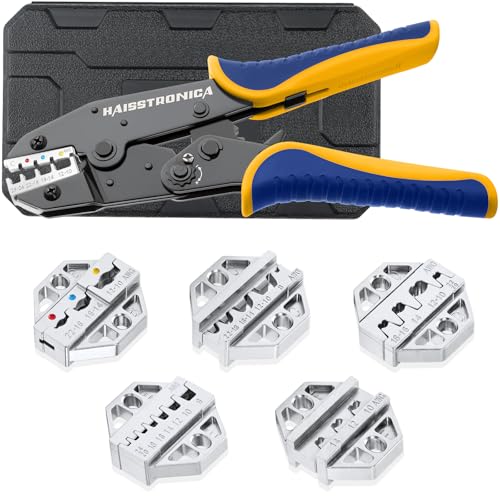
A bad crimp looks fine until salt water or engine vibration finds it, which is why wiring harness builders care about jaw consistency. This six-piece haisstronica set swaps interchangeable dies into one handle, letting you match the die to ring terminals, spades, or open-barrel connectors without buying separate tools. The jaws are precision-forged steel designed to seat a connection firmly on the first squeeze.
Boat owners and automotive restorers get the most from this format, especially since the secure die mounting resists loosening in damp, bouncy conditions.
What Stands Out
- Six interchangeable dies replace a drawer full of single-purpose crimpers
- Tightened die mounting prevents jaw drop, a common failure point on cheaper ratcheting tools
- Forged jaws produce a full-strength crimp in one motion, saving time on long harness runs
- Consistent crimps mean heat-shrink sleeves seat properly instead of bulging over a sloppy joint
Worth Noting
- Swapping dies mid-job costs seconds, so high-volume shops often prefer dedicated fixed-die tools
- This set isn’t voltage-insulated, so keep it away from live-panel tasks meant for the Knipex pliers below
- Dies need occasional cleaning and a light oil wipe to stay smooth in humid garages
Feature Snapshot
The Right Fit
DIY marine electricians and auto hobbyists building or repairing wire harnesses with mixed connector types.
Reach For A Different Pick When
Live electrical panels demand the KNIPEX 98 62 01 pliers instead, because their full insulation protects where bare metal crimpers cannot.
Here’s the unusual entry: these snipe-nose pliers contain no metal at all. Fiberglass-reinforced plastic forms the entire body, giving full insulation against bridging live AC parts up to 1000 volts and DC up to 1500 volts. Because nothing conductive touches the workpiece, they’re also spark-free and invisible to magnetic fields, a genuine advantage during meter assembly or meter blocking where steel tools cause trouble.
Chemically aggressive environments suit them too, since there’s no plated surface to corrode. The trade-off shows up in grip strength: plastic flexes where forged steel doesn’t.
Positive Takeaways
- Fully insulating body eliminates short-circuit risk from the tool itself, not just the handle coating
- No magnetic interaction makes them safe around sensitive meter internals and sensors
- Spark-free operation matters in areas where flammable atmospheres are a concern
- Plastic shrugs off corrosive chemicals that would eat a chrome-plated steel tool alive
Points To Note
- Jaws can’t match steel torque for stubborn or seized fasteners, so treat them as a positioning tool
- Owners commonly report the tips wear faster than metal equivalents under heavy daily twisting
Whose Shelf It Belongs On
Utility meter technicians and lab workers handling live low-force components where any conductive tool creates risk.
Consider Something Else When
Heavy gripping and cutting jobs belong with the KNIPEX 98 55 knife’s sibling steel tools or the Klein driver set, both of which tolerate far more force.
Breaker panels are cramped, and fat driver tips simply don’t fit between adjacent terminals. Klein’s Slim-Tip design thins the profile so the blade slips into terminal blocks and slim-style breakers without scraping neighboring lugs. Each of the six drivers carries bright orange insulation that’s both flame and impact resistant, molded flush with the tip to reduce chipping along the shaft.
Phillips, cabinet, and square bit patterns cover the fasteners you actually meet in North American electrical work, and a included magnetizer keeps small screws attached to the tip overhead. Compared to the Wera kit’s broader scope, this set is narrower but sharper in its focus.
Where It Excels
- Slim tips access recessed terminal blocks that standard drivers physically cannot enter
- Flush-molded insulation resists the chipping that peels away on cheaper dipped handles
- US manufacturing gives consistent quality control batch after batch, in our view a real durability signal
- The magnetizer turns any driver into a screw-holding tool for ceiling fixtures and deep boxes
- Square-recess coverage matches the outlet and switch screws found throughout American homes
Less Ideal Details
- Insulation should be inspected before each shift, since a nicked coating voids the protection it provides
- Six patterns cover electrical basics but skip Torx and hex heads some appliance repairs need
The Details
Who Will Love This
Residential electricians and serious DIYers who spend real time inside breaker panels and junction boxes.
Another Choice May Suit
Technicians needing wrenches, sockets, and ratchets alongside drivers will find the Wera Kraftform Kompakt W 2 covers far more ground per dollar.
What Matters Most Before Choosing Insulated Tools
Match The Rating To Your Actual Work
Every tool here carries a 1000-volt insulation rating except the plastic Knipex pliers, which add DC coverage to 1500 volts. That number describes the maximum contact voltage the insulation is engineered to withstand, not permission to work casually on live gear. Panel technicians need the full rating; hobbyists swapping outlets benefit from it too, but rarely stress it.
Handle Feel Decides Daily Comfort
You’ll hold these tools longer than you think. Slim tips like Klein’s reduce wrist strain in crowded boxes, while Wera’s cushioned Kraftform grip spreads pressure across the palm. A tool that fights your hand on hour six of a job gets left in the truck.
Coverage Versus Specialization
Kits such as the Wera bundle many functions into one case but add bulk. Single-purpose picks like the dismantling knife do one job superbly. Count how often each function appears in your week before deciding which direction fits.
Environment Changes Everything
Marine and automotive wiring punishes loose dies and corroded steel, favoring the haisstronica’s forged jaws. Meter rooms and labs punish magnetic and conductive tools, which is precisely where the plastic Knipex earns its odd-but-valuable place.
Key Considerations Across These Picks
Traps First Timers Fall Into
The biggest mistake is treating insulation as indestructible. Coatings chip when drivers pry or scrape, and a damaged layer offers no protection, so inspect yours before every session. Another trap is buying a full kit when three drivers would do, leaving expensive blades rusting unused in a drawer.
When Paying More Pays Off
Premium brands forge their steel harder and mold insulation flush with the working tip, which slows the chipping cycle dramatically. For daily professional use, that difference compounds into years of extra life. Occasional home users can comfortably start with the value-tier option and upgrade later.
Frequently Asked Questions
What does a 1000V rating actually mean?
It indicates the insulation is engineered to withstand contact with energized parts up to 1000 volts under applicable standards. It reduces risk during incidental contact but never replaces de-energizing equipment whenever possible.
Are insulated tools safe for completely live work?
They’re designed to reduce injury risk from accidental contact, not to enable deliberate work on energized systems. Follow lockout procedures and local electrical codes first.
How do I maintain insulated coatings?
Wipe tools clean after use and store them away from sharp objects that could nick the coating. Inspect visually before each job and retire any tool showing cracks or exposed metal.
Do plastic pliers really replace steel ones?
Only for light-duty positioning near live or magnetically sensitive components. Steel tools still win for torque, cutting, and general durability.
Is a crimping tool considered an insulated tool?
Standard crimpers like the haisstronica set are not voltage-insulated despite being essential electrical tools. Pair them with insulated drivers and pliers for complete live-work coverage.
Closing Thoughts
Your best choice depends on where your hands spend their hours. Panel work points straight at the Klein slim-tip set, while broad maintenance duties justify the Wera kit’s wider coverage. Cable crews, marine wirers, and meter technicians each have a purpose-built answer above. Start with the tool matching your most frequent task, then let the rest of the collection grow around it naturally.