


A shaky bench setup ruins more circuit boards than bad technique ever will. Whether you’re reworking a phone board at midnight or tinning wires for a hobby drone, the right station keeps temperature stable, tips clean, and your workspace organized. The five options below cover everything from full rework rigs to magnifying work lamps, so you can match the tool to what you actually build.
A Fast Comparison Of The Options
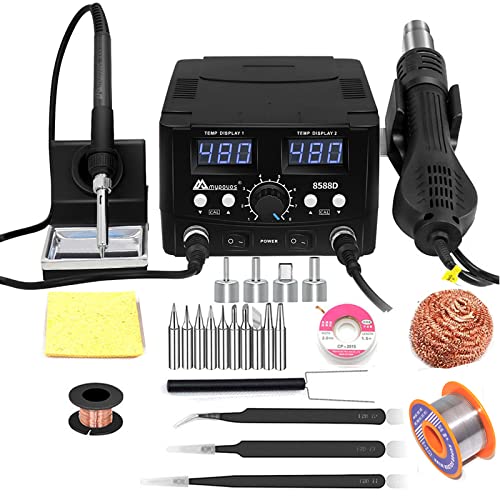
MYPOUOS 8588D 2-in-1 750W Rework Station

YIHUA 928D-III 110W Soldering Iron

Crtsweker 100W Digital Soldering Station Kit (Green)

Crtsweker 100W Digital Soldering Station Kit (Gray)

SainSmart Soldering Station with 6 Helping Hands
The Picks, Examined More Closely
Most stations do one job well. This MYPOUOS unit pairs a hot air gun with a traditional iron in a single compact housing, which is exactly what phone and PCB repair demands. Hot air rework means lifting chips like BGA packages without touching them directly, something an iron alone can’t manage.
The dual blue LED screens let you watch both channels at once, and the handle induction system cools the gun automatically after you set it down. That last detail matters more than it sounds; forgetful users are how workbenches catch fire.
Useful Strengths
- Two tools in one footprint, saving serious bench space compared to separate rework and soldering units.
- Temperature spans 100°C to 480°C with ±1°C setting resolution, tight enough for heat-sensitive SMD parts.
- Anti-static design protects delicate components from electrostatic discharge during handling.
- Built-in fault self-detection warns you before a failing element ruins a board.
- Automatic cooling extends heating element life over years of shop use.
Small Caveats
- The ABS shell keeps weight down but won’t shrug off a drop the way steel-bodied stations do.
- Owners commonly report needing a few sessions to dial in airflow settings for different nozzle sizes.
Key Specs
Who It Suits Best
Repair technicians and advanced hobbyists who regularly desolder ICs and connectors from multilayer boards.
Another Choice May Suit
Hobbyists who never touch hot air work get better value from the YIHUA 928D-III, a dedicated high-power iron.
Where the MYPOUOS rig spreads its wattage across two tools, this YIHUA iron commits all 110 watts to one tip. That translates into fast recovery, the tip snapping back to set temperature right after you drag it across a big copper pad or a stained-glass seam. Anyone who has fought a 40W pencil iron through thick wire knows why that matters.
You still get digital control across 194°F to 896°F, switchable between °F and °C, plus an automatic sleep mode that drops tip temperature when the handle rests idle. The bundled brass wool cleaner beats damp sponges for tip longevity, since it doesn’t shock the plating with cold water.
Points In Its Favor
- 110W output handles demanding jobs like stained glass panels and heavy-gauge wire without stalling.
- Sleep mode protects tips from oxidation between joints, stretching consumable life noticeably.
- An ON/OFF switch means no unplugging the unit every session.
- Iron tip and brass wool included, so the first job can start the day it arrives.
Things To Consider
- No hot air capability, so surface-mount chip removal stays off the menu.
- Single-tip configuration means buying additional tip shapes separately as projects diversify.
Made For
Crafters and electrical workers tackling large joints, thick conductors, and long continuous soldering runs.
Where A Sibling Pick Shines
For mixed electronics benches that occasionally need component removal, the MYPOUOS 8588D’s hot air channel fills that gap.
Starting a soldering habit usually means piecing together six small purchases. This Crtsweker kit collapses that shopping list into one box: the 100W station, spare tips, solder wire, tweezers, a stand, a desoldering pump, tip cleaner, and even two helping hands for holding boards steady. For a first bench, that completeness is hard to argue with.
The LED display reads clearly across the room, and calibration lets you true up the reading against a tip thermometer later on. Auto sleep kicks in during pauses, which beginners trigger constantly while double-checking pinouts.
Advantages To Know
- Everything needed for a first project ships together, eliminating guesswork about compatible accessories.
- Temperature calibration keeps readings honest as the element ages.
- °C/°F conversion suits users following either imperial or metric tutorials.
- Helping hands free up both hands, a genuine safety improvement for newcomers.
Room For Improvement
- Included accessories are entry grade; expect to upgrade tips and tweezers as skills grow.
- The helping-hands arms can loosen over time and benefit from an occasional retighten.
At A Glance
Right Fit For
Students, makers, and anyone assembling their first electronics bench without prior tooling.
Skip It When
Experienced builders with stocked tool drawers gain little here and may prefer the YIHUA 928D-III’s raw power instead.
This is the same Crtsweker package as the green version above, down to the 100W element, auto sleep behavior, and full accessory bundle. The difference is purely cosmetic, and that’s worth saying plainly: pick whichever color fits your bench, because functionally nothing separates them.
For households where one station serves several people, the neutral gray shell tends to look at home next to other workshop gear rather than standing out. Everything else holds true, fast heating across 356°F to 896°F, a readable LED panel, and enough included extras to start soldering immediately.
What It Does Well
- Identical performance to the green kit, giving you a color choice rather than a compromise.
- Auto sleep conserves tip plating when you step away mid-project.
- Desoldering pump and tip cleaner in the bundle handle cleanup tasks many kits omit.
Points To Note
- Accessory quality matches the price tier, so frequent users will replace tips sooner than premium brands.
- Storage is a real consideration; the loose bundle benefits from a small parts tray to stay organized.
Whose Shelf It Belongs On
General home-repair users and shared family workshops wanting one dependable, fully equipped station.
Reach For A Different Pick When
Detail-focused builders doing tiny SMD work under magnification will get far more mileage from the SainSmart lamp station below.
Older helping hands use rigid columns with clamps that fight you at every adjustment. SainSmart replaces that layout with six flexible alligator-style arms in three sizes, each flipping, removing, and repositioning without tools. Pair that with an integrated 5X magnifying lamp and you have a workstation built around visibility and part control.
The wireless lamp design deserves specific mention: earlier versions ran power cables alongside each arm, tangling into a nest mid-job. Here the body integrates everything, leaving the arms free to hold connector leads, sensor boards, or model parts exactly where your eyes need them.
Good Reasons To Consider
- Six arms across three sizes hold awkward assemblies that two-arm stands simply drop.
- 5X magnification reveals cold joints and hairline solder bridges invisible to the naked eye.
- Five color temperatures let you tune light warmth for comfortable long sessions.
- Tool-free arm swaps mean reconfiguring for a new project takes seconds.
Worth Noting
- Alligator teeth can mar soft finishes on painted or plated parts; a scrap of tape solves it.
- Base stability depends on even weight distribution, so very heavy workpieces may need counterbalancing.
Core Details
Who Will Love This
Jewelry makers, drone builders, and electronics hobbyists working on small parts that demand both hands and sharp vision.
Consider Something Else When
Users whose main need is raw melting power rather than visibility should compare the YIHUA 928D-III instead.
What Matters Most Before Choosing
Match Power To Your Projects
Wattage determines heat recovery. Light electronics work on small pads runs fine at moderate output, while stained glass, thick wire, and big ground planes drain lesser irons quickly. A 100W-class station covers most home benches; dedicated rework adds a hot air channel on top.
Temperature Control And Stability
Digital readouts with tight tolerance beat analog dials for repeatability. Look for ±2°C accuracy or better, plus sleep modes that protect tips. Calibration matters too, since elements drift with age and honest readings keep your process consistent.
Included Accessories Versus Long-Term Cost
Kits bundling tips, pumps, and helping hands save startup hassle but often include entry-grade versions. Budget for upgrades within the first year. Frequent solderers eventually invest in quality tips regardless of the base station chosen.
Key Considerations Across These Picks
Wrong Turns To Avoid
The classic mistake is buying a bare-bones iron, then spending weeks accumulating mismatched accessories. Another trap: ignoring sleep mode entirely, which cooks tips dry and shortens their usable life dramatically. Check voltage compatibility before checkout, since some rework stations ship in regional variants.
When Paying More Pays Off
Higher-tier stations justify cost through tighter temperature tolerance, faster recovery, and durable housings. Repair professionals recoup that quickly through fewer ruined boards. Casual hobbyists building once a month rarely feel the gap, making kit-based picks the smarter allocation of budget there.
Frequently Asked Questions
What temperature works best for general electronics soldering?
Around 600°F to 700°F handles most through-hole and leaded-solder work cleanly. Lead-free formulations typically want the upper end of that range.
Do I really need a hot air gun?
Only for surface-mount chip removal, shielded connectors, or BGA rework. Straightforward wiring and through-hole assembly never touches it.
How often should soldering tips be replaced?
Heavy daily users swap tips every few months, while weekend hobbyists stretch them a year or more. Tinning after each session extends life considerably.
Is a higher wattage always better?
Not necessarily, since excessive heat damages sensitive components. Adequate wattage with precise control beats raw power alone.
Can these stations run on 220V power?
Some models ship in region-specific variants. Verify the listing states 110V or dual-voltage support before ordering for overseas use.
Bottom Line
Your bench tells you what to buy. Board-level repair points straight at the MYPOUOS 8588D, stained glass and heavy wire favor the YIHUA 928D-III, and a first toolkit is easiest with either Crtsweker kit. Detail work under magnification belongs to the SainSmart lamp station. Match the tool to the projects already sitting on your desk, and you’ll spend your time soldering instead of shopping.




