


Swapping drill bits with a chuck key is a small annoyance that adds up fast, especially mid-project when your hands are dusty and the key has wandered off somewhere in the garage. A good keyless chuck solves that: you grip, twist, and get back to work in seconds. This roundup covers five options spanning full cordless drill kits to adapter chucks that turn an impact driver into a proper drilling tool. Whether you’re assembling furniture on weekends or drilling masonry anchors, there’s a fit here for how you actually work.
Your Options, Compared

COMOWARE Pink Cordless Drill Set 12V with 3/8″ Keyless Chuck

Mudder 4 Pcs Keyless Drill Chuck for Impact Driver
BlueNatHxRPR Keyless 1/2″ (13mm) Chuck Adapter
Bestgle 2-13mm Keyless Chuck with 1/2″ Socket Adapter

Rockwell RW9275 3/8-Inch Keyless Chuck for 1/4″ Hex Drives
Inside Each Recommended Option
A 12-volt platform is where most people should start, and this kit leans into that honestly. The 3/8-inch keyless chuck means bit changes happen by hand, no loose key hunting through a drawer mid-task. The whole package ships with a battery, a pink tool bag, and a compact body designed around smaller hands, so it reads less like power equipment and more like a household toolkit.
In day-to-day use, think curtain rods, shelf brackets, flat-pack furniture, and the occasional pilot hole in softwood. The dual-speed setup gives you a gentle low gear for driving screws without stripping them, plus a faster high gear when you need to bore through material. For anyone who’s ever borrowed a heavy 18V drill and felt wrist fatigue after ten minutes, the lighter frame is the real selling point here.
Everyday Advantages
- The 12V battery system keeps overall weight down, which matters a lot during overhead or extended tasks.
- Hand-tightening the 3/8″ chuck saves time and removes the classic lost-chuck-key problem entirely.
- Dual-speed control lets delicate screwdriving and quicker drilling coexist on one tool.
- Everything arrives as a coordinated kit with a storage bag, so there’s nothing extra to source.
Things To Consider
- A 12V motor has limits; dense hardwood or repeated metal drilling may push it harder than it’s designed for.
- Lithium batteries last longest when stored partially charged rather than drained flat between projects.
Who Will Love This
First-time DIYers and anyone with smaller hands who wants a complete, approachable kit for light home projects.
A Better Fit Elsewhere
Shoppers needing serious torque for masonry should look at the BlueNatHxRPR 1/2″ chuck adapter paired with their existing driver instead.
Where the COMOWARE kit is a whole tool, this is pure accessory value: four small chucks sized at 1/4″, 1/8″, and 1/16 inch that snap into a 1/4-inch hex quick-change collar. The idea is simple. Your impact driver becomes a mini drill for tiny bits, which is exactly what electronics work, model building, and hinge pilot holes demand.
The construction pairs carbon steel with aluminum alloy, a combination that resists wear while keeping each unit light enough not to upset the driver’s balance. Because they’re separate sizes rather than one adjustable jaw, you swap the whole chuck instead of fiddling with jaws for every bit change, which some hobbyists find faster for repetitive small-hole work.
A Favorable Mix
- Four fixed sizes cover the tiny shank diameters standard chucks grip poorly at the bottom of their range.
- Carbon steel and aluminum alloy construction holds up to regular hobby-shop use.
- Hex-shank mounting means installation takes seconds on any standard quick-change driver.
- Owning all four at once eliminates mid-project size gaps.
Worth Noting
- Fixed sizes mean you need the right chuck for each bit, so keeping all four together in a labeled case prevents frustration.
- These suit light-duty drilling; heavy torque applications are outside their intended role.
Feature Snapshot
Built With In Mind
Hobbyists, model makers, and installers who regularly drive sub-1/4-inch bits through wood or plastic.
Reach For A Different Pick When
Anyone drilling larger holes in hard materials will get more from the Bestgle 2-13mm conversion adapter below.
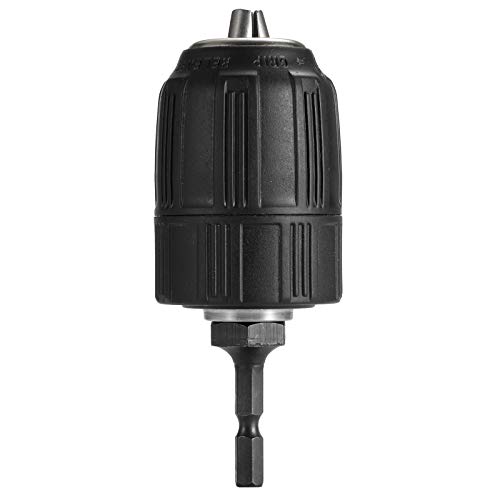
This is the big-bore option of the group. The jaws open from 2 mm up to a half inch, so it accepts the fat masonry and spade bits that smaller chucks simply can’t clamp. The 1/4-inch hex base drops straight onto most standard impact drivers, turning a driving tool into something capable of wall and stone work.
The honest trade-off with adapters like this is runout. You’re stacking tolerances between the driver’s collar, the adapter, and the chuck itself, so concentricity won’t match a dedicated hammer drill. For occasional anchor holes in brick or block, though, that’s rarely a dealbreaker, and the hand-tightening design means no key to lose on a dusty job site.
Advantages To Know
- The 2-13 mm capacity range accepts large shank bits for concrete anchors and wide holes.
- Hex quick-connect mounting swaps between driving and drilling in seconds.
- Jaws lock by hand alone, keeping the workflow truly keyless end to end.
- Suits demanding materials like stone and masonry that defeat lighter setups.
Points To Keep In Mind
- Expect slightly more bit wobble than a factory-fitted drill chuck; check tightness before each heavy hole.
- Impact-rated hammering can loosen the jaws over a long session, so re-grip periodically.
Right Fit For
Homeowners with an existing impact driver who occasionally face masonry, stone, or large-diameter holes.
Another Choice May Suit
Those working from a square-drive impact wrench rather than a hex driver will find the Bestgle adapter’s socket interface more convenient.
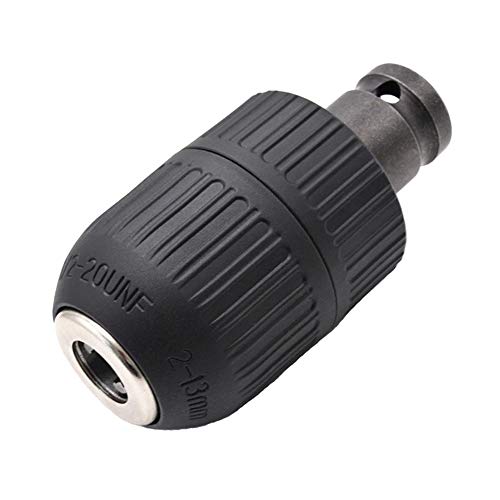
Most adapters in this category assume a hex driver. This one doesn’t. It mounts on a 1/2-20 UNF thread and ships with a 1/2-inch square female socket adapter, which means it also converts an impact wrench into a drilling tool. In a garage where the wrench already lives, that’s a genuinely useful second life for a tool you own.
The three-jaw design grips round-shank bits across the same 2-13 mm span as the BlueNatHxRPR above, so capacity is comparable. The difference is the connection style and the wrench compatibility, not raw range. One important note from the manufacturer: this setup isn’t approved for high-torque hammering, so treat it as a rotary drilling solution only.
The Case For It
- Square-drive compatibility turns an impact wrench into a capable drill without buying another tool.
- Three jaws hold round-shank bits securely from 2 mm to 13 mm.
- Tool-free locking keeps bit changes quick even with gloves on.
- Snaps onto the power tool directly, no disassembly required.
Small Caveats
- The manufacturer excludes high-torque applications, so hammer modes and heavy structural drilling are off the table.
- Threaded mounts benefit from an occasional wipe-down and light oil on the threads to stay smooth.
Core Details
Whose Shelf It Belongs On
Garage tinkerers and auto enthusiasts who already own a 1/2-inch impact wrench and want drilling capability on demand.
Swap It Out When
Cordless-driver owners without a wrench will connect faster with the Mudder four-piece hex set or the BlueNatHxRPR hex adapter.
Rounding out the list is the simplest proposition here: one traditional three-jaw chuck, 3/8-inch maximum capacity, built for 1/4-inch hex quick-change drivers. Rockwell has sold this accessory for years alongside its compact driver line, and the design hasn’t needed reinventing. It exists to let a screwdriver-shaped tool accept ordinary round-shank bits, and it does exactly that.
The manufacturer is upfront about its limits, which builds trust. This is rated for light duty and explicitly unsuited to impact drivers or high-torque loads. Within those boundaries, hanging curtains, drilling pilot holes, and general household fixes are well inside its comfort zone, and the familiar brand backing counts for something when you’re trusting a small part with your bits.
Strong Points
- Traditional three-jaw clamping handles round-shank bits reliably for everyday holes.
- Attaches to any 1/4-inch hex quick-change chuck in seconds.
- A recognized brand name makes replacement and fit questions easier to resolve.
Less Ideal Details
- Light-duty rating rules out impact drivers entirely; forcing it risks damage to both chuck and tool.
- The 3/8-inch ceiling won’t take larger spade or hole-saw shanks.
Quick Facts
Made For
Owners of compact hex-shank screwdrivers who want occasional drilling ability without buying a separate drill.
Not Your Match When
Higher-capacity needs point toward the BlueNatHxRPR 1/2″ adapter, which doubles the maximum bit diameter.
What Actually Matters Before You Buy
Match the Mount to Your Tool
The single biggest mistake is ordering a chuck that physically can’t attach to your equipment. Hex-shank drivers need a 1/4-inch hex base like the Mudder or BlueNatHxRPR options, while older drills and many impact wrenches use threaded mounts such as 1/2-20 UNF. Check your tool’s collar before anything else, because no amount of jaw capacity fixes the wrong connection.
Capacity Beats Features
Jaw capacity defines what you can actually drill. A 3/8-inch ceiling covers household bits comfortably, while a 13 mm opening opens the door to spade bits and masonry work. Buy for the largest bit you realistically use, not the smallest, since undersized chucks force awkward workarounds later.
Torque Ratings Are Not Suggestions
Several adapters carry explicit limits on high-torque or hammer use, and ignoring them tends to strip jaws or damage bits. Rotary drilling is the safe lane for most conversion chucks. Dedicated hammer drills exist for a reason, and an adapter is a supplement, not a substitute.
Think About Runout Honestly
An add-on chuck stacks mechanical tolerances, so expect a little more wobble than a factory-fitted drill. For shelving and furniture that’s irrelevant. For precision doweling or metalwork, a purpose-built drill remains the better instrument.
Key Considerations Across These Picks
Traps First Timers Fall Into
Two errors dominate returns in this category. First, mismatched mounts: a square-drive wrench owner grabbing a hex-base chuck. Second, expecting impact-rated performance from a light-duty accessory. Read the connection type and the torque guidance before checkout, and both problems disappear.
The Upgrade Payoff
Higher-capacity chucks cost more because larger jaws need stronger springs, better machining, and tougher steel. That spend pays off the moment you face a 10 mm masonry anchor. Sticking with small fixed-size sets costs less but caps your versatility permanently.
Frequently Asked Questions
What does “keyless” mean on a drill chuck?
It means the jaws tighten and release by hand grip alone, with no separate chuck key required. You twist the collar to clamp the bit and twist again to free it.
Can I put a keyless chuck on any impact driver?
Only if the chuck’s mount matches your driver’s connection, usually a 1/4-inch hex collar. Always confirm the fitting before purchasing.
Are chuck adapters safe for hammer drilling?
Most manufacturers exclude high-torque and hammering applications from their adapters. Treat these as rotary drilling tools unless the listing states otherwise.
Why does my bit wobble in an adapter chuck?
Added connections stack small machining tolerances, producing slight runout compared to a factory chuck. Re-tightening the jaws firmly usually minimizes it.
How do I maintain a keyless chuck?
Keep the jaws clear of sawdust and debris, and apply a drop of light machine oil to threaded mounts occasionally. Clean jaws grip better and slip less.
Final Thoughts
The right choice comes down to the tool already in your hand. Own nothing yet? The COMOWARE 12V kit gives you a complete starting point. Running an impact driver daily, the BlueNatHxRPR covers the widest bit range, while the Mudder set handles precision micro-bits. Impact wrench owners should shortlist the Bestgle adapter, and Rockwell’s compact chuck suits minimal light-duty needs. Match the mount, respect the limits, and any of these will earn its drawer space.




