


A big home punishes weak routers. Walls eat the signal, upstairs rooms drop calls, and every new smart device makes the lag worse. This roundup sorts through five options built to fix exactly that, from a single powerful unit for mid-size layouts to a three-node mesh system that blankets thousands of square feet. Match the hardware to your floor plan and device count, and the dead zones disappear.
A Quick View Of The Lineup

GL.iNet GL-BE9300 Flint 3 Tri-Band Wi-Fi 7 Router

NETGEAR Orbi 770 Series WiFi 7 Mesh System 3 Pack
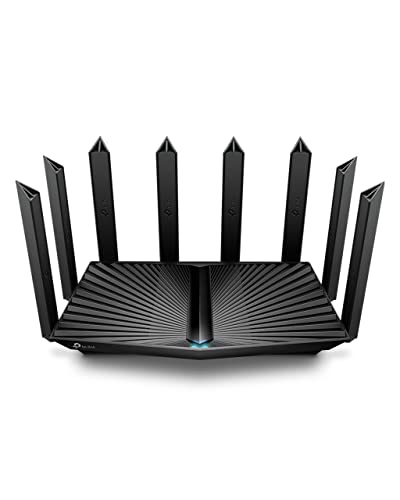
TP-Link Archer AX80 AX6000 Dual Band Router

NETGEAR Nighthawk RS200 WiFi 7 Router

NETGEAR R6700AX WiFi 6 Router
Why These Options Stand Out
Most routers hide their settings behind a glossy app. The Flint 3 goes the other direction, pairing tri-band Wi-Fi 7 hardware with open, configurable firmware that appeals to people who actually want to manage their network. Five 2.5G ports give it serious wired muscle too.
Where this unit earns its spot in a large house is VPN performance. WireGuard and OpenVPN connections can run up to 680Mbps here, which is fast enough to route your entire household’s traffic through a privacy tunnel without choking streaming or calls. Built-in AdGuard Home support adds DNS-level blocking of trackers, a nice touch for families.
The Value In It
- Tri-band Wi-Fi 7 architecture keeps gaming, streaming, and work traffic separated across three bands instead of fighting over one.
- Up to 680Mbps through WireGuard or OpenVPN means a household-wide VPN no longer halves your connection speed.
- Five 2.5G Ethernet ports let you wire desktops, consoles, and a switch without bottlenecking at gigabit.
- AdGuard Home integration blocks unwanted tracking at the DNS level before it reaches individual devices.
- Open-source-friendly firmware suits owners who want granular control most consumer apps never expose.
Points To Note
- The advanced interface has a learning curve, so households wanting a purely tap-and-done setup may find it heavier going than app-first rivals like the Nighthawk RS200.
- Real-world VPN speeds shift depending on your provider, server location, and line quality, so treat the 680Mbps figure as a ceiling rather than a promise.
Quick Facts
Built With In Mind
Remote workers, gamers, and hobbyists who want VPN routing and deep configuration without sacrificing modern Wi-Fi 7 speed.
Another Choice May Suit
Homes over 5,000 square feet should look at the NETGEAR Orbi 770 mesh system instead, since a single router, however capable, can’t reach every corner of that much floor space.
Two problems kill large-home networks: a dead bedroom at the far end, and everything slowing down once the kids’ tablets join. The Orbi 770 attacks both at once. A router plus two satellites act as one seamless mesh, rated to cover up to 8,200 square feet and handle around 100 devices.
The trick is its dedicated backhaul band, a full radio frequency reserved purely for node-to-node traffic so your devices don’t compete with the satellites themselves. Tri-band Wi-Fi 7 pushes peak speeds toward 11Gbps, though real rooms and walls will always shave that down somewhat.
Everyday Perks
- One network name across all three units means your phone roams between floors without dropping a video call.
- The reserved backhaul band keeps satellite links strong even while dozens of devices stream simultaneously.
- Roughly 100-device capacity absorbs a fully loaded smart home, from doorbells to thermostats to TVs.
- Mesh placement flexibility lets you position satellites where coverage is weakest rather than where outlets happen to be convenient.
Small Caveats
- Three units cost more than any single-router option here, so smaller homes pay for coverage they won’t use.
- Satellites need sensible placement near power outlets and away from thick masonry to hit their rated footprint.
Who Will Love This
Families in sprawling two-story or L-shaped houses where a lone router leaves the far bedrooms buffering.
Swap It Out When
Apartment dwellers under 2,500 square feet get everything they need from the single-unit NETGEAR Nighthawk RS200 at a friendlier outlay.
While the picks above chase Wi-Fi 7, the Archer AX80 proves last-generation Wi-Fi 6 still holds up beautifully. Eight high-gain antennas with beamforming, a technology that aims the signal toward each device instead of spraying it everywhere, give it reach that surprises people expecting an older standard to fall short.
Its standout spec sits on the back panel: a 2.5G multi-gigabit port. As ISPs roll out plans faster than one gigabit, most routers become the bottleneck. This one doesn’t, which matters if you’ve just upgraded your service tier.
The Good Stuff
- Dual-band AX6000 throughput delivers up to 4804Mbps on 5GHz and 1148Mbps on 2.4GHz, plenty for several 4K streams at once.
- The 2.5G WAN port future-proofs your setup against multi-gig internet plans that would saturate ordinary gigabit routers.
- Eight antennas with beamforming push usable signal deeper into large floor plans than typical four-antenna designs.
- Mature TP-Link software and firmware updates make day-to-day management straightforward for non-technical households.
Worth Bearing In Mind
- Being dual-band rather than tri-band, there’s no dedicated backhaul, so adding mesh extenders later dilutes wireless capacity more than on the Orbi 770.
- Eight external antennas give it a wider physical footprint, worth measuring shelf space before ordering.
Feature Snapshot
Right Fit For
Households with multi-gig internet service and a mix of wired and wireless devices spread across a large single level.
Reach For A Different Pick When
Tinkerers who need VPN routing will get more mileage from the GL.iNet Flint 3, whose firmware opens doors the AX80 keeps closed.
Older Wi-Fi simply wasn’t designed for forty connected gadgets. The Nighthawk RS200 answers with dual-band Wi-Fi 7, rated up to 6.5Gbps, roughly 1.2 times faster than comparable Wi-Fi 6 hardware. For a single-box solution, that’s serious headroom.
It covers up to 2,500 square feet and supports around 80 devices, which handles most suburban homes comfortably. The included 2.5G internet port matches what the pricier Archer AX80 offers, keeping your wired side current as ISP speeds climb.
The Helpful Details
- Wi-Fi 7 efficiency features help many devices share airtime smoothly, cutting the slowdown you feel when everyone comes home and connects at once.
- Rated for about 80 simultaneous devices, enough for a tech-heavy household running cameras, TVs, laptops, and consoles together.
- A 2.5G port keeps wired connections aligned with faster broadband tiers.
- Nighthawk’s app-guided setup gets most homes online within minutes, no networking background required.
Things To Consider
- Dual-band only, so very large or multi-story homes pushing past its 2,500-square-foot rating will notice thinning signal at the edges.
- As with any high-throughput router, expect it to run warm; owners commonly report better longevity with open airflow around the unit rather than a closed cabinet.
Core Details
Best Suited To
Owners of large single-level homes who want current-generation Wi-Fi 7 speed without committing to a multi-node mesh system.
Look Elsewhere When
Anyone needing VPN controls should step up to the GL.iNet Flint 3, and sprawling houses beyond 5,000 square feet belong with the Orbi 770 trio.
Not every large-household network needs bleeding-edge silicon. The R6700AX covers up to 1,500 square feet with AX1800 dual-band Wi-Fi 6, supporting about 20 devices, and does the everyday job of streaming, calls, and casual gaming without drama.
Compared with the Nighthawk RS200 above, you trade raw speed and device count for a much gentler entry point. In apartments, townhomes, and modest single-story houses, that trade often makes complete sense.
Practical Pluses
- Four-stream AX1800 throughput comfortably carries a handful of HD streams and video calls at the same time.
- Wi-Fi 6 efficiency improves battery life on phones and laptops versus older Wi-Fi 5 routers.
- Compact footprint and simple setup suit first-time router owners who just want things working.
- Dual-band design keeps legacy smart devices on 2.4GHz while phones and laptops use the faster 5GHz lane.
Less Ideal Details
- The 1,500-square-foot rating falls short of genuinely large homes, where edge rooms may see weaker signal.
- Around 20 supported devices fills up quickly in gadget-heavy households.
At A Glance
Who It Suits Best
First-time upgraders in apartments or small houses replacing an aging ISP-supplied router on a tight budget.
Consider Something Else When
Homes larger than roughly 2,000 square feet, or those with more than twenty devices, will breathe easier with the Nighthawk RS200.
What Matters Most Before Choosing Large House Routers
Match Coverage To Your Floor Plan
Coverage ratings assume open air, not drywall. A router rated for 2,500 square feet performs best in a single-story layout; add a second floor or brick exterior walls and effective coverage shrinks noticeably. Measure your space honestly, then buy one tier above your estimate.
Count Your Devices Before You Buy
Every phone, TV, camera, bulb, and console competes for airtime. Households past thirty devices benefit from Wi-Fi 6 or newer, whose scheduling features let the router serve many gadgets efficiently instead of one at a time. Under fifteen devices, older standards remain perfectly serviceable.
Wired Ports Still Matter
A 2.5G multi-gigabit port is the quiet differentiator among these picks. Internet plans above one gigabit are spreading quickly, and a gigabit-only WAN port caps whatever you pay for. Gamers and streamers also gain from wiring consoles directly, since Ethernet sidesteps wireless interference entirely.
Key Considerations Across These Picks
Traps First Timers Fall Into
Shoppers frequently overspend on mesh systems for homes that one strong router covers easily, or underspend on a budget unit for a layout twice its rated size. Placement matters as much as hardware: tucking any router inside a media cabinet strangles its range, so keep it central, elevated, and unobstructed.
The Case For Spending Up
Higher-tier models earn their price through newer wireless standards, more radios, and multi-gig wired ports. Those upgrades translate into steadier performance when the whole household is online at once. Paying more pays off mainly in busy, device-dense homes; quieter ones rarely feel the difference.
Frequently Asked Questions
Do I need a mesh system for a large house?
Only when a single router cannot reach your farthest rooms reliably. Homes beyond roughly 4,000 square feet or with multiple floors usually benefit from mesh nodes placed strategically.
Is Wi-Fi 7 worth it over Wi-Fi 6 right now?
For most households, Wi-Fi 6 remains entirely adequate. Wi-Fi 7 shines when many high-bandwidth devices run simultaneously or you own devices supporting its newest features.
What does a 2.5G port actually do?
It allows wired connections faster than one gigabit per second. Pairing it with a matching multi-gig internet plan removes the router as a speed bottleneck.
Where should I place my router?
Centrally, elevated off the floor, and away from metal objects or thick walls. Avoid cabinets and corners, which absorb and redirect signal poorly.
Can I mix brands between router and modem?
Generally yes, since routers connect to any compatible modem via Ethernet. Check that your modem supports your ISP and your plan’s top speed.
Closing Thoughts
Large homes reward honest planning more than expensive hardware. Start with your true square footage and device count, add headroom for future gadgets, and pick the option that fits rather than the flashiest name. Any of these five will outperform an aging rental router; the right one simply matches your walls.




