


Tape measures have a way of failing exactly when you need them most: across a long room, up a stairwell, or when you’re standing alone with no one to hold the other end. A laser distance measurer solves that in one click, bouncing a beam off a wall and handing you the number instantly. The five options below cover everything from pocket-sized DIY helpers to construction-grade outdoor units, so whether you’re hanging shelves or laying out a job site, there’s a fit here for your toolkit.
A Side-By-Side Look

POWERTEC Laser Measure 165 ft Digital Distance Meter (72316)

PREXISO Mini Laser Measurement Tool 135Ft Rechargeable

Inkerma Dual Laser Measurement Tool 393Ft/120M Rechargeable

Leica DISTO D1 120ft Laser Distance Measure Black/Red
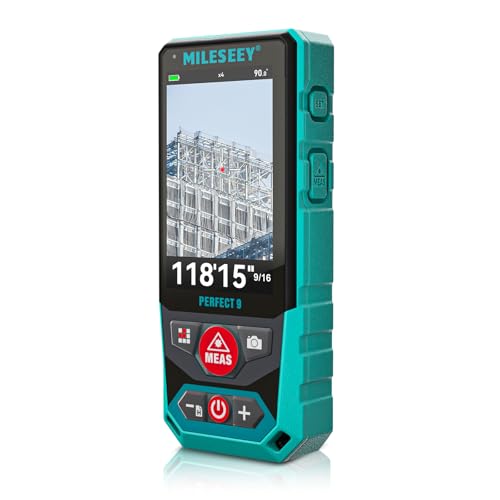
MILESEEY P9 Outdoor Laser Measuring Tool 985ft Professional
A Deeper Look At The Lineup
Most weekend projects fail at the measuring stage, not the cutting stage, and that’s where this POWERTEC earns its keep. Its 165-foot range covers an entire open-plan floor from one corner, and the one-button capture means you never need a second person holding a tape hook.
The backlit LCD keeps readings visible in dim basements or garages, and the built-in angle sensor adds tilt data that helps with sloped ceilings and stair runs. Compared with the PREXISO later in this list, it trades pocket size for a fuller mode set.
The Good Stuff
- 165-foot reach handles whole-room and multi-room spans without repositioning
- Area, volume, and Pythagorean modes turn three quick shots into square footage you can price materials from
- Continuous measurement lets you slide along a wall and watch numbers update live
- Onboard memory stores recent readings so you’re not scribbling mid-task
- Batteries ship included, so it works straight out of the box
Small Caveats
- Owners commonly report that very glossy or glass surfaces can deflect the beam, so aim at matte targets when possible
Who Should Grab It
Homeowners and DIY renovators who want dependable indoor measuring with calculation modes built in, without stepping up to pro-tier pricing.
A Better Fit Elsewhere
The MILESEEY P9 suits contractors working outdoors, where its 985-foot range and interference filtering outclass this unit’s indoor focus.
This is the one that lives in a jacket pocket rather than a toolbox. PREXISO shrank the body to roughly a third of a standard laser measure’s volume using ABS housing, yet kept a 135-foot working range, which covers nearly any residential interior.
Recharging replaces battery swaps entirely, a genuine convenience if you measure weekly rather than yearly. Just note the brand’s own guidance: give it a charge first before first use, since shipping storage can leave cells empty. Against the POWERTEC above, you lose some calculation depth but gain portability and no disposable batteries to manage.
A Favorable Mix
- Fits comfortably in one hand and stows in a pocket thanks to the compact ABS body
- USB-free rechargeable design means no hunting for button cells before a job
- Hand strap attachment reduces drop risk while working on ladders
- 135-foot range handles typical rooms and small apartments easily
Things To Consider
- A depleted internal battery can delay a job, so build charging into your routine before heading out
- Shorter range than the Inkerma makes it less suited to large commercial spaces
Feature Snapshot
Made For
Renters, apartment dwellers, and casual DIYers who want a grab-and-go tool for furniture spacing, wall hangings, and room planning.
Swap It Out When
Reach for the Leica DISTO D1 instead when measurement accuracy within a sixteenth of an inch matters more than pocketability.
Here’s the efficiency argument: two lasers firing in opposite directions mean you can capture width and length of a room from a single stance instead of walking corner to corner twice. On a remodeling job with dozens of measurements, those saved steps add up fast.
The 393-foot ceiling puts it well past the PREXISO and into light-commercial territory, and switchable feet, inches, and meters keep imperial-first users happy. An angle sensor rounds out the kit for sloped work like roof pitches and ramp grading.
Where It Excels
- Bilateral lasers take multiple dimensions from one position, cutting walk time dramatically
- Angle sensor supports tilted surfaces such as stairs, ramps, and rafters
- Pythagorean mode derives hard-to-reach heights indirectly, useful around fixed obstacles
- Area and volume outputs feed directly into flooring or paint estimates
- Rechargeable power suits all-day site use without spare batteries
Points To Note
- The dual-laser housing is larger than single-beam rivals, so pocket carry is less realistic
- Some owners note the extra features carry a learning curve on first use
Core Details
Right Fit For
Remodelers, interior designers, and handymen who measure constantly and value speed over minimal size.
Look Elsewhere When
Occasional home users will find the simpler POWERTEC easier to live with day to day.
Leica has built measuring optics for decades, and the D1 distills that heritage into a deliberately simple two-button device. Accuracy holds to plus-or-minus 1/16 inch (2mm), which matters when cabinetry gaps and tile layouts punish sloppy numbers.
Bluetooth 4.0 pairs readings to a phone app for sketching floor plans, something none of the budget picks here offer. The trade-off is range: 120 feet trails the Inkerma by a wide margin, and you may find that limiting on large sites. For finish carpentry and design work indoors, though, the tighter tolerance justifies itself.
What Pays Off
- Plus-or-minus 1/16-inch accuracy supports fine layout and installation work
- Bluetooth connectivity streams measurements into phone-based sketching apps
- Two-button operation keeps the learning curve nearly flat
- Distance tracking mode gives continuous feedback while positioning
- Metric and imperial switching suits mixed-standard projects
Honest Caveats
- Range tops out lower than every other pick here, which constrains outdoor use
- App pairing adds a dependency; some users prefer standalone devices for speed
Whose Shelf It Belongs On
Finish carpenters, interior designers, and quality-focused homeowners who prize tight tolerances over maximum distance.
Another Choice May Suit
The Inkerma dual-laser unit fits better for large-space layout work where 393 feet of reach beats sub-millimeter polish.
Sunlight is the natural enemy of every laser measure, and this is the pick engineered to fight it. MILESEEY’s Powerburst and PowerChirp signal processing filters environmental interference, letting the P9 hold reliable reads at distances approaching 985 feet, roughly seven times the Leica’s ceiling.
The 4x HD zoom viewfinder helps you locate the target dot on far walls where it would otherwise vanish, and the 3-inch backlit display stays legible in bright conditions. Point-to-point technology measures between two remote targets directly, handy for fencing lines and facade work.
Everyday Wins
- Near-1000-foot range covers lots, driveways, and building exteriors
- Noise-filtering technology keeps accuracy stable in bright, active environments
- Zoom viewfinder makes distant target points easy to acquire
- Large 3-inch screen improves readability on sunny job sites
- Point-to-point mode measures between remote positions without walking them
Trade Offs To Consider
- Larger professional housing costs you the pocketability of smaller picks
- Capability exceeds what typical indoor home projects will ever use
The Numbers That Matter
Who Will Love This
Contractors, landscapers, and site surveyors who measure outdoors daily and need distance plus daylight reliability.
Where A Sibling Pick Shines
Indoor-focused users should stick with the PREXISO mini, whose compact body handles rooms without the bulk of a survey-grade tool.
What Matters Most Before Choosing One
Range And Accuracy Together
A big number on the box means little without matching precision. Indoor work forgives wider error bands, but tile setting and cabinetry demand tolerance near a sixteenth of an inch. Match the stated range to your longest typical measurement, then add margin.
Power Style
Rechargeable models suit frequent use and eliminate battery runs, though they need charging discipline. Battery-powered units sit ready for months, which occasional users often prefer.
Modes That Earn Their Space
Area, volume, and Pythagorean functions convert raw distances into usable figures for material estimates. Continuous mode helps when marking positions alone. Skip features tied to jobs you never do.
Handling And Visibility
Backlit screens matter in basements; zoom viewfinders matter outdoors. Weight and grip shape affect comfort during long sessions, so consider how long your typical measuring run lasts.
Key Considerations Across These Picks
Wrong Turns To Avoid
The most common slip is buying range you’ll never use, paying for survey-grade reach to measure bedrooms. Another is ignoring surface type: dark, glossy, or glass targets reflect poorly for every model here. Aim at matte walls or place a paper target. Lastly, skipping the manual costs real time, since Pythagorean and continuous modes hide behind button combos.
When Paying More Pays Off
Higher-tier units buy three things: tighter accuracy tolerances, stronger outdoor signal processing, and app connectivity. Professionals billing by the hour recover the premium through fewer remeasurements. Weekend DIYers rarely see that return, so spending up only makes sense once your projects regularly push past indoor scale.
Frequently Asked Questions
How accurate are laser distance measurers compared to tape measures?
Quality laser units match or beat tapes, typically holding error within a few millimeters. Tapes sag over long spans, so lasers often win beyond about 25 feet.
Can these tools measure outdoors in sunlight?
Yes, but bright sun washes out the dot on most consumer models. Models with zoom viewfinders and interference filtering, like the MILESEEY P9, handle daylight far better.
Do laser measurers work through windows?
Glass reflects and transmits the beam unpredictably, producing false readings. Measure to solid, opaque surfaces for trustworthy numbers.
What does Pythagorean mode actually do?
It calculates an unreachable side of a triangle from two measurable sides. Practically, that means finding a second-story height from ground level without climbing.
Are rechargeable models less reliable than battery ones?
Not inherently, but a dead cell stops work until you find power. Frequent users favor recharging; infrequent users often prefer replaceable batteries.
Bottom Line
Pick by range first, then by environment. The POWERTEC covers everyday home measuring with useful calculation modes, while the PREXISO mini wins on pure portability. Stepping up, the Inkerma speeds up repetitive layout work, the Leica D1 delivers finish-grade accuracy with app support, and the MILESEEY P9 owns the outdoors. Match the tool to your longest, hardest measurement and you won’t regret the choice.




