Anyone wiring sensors, battery cables, or panel terminations knows a bad crimp is worse than no crimp at all. A loose joint heats up, corrodes, and fails quietly at the worst moment. This roundup covers five options across the spectrum: precision metric connectors for industrial sensor runs, ratcheting hand crimpers for everyday wire work, and a hydraulic beast for heavy battery cable. Whether you’re building a control cabinet on a weekend or splicing trailer harnesses in a driveway, one of these should fit your bench.
A Fast Comparison Of The Options

HARTING M12 INOX D 4P Male Crimp Connector
HARTING M12 INOX B 5P Female Crimp Connector

haisstronica 200PCS Ratchet Crimper Kit AWG 22-10
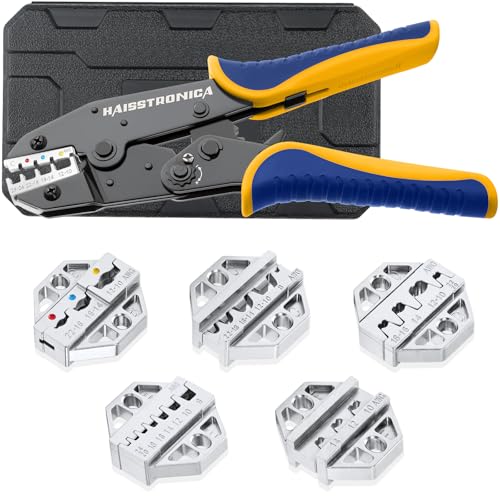
haisstronica 6PCS Crimping Tool Set, Interchangeable Dies

YUZES 10-Ton Hydraulic Cable Crimper 12-2/0 AWG
A Deeper Look At The Lineup
This is a field-installable connector rather than a tool, and it matters for anyone terminating sensor cable inside machinery or along conveyor lines. The stainless housing shrugs off washdown environments where plated brass versions tend to pit over time.
The four-position male contact set takes conductors in the 4.5 to 8.8 mm range, which covers most standard industrial cable jackets. You’ll need a proper crimper for the contacts, so pair it with something like the haisstronica kit further down this list.
What Stands Out
- Stainless construction holds up in wet or corrosive plant settings where ordinary finishes degrade.
- Crimp-style contacts give you a gas-tight joint that resists vibration loosening far better than solder.
- D-coded four-pin layout suits Ethernet and common sensor signaling without adapter fuss.
- HARTING’s part numbering makes reordering replacements straightforward for maintenance crews.
Things To Consider
- You supply your own crimping tool, so budget for one if your bench is bare.
- Assembly takes practice; first-time terminations often fail an inspection until your technique settles.
Key Specs
Built With In Mind
Maintenance technicians and panel builders who terminate M12 sensor runs regularly and want corrosion-resistant hardware.
A Better Fit Elsewhere
For general automotive or household wire splicing, the haisstronica 200PCS Ratchet Crimper Kit handles butt connectors more affordably than this specialty connector ever could.
Where the HARTING D-coded unit above handles four-pin networking duty, this B-coded sibling steps up to five contacts aimed at fieldbus and analog signal work. The female socket side pairs with male cordsets, letting you build custom-length drop cables on site instead of ordering fixed lengths and coiling the excess.
Same stainless INOX body, same 4.5 to 8.8 mm cable acceptance. In a busy plant that distinction matters: B-coding physically prevents someone plugging a network connector into a power circuit, which saves troubleshooting headaches later.
A Strong Showing
- Five crimp positions accommodate multi-conductor signal cables cleanly.
- B-coded keying stops mismatched connections before they happen.
- Field assembly means exact cable lengths with no slack loops behind panels.
Small Caveats
- Contact insertion needs fine motor work; owners commonly report fumbling small pins under time pressure.
- No crimping tool included, and the wrong die can deform delicate contacts.
Who Should Grab It
Controls electricians running Profibus-style or multi-signal trunk lines who value coded, washdown-safe terminations.
Swap It Out When
Ethernet-based setups fit the HARTING M12 INOX D 4P Male better, since its D-coding aligns with standard data cabling conventions.
Most home wiring projects stall not because of skill but because of missing parts. This kit solves both problems at once: a ratcheting crimper plus 200 heat shrink butt connectors spanning AWG 22 through 10. For context, that range runs from thin speaker wire up to heavier appliance and marine circuits.
The ratchet mechanism deserves explanation if you’re new to the term. It locks the jaws closed until the crimp reaches full compression, which prevents half-done joints that slip out under load. Color-coded sizing marks on the handle speed things along when you’re mid-project with cold hands.
Useful Highlights
- Ratchet release only after full compression, so every joint gets consistent pressure.
- Jaw profile grips heat shrink barrels without slicing the outer shell.
- 200 pre-sorted connectors mean a splice job never waits on a parts run.
- Color-coded gauge markings cut down on mis-sized crimps.
Points To Note
- The jaws are purpose-shaped for barrel-style connectors; open-barrel terminals may not compress as neatly.
- Heat shrink connectors require a heat gun, which isn’t part of the package.
Feature Snapshot
Right Fit For
DIYers tackling their first real wiring project, or anyone stocking a garage drawer with a complete splice solution.
Where Another Pick Suits Better
Shops working across many terminal styles will get more mileage from the haisstronica 6PCS Crimping Tool Set, whose swappable dies cover far more connector shapes.
Think of this as the grown-up version of the kit above. Instead of one fixed jaw, you get six interchangeable die sets that swap into the same handle, covering everything from insulated terminals to open-barrel contacts. One handle, six jobs, less drawer clutter.
The dies themselves are forged from 40CR steel, a chromium-alloy grade chosen for hardness retention under repeated compression. Owners frequently mention the secure locking of each die set, which matters when you’re working overhead or in awkward spots where a dropped jaw means a ladder trip.
Points In Its Favor
- Six die sets replace a shelf of single-purpose crimpers.
- Forged alloy jaws hold their edge shape through years of repetitive work.
- Tight die retention keeps everything together during mobile or marine use.
- One clean squeeze produces a firm crimp, cutting rework on production-style jobs.
Less Ideal Details
- Swapping dies mid-job adds seconds, which adds up during high-volume runs.
- No connectors are bundled here, unlike the 200-piece kit earlier in this list.
- Die storage organization falls entirely on you once the case wears out.
Whose Shelf It Belongs On
Hobbyist fabricators and small-shop techs who encounter varied terminal types week to week and want one dependable handle.
Consider Something Else When
Heavy battery cable work calls for the YUZES 10-Ton Hydraulic Cable Crimper, since hand-leverage dies struggle past roughly AWG 4 territory.
Try crimping 2/0 welding cable by hand and you’ll understand why hydraulic tools exist. Ten tons of ram pressure does what no pair of forearm muscles can, producing uniform hex crimps on lugs for car audio installs, solar banks, winch lines, and golf cart rebuilds. The range spans AWG 12 all the way to 2/0.
The head is quenched for toughness, and the dies carry hardened steel with a chrome finish, a combination that stands up to stainless-lug work without galling quickly. Compared to the haisstronica hand tools earlier, this is a different weight class entirely, both in capability and in heft on the bench.
What It Does Well
- Hydraulic force turns brutal cable terminations into a steady pump-and-release rhythm.
- Wide AWG 12 to 2/0 coverage handles nearly any battery or welding task you’ll meet.
- Quenched head resists cracking under repeated high-load cycles.
- Chrome-finished hardened dies stay smooth against tough terminal materials.
Worth Bearing In Mind
- Hydraulic units need occasional seal checks and clean storage to avoid fluid leaks, a commonly reported upkeep point.
- Overkill for thin household wire, where it simply wastes effort.
- The bulk makes it a bench or truck-box resident, not a pocket tool.
The Numbers That Matter
Best Suited To
Solar installers, auto electricians, and serious DIYers who regularly terminate heavy cable and want labor-saving force on demand.
Reach For A Different Pick When
Lighter splicing work fits the haisstronica 200PCS Ratchet Crimper Kit far better, keeping this hydraulic option reserved for jobs that genuinely need tonnage.
What Matters Most Before Choosing M12 Crimp Tools
Match The Jaw To The Terminal
The single biggest mistake in this category is buying a crimper before inventorying your terminals. Barrel-style heat shrink splices, open-barrel pins, and large copper lugs each demand a different jaw geometry. Using the wrong profile crushes strands unevenly and creates resistance hotspots down the road. Write down the three connector types you actually touch most, then buy for those.
Gauge Range And Headroom
A tool rated AWG 22-10 covers most household and automotive work, but solar and welding cable quickly outruns it. Give yourself one gauge size of headroom beyond your current largest project. Future projects always seem to arrive thicker than planned.
Mechanism Quality Over Feature Lists
Ratchet consistency separates a tool you’ll trust from one you’ll fight. A weak ratchet lets you stop halfway, and a half-crimp on a battery lug is a genuine hazard. Forged or hardened jaw steel also matters more than grip padding when the tool sees weekly use.
Environment And Upkeep
Garage benches forgive almost anything. Marine, agricultural, and washdown environments don’t, so favor stainless hardware there. Hydraulic units add a small maintenance routine: wipe the ram, check seals, store dry.
Key Considerations Across These Picks
Traps First Timers Fall Into
Newcomers often grab the cheapest handled tool and discover it slips on insulated terminals, then blame their technique. Another common trap is skipping the gauge chart printed on most dies and eyeballing wire size by color alone. Read the markings, match twice, crimp once.
The Case For Spending Up
Higher-tier tools buy forged jaws, tighter tolerances, and mechanisms that survive thousands of cycles. For occasional weekend splices, a basic ratchet serves fine. Anyone crimping daily, especially on heavy cable, recovers the extra cost in saved rework within months.
Frequently Asked Questions
Do I need a special crimper for M12 connectors?
Yes, M12 contacts are small open-barrel pins that need a precise die to crimp without deforming them. A general-purpose barrel crimper usually mangles these contacts.
Can one crimper handle both small and heavy cable?
Interchangeable-die systems come closest, but even they top out well below 2/0 gauge. Heavy battery cable realistically requires a hydraulic press-style tool.
Are crimped joints reliable compared to soldered ones?
A proper crimp forms a cold weld between strand and barrel and resists vibration better than solder, which can crack where it wicks up the wire. Technique and correct tooling make the difference.
How do I know my crimp is good?
A sound crimp shows even indentation, no exposed strands outside the barrel, and a gentle tug test passes without movement. Insulation should sit undamaged at the entry point.
Do heat shrink connectors really need a heat gun?
They do, since the adhesive liner only flows and seals at proper temperature. Lighters work in a pinch but scorch the sleeve unevenly and weaken the joint.
Bottom Line
Your workload decides this list, not the other way around. Plant technicians should start with the HARTING connectors, weekend DIYers get everything they need in the haisstronica kit, and anyone touching battery cable owes themselves the YUZES hydraulic. Match the tool to the terminals already sitting in your drawer, and every joint you make from here on will hold.