A mini cordless rotary tool solves one specific problem: fiddly jobs that a full-size drill or sander handles badly. Engraving a gift, smoothing a 3D print’s layer lines, cleaning rust off a hinge, polishing resin jewelry. These five options cover that range, from budget-friendly starter kits to a corded workhorse that has anchored workshops for over a decade. The right choice depends less on specs and more on how often you’ll reach for it and what materials you cut, grind, or polish.
How The Shortlist Stacks Up

HARDELL Cordless Rotary Tool Kit with 69 Accessories

Fanttik F2 PRO Cordless Rotary Tool Kit
HOTO Cordless Rotary Tool Kit, 5-Speed

Dremel 4000-2/32 Rotary Tool Kit
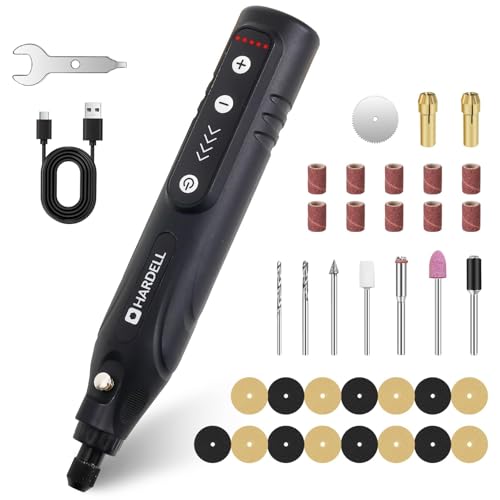
HARDELL 4V Mini Cordless Rotary Tool
Why These Options Stand Out
The appeal here starts with the box contents. Sixty-nine accessories cover engraving, sanding, carving, drilling, grinding, cutting, and polishing, so you can finish a resin pendant, touch up wood trim, and clean a corroded bolt without ordering extra bits. For anyone starting from an empty toolbox, that breadth removes the usual second purchase.
Five speed settings run from 5,000 to 18,000 RPM (revolutions per minute, how fast the bit spins). Lower speeds suit plastics and delicate engraving; higher settings handle grinding and cutting. In our view, that ceiling is modest compared with pricier picks below, but plenty for hobby-scale material.
Everyday Perks
- One kit replaces several single-purpose craft tools, saving drawer space and repeat spending.
- Cordless design lets you work at a desk, garage bench, or patio table without hunting for outlets.
- Five stepped speeds give beginners a forgiving learning curve on fragile materials.
Things To Consider
- With 69 small bits to track, organization matters; owners commonly report losing accessories without a dedicated case routine.
- The 18,000 RPM top end may feel slow on dense hardwood or thick metal.
Key Specs
Who It Suits Best
Beginners in crafting, jewelry making, and light home repair who want a complete starter setup in one purchase.
A Better Fit Elsewhere
Shoppers needing higher RPM for aggressive grinding will get more from the Fanttik F2 PRO’s 25,000 RPM ceiling.
Where the HARDELL kit wins on quantity, the F2 PRO pushes performance. Its magnetic motor and 5-speed control span 5,000 to 25,000 RPM, which translates to finer detail work at the low end and genuinely faster cutting at the top. The 3,000mAh battery delivers roughly 20 to 120 minutes of runtime depending on material and speed, so plan charging around longer carving sessions.
The standout extra is the RevoStor Hub, a 360-degree rotating magnetic holder that keeps bits visible and reachable mid-project. Anyone who has paused a job to dig through a pouch for the right burr will appreciate it. This is the pick for makers juggling multiple task types in one sitting.
Key Advantages
- 25,000 RPM ceiling cuts coarse material noticeably faster than entry-level rivals.
- RevoStor Hub keeps accessories organized and swaps quick during multi-step projects.
- High-capacity battery supports extended wireless sessions between charges.
- Five speeds cover fine grinding through heavy cutting without tool changes.
Potential Sticking Points
- Runtime swings widely with speed; sustained high-RPM cutting may interrupt bigger jobs for recharging.
- Extra features add bulk relative to pen-style tools like the HARDELL 4V.
Right Fit For
Intermediate DIYers and makers who rotate between cutting, grinding, and detailing and want storage built into the workflow.
Swap It Out When
Budget-focused first-timers will find the HARDELL 69-piece kit covers the same basics at a friendlier entry point.
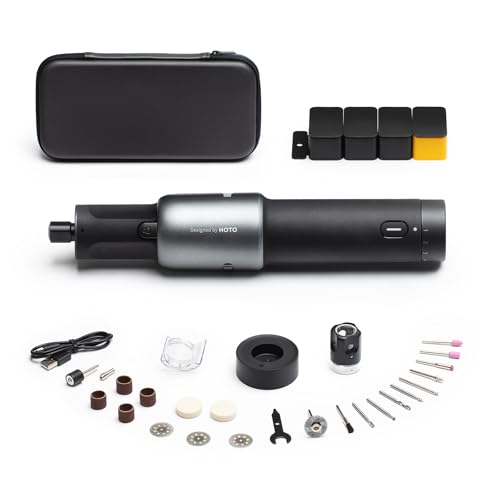
This is the quiet one of the group, and that matters more than it sounds. The low-vibration motor makes desktop finishing work, say sanding layer lines off a 3D print, comfortable in an apartment or a room where others are working. The pen-style body sits naturally in one hand for long detailing passes.
Two thoughtful touches set it apart: an integrated LED that lights tight recesses while you carve, and a snap-on dust shield that catches debris before it reaches your hands or desk. Speeds step from 5,000 to 25,000 RPM, matching the Fanttik’s range with a calmer character. The trade-off shows up on heavy material removal, where a louder, harder-working rival may serve better.
The Helpful Details
- Quiet, low-vibration operation suits shared living spaces and evening workshop sessions.
- Built-in LED reveals detail inside shadows and small cavities.
- Snap-on dust shield keeps sanding and carving mess contained.
- Compact ergonomic grip reduces fatigue during fine, patient work.
Small Caveats
- The dust shield needs regular clearing during dusty jobs like sanding, a minor but real maintenance habit.
- Gentle tuning favors precision over raw power for demanding stock removal.
Quick Facts
Made For
Apartment dwellers, 3D printing hobbyists, and detail-oriented crafters working near pets, family, or roommates.
Reach For A Different Pick When
Long, high-torque sessions call for the Dremel 4000’s corded 1.6 Amp motor instead of battery limits.
The odd one out here is also the anchor. The Dremel 4000 has been the brand’s flagship rotary platform since 2012, and this kit pairs it with two attachments and 32 accessories spanning cutting, detail sanding, engraving, wood carving, and polishing. Unlike every other pick on this list, it plugs into the wall, which means no runtime anxiety on a three-hour carving project.
The 1.6 Amp motor delivers consistent torque under load, something battery tools in this size class struggle to match on dense hardwood or steel. The housing now uses recycled plastic in its construction, a quiet nod toward sustainability. The honest read: it’s heavier and tethered, and that’s exactly why serious users choose it.
Strong Points
- Corded power sustains long sessions without mid-task charging breaks.
- Variable speed control adapts smoothly across soft and hard materials.
- A decade-long platform means widespread accessory compatibility and replacement parts availability.
- Ergonomic body balances well for controlled handheld carving.
Worth Bearing In Mind
- The power cord restricts reach; outdoor or away-from-outlet jobs need an extension lead.
- Larger body than the pen-style cordless picks, so pocket portability is off the table.
Whose Shelf It Belongs On
Committed woodworkers, model builders, and home-repair regulars who value sustained torque over portability.
Consider Something Else When
Casual crafters working at a kitchen table will find the HOTO’s quieter, lighter format far easier to live with.
Weighing roughly 0.41 pounds, this pen-style tool practically disappears in hand. At that weight, intricate glass engraving or resin polishing for an hour leaves far less ache than bulkier bodies, and it slips into a backpack or jacket pocket without thought. Two chuck sizes, 1.0mm and 2.3mm, widen the accessory compatibility beyond typical fixed-collet designs.
Five speeds run 5,000 to 18,000 RPM, mirroring its larger HARDELL sibling from the first review, and an onboard LED plus 2,000mAh battery round out the package. You may find the low power ceiling limiting on metal removal, but for smoothing 3D prints, rust touch-ups, and small drilling, it earns its keep.
Benefits That Matter
- Featherlight build minimizes hand fatigue during long, detailed sessions.
- Dual chuck sizes accept a broader range of accessory shanks.
- Pocketable size travels easily to craft groups, markets, or a friend’s garage.
Points To Note
- Small battery capacity means frequent recharging during all-day use, so keep the cable handy.
- Modest torque limits effectiveness on thick metal or hardwood stock.
At A Glance
Who Should Grab It
Hobbyists focused on engraving, print finishing, and light polishing who prize portability above power.
Where A Sibling Pick Shines
Anyone wanting a fuller accessory arsenal alongside similar speed control should step up to the HARDELL 69-piece kit.
What To Look For Before Buying
Match The Motor To Your Materials
RPM range tells only half the story. Soft materials like plastic, resin, and softwood forgive lower speeds, while dense hardwood, glass, and steel demand both higher RPM and enough torque to hold that speed under load. A 5-speed tool with clear steps gives you the most flexibility across mixed projects.
Corded Or Cordless Depends On Session Length
Cordless tools win for convenience, desk work, and travel, but battery capacity dictates how long you can work. Under an hour of occasional use favors any cordless option here; marathon carving weekends favor the corded Dremel 4000, which never pauses to recharge.
Weight And Grip Shape Matter More Than You Think
Detail work means long holds. A 0.41-pound pen-style body fatigues hands far slower than a full-size barrel grip, so weigh your typical project length against your comfort threshold.
Count The Accessories Honestly
A big accessory count looks generous until you realize half the bits may never fit your projects. Skim the list against your actual tasks: engravers need burrs, 3D-print finishers need sanding drums, jewelry makers need polishing tips.
Key Considerations Across These Picks
Traps First Timers Fall Into
The most common slip is buying on accessory count alone, then discovering the motor lacks the torque for your main material. Another frequent miss: ignoring battery runtime claims and assuming all-day wireless use. Read the speed range carefully too, since some budget tools top out around 18,000 RPM, which limits aggressive cutting.
What Separates Premium From Basic
Higher-tier models buy you torque consistency, faster top speeds, smarter storage, and quieter motors. The Fanttik F2 PRO’s magnetic hub and the HOTO’s dust shield are convenience engineering you pay for once and appreciate every session. Pay up when a project type is central to your week; stay basic when the tool comes out monthly.
Frequently Asked Questions
Can a mini cordless rotary tool cut metal?
Yes, thin sheet metal and small fasteners are within reach, especially above 18,000 RPM. Thick steel stock calls for a corded model with stronger sustained torque.
How long do batteries typically last per charge?
Runtime varies widely with speed setting and material resistance. Expect anywhere from roughly 20 minutes of heavy cutting to two hours of light polishing on comparable capacities.
Are accessories interchangeable between brands?
Many mini rotary tools accept common 1/8-inch and smaller shanks, but always check collet or chuck sizes. Dual-chuck designs like the HARDELL 4V widen compatibility considerably.
Is a rotary tool safe for beginners?
Yes, at low speeds with light pressure it’s among the more approachable power tools. Start on scrap material, wear eye protection, and secure the workpiece before touching bit to surface.
Do I need a dust shield for indoor work?
It isn’t required, but it makes a noticeable difference. Sanding and carving throw fine particles, and a shield like the HOTO’s keeps desks, keyboards, and lungs happier.
Closing Thoughts
Every tool on this shortlist earns its place for a different kind of user. Start with the HARDELL 69-piece kit if you’re new, choose the HOTO for quiet apartment work, step up to the Fanttik F2 PRO for feature depth, commit to the Dremel 4000 for serious shop time, or grab the featherweight HARDELL 4V for pure portability. Match the tool to your actual projects, not the spec sheet, and any of these will serve you well for years of small, satisfying fixes.