


A good fence quietly does the hard work in any shop. It holds stock square, locks in repeatable length, and turns a basic chop saw into something you can trust for finish work. The right system matches your saw, your stock, and the kind of cuts you actually make, from picture frames to crown moulding.
This roundup covers eight miter saw fence systems worth a look in 2026. Some are bare-bones flip-stop add-ons for hobbyists, while others bring engraved scales, telescoping arms, and shop-grade angle stops to the table. The picks below lean on real specs: bar dimensions, slot fit, number of angle stops, and fence adjustability. Read on to find the one that matches your shop, your saw, and the projects already piling up on the bench.
A Fast Comparison Of The Options

POWERTEC Miter Saw Fence with T-Track Stop Kit

VEVOR Precision Miter Gauge with 18 in Fence

Kreg Precision Miter Gauge System KMS7102
INCRA MITER1000SE Miter Gauge Special Edition

Kreg Precision Trak & Stops Kit KMS8000

POWERTEC 71391 Table Saw Miter Gauge System

REEKON M1 Caliber Adapter Fence for Miter Saws
17″ Aluminum Miter Gauge Fence with Flip Stop
More On The Choices That Made The List
POWERTEC designed this system for shops that run more than one tool. The fence caps mount on top of an existing fabricated fence on a radial arm saw, miter saw, or drill press, so it slots into mixed workshops without forcing a single-tool commitment. For someone running a small production space, the cross-tool flexibility is the real draw.
Setup leans on T-tracks, so any stop or hold-down you already own slides right in. Self-adhesive tape measures give you quick reference points, which saves time on repeat cuts. You’ll want to measure your current fence before ordering, since the 24-inch cap length assumes a particular work surface footprint.
Where It Helps
- Works across miter saws, drill presses, and radial arm saws for shared-shop flexibility
- T-track design accepts standard stops, hold-downs, and shop-made jigs
- Adhesive tape measures give a visual reference without re-measuring every cut
- Modular layout lets you expand the system as projects grow
Worth Noting
- Adhesive tape measures may need replacement after heavy shop dust and cleaning cycles
- Requires an existing fence to mount onto, so it’s an upgrade, not a standalone solution
Who It Suits Best
Shops with a drill press, radial arm saw, and miter saw sharing the same workflow will get the most out of this modular layout.
Look Elsewhere When
The Kreg KMS7102 is a better fit for table saw users who want an all-in-one gauge rather than a fence-top add-on.
VEVOR built this gauge around the standard 3/4″ x 3/8″ T-slot found on most table saws, which keeps installation simple for first-time buyers. An aluminum alloy body keeps weight down while still feeling sturdy during cuts. The 15 angle stops handle the common miters most hobbyists actually use, from 7.5° to 45°.
A spring-loaded plunger (a spring-loaded pin that locks the bar into the slot) makes the bar feel secure without fussing with set screws, and the removable disc is a nice touch for when you need to switch out the head. The 18-inch fence covers stock up to about 16 inches wide in most setups, so it suits smaller trim and craft projects rather than full sheet goods.
Where It Delivers
- Standard 3/4″ x 3/8″ bar fits the majority of table saws without adapter plates
- 15 pre-set angle stops cover common miter cuts without manual calculations
- Spring-loaded plunger keeps the bar seated during cuts
- Aluminum construction balances lightness with everyday durability
Trade Offs
- 18-inch fence length is limiting for wider stock like door casings or wide panels
- Pre-set stops are convenient, but calibration may drift over months of heavy use
Quick Facts
Made For
First-time table saw users who want a usable gauge on day one without mastering calibration routines.
Consider Something Else When
The INCRA MITER1000SE makes more sense for anyone running higher-tolerance work that needs 41 stops rather than 15.
The KMS7102 has earned its place in home shops over the years for a reason. It glides smoothly in standard table saw slots, and the adjustable fence lets you dial in repeatable cuts without reaching for calipers every time. Compared to the VEVOR above, this system feels more refined during long cutting sessions.
For trim carpenters and hobby woodworkers running angled cuts day after day, the consistency is the selling point. The bar design resists side-to-side play, which is the usual culprit behind misaligned miters. You may find the included angle markers a touch basic for specialty cuts, but the core accuracy holds up well for cabinetry and trim.
A Favorable Mix
- Adjustable fence adapts to different stock widths without shims
- Bar fit keeps the gauge tracking straight, even on saws with worn slots
- Smooth glide reduces the chance of jerking the workpiece mid-cut
- Solid fit and finish reflect a tool built for repeated daily use
Points To Note
- Angle reference system is less detailed than the 41-stop INCRA layout
- Heavier than aluminum gauges, which can be a factor if you swap tools often
Best Suited To
Woodworkers who need repeatable, smooth angle cuts for trim and cabinetry without the price tag of a premium system.
Swap It Out When
Step up to the INCRA MITER1000SE if you cut a wide range of angles and want factory-style stop accuracy on a regular basis.
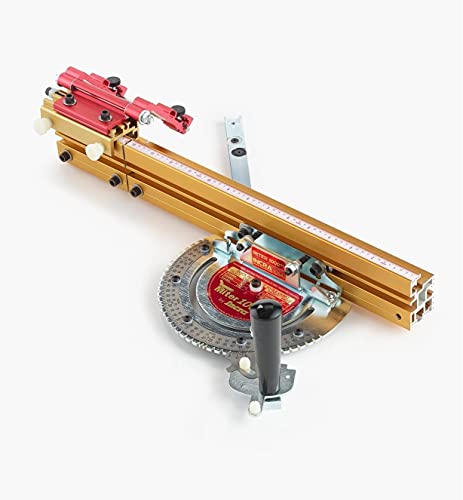
The MITER1000SE is the kind of gauge that pulls double duty in a serious shop. An engraved stainless steel primary scale gives the kind of legibility that holds up under shop lighting, and 41 laser-cut V-stops cover nearly any angle you can imagine. The 18- to 31-inch telescoping fence (a sliding fence that extends and locks at multiple lengths) handles stock from narrow trim pieces to wider panels, which removes the need to swap gauges mid-project.
Where this stands apart from the Kreg KMS7102 is the patented GlideLOCK miter bar, with six expansion points that lock the bar in place. For production runs, the dual flip shop stop keeps repeat cuts consistent without babysitting the stop arm. Depending on how complex your angle work gets, the upfront investment pays off fast.
Standout Benefits
- 41 laser-cut V-stops cover an extensive range of miter angles out of the box
- Telescoping fence adjusts from 18 to 31 inches for varied stock widths
- Engraved stainless scale stays readable through years of shop grime
- GlideLOCK bar with six expansion points holds zero side play during cuts
- Dual flip shop stop keeps length-based repeat cuts consistent
Less Ideal Details
- Higher price point than the Kreg KMS7102 or VEVOR alternatives
- Learning curve is real; the many stops take a few sessions to use fluidly
Feature Snapshot
Who Should Grab It
Production woodworkers and trim carpenters who cut a high volume of varied angles and want near-factory repeatability.
Where A Sibling Pick Shines
For occasional weekend projects, the Kreg KMS7102 delivers smoother results at a friendlier price point.
The KMS8000 turns a miter saw into a production-style workstation. The L-shaped track base aligns with your saw’s fence, and the swing stop plus production stop work together to keep identical cuts coming off the saw without re-measuring. If you build the same trim profile across multiple rooms, this kit feels like an extra pair of hands.
What separates this from the POWERTEC 71742 above is the focus on saw workflow. The track mounts to the saw itself, with stops that pivot out of the way for through-cuts. In most home shops, the time savings on a 20-piece crown moulding run alone justify the upgrade.
What Makes Sense
- Swing stop and production stop work in tandem for batch cutting
- L-shaped base aligns cleanly with most miter saw fences
- Cross-compatible with miter saws, radial arm saws, and drill presses
- Removes the measuring step between identical cuts
- Solid fit and finish hold up to repeated production runs
Potential Drawbacks
- Takes up bench space, which matters in tighter shop layouts
- Setup takes longer than a simple flip-stop add-on
The Right Fit
Finish carpenters and serious DIYers running repeat trim cuts where consistency matters more than tool swaps.
Not Your Match When
The Fulton 17-inch aluminum gauge is a better fit for casual shop owners who only need a basic flip stop.
POWERTEC packed the 71391 with features that would normally live across multiple accessories. You get a high-precision miter gauge, a 24-inch T-track fence with a laser-engraved scale, and a T-track flip stop, all in one box. The 27 angle stops are pre-set at the factory, so calibration is essentially a non-issue on day one.
For shop owners who want a turnkey system without buying components separately, this delivers real value. Compared to the VEVOR gauge above, the 24-inch fence reaches further, and the removable T-slot plate adds versatility for custom jigs. The system rewards anyone who plans to keep their table saw setup stable for years.
The Good Stuff
- 27 pre-set stops mean no calibration routine to learn
- 24-inch laser-engraved fence handles wider stock and improves visibility
- 3/4″ x 3/8″ T-slotted bar fits standard table saw slots out of the box
- Removable T-slot plate lets you build custom jigs on the same platform
- Three-piece set covers fence, gauge, and flip stop in one purchase
Honest Caveats
- Larger footprint than a single-gauge setup, which may matter in compact shops
- More components mean more pieces to keep track of during storage
- Pre-set stops are convenient but limit fine-tune angle adjustments
Feature Card
Who Will Love This
Shop owners who want a complete table saw gauge system without sourcing parts individually.
A Better Fit Elsewhere
The INCRA MITER1000SE is the right pick if fine-tuned angle precision matters more than a ready-to-go bundle.
The REEKON M1 Caliber is a digital measuring tool, and this adapter fence is the bridge that lets it clamp onto short miter saw fences. If you already own the M1 Caliber, this is the missing piece. If you don’t, the bundle math only works if you want digital readouts on every cut.
It mounts to any miter saw with at least two holes on each side of the blade, which covers the bulk of saws in circulation. Compared to the tape-measure approach on the POWERTEC 71742, you’re getting live digital readouts and a much faster repeat-cut workflow. Depending on how your shop is set up, you may find the adapter more useful than a traditional flip stop.
The Upside
- Unlocks the M1 Caliber’s digital readouts on standard miter saws
- Works with any saw that has two mounting holes on each side of the blade
- Aluminum mount gives a stable platform for the digital tool
- Speeds up repeat cuts compared to manual tape-measure methods
Things To Consider
- Requires owning the M1 Caliber to get the full benefit
- Adds a powered device to a workflow that’s usually purely manual
Perfect Match For
Trim carpenters and finish carpenters who already use the M1 Caliber on table saws and want the same precision on a miter saw.
Skip It When
The Fulton aluminum gauge is a better match for shop owners who prefer simple mechanical stops over digital readouts.
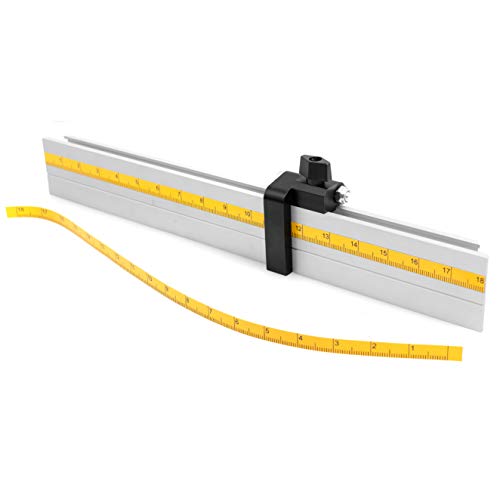
Fulton’s 17-inch aluminum gauge is a clean, simple upgrade over the factory gauge that ships with most table saws. The 45° angled fence ends let you push closer to the blade, which reduces gaps and improves safety during miter cuts. For garage workshops and weekend projects, that’s a meaningful step up.
The built-in flip stop handles identical-length cuts without re-measuring, and the dual 17-inch measuring tapes give you reference points from both sides of the cut. It feels lighter than the heavier steel gauges above, so swapping it in and out is easy. The honest read is that it suits hobbyists more than production shops, but for the price, the upgrade over a stock gauge is real.
Positive Takeaways
- 45° angled fence ends reduce the gap between fence and blade for cleaner miters
- Aluminum build keeps the gauge light enough for easy swaps
- Dual 17-inch measuring tapes offer reference on both sides of the workpiece
- Flip stop speeds up repeat cuts without re-measuring
Small Caveats
- Lacks the angle-stop count of the Kreg or INCRA gauges for specialty cuts
- Aluminum can dent if dropped, so storage matters in shared shops
Feature Rundown
Whose Shelf It Belongs On
Garage workshop owners running small trim and craft projects who want a clean upgrade over a stock table saw gauge.
Reach For A Different Pick When
The Kreg KMS8000 is a smarter choice for anyone running production-style repeat cuts that need a more robust stop system.
What To Weigh Before Choosing Your Miter Saw Fence System
Match The Bar To Your Saw Slot
The single biggest compatibility check is the miter bar, the metal bar that slides into your table saw’s slot. Most home saws run a 3/4″ x 3/8″ T-slot, and any standard gauge will fit. Contractor or industrial saws sometimes run different dimensions, so measure your slot before ordering. Skipping this step is the most common reason a new gauge wobbles in the cut.
Decide How Many Angle Stops You Actually Need
Pre-set angle stops (notched positions that lock the gauge at common angles) save real time when you cut the same angles repeatedly. The VEVOR offers 15 stops, the POWERTEC 71391 offers 27, and the INCRA MITER1000SE offers 41. For picture frames and basic trim, 15 is plenty. For compound angles and specialty work, more stops reduce the chance of misreading a scale mid-project.
Look At Fence Length And Adjustability
An 18-inch fence handles small trim, while a 24-inch or telescoping fence (extending from 18 to 31 inches) covers wider panels. Telescoping fences like the one on the INCRA replace the need to swap gauges when the stock size changes. In a small shop, fence length can also dictate how much bench space the gauge takes up.
Match The System To Your Workflow
Drill press and radial arm saw users will get more out of T-track-based systems like the POWERTEC 71742, which mounts across multiple tools. Dedicated table saw users benefit more from a precision gauge like the Kreg KMS7102 or INCRA MITER1000SE. Repeat-cut trim work rewards swing-stop systems like the Kreg KMS8000. Match the system to the work, not the other way around.
Smart Choices When Shopping This Category
Pitfalls Shoppers Hit
The most common mistake is buying a gauge before measuring the table saw slot. A bar that’s slightly off slides back and forth during cuts, ruining the angle. The other slip-up is chasing a high stop count when the work only ever uses three or four angles. A 15-stop gauge used well beats a 41-stop gauge that overwhelms the user.
Where The Extra Money Goes
Premium systems like the INCRA MITER1000SE earn their price through engraved scales, GlideLOCK bars, and laser-cut V-stops. Those features matter when the work is sold by the piece and tolerances get tight. For occasional weekend builds, the price premium is harder to justify, and a mid-tier gauge will do the job without overspending.
Frequently Asked Questions
What Is A Miter Saw Fence System?
A miter saw fence system is a guide and stop assembly that holds stock square and repeatable against the saw fence. It typically includes a bar that slides in the saw slot, a fence for support, and a stop arm for repeat length cuts. Some systems add angle stops, T-tracks, or digital measuring tools for higher precision.
Do Miter Saw Fence Systems Fit All Table Saws?
No. Most systems are built for the standard 3/4″ x 3/8″ T-slot, which fits the majority of home table saws. Always measure your slot width and depth before ordering. Industrial or older saws may require adapter bars or alternative gauges.
How Many Angle Stops Do You Need?
For typical trim and frame work, 15 angle stops cover the common cuts between 7.5° and 45°. Cabinetry, compound miters, and specialty projects benefit from 27 to 41 stops. Choose based on the angles you actually cut, not the highest count on the market.
Can I Use One Fence System On Multiple Saws?
Some systems, like the POWERTEC 71742, mount to miter saws, drill presses, and radial arm saws with T-track compatibility. Others, like table saw miter gauges, only fit standard table saw slots. If cross-tool use matters, look for systems with universal T-track mounting.
Are Digital Miter Fences Worth The Upgrade?
Digital fences, like the REEKON M1 Caliber system, give live readouts and reduce measurement errors. They shine on high-volume production runs where speed and consistency pay off. For occasional cuts, a quality mechanical gauge delivers plenty of accuracy at a lower cost.
Closing Remarks
The right miter saw fence system comes down to matching your saw, your stock, and how often you cut the same angles. For most home woodworkers, a mid-range gauge with 15 to 27 stops handles the work without overspending. Production carpenters and serious hobbyists will appreciate the precision and repeatability of higher-end systems. Pick the one that fits your shop, set it up properly, and let it do the measuring for you.




