Trim work, deck boards, baseboard runs, the occasional steel rod: a good saw handles all of it without complaint. The problem is that most garages only have room for one, and the market is full of models that look identical until you actually pull the trigger. This guide sorts five well-regarded machines by what they genuinely do best, so you can match one to your projects instead of guessing.
An Overview Of The Picks

Evolution Power Tools R185SMS+ Sliding Miter Saw 7-1/4″
Genesis GMS1015LC 15-Amp 10-Inch Compound Miter Saw

DEWALT 20V MAX* 7-1/4-Inch Cordless Miter Saw (DCS361M1)
CRAFTSMAN V20 Cordless Sliding Miter Saw CMCS714M1

BOSCH CM10GD 10 In. Dual-Bevel Glide Miter Saw
A Deeper Look At The Lineup
Most miter saws are wood-only tools. The Evolution R185SMS+ breaks that rule with a blade and motor setup built for multi-material work, handling lumber along with plastic, metal, and more on a 7-1/4-inch wheel. For anyone renovating an older home where every third cut seems to hit something unexpected, that flexibility changes how you plan a weekend.
The sliding mechanism adds reach beyond what a fixed 7-1/4-inch blade normally manages, and the angle range is generous: bevels to 45 degrees, miters out to 50 degrees. A blade ships in the box, so you can make your first cut the day it arrives.
The Value In It
- One machine covers wood, plastic, and metal stock, which trims tool clutter in a small shop.
- Sliding action extends crosscut capacity past the blade diameter alone.
- Wide 50-degree miter range helps with unusual corner angles in older houses.
- A blade is included, so there’s nothing extra to buy before cutting.
Small Caveats
- The 7-1/4-inch wheel limits thick hardwood capacity compared with 10-inch or 12-inch saws like the Bosch below.
- Owners commonly report that keeping the blade clean matters more here, since residue buildup from mixed materials dulls cuts faster.
Key Specs
Who It Suits Best
DIYers tackling mixed-material renovations who want one versatile saw instead of three single-purpose ones.
Where A Sibling Pick Shines
For dedicated finish carpentry on wider boards, the BOSCH CM10GD’s 10-inch dual-bevel platform delivers more capacity and refinement.
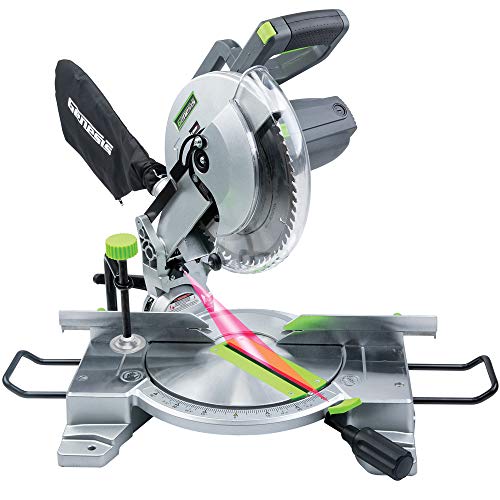
Learning to cut straight takes enough concentration without squinting at pencil lines. The Genesis GMS1015LC puts a laser guide on the workpiece so you see exactly where the blade will land, which shortens the confidence curve considerably for first-time users. Nine positive miter stops click into the common angles, so there’s less guesswork between cuts.
Under the hood sits a 15-amp motor driving a 10-inch blade, plenty of muscle for dimensional lumber, flooring, molding, and general woodworking. Where the Evolution above trades capacity for material versatility, this Genesis leans the other way: straightforward wood cutting with a bigger wheel and simpler controls.
A Few Highlights
- Laser line shows the cut path before the blade drops, reducing wasted boards while you learn.
- Nine preset miter detents snap to standard angles quickly during repetitive trim runs.
- Compound capability handles beveled crown and casing work as skills grow.
- 15 amps of power keeps cuts steady through dense stock.
Things To Consider
- Being corded, it needs outlet access or a heavy-gauge extension cord on distant jobs.
- Some owners note the factory laser needs a quick calibration check against a scrap cut before trusting it fully.
Made For
New woodworkers and occasional DIYers who want guided accuracy without paying for features they won’t use yet.
Skip It When
Job sites without reliable power call for the DEWALT DCS361M1, whose battery platform removes the cord entirely.
Basements, closets-turned-workspaces, second-floor installs: some rooms simply don’t offer an outlet where you need one. The DEWALT DCS361M1 runs on a 20V MAX battery, and DeWalt’s own figures suggest roughly 183 crosscuts of 2×4 pine or around 275 cuts of 3-1/4-inch baseboard per charge, depending on the wood. That’s a full day of trim work for most people.
An integrated cut-line positioning system projects the cut indication without any adjustment, improving visibility over penciled marks. Inside, an adjustable stainless-steel miter detent plate carries eleven positive stops for fast, repeatable angles. Compared with the Genesis, you give up an inch of blade and corded stamina; you gain freedom of placement.
Positive Takeaways
- Battery power means no extension cords snaking through finished rooms.
- Adjustment-free cut-line indication speeds up accurate placement on every board.
- Eleven positive detents cover the angles trim carpenters reach for daily.
- Fits nested crown up to 3-5/8 inches and vertical base up to 3-1/2 inches.
Points To Note
- The 7-1/4-inch blade caps wide-board capacity, so long crosscuts demand flipping the workpiece.
- Battery runtime depends on stock hardness; dense hardwood drains packs noticeably faster than pine.
Feature Snapshot
Right Fit For
Finish carpenters and remodelers working inside occupied homes where outlets are scarce and portability matters.
Another Choice May Suit
Shoppers wanting sliding-arm reach in a cordless package should look at the CRAFTSMAN CMCS714M1 instead.
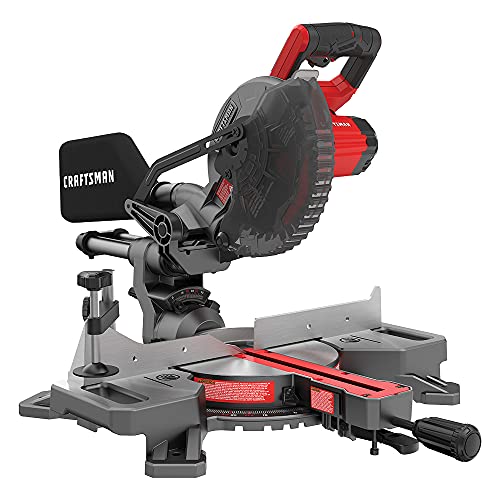
Here’s where the cordless category gets interesting. Unlike the fixed-head DEWALT above, the CRAFTSMAN CMCS714M1 pairs its battery platform with a sliding arm, pushing crosscut capacity to roughly 8 inches on a 7-1/4-inch blade. Deck boards, shelving stock, wide fence pickets: the kind of material that usually forces a flip-cut suddenly fits in one pass.
An LED worklight throws shadow-free illumination across the cut line, which matters more than it sounds when you’re working under a carport at dusk. Nine miter detents and a single-bevel design keep the layout simple, and the kit arrives with both battery and charger included, so the total cost picture stays honest.
Reasons It Performs
- Sliding action reaches about 8 inches of crosscut despite the compact blade.
- LED lighting eliminates shadows over the cut line for cleaner follow-through.
- Battery and charger ship together, ready to run out of the box.
- Motor handles 2x dimensional lumber, hardwoods, baseboard, and trim.
Honest Caveats
- Single-bevel only, so compound crown work requires repositioning the board rather than tilting the other way.
- The sliding mechanism adds moving parts that benefit from periodic cleaning, especially in dusty shops.
Built With In Mind
Weekend builders and homeowners running deck, fence, or shelving projects away from wall power.
Consider Something Else When
Precision-focused furniture makers will find the BOSCH CM10GD’s glide system and dual bevel better matched to fine joinery.
Bosch’s Axial-Glide System replaces traditional sliding rails with hinged articulating arms, and the difference shows up in two places. First, the saw needs up to 10 inches less front-to-back bench depth than a conventional slider, a real advantage against a basement wall. Second, the glide motion tends to hold alignment smoother over years of daily use, according to long-term owners.
The 15-amp motor spins a 10-inch blade at 4,800 rpm unloaded, and dual bevel lets you tilt left or right without flipping tall crown molding. Set beside the Genesis earlier in this list, everything about the CM10GD feels one tier up: sturdier fences, tighter tolerances, better dust control.
Everyday Advantages
- Axial-Glide arms save significant workspace depth compared with rail sliders.
- Dual bevel handles tall crown from either side without repositioning stock.
- 15-amp motor sustains 4,800 rpm for confident cuts in hardwood.
- Glide design supports consistent accuracy across the tool’s life.
Trade-Offs To Weigh
- The premium build carries a higher price than the beginner-oriented options here.
- Articulated joints collect fine dust; owners recommend blowing them out regularly to keep movement smooth.
Core Details
Whose Shelf It Belongs On
Professional carpenters and committed hobbyists who cut daily and value precision over portability.
Swap It Out When
Budget-conscious shoppers starting out will get more immediate value from the Genesis GMS1015LC.
What Matters Most Before Choosing Miter Saws
Match Blade Size To Your Stock
Blade diameter sets your ceiling. A 7-1/4-inch wheel handles trim, baseboard, and 2x lumber comfortably, while 10-inch blades open up wider boards and thicker hardwoods. Measure the widest material you realistically cut, then buy one size above it. Overbuying capacity costs money and bench space you may never recover.
Corded Or Cordless Changes Everything
Corded models deliver unlimited runtime and typically more raw power per dollar, which suits a permanent workshop bench. Cordless versions trade some endurance for freedom, ideal for finished interiors, rooftops, or remote job sites. Check the manufacturer’s estimated cuts per charge against your typical session length before committing.
Slides, Glides, And Footprint
Fixed-head saws sit closest to the wall but cap crosscut width. Traditional rail sliders extend reach yet demand deep clearance behind and in front. Articulated glide systems split the difference, offering extended capacity in a shallower package. Your available workspace often decides this question faster than any spec sheet.
Detents, Lasers, And Daily Accuracy
Positive miter stops at common angles speed up repetitive work and reduce measuring errors. Laser guides or projected cut lines help beginners place cuts confidently, though experienced users sometimes prefer a plain pencil mark. Prioritize whichever aid matches your skill level rather than chasing every feature.
Key Considerations Across These Picks
Traps First Timers Fall Into
The most common mistake is buying capacity you don’t need, then discovering the saw dominates a cramped garage. Another frequent slip is ignoring power source: a beautiful cordless saw frustrates anyone who forgets to charge batteries mid-project. Read the included-accessories list carefully too, since some kits arrive without a blade or charger while others bundle everything.
What Separates Premium From Basic
Higher-tier models spend their extra cost on build quality: machined detent plates, sealed bearings, smoother slide mechanisms, and fences that stay square through years of transport. Those details rarely matter on a dozen cuts a year. For daily professionals, they’re the difference between a tool that lasts a season and one that earns its keep for a decade.
Frequently Asked Questions
Can a 7-1/4-inch miter saw handle 2×4 lumber?
Yes, comfortably. Models like the DEWALT DCS361M1 are rated for repeated 2×4 crosscuts on a single battery charge. Wider stock is where smaller blades start requiring flipped cuts.
Do I really need a sliding miter saw?
Only for boards wider than roughly 6 inches. Sliders such as the CRAFTSMAN CMCS714M1 extend crosscuts to about 8 inches, which suits decking and shelving. Trim-only workers can skip the added bulk.
How important are positive miter stops?
Very, for repetitive work. Preset detents at nine or eleven common angles let you dial in crown, casing, and framing cuts quickly without re-measuring. They also reduce angle drift between cuts.
Are laser guides worth having?
For beginners, absolutely, because seeing the cut line before the blade drops prevents costly miscuts. Experienced carpenters often rely on the kerf itself and skip lasers entirely.
Which pick works best in a small garage?
Two candidates stand out. The cordless DEWALT DCS361M1 eliminates cords and stores compactly, while the BOSCH CM10GD saves up to 10 inches of bench depth with its glide arms.
Bottom Line
Match the saw to the work, not the wishlist. Renovators cutting mixed materials will lean on the Evolution, newcomers get guided accuracy from the Genesis, and cordless users choose between the compact DEWALT and the wider-reaching CRAFTSMAN based on board width alone. Professionals cutting daily will find the Bosch’s glide system justifies its position at the top of the range. Whatever you choose, measure your space and your most common stock first; those two answers narrow the field faster than anything else.