


Electrical work lives in the details. A reliable multimeter tells you whether a circuit is truly dead, whether a battery is worth keeping, or whether a sensor in your car is drifting toward failure. The right pick depends on whether you wire houses, fix your own car, or just want to know why an outlet stopped working.
The Choices Worth Comparing

Fluke 117/323 Kit Multimeter and Clamp Meter Combo

Klein Tools MM320KIT Digital Multimeter Electrical Test Kit
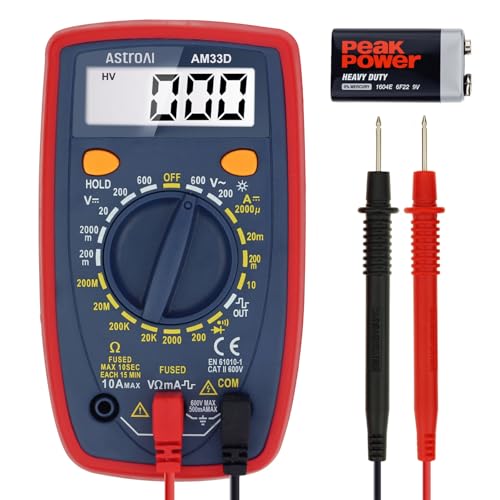
AstroAI Digital Multimeter Tester 2000 Counts (Blue)

AstroAI True RMS 6000 Counts Auto-Ranging Multimeter

AstroAI Digital Clamp Meter Multimeter 2000 Counts (Blue)
The Strengths Of Each Pick
The Fluke 117/323 Kit pairs a true RMS digital multimeter with a 400-amp clamp meter, giving working electricians two tools in one C115 soft carrying case. The 117 handles AC/DC voltage, resistance, frequency, and capacitance with non-contact voltage detection built in. The 323 clamp measures AC current up to 400 amps without breaking the circuit, which is the whole point of owning a clamp in the first place.
You see this kit hanging on service van walls for a reason. The True RMS (root mean square, a method that gives accurate readings on non-sine waveforms from variable-speed drives and modern electronics) sensing matters on jobs with LED lighting, computer power supplies, and variable-frequency motor controls. Owners commonly report the meters hold calibration well over years of daily use, though the TPAK magnetic hanger becomes a quietly indispensable accessory when working overhead in a panel.
The Helpful Details
- True RMS multimeter paired with a dedicated clamp meter in one organized case
- Non-contact voltage detection on the 117 speeds up outlet and wire checks
- 400-amp AC clamp range covers residential panels and most light commercial gear
- Includes TPAK magnetic hanger for hands-free panel work
- Fluke’s reputation for long-term calibration stability holds up in daily service use
Things To Consider
- The clamp meter measures AC current only, not DC, which limits automotive alternator testing
- Pricing sits well above hobbyist-tier meters, so beginners may not use the full feature set
- Replacement test leads and cases are proprietary and cost more than generic alternatives
Key Specs
Right Fit For
Licensed electricians and serious apprentices who need a meter they can trust on live residential or light commercial panels every day.
Where Another Pick Suits Better
The Klein Tools MM320KIT suits a homeowner learning the basics, since it ships with a non-contact voltage tester and a receptacle tester alongside the meter.
The Klein Tools MM320KIT bundles four tools into one padded pouch: the MM320 digital multimeter, an NCVT-3P non-contact voltage tester with a built-in flashlight, an ET45 AC voltage tester, and an RT210 GFCI receptacle tester. That means you can check whether a wire is live, verify the meter reading, and confirm the outlet itself is correctly wired, all without leaving the bag. For someone learning residential electrical work, that sequence matters more than raw precision.
Compared to the Fluke 117/323 Kit’s professional-grade build, the MM320 is a manual-ranging meter that rewards basic understanding of voltage and resistance scales. The RT210 in particular earns its slot, because GFCI (ground-fault circuit interrupter, the shock-prevention outlet type used in kitchens and bathrooms) troubleshooting is something homeowners actually run into. The padded pouch keeps the components organized, though owners report the MM320 runs through batteries faster than the Fluke when the backlight stays on.
Good Reasons To Consider
- Four tools in one kit, ideal for learning the full testing sequence
- NCVT-3P adds a flashlight, useful in dark panels and crawlspaces
- RT210 GFCI receptacle tester catches common wiring mistakes in seconds
- All batteries included, so you can use it the day it arrives
Worth Noting
- Manual ranging means you set the scale yourself, which slows down beginners until they learn the dial
- Not True RMS, so readings on variable-speed motor controls may be off
- Lacks a clamp function for non-contact current measurement
Who It Suits Best
DIY homeowners and trade students who want a complete starter set rather than piecing together individual testers.
Not Your Match When
The AstroAI True RMS 6000 Counts Auto-Ranging meter suits auto hobbyists who need a meter that picks the right range on its own and handles automotive sensors.
The AstroAI 2000 Counts multimeter covers the basics that most household troubleshooting calls for: AC and DC voltage, DC current, resistance, continuity, and diode testing. The blue casing is easy to spot in a cluttered toolbox, and the rotary dial is straightforward enough that the meter won’t intimidate someone opening it for the first time. It runs on a standard 9V battery and includes the test leads you need to start.
What you give up compared to the Klein Tools MM320KIT is the accessory bundle. The AstroAI is just the meter, so you would need a separate non-contact voltage tester and receptacle tester to match the Klein kit’s coverage. The 2000-count display also means lower resolution than the AstroAI 6000-count model further down this list, which matters when you are reading small voltage drops across automotive sensors. For checking a wall outlet or a battery, though, it does the job without overcomplicating the dial.
Strengths Worth Knowing
- Entry-level price point for occasional household electrical checks
- Compact form factor stores easily in a kitchen drawer or small toolbox
- Covers the standard residential testing modes most homeowners actually use
Points To Keep In Mind
- Does not measure AC current, so panel work is out of scope
- Manual ranging requires the user to set the right scale before each reading
- Build quality is lighter than Klein or Fluke, so drops onto concrete tend to be harder on the case
Made For
Shoppers on a tight budget who need a no-frills meter for outlet checks, battery testing, and basic continuity work a few times a year.
Consider Something Else When
The AstroAI Digital Clamp Meter Multimeter suits anyone who needs to measure current without breaking a wire connection, which a 2000-count standard meter cannot do.
The AstroAI 6000 Counts meter steps up in two ways that matter for serious home and automotive use: True RMS sensing and auto-ranging. Auto-ranging means the meter picks the correct measurement scale on its own, which removes the most common beginner mistake of leaving the dial on the wrong setting. True RMS keeps readings honest when you are probing modern electronics, switching power supplies, and automotive sensors with non-sine waveforms.
The feature set stretches well beyond the cheaper 2000-count model in the same family. It measures AC/DC voltage and current, resistance, continuity, diode, capacitance, frequency, duty cycle, and even temperature with the included thermocouple probe. The backlit LCD, data hold, kickstand, and auto shut-off make it practical in a dim garage, and the support for capacitance and frequency opens up HVAC and electronics-adjacent repairs. Compared to the Klein Tools MM320KIT, you trade the non-contact voltage tester and receptacle tester for a much more capable meter core.
Features That Help
- True RMS for accurate readings on variable-speed drives and modern electronics
- Auto-ranging removes the need to manually set scales before each test
- Capacitance, frequency, and duty cycle support opens up HVAC and electronics work
- Backlit display and kickstand make it usable in dark engine bays
Honest Caveats
- No clamp function, so current measurements still require breaking the circuit
- Includes a thermocouple, though users commonly report replacing it with a higher-quality probe for precise temperature work
- Auto shut-off can interrupt longer diagnostic sessions if you forget the button location
Feature Snapshot
Best Suited To
Automotive hobbyists and homeowners who want a single meter for cars, appliances, and electronics without juggling manual ranges.
A Better Fit Elsewhere
The AstroAI Digital Clamp Meter Multimeter fits anyone who regularly measures current without disconnecting wires, which this auto-ranging meter cannot do.
The AstroAI Clamp Meter earns its slot by solving one problem that standard multimeters cannot: measuring current without breaking the circuit. The clamp jaw opens around a single wire to read AC current, which matters when checking whether an HVAC compressor or a pool pump is actually drawing the amperage it should. NCV (non-contact voltage) detection adds a quick live-wire check, and the auto-ranging keeps operation simple for occasional use.
Where this meter runs into limits is DC current. The clamp head on this model measures AC only, so checking a vehicle’s parasitic draw or an alternator output is out of scope. For that kind of work, the Fluke 117/323 Kit’s approach, where the clamp and multimeter are separate tools with different specialties, still makes more sense. Owners commonly report the jaw alignment being sensitive, and you get a cleanest reading by centering the conductor inside the clamp.
Useful Strengths
- Clamp jaw reads AC current without disconnecting wires
- Auto-ranging across voltage, resistance, and capacitance simplifies operation
- NCV detection provides a quick live-wire check before probing
- Compact body fits into tighter panel spaces than larger combo kits
Less-Strong Areas
- Cannot measure DC current, which rules out most automotive parasitic-draw diagnosis
- 2000-count display offers less resolution than the AstroAI 6000-count model
- Jaw placement matters, and off-center conductors give noticeably less accurate readings
Quick Facts
Whose Shelf It Belongs On
Homeowners and HVAC technicians who need a compact clamp meter for AC load checks without the cost of a professional combo kit.
Swap It Out When
The AstroAI True RMS 6000 Counts Auto-Ranging multimeter suits users who prioritize True RMS accuracy and resolution over clamp-based current sensing.
What Matters Most Before Choosing Multimeter Testers
Safety Ratings And Category Ratings
Multimeters used on household wiring should carry an appropriate CAT III (Category III) rating, which means the meter is rated for distribution-level circuits like panels and permanently installed loads. A meter without a clear category rating is a gamble around anything beyond a battery. Look for the rating printed on the meter or in the manual before you ever clip a lead to a live conductor.
True RMS Versus Averaging Sensing
True RMS meters give accurate readings on the non-sine waveforms produced by variable-speed drives, LED lighting, computer power supplies, and modern appliances. Averaging meters read these incorrectly, sometimes by 10 percent or more. For automotive and modern home electronics work, True RMS pays for itself; for purely resistive loads like old incandescent lighting, either works.
Manual Ranging Versus Auto-Ranging
Manual-ranging meters cost less and force you to learn what each measurement range means, which is a genuine benefit for beginners. Auto-ranging meters pick the scale for you, which speeds up diagnostics once you already know what you are measuring. Your experience level and the variety of work you do should drive this choice more than the spec sheet does.
Accessories That Match Your Work
A bare meter is fine for bench electronics, but residential and HVAC work benefits from a non-contact voltage tester, a GFCI receptacle tester, and a padded case. Kits that bundle these accessories cost less than buying them separately and keep everything organized. If you already own a non-contact voltage tester, a meter-only purchase may serve you better.
Key Considerations Across These Picks
Common Buying Slip Ups
Chasing the cheapest meter usually costs more in the long run when the leads break, the range switch gets flaky, or the readings drift. Manual ranging feels cheaper upfront, but a beginner who leaves the dial on the wrong scale gets bad numbers and may not realize it. Accessories matter too: a multimeter without a non-contact voltage tester is a kit you will quietly complete with another purchase anyway.
Where The Extra Money Goes
Stepping from a basic 2000-count meter to a 6000-count True RMS model buys you more resolution and accurate readings on modern electronics. The jump to a Fluke-grade meter adds long-term calibration stability, rugged cases, and magnetic hangers that speed up real work. None of that is necessary for a homeowner who tests a battery twice a year, but it earns its place fast once the meter becomes a daily tool.
Frequently Asked Questions
What Is True RMS And Do You Need It?
True RMS is a measurement method that gives accurate readings on non-sine waveforms from electronics, LED drivers, and variable-speed motors. You need it for modern automotive, HVAC, and electronics work. You can skip it for purely resistive household loads.
Can A Multimeter Measure Current Without Breaking The Circuit?
Standard multimeters measure current by completing the circuit through the meter’s shunt. Clamp meters measure current by sensing the magnetic field around a single conductor, so no circuit break is required. The AstroAI Clamp Meter and the Fluke 323 both use this approach.
What Is The Difference Between CAT II And CAT III Ratings?
CAT II covers local-level loads like outlets and plug-in appliances. CAT III covers distribution-level wiring like panels, hardwired equipment, and feeder circuits. Always match or exceed the category of the circuit you are testing.
Do You Need A Non-Contact Voltage Tester?
A non-contact voltage tester gives a quick live-wire check before you touch anything, which is the most important safety step in residential work. The Klein Tools MM320KIT bundles one with the meter. The AstroAI clamp meter also includes NCV detection.
How Often Should You Replace Test Leads?
Replace test leads as soon as the insulation shows cracks, the connectors feel loose, or the readings become intermittent. Owners commonly replace budget leads every year or two under daily use. Pro-grade leads last longer but cost more upfront.
Closing Remarks
The right multimeter is the one you actually pick up when something stops working. Match the meter to the work you do, not the spec sheet, and you will use it often enough to justify the cost.




