


Choosing the right tool for hanging siding can quietly decide whether a weekend re-cladding project drags on for weeks or wraps up clean. Pneumatic coil nailers handle the volume, but the fastener choice, the angle, and the housing material all shape how the work feels in your hands. The lineup below mixes professional-grade guns with the coil nails they actually accept, so you can match a tool to your scope without buying the wrong consumables on day one.
Your Options, Compared

Metabo HPT Coil Siding Nailer, NV65AH2
DeWalt 20V MAX 15-Degree Coil Roofing Nailer

HBT HBCN65P 15-Degree Coil Siding Nailer

findmall 2-Inch Ring Shank Siding Nails 3600-ct
Hotop 2-1/4-Inch Coil Siding Nails 3600-ct

Hotop 1-1/2-Inch Coil Siding Nails 3600-ct
Hotop 1-3/4-Inch Coil Siding Nails 3600-ct

Metabo HPT NV75A5 Coil Siding and Framing Nailer

Makita AN613 Pneumatic 15-Degree Siding Coil Nailer
More On The Choices That Made The List
The Metabo HPT NV65AH2 is a pneumatic (air-powered) siding nailer that pros reach for when a single compressor and a long hose are already on site. Its side-loading tilt-bottom magazine keeps the reload motion short, which matters on second-story work where you spend half the day bending over a coil. The selective actuation switch lets you flip between single-shot and bump fire (a rapid-fire mode triggered by holding the trigger and bouncing the nose), so a careful trim detail and a fast lap-siding run can happen with the same tool.
Where this gun tends to win users over is the depth-of-drive dial, which is repositioned so you can tweak nail depth without flipping the tool upside down. The trade-off is a pneumatic setup, so a hose and compressor are non-negotiable. For most full-day siding jobs on a wood frame, the NV65AH2 lands in a comfortable middle of the lineup.
What Stands Out
- Side-load tilt-bottom magazine shortens reloads during long runs
- Selective actuation switch covers both detail and production pace
- Repositioned depth-of-drive dial is easy to reach on the job
- Drives 15-degree plastic-collated coil nails, widely available in the consumables aisle
- Solid track record on lap, panel, and fiber-cement siding work
Trade Offs
- Needs a compressor and hose, so cordless jobsites stay out of reach
- Plastic-collated nails only, which rules out cheaper wire-coil stock
At A Glance
Who It Suits Best
Contractors and serious DIYers who already own or plan to run a compressor and want a refined pro-grade siding gun.
Consider Something Else When
Roofing-only crews with no compressor on the roof should look at the DeWalt 20V MAX 15-Degree Coil Roofing Nailer for cordless freedom.
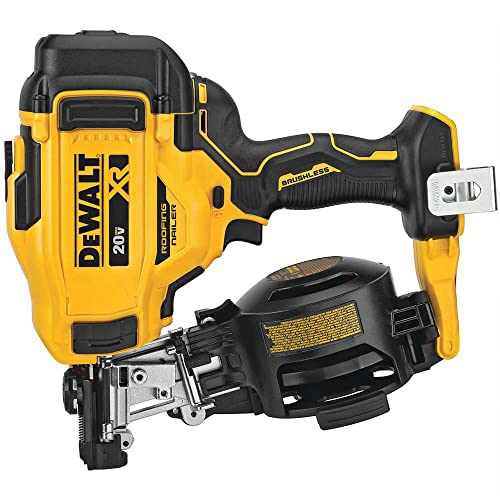
The DeWalt 20V MAX 15-Degree Coil Roofing Nailer is built for jobs where dragging a hose up a ladder is the worst part of the day. A brushless motor (a design with no carbon brushes to wear out, so it runs cooler and lasts longer) drives 15-degree wire-collated nails, and the tool-free nail tray adjusts to the full range of roofing coil sizes. Bump mode handles shingle work at production pace, which is exactly how most roofers want to run.
For siding, this gun reads as a roofing-first tool that happens to handle some siding nail ranges. If your project leans toward asphalt, felt, or sheathing on a roof or a detached outbuilding, the cordless platform saves setup time. House-siding-only jobs may leave some of its features underused.
What Pays Off
- 20V MAX battery platform means no hose, no compressor noise on the roof
- Brushless motor for longer runtime and a longer service life
- Tool-free nail tray adjusts across the common roofing coil range
- Bump mode supports high-volume shingle work
Points To Note
- Battery and charger sold separately on some listings, which adds to the entry cost
- Optimized for roofing rather than fine siding trim work
- Tool-free depth adjustments on a cordless platform can feel less precise than pneumatic dials
Right Fit For
Crews already invested in the DeWalt 20V MAX platform who want a cordless option for roof decking and similar exterior nail work.
Where Another Pick Suits Better
Dedicated siding pros should weigh the Makita AN613 Pneumatic 15-Degree Siding Coil Nailer for daily lap and panel work where a compressor is already on the trailer.
The HBT HBCN65P is a magnesium-bodied coil siding nailer, and the housing choice is the headline feature. Magnesium keeps the tool light without sacrificing the rigidity you want when driving 2-1/2-inch fasteners into denser siding substrates. Owners commonly report that the lighter housing helps during long overhead runs, where every ounce on the end of your arm adds up by the fourth hour.
The exposed nose guide opens up for jam clearing without tools, which is the kind of detail that only matters when something actually jams. Sequential and contact fire modes are toggled by a switch, and the 360-degree adjustable exhaust keeps dust and air off the workpiece. The honest read is that HBT plays in a more budget-conscious lane than the Metabo HPT, but the build feels considered.
Notable Gains
- Magnesium housing trims weight for long overhead and ladder work
- Exposed nose guide allows fast, tool-free jam clearing
- Switchable sequential and contact fire modes
- Tool-free depth adjustment for quick substrate changes
- 360-degree adjustable exhaust directs air away from the work
Things To Consider
- Less brand recognition than major-name pneumatic siding nailers
- Replacement parts may take longer to source than mainstream brands
Quick Facts
Made For
Siding installers who rack up hours overhead and want a lighter pneumatic that does not feel disposable.
Not Your Match When
Builders needing framing-grade power should step up to the Metabo HPT NV75A5 Coil Siding and Framing Nailer, which handles heavier sheathing work.
Fasteners deserve their own conversation, and the findmall 2-inch ring-shank coil nails are aimed at the harsher side of siding work. Hot-dipped galvanizing (a zinc coating bonded to the steel by dipping it in molten zinc) coats the full round head and the shank, and the 0.092-inch shank diameter is on the heavier side of residential siding stock. Ring shanks bite into the wood fibers instead of sliding, which helps with holdout on softer cedar and pine lap siding.
The 3600-count pack covers a meaningful chunk of a single-family re-siding project, assuming two nails per lap and a typical home footprint. These nails fit 15-degree wire-collated guns like the CN57, CN65, and CN70 platforms. The tradeoff is galvanizing thickness, which can sometimes interact poorly with very hard species, so test fire a small section before committing to a full wall.
Practical Pluses
- Hot-dipped galvanized steel for corrosion resistance in treated lumber
- Ring shank design resists pull-out over time
- Full round head sits cleanly against most siding profiles
- 2-inch length suits standard residential lap and panel siding
Small Caveats
- Galvanizing thickness may need a brief test fire on dense hardwoods
- Wire collation only, so confirm your gun handles wire coil before ordering
Best Suited To
Homeowners and pros installing siding onto pressure-treated sheathing or furring strips where corrosion is the chief concern.
Look Elsewhere When
Anyone running the Metabo HPT NV65AH2 should grab the plastic-collated Hotop 2-1/4-Inch Coil Siding Nails 3600-ct, since the NV65AH2 does not accept wire collations.
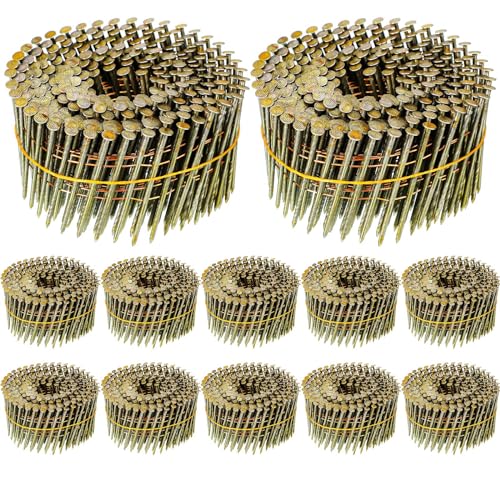
The Hotop 2-1/4-inch wire-collated coil nails arrive in 12 individual 300-count rolls, totalling 3600 nails per case. That packaging is the quiet win: you can grab a single roll for a repair run or stack the case for a full re-side without splitting a giant master pack. The 0.09-inch shank diameter and 2-1/4-inch length slot into the common residential siding range, and the wire collation fits the popular 15-degree coil gun family.
Compatibility is broad, spanning NV65AH2, NV65AH2M, PCN65, HBCN65P, and similar platforms. The honest read is that Hotop sits in the consumable lane where consistency between rolls matters more than branding. A short test coil on your particular gun is worth a few minutes before committing the full case.
Everyday Advantages
- Twelve individual rolls, easy to store and stage around the jobsite
- Broad gun compatibility across common 15-degree coil platforms
- 2-1/4-inch length handles most residential lap and panel siding
- Wire collation is typically lower cost than plastic-collated stock
Honest Caveats
- Test fire on a small section first to confirm fit on your specific gun
- Wire collation can fracture in extreme cold if stored outside overnight
Feature Snapshot
Perfect Match For
Multi-day siding projects where keeping rolls staged at different walls saves real time.
Swap It Out When
Roofing-first crews should consider shorter coil stock like the Hotop 1-1/2-Inch Coil Siding Nails 3600-ct for shingle and underlayment work.
The Hotop 1-1/2-inch wire-collated coil nails are the shortest option in the lineup, and that length is the point. Short shanks suit thinner siding panels, furring strips, and trim work where a longer fastener would punch through the face of the material. The 0.09-inch shank is still meaty enough to hold against wind loads on lap siding, but the trade-off is reduced pull-out strength compared to longer stock on denser substrates.
The same 12-roll, 3600-count packaging applies, so storage and staging stay manageable. Compatibility spans the common 15-degree coil gun family. For most homeowners, this length is the right answer for thin-panel siding, soffit, and similar lighter fastening.
What Helps Most
- 1-1/2-inch length is the safe pick for thin panel and soffit material
- Same 12-roll format as the longer Hotop coils for simple staging
- Works with the common 15-degree coil gun family
Worth Noting
- Too short for dense sheathing or thicker fiber-cement panels
- Test fire before committing to a full lap siding run on dense species
Who Should Grab It
DIYers handling thin lap siding, soffit panels, or trim work where a longer fastener would blow through the face of the material.
Reach For A Different Pick When
Standard residential lap siding projects typically want the Hotop 1-3/4-Inch Coil Siding Nails 3600-ct, which sits in the most common mid-length range.
The Hotop 1-3/4-inch wire-collated coil nails are the middle of the residential siding length range, and that makes them the safest default for most lap siding installs. The 0.09-inch shank diameter is consistent with the rest of the Hotop coil family, and the 12-roll packaging keeps jobsite handling simple. Compatibility covers the same broad 15-degree coil gun family as the other Hotop coils.
The trade-off versus a 2-inch or 2-1/2-inch nail is slightly reduced grip in denser sheathing, but on standard 1/2-inch lap siding over plywood sheathing, the 1-3/4-inch length lands right in the recommended range. The honest read is that this is a versatile length, useful across a wider set of siding profiles than the shorter option.
Strengths Worth Knowing
- 1-3/4-inch length is the common residential lap siding standard
- Compatible with popular 15-degree coil gun platforms
- 12-roll packaging simplifies transport and staging
Possible Compromises
- Less holding power than 2-1/2-inch stock on dense sheathing
- Wire collation can be finicky in very cold storage
Feature Snapshot
Whose Shelf It Belongs On
Homeowners and remodelers running a typical lap siding project who want a versatile mid-length coil that fits most 15-degree guns.
Where A Sibling Pick Shines
Anyone hanging pressure-treated lap siding over furring strips should pick the findmall 2-Inch Ring Shank Siding Nails 3600-ct for the extra corrosion protection and grip.
The Metabo HPT NV75A5 sits in the gap between framing and siding, which is a useful lane on a small jobsite where one tool has to cover both. It drives fasteners up to 3 inches long and 0.131-inch shank diameter, which puts it firmly in sheathing territory. The lighter body weight, around 5.7 pounds, keeps it from feeling like a full framing gun, and the adjustable depth of drive supports siding-grade work as well.
It accepts both wire and plastic collations, so the same gun can run standard framing coil stock and siding-specific nails. For mixed sheathing and siding projects, that flexibility can pay for itself. The trade-off is specialization. Siding-only pros may still prefer the lighter, more refined NV65AH2 for lap and panel work.
Notable Upsides
- Handles both sheathing and siding with the same tool
- Accepts wire and plastic collations for fastener flexibility
- Drives up to 3-inch, 0.131-inch fasteners for framing-adjacent work
- Adjustable depth of drive for varied substrates
Trade-Offs To Consider
- Heavier and bulkier than a siding-only nailer
- Overkill for a single, narrow siding project
Built With In Mind
Small crews and remodelers who bounce between sheathing, subfloor, and siding and want one gun that covers both lanes.
A Better Fit Elsewhere
Siding-only specialists who spend the day running lap and trim should stick with the Metabo HPT NV65AH2 Coil Siding Nailer for a more refined, lighter feel.
The Makita AN613 closes the list with a focus on refined daily use. The aluminum housing keeps the tool light while still feeling substantial, and the tool-less depth adjustment has nine detent settings, which is more granular than most rivals. The easy-loading adjustable canister speeds up coil swaps on a long day, and the 15-degree collation covers both wire and plastic coil nails.
It drives 2-1/2-inch siding nails, putting it at the long end of the residential siding range, so it handles thicker fiber-cement panels and heavier lap profiles without complaint. The trade-off is the same as most pneumatic tools on this list: you need a compressor and hose on site. For pros who already run a Makita pneumatic setup, the AN613 slides right into the existing tool family.
The Upside
- Aluminum housing balances light weight with daily durability
- Tool-less depth adjustment with nine detent settings for fine control
- Easy-loading adjustable canister speeds up coil swaps
- Drives 15-degree wire and plastic collated nails
Less Ideal Details
- Requires a compressor and hose, no cordless option
- Premium pricing versus entry-level pneumatic siding nailers
Who Will Love This
Pros running daily siding installs who want a refined pneumatic with a granular depth system and a smooth coil-loading routine.
Skip It When
Cordless-first crews and roofing-focused operators should pick the DeWalt 20V MAX 15-Degree Coil Roofing Nailer instead.
Choosing the Right Coil Siding Nailer and Fastener Combination
Nailer Style and Power Source
Pneumatic coil siding nailers still dominate because a small compressor is already part of most exterior jobs. Cordless coil nailers, like the DeWalt 20V MAX option above, earn their place on rooftops and remote sites where running a hose is impractical. Most homeowners renovating one house will get more value from a pneumatic gun, while contractors working across multiple properties may justify the cordless platform for the time saved on setup.
Collation, Angle, and Compatibility
The 15-degree coil format is the most common angle in residential siding, and most guns in this category stick to it. The bigger decision is plastic versus wire collation. Plastic-collated nails are usually cleaner to load and less prone to breakage in cold weather, but wire-collated stock tends to be cheaper and more widely available. Confirm your gun accepts the coil stock you plan to buy before you order a 3600-count case.
Housing Material and Weight
Aluminum and magnesium housings both trim weight versus steel, and on long overhead runs, that weight difference shows up in your forearms by mid-afternoon. The HBT HBCN65P uses magnesium, while the Makita AN613 and Metabo HPT NV75A5 lean on aluminum. None of these are fragile, but each behaves slightly differently in cold weather and under heavy use.
Fastener Length and Shank Type
Residential lap siding usually lives in the 1-1/2 to 2-1/2-inch range, with 1-3/4-inch being the most common mid-length default. Thicker fiber-cement panels and sheathing benefit from the longer end. Ring shank nails, like the findmall 2-inch option, hold better over time but cost a bit more per coil and may need a brief test fire on dense species.
Smart Shopper Notes for Coil Siding Tools
Pitfalls Shoppers Hit
The most common mistake is mismatched collation. A pneumatic siding nailer set up for plastic-collated nails will choke on wire coil stock, and a wire-collated gun will not accept plastic. Confirm the format on the gun before you buy a 3600-count case of nails. Another trap is underestimating the compressor requirement. Pneumatic coil siding nailers typically need a unit that can sustain 4 to 5 CFM (cubic feet per minute, a measure of how much air the tool consumes) at 90 PSI, and small pancake compressors will struggle on long production runs.
Where The Extra Money Goes
Premium siding nailers tend to spend the extra cost on housing material, depth-of-drive precision, and jam-clearing access. The Metabo HPT NV65AH2 and Makita AN613 are good examples: lighter housings, easier reloads, and more nuanced depth adjustment. The honest case for paying more is daily, all-day use. Weekend DIYers typically do not need that level of refinement, and a value-tier gun covers a single project without complaint.




