


A gas leak starts as a faint hiss and ends with a shutoff valve and a very bad day. Thread sealants, often called pipe dopes, sit at the seam where every gas fitting tightens down, and they are the difference between a joint that holds for a decade and one that never should have left the workbench. This roundup sorts through flexible connectors, soft-set sealants, and high-pressure joint compounds that get called on for residential and light commercial gas work, so you can match the right product to the fitting in front of you.
How The Shortlist Stacks Up
72″ Dryer Gas Line Kit with 5/8″ OD Connectors

Black Swan All Purpose Pipe Dope (Yellow, 1 fl. oz.)
48″ Gas Dryer Hose Kit with 5/8″ OD Connectors
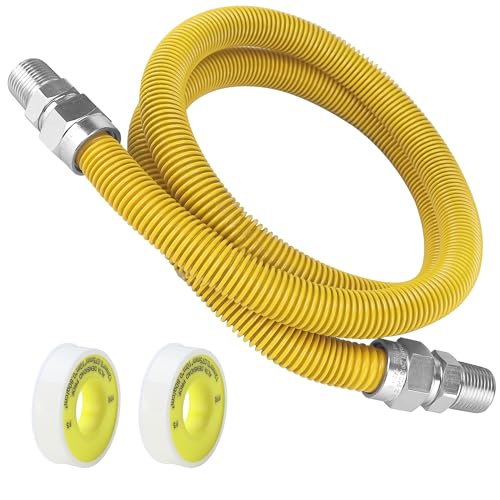
72″ Flexible Gas Line Hose with 1/2″ OD Connectors

Oatey Pipe Joint Compound 4 oz. (Pack of 2)
Taking A Closer Look At The Options
Long runs between the wall shutoff and a freestanding range or dryer demand a connector that bends without kinking, and this 72-inch stainless steel flex line from MIFLUS arrives ready for that job. The package ships with several adapter fittings covering 1/2″ MIP, 3/4″ FIP, and 3/4″ MIP thread patterns, so you can thread it into older valves or newer appliances without a separate hardware store run.
The yellow-coated stainless steel body resists corrosion in laundry rooms where humidity climbs, and the included thread tape gives you a secondary seal on every joint. Homeowners replacing a worn dryer connector before it fails will find this kit covers most residential hookup scenarios, though you should always confirm your local code allows corrugated stainless connectors in your jurisdiction.
Real-World Strengths
- 72-inch length clears most dryer and range offsets from the wall valve
- Multiple fitting adapters (1/2″ MIP, 3/4″ FIP, 3/4″ MIP) cover common thread patterns in one box
- Stainless steel core with a protective yellow coating holds up to laundry room humidity
- Thread tape included, so you do not have to source a second consumable mid-job
Things To Consider
- 5/8″ OD diameter may not fit tight appliance cavities designed for slimmer lines
- Local codes in some municipalities restrict flexible connectors on certain gas appliances
Who It Suits Best
Homeowners running a new gas dryer or range where the appliance sits well away from the wall valve and standard plumbing knowledge is on hand.
Skip It When
The 48″ Gas Dryer Hose Kit from MIFLUS is a better match for tight laundry closets where extra length would just coil behind the appliance.
Pipe dope is the paste you brush onto male threads before you wrench a joint home, and the Black Swan tube is the bottle most often within reach on a service truck. This soft-set, high-viscosity formula fills small voids in imperfect threads, which matters on older galvanized fittings where the thread flanks have worn slightly out of true. The label specifically calls out natural gas lines, so you are not guessing whether the chemistry suits fuel gas.
The low-odor profile is a quiet quality-of-life upgrade for anyone working indoors, and the 1 fl. oz. tube is small enough to keep in a toolbox drawer. Compared to rigid flex lines like the MIFLUS kit above, this sealant is the partner you use when the threaded joint is already correct but needs the chemical seal a gasket alone cannot provide.
Positive Points
- Soft-set paste fills tiny thread gaps on worn or slightly imperfect fittings
- Specifically formulated and labeled for natural gas line service
- Low-odor formula keeps indoor work tolerable
- Small 1 fl. oz. tube fits in a standard toolbox or apron pocket
Points To Keep In Mind
- Soft-set consistency means longer cure time before pressure testing than faster-hardening compounds
- One ounce goes quickly across multiple large-diameter joints
Feature Snapshot
Made For
Homeowners and trade technicians reseating threaded black iron or galvanized gas fittings who want a sealant specifically labeled for fuel gas service.
Consider Something Else When
The Oatey Pipe Joint Compound suits higher-pressure applications and mixed-material runs where the 3,000 psi gas pressure rating matters more than a soft-set paste.
Not every laundry room gives you six feet of slack between the wall valve and the back of the dryer. The 48-inch MIFLUS flex line trims two feet off the longer kit above, and that shorter arc keeps the connector from coiling into a service loop where it can rub against the appliance housing. You still get the same yellow-coated stainless construction and the same family of adapter fittings.
Tight closet installations in older homes and stacked laundry centers benefit most from a line that arrives roughly the right length instead of being bundled and zip-tied. The trade-off is reach, so measure from the valve to the dryer inlet before choosing this over the 72-inch sibling.
Where It Delivers
- 48-inch length suits closets and tight laundry nooks where excess line would coil behind the dryer
- Same 5/8″ OD stainless core as the longer MIFLUS kit, with identical thread adapter coverage
- Yellow coating protects against the moisture and detergent splash common in laundry rooms
Small Caveats
- Two feet shorter than the 72″ kit, so it is wrong for offset hookups
- Stiff out of the box; give the line a gentle pre-bend before final tightening to avoid stressing the flare
Best Suited To
Apartment dwellers and homeowners with compact laundry closets where the dryer sits close to the wall and a shorter run reduces clutter.
Not Your Match When
The 72″ Dryer Gas Line Kit from MIFLUS fits rear-vented ranges and wide laundry rooms where the appliance is set well away from the valve.
The 1/2″ OD profile of this MIFLUS line is the slimmer cousin of the 5/8″ connectors above, and that smaller diameter matters when the gas port on the appliance is sized for a thinner feed. You get 72 inches of run with 1/2″ MIP and 1/2″ FIP adapters included, plus a roll of thread tape, so the kit is genuinely complete rather than a bare hose.
Range tops, smaller water heaters, and some wall heaters use this 1/2″ fitting size as standard, making this a sensible default when you are not sure which diameter the appliance expects. Owners commonly report that the line bends cleanly around corners, though a tight 90-degree turn in a confined cabinet is still going to fight back.
Practical Pluses
- 72-inch length with a slimmer 1/2″ OD profile for appliances designed around that port size
- Includes 1/2″ MIP and 1/2″ FIP adapters plus thread tape in a single package
- Yellow-coated stainless construction handles typical basement and utility room conditions
Worth Bearing In Mind
- 1/2″ OD may be too narrow for high-BTU appliances that expect 5/8″ or 3/4″ supply lines
- Sharp cabinet corners can kink the line if forced without a sweep elbow
Quick Facts
Whose Shelf It Belongs On
Shops and homeowners who service a range of mid-size gas appliances and want one connector diameter on hand for most service calls.
Look Elsewhere When
The Oatey Pipe Joint Compound 4 oz. is a better pick for sealing threaded black iron where a paste, not a connector, is the missing piece.
Oatey is one of the names you find in a professional plumber’s van, and this two-pack of 4 oz. white pipe joint compound is the bulk option for anyone with more than a single fitting to seal. The compound is rated for gas pressure up to 3,000 psi and liquid pressure up to 10,000 psi, which puts it well above the operating pressure of any household gas branch line.
Application temperature range stretches from -50°F to 500°F, so it tolerates the hot-side runs near a water heater or the cold side of an exterior meter set. The white paste works across PVC, CPVC, ABS, iron, steel, and copper, though for natural gas you are almost always dealing with black iron or steel, where this compound is in its element.
Features That Help
- Gas pressure rating up to 3,000 psi covers any residential branch line with margin to spare
- Two 4 oz. jars give you enough compound for multiple projects without reordering
- Wide temperature tolerance from -50°F to 500°F handles exterior meter sets and hot appliance feeds
Trade-Offs
- White compound can be messier to apply than the soft-set yellow tube, and residue shows on dark threads
- Larger jar format is overkill for a one-off dryer hookup
Feature Rundown
Who Should Grab It
Plumbers, HVAC techs, and serious DIYers running threaded black iron for new gas branch lines or carrying out a multi-fitting repipe.
Swap It Out When
The Black Swan All Purpose Pipe Dope is a friendlier choice for a single-seat repair where the small soft-set tube is easier to handle than a 4 oz. jar.
What To Weigh Before Picking A Pipe Dope
Picking the right product starts with the fitting in front of you, not the brand on the shelf. Threaded black iron and galvanized steel use pipe dopes; flexible stainless connectors use flare-to-thread gaskets and the flare geometry itself for the seal. Mixing those two worlds is the fastest path to a joint that does not behave the way the label promises, so identify whether you are sealing a threaded joint or routing a connector before you start shopping.
Material compatibility matters just as much as pressure rating. A paste rated for water lines may not list natural gas on the label, and a few thread sealants contain solvents that degrade certain plastics used in appliance manifolds. Look for explicit language about natural gas or fuel gas, and check the compatible pipe materials list against the metals in your run.
Pressure and temperature ratings should exceed your real-world conditions by a comfortable margin. A residential natural gas branch runs at roughly 0.25 psi at the appliance, so any paste rated in the thousands of psi handles normal service easily. The temperature range matters more for lines that run through unconditioned spaces or sit near a water heater flue, where attic heat or basement cold can push the joint toward its working limits.
Finally, think about the working environment and your experience level. Soft-set pastes in small tubes are forgiving for first-timers and let you reposition a fitting during assembly. Faster-curing or higher-viscosity compounds reward careful prep and clean threads, which is fine for seasoned hands but punishing if you rush the brush-out.
Key Considerations Across These Picks
Mistakes Worth Dodging
The most common error is using a liquid or paste thread sealant that is not labeled for natural gas, then assuming the joint is safe because it stopped dripping. Some general-purpose sealants are designed for water or air and lack the chemistry to resist the hydrocarbon exposure a gas line sees over decades. Always read the label for explicit fuel gas or natural gas language.
A second trap is reusing old flexible connectors because they still look intact. Corrugated stainless lines have a finite service life, and a connector that has been through one move and one appliance swap is closer to replacement than a new install. The cost of a new line is far smaller than the cost of a leak you cannot smell in time.
Where The Extra Money Goes
Premium pipe dopes and connectors cost more because the certification paperwork, the batch testing, and the labeled compatibility data have all been done by the manufacturer. A bargain tube from an unknown brand may perform identically on day one, but you have less assurance that the formula will hold up after ten years of gas exposure. For gas work specifically, the paperwork trail is part of what you are paying for, and it is worth the small premium for any joint you cannot easily re-inspect.
Frequently Asked Questions
Can You Use Standard Thread Sealant On Natural Gas Lines?
Only if the label explicitly lists natural gas or fuel gas as an approved service. General-purpose pipe dopes rated only for water or air can break down over time when exposed to hydrocarbons, which is why a gas-rated product is the safer choice for any threaded gas joint.
Do Flexible Stainless Connectors Need Pipe Dope On The Threads?
Most flexible connectors use a flared end that seals through metal-to-metal contact, so pipe dope is generally not applied to the flare itself. The threaded end that screws into the valve may still benefit from gas-rated thread tape or sealant, depending on the fitting style and local code.
How Long Does Pipe Joint Compound Take To Cure?
Soft-set formulas like the Black Swan tube typically need several hours before they reach full pressure resistance, while harder-setting compounds can be pressure-tested sooner. Always confirm the cure window on the product label and avoid pressurizing the line until the sealant has set.
Is Pipe Dope The Same As Teflon Tape?
Both seal threaded joints, but they work differently. Teflon tape wraps the male thread and fills spiral gaps, while pipe dope is a paste that brushes into the threads and cures into a flexible gasket. Many professional plumbers use both together, with tape wrapped first and a thin coat of dope brushed over it.
How Often Should Gas Connectors Be Replaced?
Flexible gas connectors have a service life of roughly ten years under normal residential conditions, and earlier replacement is wise if the line shows corrosion, kinks, or mechanical damage. A visual inspection during any appliance service is a reasonable checkpoint for planning a swap.




