


Cut a bad fish-mouth and the weld fights you the whole way around the tube. Cut a clean one and the bead lays down like it knows where to go. That gap between frustration and flow is exactly where the right tubing notcher earns its keep, whether you’re building a roll cage in a home garage, fitting custom exhaust, or laying out HVAC relief cuts in sheet metal.
This roundup covers nine tools that tackle different sides of that problem. Some are dedicated tube notchers for round and square stock, one is a hand-held sheet-metal V-notcher for HVAC work, and one is a contour template that helps you lay out saddle joints on pipe. Each one fits a different workshop reality, from weekend hobbyists to full-time fabricators.
A Side-By-Side Look
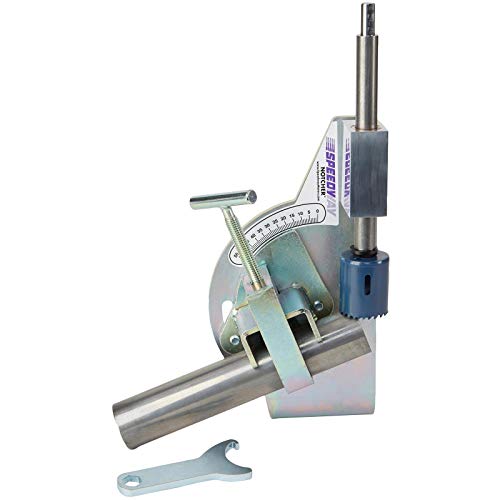
Speedway Motors Tube Notcher 9/16-2in 40-90 Degree

Jeremywell Industrial Professional Pipe & Tube Notcher 3/4″ – 3″

KASTFORCE KF5008 2 Inch Hole Saw Pipe Tube Notcher

Pipemaster P-T175 Contour Gauge Pipe & Tube Fitting Tool

VKRP Enterprises Industrial Pipe & Tube Notcher 3/4″ – 3″
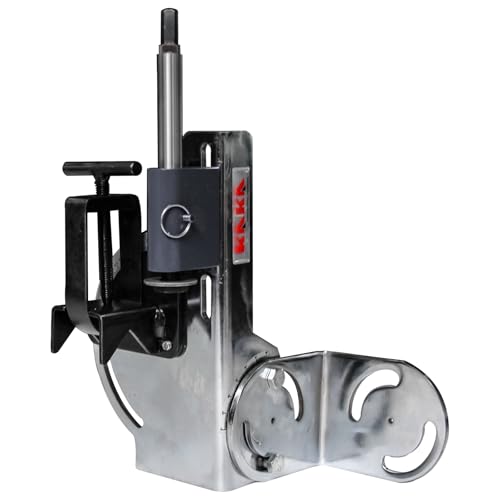
KAKA INDUSTRIAL PN-1/2S Pipe Notcher 0-60 Degree

Allstar Performance ALL10411 Tubing Notcher

HURRICANE Sheet Metal V Notcher 30° Manual Hand Tool
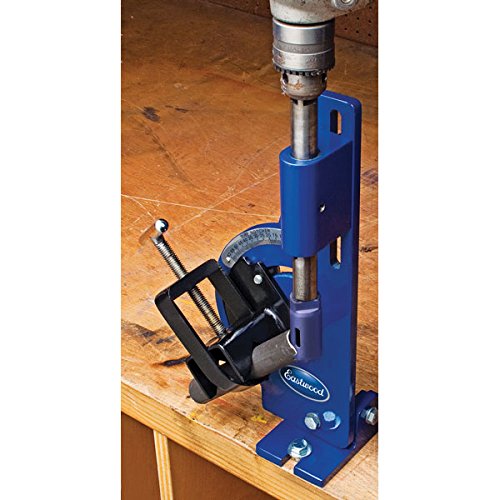
Eastwood Tube and Pipe Notcher 0-60 Degree 2 in.
More Details On Our Top Picks
Most hobby-grade notchers stop at 50 or 60 degrees and leave you eyeballing anything steeper. This Speedway unit swings the other way, offering an integrated protractor gauge that lands anywhere from 40 to 90 degrees, which matters when you’re coping crossmembers into a chassis or fitting a tight header tube. The body uses steel and aluminum with bronze bushings, so the pivot action stays smooth after dozens of cuts instead of developing the wobble cheaper castings tend to pick up.
You can clamp it in a bench vise for handheld work or bolt it to a drill press table for repeatable cuts, and it ships with a 1-3/4 inch hole saw, mandrel, and threaded adapter so you can start cutting the day it arrives. Round tubing from 9/16 inch up to 2 inch fits, plus square stock up to 1-1/2 inch, covering most home-fab projects without swapping fixtures.
Useful Touches
- 40 to 90 degree protractor covers steeper angles than most competitors
- Steel and aluminum frame with bronze bushings for smoother long-term pivoting
- Includes hole saw, mandrel, and threaded adapter right out of the box
- Accepts both round tubing and 1-1/2 inch square stock for varied projects
- Works in a vise or mounted to a drill press table, depending on your shop layout
Trade Offs
- Heavier than compact notchers, so a permanent bench mount may suit you better than portable use
- Lower angle range stops at 40 degrees, so shallow fish-mouths require a different tool or careful freehand grinding
Feature Snapshot
Who It Suits Best
Garage fabricators building roll cages, bumpers, and custom chassis who need steeper angles than a typical 0-50 degree notcher offers.
Consider Something Else When
You work mostly with thin exhaust tubing under 3/4 inch, where the KASTFORCE KF5008 2 Inch Hole Saw Pipe Tube Notcher is a lighter, drill-press-friendly alternative.
When the tubing in front of you is 2-1/2 inch exhaust or 3 inch structural pipe, smaller notchers simply will not open wide enough to seat the stock. The Jeremywell punch-and-press design clamps round tubing from 3/4 inch all the way to 3 inch, which is enough headroom for most automotive and light-industrial builds. The angle range tops out at 50 degrees, which covers the majority of common chassis and exhaust layouts without forcing you to freehand the cut.
It mounts to an adjustable bracket and pairs with any 1/2 inch chuck drill or drill press, so you bring the muscle and the tool handles the alignment. The press-style body keeps the hole saw cutting true through thicker walls, which is where slimmer notchers tend to flex and leave a wobble in the bore.
Good Reasons To Consider
- 3 inch tubing capacity dwarfs most hobby notchers on the market
- Press-style frame resists flex when cutting thick-wall pipe
- Adjustable mounting bracket fits a range of bench setups
- Works with a standard 1/2 inch chuck hand drill, no specialty power tool required
Things To Consider
- 50 degree maximum angle is shallower than the Speedway Motors Tube Notcher, so very steep joints need a different tool
- Bulkier footprint takes up more bench space than compact notchers
- Drill and hole saw are not included, so budget for a matched set before you start cutting
Built With In Mind
Shops and serious hobbyists working with thick-wall pipe from 1-1/2 inch up to 3 inch who need a press-style tool that will not flex mid-cut.
A Better Fit Elsewhere
You mostly cut small-diameter tubing under 1 inch and want a lighter tool, in which case the Allstar Performance ALL10411 Tubing Notcher is a friendlier starter option.
The KF5008 lives in a comfortable middle ground. It handles round tubing up to 2 inches in diameter and tilts through 60 degrees of adjustment, which covers the bulk of home-shop exhaust and chassis work. The body mounts to a drill press table, and the 1/2 inch chuck dimension means your existing hole saws drop right in without a separate adapter.
For someone setting up a first fab station, this strikes a usable balance between capacity and bench footprint. You can build a complete exhaust system for a small-block or a basic roll cage without buying two different notchers, and the design stays simple enough that you will not spend a weekend learning the adjustments.
The Value In It
- 2 inch tubing capacity is generous for a hobby-tier notcher
- Drill press mount gives repeatable, square cuts without fatigue
- Standard 1/2 inch chuck accepts most hole saws already in your shop
- 60 degree range covers the most common exhaust and chassis angles
Where It May Fall Short
- No hand-held clamp option, so you need a drill press to use it
- Lighter frame may flex slightly on thicker-wall steel compared to press-style tools
Key Specs
Right Fit For
Home garage hobbyists who already own a drill press and want a single notcher that covers 90 percent of typical exhaust and chassis projects.
Skip It When
You need to take the notcher to a job site, in which case the VKRP Enterprises Industrial Pipe & Tube Notcher 3/4″ – 3″ runs on a portable hand drill instead.
This one breaks the pattern of the list. The P-T175 is not a powered notcher; it’s a spring-tempered contour gauge sized for 1-3/4 inch tube that you press against a pipe to capture its profile, then trace that profile onto the mating tube for a hand-cut saddle joint. That makes it a layout tool rather than a cutting tool, and the right pick when you need to notch existing pipe in place without disassembling the run.
The internal core is 6061 aluminum and the housing is rugged ABS, so the gauge holds its shape after repeated use in a hot or cold shop. You size the gauge to your tube, snap the contour, transfer the line, and cut with a grinder or plasma. It is the kind of tool that earns its space on the bench the first time you avoid a three-hour rework on a complex exhaust merge.
Positive Points
- Spring-tempered stainless pins keep the captured profile accurate over time
- 6061 aluminum core adds rigidity without making the gauge heavy
- Works without power, so you can layout in tight spots where a notcher cannot reach
- Ideal for saddle cuts where the pipe is already welded in place
Practical Considerations
- Sized specifically for 1-3/4 inch tube, so you need separate gauges for other diameters
- Does not actually cut, so you still need a grinder, saw, or plasma to finish the notch
Best Suited To
Fabricators who frequently cut saddle notches into existing pipe runs and want a fast, accurate layout reference without dragging out a powered notcher.
Where A Sibling Pick Shines
You need a powered tool to handle round tubing up to 2 inches automatically, in which case the Eastwood Tube and Pipe Notcher 0-60 Degree 2 in. covers the cutting side of the job.
The VKRP notcher runs on any 1/2 inch hand drill, which removes the need for a dedicated drill press setup. For someone who fabricates at the track, on a farm, or in a driveway without a stationary bench, that portability is the whole point. It accepts standard hole saws and tilts through 50 degrees, with a single-bolt angle lock that you can adjust one-handed.
Capacity spans 3/4 inch to 3 inch tubing, so it covers everything from a go-kart frame to a hot rod exhaust in one tool. Owners commonly use it for one-off projects where dragging a full shop to the jobsite is impractical, and the press-style frame keeps the cut from walking even when you are feeding the drill by hand.
Notable Upsides
- Pairs with any standard 1/2 inch hand drill, no drill press required
- 3 inch capacity handles heavy exhaust and chassis tubing
- One-handed angle adjustment speeds up repeat cuts on the same project
- Accepts all standard hole saws, so you use what you already own
Some Limits To Know
- 50 degree maximum limits very steep chassis angles
- Handheld operation requires a firm grip to keep the cut from drifting
- You supply the drill, hole saw, and a sturdy surface to brace against
Whose Shelf It Belongs On
Mobile fabricators and field welders who need a portable notcher that runs off a hand drill instead of a shop-bound drill press.
Another Choice May Suit
You want a self-centering clamp and lower entry cost for a stationary garage setup, in which case the Allstar Performance ALL10411 Tubing Notcher is the more beginner-friendly option.
The PN-1/2S leans into shop permanence. The frame is steel, the clamping is rigid, and the angle range runs from 0 to 60 degrees, which is enough for most fish-mouth joints you will see in custom exhaust and chassis work. Round tube capacity tops out at 2 inches, fitting the bulk of mild-steel automotive tubing without a second fixture.
This is the kind of tool you bolt to a bench and leave there. The steel body holds alignment under repeated cuts, so once you dial in an angle, the next ten notches come out the same. For a fab shop running the same profile all day, that consistency is worth more than fancy adjustment ranges.
Key Advantages
- Steel frame holds alignment for repeatable, production-style cuts
- 0 to 60 degree range covers most standard fish-mouth joints
- 2 inch round tube capacity matches typical automotive tubing
- Stable bench footprint for shops that run the same profile repeatedly
Honest Caveats
- Heavier than aluminum-body notchers, so it is not a grab-and-go tool
- Does not list square tube capacity, so stick to round stock unless you confirm fit with the seller
Made For
Shops and serious home fabricators who want a stationary, steel-bodied notcher that delivers the same angle cut after cut.
Reach For A Different Pick When
You want to cover both round and square tubing in one tool, in which case the Speedway Motors Tube Notcher 9/16-2in 40-90 Degree explicitly handles square stock up to 1-1/2 inch.
Allstar’s notcher is a budget-friendly entry point that still gets the basics right. It accepts up to 2 inch round stock, tilts to 45 degrees, and uses a self-centering clamp so the tube sits true in the bore without constant nudging. The economy steel body is lighter than the KAKA PN-1/2S, which makes it easier to clamp into a portable bench or carry to a friend’s shop.
You can run it from a drill press or a hand drill, depending on the project. The 45 degree limit rules out the steepest crossmember joints, but for the average first-time roll-cage builder or weekend chassis tinkerer, it covers the angles you are actually going to use.
Notable Gains
- Self-centering clamp removes the trial-and-error of lining up round tube
- Works in either a drill press or with a hand drill
- 2 inch stock capacity matches most home-built chassis needs
- Lighter steel body is easier to reposition than heavier shop-bound tools
Where It Is Less Suited
- 45 degree maximum angle is the shallowest range on this list, so steep joints are out of reach
- Economy steel finish can show surface wear faster than heavier-frame options
Who Should Grab It
First-time fabricators building a basic roll cage, bumper, or chassis who want an affordable notcher that does not fight them on tube alignment.
Not Your Match When
You regularly need angles steeper than 45 degrees, in which case the Speedway Motors Tube Notcher 9/16-2in 40-90 Degree covers the full 40 to 90 range.
This is the odd one out, and it earns its spot. A V-notcher is a hand tool that punches a clean 30 degree V-shaped relief into sheet metal so you can fold a corner or seam a duct without buckling the panel. The HURRICANE cuts up to 13/16 inch deep at a fixed 30 degree angle, with a manual safety locking latch that keeps the jaws closed when the tool is sitting on a ladder or a truck shelf.
HVAC installers, roofers, and gutter fitters reach for it on every rectangular-to-round transition and inside corner. It runs without power, fits in a tool belt, and is rated for 24 gauge mild steel and 26 gauge stainless, which covers standard ductwork without chewing through the metal.
What Makes Sense
- Hand-powered, so there is no cord to drag through an attic or across a roof
- Safety locking latch keeps jaws closed during transport and storage
- 13/16 inch notch depth handles standard duct corner reliefs
- Rated for both mild steel and stainless duct stock
Trade-Offs To Consider
- Fixed 30 degree angle only, so non-standard reliefs require a different tool or hand filing
- Not designed for tubing at all, so it cannot replace a powered tube notcher in your shop
- Limited to lighter-gauge sheet metal, not structural plate
Perfect Match For
HVAC technicians, roofers, and gutter installers who need a portable, no-cord way to cut consistent V-reliefs in standard-gauge sheet metal.
Look Elsewhere When
You need to notch round tube for chassis or exhaust work, in which case the Eastwood Tube and Pipe Notcher 0-60 Degree 2 in. is built for that job.
The Eastwood closes the list as the most material-flexible tube notcher in the group. It is rated to cut mild steel, stainless, and aluminum up to 2 inch round, with a 0 to 60 degree angle range and a standard hole saw capacity up to 2-1/2 inch. For someone who moves between stainless exhaust work and aluminum chassis components, that flexibility removes the need to swap tools between materials.
It also handles rectangular tube up to 2 inch by 2-1/2 inch, which opens up cage-building layouts that round-only notchers cannot grip. Saddle notches on pipe for weld fit-up fall within its standard use cases, and the design accepts any standard hole saw up to 2-1/2 inch in diameter.
Benefits That Matter
- Cuts mild steel, stainless, and aluminum without changing tools
- Handles both round and rectangular tubing in one fixture
- Accepts standard hole saws up to 2-1/2 inch for varied cut profiles
- 0 to 60 degree range covers the most common fish-mouth and saddle angles
Worth Noting
- Power drill and hole saw are sold separately, so factor that into your total cost
- 2 inch round limit rules out the heavy-wall 3 inch pipe that the Jeremywell and VKRP notchers handle
Who Will Love This
Fabricators who regularly switch between mild steel, stainless, and aluminum and want one notcher that does not need a blade change to follow along.
Swap It Out When
You mostly work with 2-1/2 to 3 inch exhaust and chassis pipe, in which case the Jeremywell Industrial Professional Pipe & Tube Notcher 3/4″ – 3″ handles the larger stock with a heavier frame.
What To Weigh Before Choosing A Pipe Notcher
Tubing Capacity And Material
The first filter is whether the tool actually opens wide enough for the stock you run. Most hobby notchers stop at 2 inch round, while heavy-duty press tools like the Jeremywell and VKRP models reach 3 inch. Match the capacity to the largest tube you currently own, then leave a little headroom for the next project. Material matters too: aluminum cuts easily, stainless works hard, and not all entry-level notchers are rated for stainless without slowing the feed rate and managing heat.
Angle Range And Joint Geometry
A 0 to 50 or 0 to 60 degree range covers most fish-mouth and chassis joints, but tighter crossmember notches can push past 60 degrees. The Speedway Motors unit’s 40 to 90 degree range fills that gap, and it is the right pick when steep angles come up regularly. For shallow reliefs, any tool in the list handles the cut, and an Allstar-style 45 degree limit is fine for first builds.
Power Source And Shop Setup
Drill press models give you the most repeatable, square cuts because the tool sits in a fixed plane. Hand-drill-friendly press notchers like the VKRP and Jeremywell trade some accuracy for portability, which is worth it on a job site or in a small shop without a stationary bench. If you are setting up a first fabrication station, a drill-press-mount notcher such as the KASTFORCE KF5008 is the safer learning curve.
Extras You Will Need To Budget For
Hole saws, mandrels, and the drill itself are rarely included. Factor a matched hole saw set into your total cost, sized to the tube diameters you cut most. A 1/2 inch chuck on the power tool is the standard across this list, so most existing arbors in your shop will drop right in. Maintenance is mostly cleaning chips out of the pivot and keeping the bronze bushings lightly lubricated, which adds almost nothing to your ongoing cost.
Smart Considerations Before You Pick
Pitfalls Shoppers Hit
A common slip is matching the notcher to the biggest project you can imagine instead of the work you actually do. A 3 inch press notcher is overkill for someone building bicycle frames, and a 45 degree hobby notcher is the wrong tool for a tight race-car crossmember. Read the angle range, the tubing capacity, and the mounting style together, and pick the tool that fits your real workload, not your fantasy one.
When Paying More Pays Off
The jump from a basic entry-level notcher to a heavier press or wider-angle model shows up in three places: alignment holding over time, accuracy on thick-wall stock, and the ability to handle steeper joints without forcing the cut. Higher-tier tools also tend to use bronze bushings and steel-and-aluminum frames, which resist the wobble that cheaper castings develop after a season of use. The upgrade is worth it for anyone fabricating weekly, and less critical for a one-off project on the driveway.




