


Planers solve the same stubborn problem across every skill level: rough lumber arriving too thick, too warped, or too inconsistent for a clean glue-up. A good planer turns construction-grade boards into furniture-ready stock in a single pass, and the right choice depends on how often you mill, the widths you handle, and whether cordless freedom matters in your shop. This roundup covers a cordless handheld, a workstation accessory, and three benchtop thickness planers built for serious volume.
The Main Contenders
Makita DKP180Z 18V Cordless Planner (Body Only)
DEWALT DW7351 Planer Folding Table Accessory
VEVOR Power Benchtop Planer Three-Blade 13-Inch

VEVOR Two-Blade 13-Inch Benchtop Planer 15A
VEVOR 13-Inch Benchtop Planer 2000W Foldable
The Details Behind The Selections
A handheld cordless planer occupies a different niche than the benchtop thickness planers that dominate this list. The Makita DKP180Z is built for trimming doors, shaving down sticking lumber on a job site, and fitting workpieces without dragging a board back to a stationary machine. It runs on Makita’s 18V LXT battery platform, so anyone already invested in that ecosystem can drop in a pack and get to work.
For remodelers and finish carpenters, the appeal is mobility. You can take it to a deck, a kitchen install, or a staircase without an outlet nearby. Body-only means you supply the battery and charger, which keeps the upfront cost lower for those who already own the system.
Points In Its Favor
- 82 mm cutting width handles standard door edges and most trim profiles in one pass.
- 18V LXT compatibility shares batteries with the wider Makita tool family you may already own.
- Lightweight handheld form factor reaches job-site locations where a stationary planer simply cannot go.
- Body-only configuration avoids forcing you to buy a battery pack you already have on the shelf.
Worth Noting
- Battery and charger are sold separately, which adds to the total spend for first-time Makita owners.
- Handheld planers cannot mill rough lumber to consistent thickness the way a benchtop thickness planer can.
Key Product Details
Who It Suits Best
Trim carpenters, remodelers, and finish contractors who already use the Makita 18V LXT platform and need portable edge-shaving capability on site.
Where Another Pick Suits Better
If you need to mill rough-sawn lumber to a finished thickness, the VEVOR Power Benchtop Planer Three-Blade 13-Inch is a much better match for that workload.
Unlike the other four items on this list, the DEWALT DW7351 is not a planer. It is a folding aluminum table that mounts to the DEWALT DW735 13-inch thickness planer, extending the infeed and outfeed support so long boards feed through without sagging. The piece matters because a planer’s stated capacity is one thing, but the practical width of board it can handle smoothly depends entirely on how well the workpiece is supported as it travels past the cutter head.
For shop owners with limited floor space, the folding design is the real headline. The wings collapse down when you are done milling, so the workstation tucks against a wall or into a corner without dominating the room.
Where It Delivers
- Aluminum construction keeps the table light enough to fold but stiff enough to support full sheets of hardwood.
- On-and-off design lets you install or remove the accessory without permanently modifying your shop layout.
- Extends usable workpiece length well beyond the planer’s bed, which reduces snipe and tear-out on long boards.
- Folding footprint frees up shop floor space when the planer is idle.
Trade Offs
- Only fits the DEWALT DW735, so it is useless without that specific planer already on your bench.
- Does not include the planer itself; you are paying for a support upgrade, not a complete milling station.
Made For
DW735 owners who routinely plane long boards and want folding infeed and outfeed support that disappears when the work is done.
Skip It When
Anyone without a DW735 should look at the VEVOR 13-Inch Benchtop Planer 2000W Foldable, which combines a full planer with a built-in foldable stand in one package.
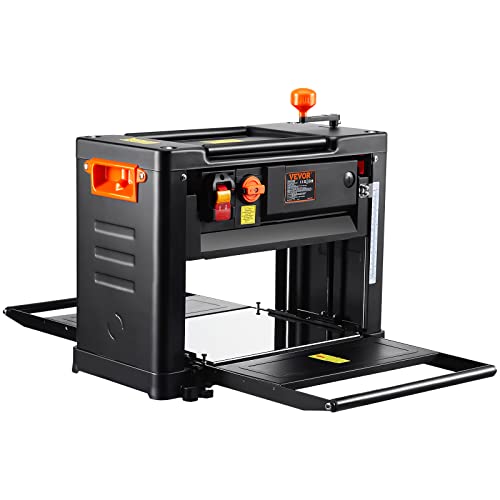
The VEVOR Power Benchtop Planer earns its place on this list through the cutter head. A three-blade design (rather than the more common two-blade setup) makes more individual cuts per revolution of the drum, which generally translates to a smoother surface out of the machine and fewer passes to reach your target thickness. For hobbyists building furniture or fine boxes, that finish quality matters more than raw material-removal speed.
Compared to the DEWALT DW7351 covered earlier, this is a complete planing solution rather than an accessory. The 13-inch worktable accepts boards up to 6 inches thick, and the table extensions provide 35 inches of total support length for long stock, which helps reduce snipe at the ends of boards.
The Upside
- Three-knife cutter head delivers finer surface cuts per pass than typical two-blade designs.
- Cast iron bed and steel plate construction keeps boards flat during the cut.
- Pull-out table extensions bring total support length to 35 inches, useful for longer stock.
- Two-speed feed control lets you slow down for hardwood and speed up for softwood.
Things To Consider
- Three-blade heads cost more to reknife when blades dull, since you replace three edges instead of two.
- Benchtop footprint still demands a sturdy stand or bench rated for the machine’s weight during use.
Feature Snapshot
Best Suited To
Serious hobbyists and small-shop woodworkers who prioritize surface finish quality and want a complete benchtop planing station with smooth results out of the cutter.
Not Your Match When
If you mostly need a folding, space-saving stand over a three-blade head, the VEVOR 13-Inch Benchtop Planer 2000W Foldable is the more practical pick.
The VEVOR Two-Blade 13-Inch Benchtop Planer slots into the sweet spot for weekend woodworkers who do not need the absolute smoothest finish from a three-blade head. A two-blade cutter still produces clean results on most hardwoods and softwoods, and the simpler design keeps blade replacement costs down over the life of the machine. You trade a touch of finish quality for a noticeably lower total cost of ownership.
The 12-inch extended infeeding table is a practical touch for garage workshops. Long boards are notoriously hard to feed flat through a planer, and a longer infeed support means the wood enters the cutter at the correct angle, reducing the snipe that ruins the first and last inches of a board.
The Helpful Details
- 15-amp 2000W motor delivers enough torque to push through dense hardwoods without bogging down.
- 12-inch extended infeeding table supports longer boards during entry, which reduces entry snipe.
- Low-noise operation makes the machine more tolerable in shared or attached-garage workspaces.
- Two-blade cutter head keeps replacement-knife costs manageable over years of regular use.
Honest Caveats
- Two-blade finish is rougher than the three-blade VEVOR covered above, so expect more sanding on premium projects.
- Dust collection is essential in the garage, since fine shavings accumulate quickly without an extractor hooked up.
Right Fit For
Garage woodworkers and weekend hobbyists who plane lumber for shop projects, jigs, and basic furniture and want a strong, affordable benchtop workhorse without paying for a three-blade head.
Consider Something Else When
If finish quality on figured hardwoods is your top priority, the VEVOR Power Benchtop Planer Three-Blade 13-Inch is the better value within the same brand family.
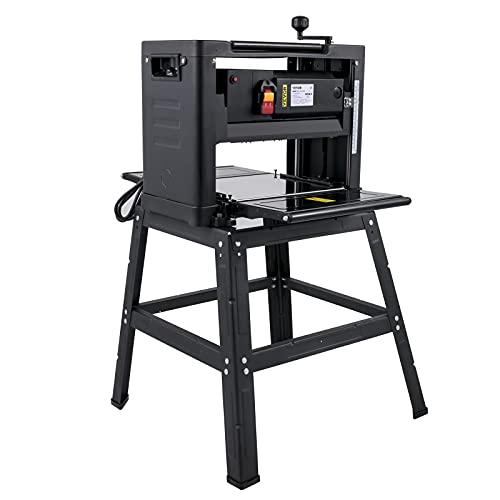
For shop owners with limited floor space, the VEVOR 13-Inch Benchtop Planer 2000W Foldable brings a different value proposition to the benchtop category. The integrated folding stand lets the machine collapse down when you finish a milling session, so the workstation can roll against a wall or into a corner instead of occupying permanent square footage. That is a meaningful advantage in a one-car garage or basement workshop.
The 6 m/min feed speed (about 236 inches per minute) is brisk for a benchtop machine, and the 8000 rpm blade speed keeps cuts clean across both softwoods and hardwoods. Owners commonly pair this planer with a shop-vac or dust collector, since the iron stand and benchtop design concentrate shavings directly below the cutter head.
What Works In Its Favor
- Foldable iron stand reduces the machine’s footprint when not in use, ideal for tight shop layouts.
- 2000W motor with 8000 rpm blade speed handles hardwood milling without slowing down on dense boards.
- 6 m/min feed rate moves stock through the cutter quickly, saving time on larger milling batches.
- Built-in dust exhaust port accepts a standard shop-vac hose for cleaner operation.
Points To Note
- Folding mechanisms add moving parts that can loosen over years of setup and teardown.
- Dust exhaust works best with a dedicated extractor; running it without one leaves fine shavings across the work area.
Who Should Grab It
Small-shop woodworkers and hobbyists with limited floor space who need a full-size 13-inch planer that tucks away between projects.
Reach For A Different Pick When
If finish quality matters more than fold-away convenience, the VEVOR Power Benchtop Planer Three-Blade 13-Inch is the more compelling choice.
Choosing Planers That Match Your Shop
Cutter Head Count And Finish Quality
A planer’s cutter head is the rotating drum that holds the knives, and the number of blades affects both surface quality and operating cost. Two-blade heads are common, affordable, and easy to reknife, but they leave slightly more tear-out on figured hardwoods. Three-blade heads produce smoother surfaces out of the machine, which means less sanding later, though replacement blades cost more when dulling finally arrives.
Width, Thickness, And Snipe
A planer’s stated width is the widest board it can pass in a single pass, and the stated thickness is the tallest board the cutter can clear. Snipe is a shallow dip that appears at the very start and end of a board, caused when the workpiece loses contact with the feed rollers. Longer infeed and outfeed tables, like the 12-inch extension on the VEVOR two-blade model or the 35-inch total support on the three-blade VEVOR, reduce snipe dramatically by keeping the board supported through the cut.
Power, Feed Speed, And Motor Demands
Benchtop planers in the 13-inch class typically use 15-amp motors drawing 1800W to 2000W, which means a standard household 15-amp circuit handles the load comfortably. Feed speed (how fast stock travels through the cutter) affects productivity on big milling jobs. A faster feed moves more board per minute but can leave a rougher surface, while a slower feed favors finish quality on premium hardwoods.
Portability And Shop Footprint
A handheld cordless planer, like the Makita DKP180Z, addresses a completely different problem than a benchtop thickness planer. The handheld tool trims edges and fits doors; the benchtop machine mills rough lumber to finished thickness. Shop owners working at job sites or doing finish carpentry benefit from the cordless option, while anyone milling rough-sawn boards needs the stationary machine.
Key Considerations Across These Picks
Common Buying Traps
A frequent slip is buying a planer based only on maximum width and overlooking infeed and outfeed support. Without those extensions, long boards sag into the cutter and produce uneven results. Another trap is ignoring dust collection. Benchtop planers throw fine shavings in every direction, and running one without a shop-vac hooked up turns a garage into a sawdust storm within minutes.
When Paying More Pays Off
The jump from a two-blade to a three-blade cutter head costs more up front, but the smoother finish reduces sanding time on premium projects, which adds up over a year of regular furniture builds. Higher-tier machines also tend to include better table extensions, more powerful motors, and more precise depth adjustments, all of which pay off when the workload grows beyond occasional weekend milling.
Frequently Asked Questions
What Is The Difference Between A Handheld Planer And A Benchtop Thickness Planer?
A handheld planer trims and shaves the surface of an already-flat board for fitting work, while a benchtop thickness planer mills rough lumber to a uniform, finished thickness across the full width of the board. They serve different stages of woodworking and rarely overlap in use.
How Wide Of A Board Can A 13-Inch Planer Handle?
A 13-inch planer accepts boards up to 13 inches wide in a single pass. Anything wider must be ripped down to fit, or run through on a second pass after flipping the board.
What Causes Snipe On A Planer?
Snipe is a shallow depression at the start or end of a board caused when the workpiece loses contact with the feed rollers. Longer infeed and outfeed support tables reduce snipe by keeping the board flat through the cut.
Do Benchtop Planers Need A Dedicated Circuit?
Most 13-inch benchtop planers draw around 15 amps and run on a standard household 15-amp circuit. Sharing the circuit with other heavy tools can trip the breaker during heavy cuts.
How Often Should Planer Blades Be Replaced?
Blade life depends on the wood species and how much material you remove. Softwoods like pine dull blades faster than hardwoods, and planing gritty or dirty lumber accelerates dulling across all species.
Wrap Up
The right planer depends on whether you mill rough lumber or trim finished stock. Handheld tools like the Makita DKP180Z handle door-fitting and on-site adjustments, while benchtop machines like the three VEVOR models covered here mill rough boards to furniture-ready thickness. Match the cutter head count, width, and infeed support to your typical workpiece, and you will get clean results without overpaying for capacity you rarely use.




