


A pneumatic framing nailer trades compressor hose for raw driving power, and picking the wrong one can wreck a framing day fast. Some handle full house builds, others specialize in delicate trim or picture-frame work. This shortlist covers the real-world range, from full-power framing guns to a bag that keeps your kit upright on the jobsite.
How The Shortlist Stacks Up

H838 Framing Nailer Bag Fits Hitachi NR83A

Metabo HPT Framing Nailer + 36V Impact Driver Bundle
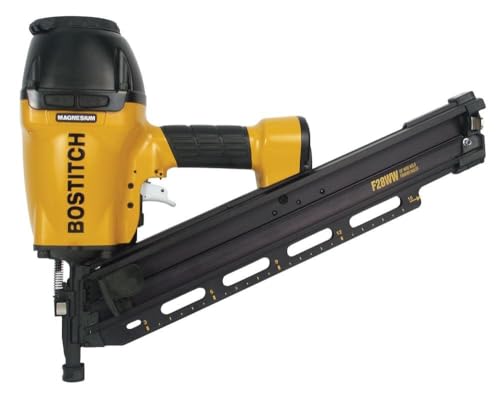
BOSTITCH F28WW Clipped Head Framing Nailer

meite V1015B Picture Frame Joiner V-Nailer

Metabo HPT NR90AES1 21° Framing Nailer
Inside Each Recommended Option
Most pneumatic framing nailers spend their day slung over a shoulder, which is a fast way to fatigue an arm and risk dropping a tool. The H838 bag is a ballistic polyester carrier sized for standard framing nailers including Hitachi, Senco, Porter Cable, Bostitch, Max, and Paslode models. Padded sides protect the finish, and a firm base keeps the whole thing standing upright between cuts.
For framers walking long jobsite runs, a dedicated carry bag beats a five-gallon bucket every time. The shoulder strap spreads the load, and the upright stance means your nailer isn’t rolling around in the bed of a truck. You’ll find it especially useful when moving between floors on a new build.
Practical Advantages
- Padded walls absorb ladder bumps and stack-on-stack drops that would otherwise scar the housing.
- Firm base keeps the bag standing in the open bed of a work truck or on plywood subfloor.
- Wide compatibility means one bag covers most of the popular framing nailer brands.
- Shoulder strap design reduces the all-day arm fatigue that comes from hand-carrying a heavy nailer.
Worth Noting
- Ballistic polyester resists scuffs but benefits from a quick brush-down after muddy site work.
- Stated sizing targets full-size framing nailers, so compact trim guns may sit loosely inside.
Made For
Working framers and remodel crews who move between floors and want their primary nailer protected, upright, and easy to grab.
Skip It When
You’re shopping for a nailer itself; the Bostitch F28WW is a better match if you actually need a new framing gun rather than a carrier.
Outfitting a new crew usually means buying a framing gun and an impact driver in the same week, so a bundle cuts the shopping list in half. This package pairs the 21-degree plastic-collated Metabo HPT NR90AES1 framing nailer with a 36V MultiVolt cordless triple-hammer impact driver. RPM (revolutions per minute) and BPM (blows per minute) ratings on the driver reach 0–3,400 and 0–4,100, with up to 1,903 in-lbs of torque for stubborn lags.
For a contractor starting a framing package from scratch, the bundle keeps everything under one battery platform. The nailer covers floor framing, truss build-up, sub flooring, and roof decking, while the impact driver handles the fastening work a framing gun can’t reach. Compared to the bag-only H838 above, this is a real tool investment rather than an accessory.
The Case For It
- Two-tool bundle covers the main fastening tasks on a wood-framed job without separate purchases.
- 36V MultiVolt driver gives cordless convenience on trim and detail work far from an outlet.
- Five-mode selector on the impact driver helps avoid stripping softer screws.
- 21-degree plastic collated nails are widely stocked at lumberyards and home centers.
Trade Offs
- Bundle pricing only makes sense if you actually need a cordless impact driver; the standalone NR90AES1 is also covered below.
- Owners commonly report the cordless driver takes some getting used to for users coming from 18V platforms.
Key Specs
Right Fit For
Contractors building a new kit who want a matched nailer-and-impact combo on one battery system from day one.
Look Elsewhere When
You already own a 36V platform; the standalone Metabo HPT NR90AES1 covered later is the more focused buy.
A clipped-head nailer holds more fasteners per strip, and the F28WW leans into that advantage for full-day framing. The magnesium body keeps weight down without sacrificing the rigidity that framing work demands. A push-button depth adjustment lets you change nail depth on the fly, and a notched 16-inch layout indicator on the magazine makes quick work of on-center stud spacing.
This is the gun that fits the standard house-framing routine: sheathing, subfloor, decking, walls. The rafter hook is a small touch that earns its place when you’re working overhead all day. Where the meite V-nailer below is a specialty tool, the F28WW is the all-purpose workhorse of the list.
Positive Takeaways
- Lightweight magnesium housing eases the fatigue of overhead fastening on roof decking.
- Push-button depth dial changes nail depth in seconds without extra tools.
- Notched layout indicator speeds up 16-inch-on-center stud placement.
- Clipped-head magazine carries more nails per strip, fewer reloads on long runs.
Possible Compromises
- Clipped-head nails aren’t accepted in every region, so check local building code first.
- Magnesium body resists jobsite knocks but can show surface oxidation if left wet overnight.
Who Will Love This
Production framers and serious DIYers building walls, roofs, and decks who want a durable daily driver.
Consider Something Else When
Your work is small picture frames or finish trim; the meite V1015B is purpose-built for that craft instead.
Picture framing is a world away from sheathing a wall, and a framing nailer would crush the moulding. The meite V1015B drives V-shaped nails sized 9/32-inch to 19/32-inch, the fasteners of choice for joining mitred picture frame corners. Bottom loading accepts roughly 200 V-nails at a time, and the well-balanced body helps with the steady pressure a clean joint requires.
This is a workshop tool, not a jobsite tool. Frame makers, door assemblers, and small-shop woodworkers get a fast, repeatable corner joint without clamps and glue dry time. It still needs an air compressor, so factor that into your shop setup before adding it to the bench.
Where It Delivers
- Bottom-load magazine holds around 200 V-nails, so reloads interrupt workflow less.
- Adjustable depth gauge matches the exact V-nail length you load, preventing blow-through.
- Light, well-balanced build reduces hand wobble on delicate mitred corners.
- Single-purpose design means the trigger and air consumption suit small workshop compressors.
Less Ideal Details
- Requires a separate air compressor, so it isn’t a true plug-and-play bench tool.
- V-nail range is narrow; this is not a substitute for the Bostitch F28WW on structural framing.
Key Specs
Best Suited To
Picture frame makers, door assemblers, and small-shop woodworkers who need repeatable corner joints on a daily basis.
Another Choice May Suit
Carpenters framing full walls and roofs should step up to the Metabo HPT NR90AES1 covered below.
Some framing jobs mean ten hours with a tool on the shoulder, and every pound matters there. The NR90AES1 weighs 7.5 lbs while still driving 2-inch to 3-1/2-inch plastic-collated framing nails, a combination that’s rare in this category. Its next-generation industrial design focuses on balance and grip, so the weight sits closer to the hand rather than the muzzle end.
For crews framing floors, trusses, windows, subfloor, and wall sheathing, this is the gun that doesn’t punish you at hour nine. Compared to the bulkier Bostitch F28WW, it’s a noticeably lighter carry with similar fastening power for most residential framing. Most owners find it comfortable for all-day overhead work.
What Earns Its Place
- 7.5 lb weight is well below category average, ideal for full-shift overhead fastening.
- Drives full 3-1/2-inch nails for headers, rim joists, and structural connections.
- Plastic-collated 21-degree nail compatibility keeps supply simple at any lumberyard.
- Industrial-design grip keeps the tool balanced rather than muzzle-heavy.
Potential Sticking Points
- Plastic-collated nails are cheaper but more weather-sensitive than paper-collated strips on wet sites.
- Needs an air compressor with enough CFM (cubic feet per minute) capacity to keep up with rapid firing.
Key Specs
Whose Shelf It Belongs On
Working framers who spend full days on wall, roof, and subfloor nailing and want the lightest reliable option.
Where Another Pick Suits Better
Picture framers and finish carvers should grab the meite V1015B; it suits that craft in a way no full-size framing gun can.
What To Weigh Before Choosing Pneumatic Framing Nailers
Nail Format and Collation Angle
Framing nailers generally run 21-degree or 30-degree magazines, and the angle determines which nail strips you can buy. Pick a model that matches the supply at your local lumberyard so you never get stuck mid-job. Clipped-head versus round-head is a second decision, and some local codes only accept one of the two.
Power-to-Weight Balance
Driving 3-1/2-inch nails all day punishes an unbalanced tool. A 7.5 lb gun with the weight near the grip feels very different from a 9 lb gun hung out at the muzzle. For overhead work like roof decking, the lower-weight class makes a real difference by hour five.
Magazine Capacity and Reload Speed
High-capacity magazines cut reloads on long sheathing runs. Bottom-load and side-load designs behave differently on the job; whichever you pick, look for a clear empty indicator so you don’t dry-fire into framing lumber. A jammed nail mid-shift eats ten minutes you can’t get back.
Air Compressor Compatibility
Every pneumatic framing nailer on this list needs a compressor with enough CFM (cubic feet per minute) and tank reserve to keep up with sustained firing. Check the tool’s CFM rating against your compressor’s output before buying, especially on small pancake compressors that struggle with rapid-fire framing cycles.
Key Considerations Across These Picks
Pitfalls Shoppers Hit
The most common mistake is buying a framing gun without checking local code on clipped-head nails; some jurisdictions only accept full round-head nails for structural fastening. Another is underestimating the compressor. A framing nailer at full tilt can drain a small tank in minutes, so the gun-and-compressor pairing matters as much as the gun itself.
When Paying More Pays Off
Higher-tier framing nailers usually bring magnesium housings, better depth controls, and refined air paths that reduce misfires. You also tend to get longer wear parts and easier jam clearing, which matters once you’re framing full-time. For weekend DIYers, a mid-tier gun is plenty; for daily crew use, the upgrade pays back fast in reduced downtime.
Frequently Asked Questions
What size air compressor do I need to run a pneumatic framing nailer?
Most framing nailers want a compressor that delivers at least 4 to 5 CFM at 90 PSI (pounds per square inch) for sustained use. A larger tank helps even out demand during rapid firing.
Are plastic-collated nails okay for structural framing?
Plastic-collated nails meet code in most regions for residential framing, but always confirm with your local building department. Some inspectors prefer paper-collated strips for specific structural connections.
Can one framing nailer handle subfloor, walls, and roof decking?
Yes, full-size framing nailers like the Bostitch F28WW and Metabo HPT NR90AES1 are designed for all three. You mostly need to adjust depth setting and nail length for each material thickness.
Why would I pick a V-nailer over a regular framing nailer?
V-nailers drive small V-shaped fasteners used in picture frame and door corner joints, where a framing nail would split the moulding. It’s a specialty tool, not a substitute for structural framing work.
How often should I oil a pneumatic framing nailer?
Most manufacturers recommend a few drops of pneumatic tool oil in the air inlet before each workday. Skipping this step leads to sticky firing valves and shorter seal life.
The Takeaway
Pneumatic framing nailers come in far more flavors than the average shopper expects, from all-day framing workhorses like the Bostitch F28WW to specialty V-nailers like the meite V1015B. Match the tool to the work and the compressor to the tool, and the right pick becomes obvious. Whatever you choose, give the air hose and the safety glasses the same attention you give the gun.




