You don’t need a full fabrication shop to fix a cracked bumper, patch a thin-gauge panel, or tackle weekend fabrication. Portable welders bring serious joining capability to a garage, driveway, jobsite, or tailgate, and the current generation runs cooler, lighter, and more versatile than older units. This list compares five distinct machines, two plastic staplers for automotive trim and three multi-process metal welders, so you can match the right tool to the repair or project in front of you.
A Fast Comparison Of The Options

ATOLS Upgraded Plastic Welder 1000PCS Staples Kit (Black)

WRDLOSY Plastic Welder 800PCS Staples Kit (Black)
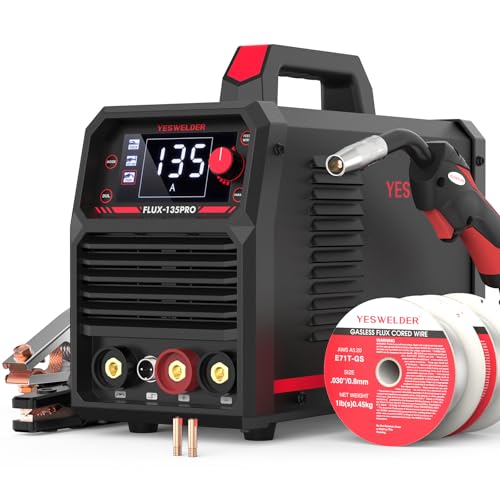
YESWELDER 135A Flux Core MIG/Lift TIG/Stick Welder 3-in-1

YESWELDER 160A MIG/Flux Core/Lift TIG/Stick 4-in-1 Welder

YESWELDER 205A 5-In-1 MIG/Flux Core/Spool Gun/TIG/Stick
The Picks, Examined More Closely
Plastic repair on a car, motorcycle, or household item rarely needs a full metal welder, and that’s exactly where the ATOLS plastic stapler earns its keep. It uses a pure copper transformer and a hot-staple approach, melting small plastic staples into a cracked panel to bridge the gap before the surrounding plastic cools and re-bonds. The 1,000-staple supply means weekend hobbyists won’t run out after a single bumper fix, and the unit ships with a brass holder for swapping staples without burning your fingers.
For someone who fixes cracked dashboards, broken headlight tabs, or split motorcycle fairings, the appeal is portability and speed. There’s no shielding gas to haul around, and the gun-style body fits in a small drawer between uses. You may find the learning curve a touch steep the first time, since staple placement and melt depth depend on the plastic’s thickness, but a few practice passes on scrap trim usually resolve that quickly.
The Helpful Details
- Rapid heat-up in one to two seconds, so staples begin melting almost the moment you pull the trigger
- 1,000 staples included, which covers multiple bumper or trim repairs before you reorder
- Pure copper transformer delivers consistent staple melt depth across long sessions
- Brass holder lets you swap staples without touching the hot tip
- Suitable for most common automotive and household plastics, including bumpers, dashboards, lamp holders, and radiator shrouds
Things To Consider
- Staple placement takes practice, and misaligned staples can be tricky to remove without trimming
- Cord length and staple size range aren’t fully detailed, so confirm compatibility with thicker industrial plastics before committing
Built With In Mind
Home mechanics and DIYers who split a plastic bumper or break a motorcycle tab and want a dedicated tool rather than a general-purpose welder.
Reach For A Different Pick When
You need to join sheet metal or steel tubing, in which case the YESWELDER 135A Flux Core MIG/Lift TIG/Stick Welder 3-in-1 is the more relevant tool.
Where the ATOLS kit feels purpose-built for heavier plastic repair, the WRDLOSY plastic welder leans into accessibility. The instant on/off control removes the wait time between trigger pulls, which matters when you’re working on small cracks that need fast, repeated staple applications. The included portable toolbox makes a bigger difference than it sounds, because loose staples and the brass holder are easy to lose in a busy garage.
Compared with the ATOLS pick, this kit ships with 200 fewer staples, but the overall workflow feels friendlier for first-time users. You may find the body slightly lighter in hand, which helps during overhead repairs like a roofline spoiler or a mirror mount. Owners commonly report that the included staple variety covers most automotive and household plastics without needing to order extras right away.
What Earns Its Place
- Instant on/off operation reduces wait time between staple placements
- Portable toolbox keeps staples, holder, and the gun organized between uses
- 800 staples cover multiple repair sessions before you need to reorder
- Lightweight gun body reduces hand fatigue during longer repair jobs
Worth Noting
- Staple variety isn’t fully broken out, so verify the included types match the plastic you plan to repair
- Fewer staples out of the box than the ATOLS kit, so heavy users may need a refill sooner
Who It Suits Best
First-time DIYers fixing a cracked plastic panel who want a forgiving tool and a tidy storage solution in the same box.
Consider Something Else When
You’re tackling heavier industrial plastics or expect to burn through staples fast, in which case the ATOLS Upgraded Plastic Welder 1000PCS Staples Kit (Black) brings a larger staple supply.
Stepping away from plastic staplers and into actual metal joining, the YESWELDER 135A is the most accessible entry point for hobbyists. The “gasless” part of the description refers to flux-cored wire, which has a hollow center filled with flux that produces its own shielding gas when the arc strikes. That means you can weld outdoors on a breezy day without losing arc stability, and you skip the cost of renting a shielding gas cylinder.
This 3-in-1 unit handles flux-core MIG, stick, and lift TIG, though the lift TIG torch must be purchased separately. For someone patching a trailer frame, repairing a rusty exhaust bracket, or learning the basics of MIG, the 135-amp output and included .030″ and .035″ flux-core wire make the first few projects approachable. The trade-off shows up when you push thicker steel; for heavier plate work, you’ll want the higher-amperage siblings further down this list.
Bright Spots
- Gasless flux core setup means no shielding gas cylinder to buy, store, or refill
- 110V power input works from a standard household outlet
- Three welding modes in one unit, giving you room to grow beyond flux-core MIG
- Includes both .030″ and .035″ flux-core wire for different material thicknesses
Trade Offs
- Lift TIG capability requires a separately purchased torch, adding to total cost
- 135-amp output limits you on thicker steel plate beyond roughly 1/8 inch
Feature Snapshot
Made For
First-time welders and weekend hobbyists who want a single machine for learning flux-core MIG, stick welding, and basic repair work at home.
Where Another Pick Suits Better
You need to weld thicker steel or run true gas-shielded MIG, in which case the YESWELDER 160A MIG/Flux Core/Lift TIG/Stick 4-in-1 Welder steps up with dual voltage and a higher amperage ceiling.
The 160A sibling fixes the biggest gap in the 135A model: real gas-shielded MIG alongside flux-core, plus dual voltage. Dual voltage means the machine can run on 110V for home use or 220V for shop and heavier work, which is the single biggest reason a welder feels “portable” instead of “stuck in one spot.” This is the unit that starts to bridge hobby and professional use without jumping to the top-tier price.
Gas MIG (Metal Inert Gas welding) differs from flux-core because you feed a solid wire through the gun while a separate bottle of shielding gas (usually argon/CO₂ mix) protects the weld pool. The result is cleaner, spatter-free welds on thin body panels and sheet metal. Owners commonly report that the 160-amp ceiling handles up to roughly 3/16-inch steel comfortably, which covers most vehicle, trailer, and furniture repair. The catch is the same as before, the lift TIG torch is still an add-on purchase.
The Upside
- Dual voltage 110V/220V input gives you flexibility between home outlets and shop power
- True gas MIG and flux-core MIG both available, so you can pick the right wire for the job
- 160-amp output handles thicker material than the 135A unit
- Four welding processes in one compact chassis, helpful for varied project types
Points To Note
- Lift TIG requires a separately purchased torch, raising the entry cost
- You need a shielding gas cylinder and regulator to use the gas MIG mode, an extra setup step
Right Fit For
Intermediate welders who already know what MIG is and want one machine that handles both home 110V projects and heavier 220V shop work.
Look Elsewhere When
You need to weld aluminum with a spool gun, since that capability is reserved for the YESWELDER 205A 5-In-1 MIG/Flux Core/Spool Gun/TIG/Stick at the top of this list.
The 205A model rounds out this roundup as the most process-rich of the three YESWELDER units, adding a dedicated spool gun mode for aluminum MIG. A spool gun is a small wire feeder that mounts on or near the MIG gun and holds a mini spool of soft aluminum wire, which feeds reliably through the liner. Without it, push-feeding soft aluminum wire through a standard MIG gun creates tangles and bird-nests.
For fabricators and serious hobbyists who work on aluminum trailers, automotive panels, or marine repairs, that spool gun compatibility is the deciding feature. The 200-amp output and 110V/220V dual voltage also mean this unit genuinely stays portable between sites, assuming a 220V outlet is available for heavy work. Compared with the 160A model, you’re paying for more processes and headroom, not just amps. The same caveat applies: the lift TIG torch and the spool gun are separately sold accessories.
A Strong Showing
- Spool gun MIG support opens the door to aluminum welding, a gap the 135A and 160A models leave open
- Five welding processes in one machine: gas MIG, flux-core MIG, spool gun MIG, lift TIG, and stick
- 200-amp output covers heavier plate work and longer weld beads
- Dual voltage for travel between home, jobsite, and shop
A Few Limitations
- Spool gun and lift TIG torch are both separately purchased, pushing total cost up
- Heavier and more complex to set up than the single-process plastic staplers, so it’s overkill for small trim repairs
Whose Shelf It Belongs On
Fabricators, automotive welders, and serious DIYers who need to weld steel and aluminum on the same jobsite and want a single machine to cover both.
Skip It When
Your projects are limited to thin sheet metal or steel-only repair, in which case the YESWELDER 160A MIG/Flux Core/Lift TIG/Stick 4-in-1 Welder is a more focused match.
What Matters Before Choosing a Portable Welder
Match the Process to the Material
The single biggest decision is whether you need to join plastic or metal. Plastic staplers like the ATOLS and WRDLOSY kits only work on thermoplastics, and they shine on automotive trim, dashboards, and broken tabs. Metal welders like the three YESWELDER units cover steel, stainless, and (with a spool gun) aluminum, but they can’t repair a cracked bumper the way a plastic stapler can. Identify your most common repair before buying.
Mind Your Power Source
A 110V-only welder runs from a standard household outlet, which is convenient but caps your output. A dual-voltage 110V/220V unit gives you flexibility for heavier projects, though the 220V outlet must already be in your shop or jobsite. If your work happens mostly in a home garage, 110V covers the vast majority of hobby repair. For site work or commercial fabrication, dual voltage pays off quickly.
Plan for Accessories and Consumables
Flux-core wire, solid MIG wire, shielding gas, regulator, lift TIG torch, and spool gun, the actual cost of owning a welder is the machine plus the supporting gear. Read the included accessories list carefully, because the lift TIG torch on the YESWELDER units and the spool gun on the 205A are sold separately. Plastic welders, by contrast, tend to ship with everything needed for the first several repairs.
Weight, Footprint, and Storage
“Portable” means different things at different scales. The plastic staplers fit in a drawer; the 135A MIG sits on a small workbench; the 160A and 205A are heavier but still cartable. If you’re loading a truck bed for jobsite runs, the dual-voltage YESWELDER units strike a better balance between power and portability than bulkier transformer welders.
Comparing These Picks Without Regret
Where Shoppers Slip Up
A common stumble is buying a metal welder for a plastic repair, or a plastic stapler for sheet metal. They look like “welders,” but they solve different problems. Another trap is grabbing a 110V-only MIG and expecting it to weld 1/4-inch plate, which exceeds its duty cycle. Match the welder to the thickest material you realistically plan to join, not the thickest you can imagine.
When the Higher Tier Earns Its Price
The jump from the 135A to the 160A YESWELDER buys you dual voltage, true gas MIG, and more headroom, useful if you move between a home garage and a shop. Stepping up to the 205A adds aluminum MIG via spool gun, a meaningful upgrade for anyone fabricating trailers or repairing aluminum panels. The plastic staplers, meanwhile, differ mostly in staple count, included accessories, and beginner friendliness rather than raw capability.
Frequently Asked Questions
Can a portable welder handle automotive body panels?
Yes, but only with the right process. Plastic bumpers and trim pieces respond well to hot-staple repair, while steel body panels need MIG or stick welding with sufficient amperage for the panel’s thickness.
What does “gasless” mean on a MIG welder?
It refers to flux-core wire, which has a hollow center filled with flux that creates its own shielding gas when the arc strikes. No external shielding gas cylinder is required, which is convenient for outdoor use.
Do I need a 220V outlet to use a dual-voltage welder?
No, dual-voltage welders can run on 110V for lighter work. The 220V option is available for higher output, but standard household power is fine for many hobby-scale projects.
What is a spool gun and when do I need one?
A spool gun is a small wire feeder that holds a mini spool of soft aluminum wire, which feeds more reliably than pushing aluminum through a standard MIG liner. You need one to MIG-weld aluminum reliably.
Are plastic welding kits a substitute for real welding?
No, they repair thermoplastics using melted staples, not metal fusion. For steel, stainless, or aluminum, you need a true metal-joining process like MIG, TIG, or stick.
Closing Thoughts
The right portable welder depends on the material in front of you and where the work happens. For cracked plastic trim, a hot-staple kit gets the job done quickly. For steel repair at home or on a jobsite, a multi-process MIG welder with dual voltage offers the best balance. Pick the tool that matches your most common repair, and the rest of the project tends to fall into place.