


A quality orbital sander is one of those tools you don’t think about until you need one, and then it quickly becomes the difference between a clean refinishing project and a piece of furniture you’ll never finish. The professional orbital sanders on this list cover the main camps: full-size 5-inch random-orbit sanders for surface work, a detail sander for tight corners, and a replacement pad for an existing DEWALT setup. Every pick here was selected on the strength of motor output, dust collection, ergonomics, and what kind of user each one actually fits.
The lineup splits pretty cleanly between corded workhorses that just need a power outlet and one cordless option for jobs where a cord gets in the way. Some are full kits with a bag and accessories, while others are bare units. The mix is intentional so you can find a match for the work in front of you rather than a one-size-fits-all answer.
The Main Contenders

SKIL 2.0 Amp 1/4 Sheet Palm Sander with Pressure Control (7292-02)

DEWALT Random Orbit Sander, Variable Speed, 5-Inch (DWE6423)
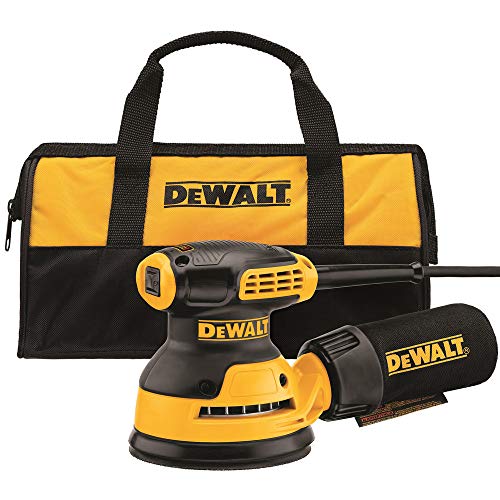
DEWALT Orbital Sander Kit, 5 inch, 3 amp, Corded, 12,000 OPM (DWE6421K)

DEWALT Orbital Sander, 5 Inch Palm Sander Tool, 12,000 OPM (DWE6421)

DEWALT Orbital Sander Kit, 5-Inch, Variable Speed (DWE6423K)

DEWALT 20V MAX Orbital Sander Cordless, 5-Inch, 2.0Ah (DCW210D1)

DEWALT Sander Pad, 5-Inch Orbital (DW4388)

SKIL 5” Random Orbital Sander with Cyclonic Dust Box (SR211601)
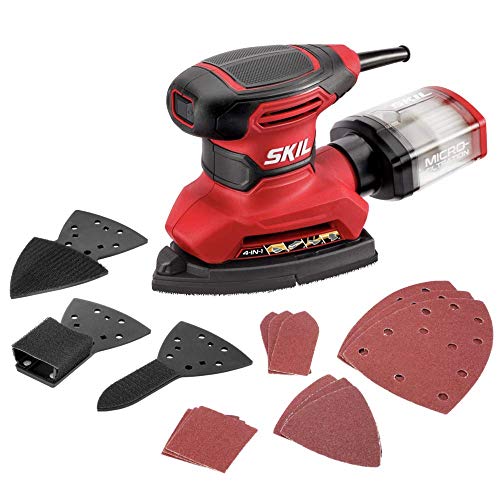
SKIL Corded Multi-Function Detail Sander (SR232301)
A Deeper Look At The Lineup
The SKIL 7292-02 sheet palm sander is a quarter-sheet design (1/4 of a standard sandpaper sheet, so it handles smaller surface areas per pass) aimed at hobby refinishers, picture-frame sanders, and trim touch-ups. At 2.0 amps, it sits on the lighter end of the motor range, but what it lacks in brute force it compensates for with user feedback.
Where this model earns its place in a workshop is the pressure control feature, which signals when you’re pushing too hard. That kind of feedback matters because excessive pressure on a sheet sander burns through paper and leaves uneven surfaces. For someone restoring a vintage nightstand or smoothing a door frame, the guidance helps avoid rookie mistakes without slowing the work down.
Where It Excels
- Pressure-sensing technology flags excessive force to protect the workpiece and extend paper life
- Micro-filtration captures fine particles, helping keep indoor air clearer during furniture work
- Clear-view canister takes the guessing out of when to empty dust, useful in longer sessions
- Dust-sealed switch adds a layer of protection against the fine grit that kills power tools over time
- Soft-grip top cover reduces hand fatigue during detail work
Trade Offs
- The 2.0-amp motor is light by sander standards, so material removal on heavy finishes takes longer than with the 3-amp picks further down the list
- Quarter-sheet format means more pad changes on larger flat surfaces like tabletops
- The pressure-sensing alert is useful, but new users sometimes mistake the feedback for a fault rather than guidance
Key Specs
Right Fit For
Weekend refinishers working on smaller pieces like chairs, frames, and trim who appreciate guided feedback.
Swap It Out When
You’re tackling a full tabletop refinish; the DEWALT DWE6421 handles larger surface area with a 5-inch pad.
The DWE6423 sits at the more capable end of the DEWALT corded lineup. The “random orbit” action means the pad moves in a random circular pattern rather than in a fixed path, which virtually eliminates visible swirl marks on flat surfaces. That alone makes it the right tool for finish sanding where the goal is a paint-ready surface.
Where it separates from the single-speed DWE6421 (covered next) is the variable-speed dial. Different materials want different orbit speeds: harder woods and old finishes can use higher speeds, while heat-sensitive veneers and softwoods benefit from a slower pace. The 8,000 to 12,000 OPM (orbits per minute) range covers the practical work envelope for most wood, paint, and metal sanding jobs in a home shop.
The Upside
- Variable-speed control adapts to hardwoods, softwoods, and paint removal without swapping tools
- 3-amp motor delivers enough power for sustained stock removal on most wood species
- Counterbalanced design reduces vibration transfer to the hand, which matters on long sessions
- Rubber overmold grip gives a secure hold when wearing gloves or working in humid conditions
- One-handed locking dust bag swaps without breaking your sanding rhythm
Honest Caveats
- It does not come with a kit bag or extra accessories, so first-time shoppers need to source a carrying case separately
- Corded design means the power cord occasionally catches on the workpiece when working on large panels
Whose Shelf It Belongs On
Workshop regulars who switch between paint stripping, raw wood prep, and finish sanding in the same afternoon.
Look Elsewhere When
You need a battery option for jobs away from outlets; the DEWALT DCW210D1 is the cordless sibling to consider.
The DWE6421K is the kit version of the DWE6421, bundled with a dust bag and the typical accessories that turn a bare tool into something ready to plug in and use. For someone stepping into random-orbit sanding for the first time, that bundle removes the awkward first evening of figuring out which dust bag, paper assortment, and storage option actually fits.
The single-speed 12,000 OPM motor is locked at one setting, which simplifies the interface to a trigger and a dust-collection switch. That simplicity is a feature, not a limitation, for finish work where you mostly want a consistent, predictable orbit speed anyway. Compared to the SKIL 7292-02’s quarter-sheet pad, this 5-inch format covers roughly four times the area per pass, which adds up fast on a dining table.
Good Reasons To Consider
- Comes as a complete kit, so no guesswork on which dust bag or paper assortment to pair it with
- 5-inch hook-and-loop pad handles large flat surfaces without constant repositioning
- Counterweight design reduces the hand-tingling fatigue that builds up on longer sessions
- Short body height keeps the pad close to the workpiece, useful for sanding inside cabinets
Worth Noting
- Single-speed motor is less adaptable than the DWE6423’s variable control for mixed-material projects
- The included dust bag fills quickly on heavy stock removal, so workshop vacuum hookup is recommended for bigger jobs
Made For
First-time random-orbit sander owners who want everything in the box and a tool that works the day it arrives.
Reach For A Different Pick When
Your projects rotate between softwood, hardwood, and metal; the DEWALT DWE6423K variable-speed kit handles that variety more flexibly.
The DWE6421 is the bare-tool sibling to the DWE6421K, sold without the kit bag or accessories. For someone who already owns a collection of compatible dust bags and sanding sheets, the bare version skips the redundancy and goes straight to the tool.
At 12,000 OPM fixed, the orbit speed matches the natural sweet spot for finish sanding on most North American hardwoods. The rubber overmold grip is a small detail that makes a real difference over a full day of cabinet work, where the alternative is a hard plastic body that transmits vibration into the heel of your hand. The shorter body height, shared with the kit version, is the feature that gets talked about less but earns its keep when you’re sanding the inside of a bookcase.
Notable Upsides
- Compact, palm-style body reaches into cabinet interiors and tight corners that full-size sanders can’t
- Counterweight balance reduces vibration for cleaner finishes and less hand strain
- One-handed dust bag attachment doesn’t interrupt the work rhythm when emptying
- Hook-and-loop pad makes grit changes fast during a multi-stage refinish
Points To Keep In Mind
- No variable-speed control, so dialing in the right orbit for delicate veneers requires careful pressure management instead
- Available as a tool only, so first-time users need to source a dust bag and sanding sheets separately
Best Suited To
Cabinet makers, furniture refinishers, and DIYers with an existing DEWALT accessory collection who want a focused, repeatable finish sander.
A Better Fit Elsewhere
You want plug-and-play convenience straight out of the box; the DWE6421K ships with the bag and accessories included.
The DWE6423K is the kit version of the DWE6423, with the variable-speed dial and the full accessory bundle. It is essentially the most versatile DEWALT corded option in this roundup, pairing the speed control of the DWE6423 with the out-of-the-box readiness of the DWE6421K.
For someone setting up a dedicated workbench, the kit format means the carrying bag, dust collector, and paper assortment all arrive in one shipment. The variable-speed range (8,000 to 12,000 OPM) covers everything from heat-sensitive veneer sanding through heavy stock removal on oak or maple. Compared to the SKIL SR211601’s cyclonic dust box, the bag-style collector is simpler to empty but less contained if you’re working indoors without a vacuum hookup.
What Pays Off
- Variable-speed range adapts to softwoods, hardwoods, paint, and metal in the same session
- Kit format includes carrying bag and dust collection, so no separate shopping trip is needed
- Counterweight balance paired with rubber overmold grip cuts down on vibration fatigue
- Hook-and-loop pad makes swapping between 80, 120, and 220-grit sheets quick
Some Limits To Know
- At roughly 4 pounds, extended overhead work on ceiling trim can tire the arm faster than lighter options
- The corded design needs a power outlet within reach, so on-site jobs without power are not its strong suit
Quick Facts
Who Should Grab It
Workshop owners and serious DIYers who want one corded sander that handles every material on the bench.
Where Another Pick Suits Better
You work far from outlets on deck or fence repairs; the DEWALT DCW210D1 cordless model runs on a 20V battery instead.
The DCW210D1 is the only cordless option on the list, and it arrives with a 2.0Ah battery, charger, and storage bag. “Brushless” means the motor uses electronic commutation rather than carbon brushes, which typically extends runtime and motor life compared to brushed equivalents. For a sander, that matters because sanders draw continuous current, so any efficiency gain shows up in more working minutes per charge.
The cordless design opens up jobs that are awkward with a cord: sanding a deck railing, working in a garage without nearby outlets, or refinishing furniture in a room with no power. The variable-speed dial (8,000 to 12,000 OPM) matches the corded DWE6423’s range, so the trade-off for going battery is mostly about runtime rather than capability. You may find the 2.0Ah pack limiting on a full afternoon of heavy stock removal.
Real-World Strengths
- Battery power removes extension-cord hassle and reach limits on outdoor and remote jobs
- Brushless motor extends runtime per charge, useful for multi-piece projects in one session
- Variable-speed dial matches the corded DWE6423, so cordless doesn’t mean capability compromise
- One-handed dust bag attachment keeps the workflow fast when emptying mid-job
Practical Considerations
- The 2.0Ah battery delivers shorter runtime than larger 5.0Ah packs on continuous heavy sanding
- Spare batteries are a worthwhile add-on for full-day use, raising the total cost beyond a corded kit
- Owners commonly report that cold weather temporarily reduces battery performance in unheated workshops
Technical Highlights
Who Will Love This
Mobile workers, deck restorers, and homeowners who sand in places without convenient power outlets.
Consider Something Else When
Your shop has reliable power and you sand for hours; a corded 3-amp model like the DWE6423K runs continuously without battery anxiety.
The DW4388 is not a sander at all. It is a 5-inch hook-and-loop replacement pad designed to fit the older DEWALT DW421K, DW423K, and related D26450-series sanders. It earns a spot on this list because even the best sander on earth is useless once the pad wears through, hooks lose their grip, or the hook-and-loop surface is gunked up with old adhesive.
For someone with a multi-year-old DEWALT random-orbit sander, this is the part that brings the tool back from the edge of the bin. The eight-hole pattern matches DEWALT’s dust-collection layout, so swapping the pad restores both the paper-holding function and the dust-extraction efficiency at the same time. It is the kind of part you don’t think about until you need it, and then you need it immediately.
Positive Points
- Restores grip on hook-and-loop sheets when the original pad has lost its hook teeth
- Eight-hole design preserves factory dust-collection performance after replacement
- Direct fit for the DW421K, DW423K, and D26450-series DEWALT sanders
- Inexpensive insurance against scrapping a working tool
Room For Improvement
- Only compatible with the older DEWALT random-orbit models, not the current DWE6421 or DWE6423
- Replacing the pad requires disassembly of the sander, so a screwdriver and patience are part of the job
Perfect Match For
Owners of legacy DEWALT random-orbit sanders whose hook-and-loop pad has finally given out.
Not Your Match When
You own a current DEWALT model like the DWE6421; that tool uses a different pad design and needs a different replacement part.
The SR211601 is SKIL’s mid-size random-orbit sander, distinguished by its cyclonic dust box. “Cyclonic” means the box spins the air to separate dust from the airstream using centrifugal force, so the filter stays cleaner and the box holds more debris before needing emptying. For a basement or garage workshop without easy vacuum hookup, that is a meaningful upgrade over the standard bag-style collectors on most sanders in this price range.
The variable-speed dial (7,000 to 13,000 OPM) covers a slightly wider range than the DEWALT DWE6423, including a slower end that’s useful for heat-sensitive finishes. Owners commonly report that the X-Flow dust collection design keeps the filter from clogging mid-job, which means less stopping to clear and more actual sanding. The included three-piece sanding sheet assortment is small but enough to get a project started.
Features That Help
- Cyclonic dust box separates debris efficiently, reducing how often the filter needs cleaning
- Variable-speed range (7,000 to 13,000 OPM) is the widest on this list, including low speeds for delicate veneers
- Vibration-control design reduces the hand fatigue that builds up on cabinet jobs
- Three included sanding sheets let you start a small project without a separate supply run
Less Ideal Details
- SKIL’s accessory ecosystem is less universal than DEWALT’s, so replacement parts and bags can be trickier to source
- The cyclonic box adds bulk compared to a simple bag collector, which matters in tight interior spaces
Built With In Mind
Homeowners refinishing furniture indoors where dust control matters more than workshop-grade build.
Skip It When
You want long-term parts availability and a wide service network; the DEWALT DWE6423K is a safer ecosystem bet.
The SR232301 is the odd one out on this list: a detail sander rather than a 5-inch random-orbit model. Detail sanders use small, shaped pads (often triangular or finger-shaped) to reach the corners, edges, and contours where larger pads cannot fit. The “4-in-1” framing means the base unit accepts four different attachment profiles: a triangular pad for corners, a finger pad for grooves, and contour pads for curves.
At 1.2 amps and 13,500 OPM, the motor is smaller than the random-orbit models on this list, which is appropriate for the precision work the tool is built for. The tool-free attachment swap is a quiet but valuable feature when you’re moving between corner sanding and edge profiling on the same project. The micro-filtration dust box plus a 1-1/4″ vacuum port gives you two ways to manage dust, depending on the workspace.
Where It Helps
- Four-in-one attachment system covers corners, edges, contours, and small flat areas with one tool
- 13,500 OPM handles the light, controlled passes that detail work requires
- Micro-filtration dust box paired with vacuum port gives flexibility for indoor or garage use
- Tool-free attachment changes keep the workflow fast when switching between sanding profiles
Factors To Consider
- Not a substitute for a random-orbit sander on large flat surfaces, where the small pad becomes inefficient
- 1.2-amp motor is light, so heavy paint removal on broad areas will take longer than with a 5-inch model
Who It Suits Best
Crafters, model makers, and refinishers who spend more time on detail than on large surfaces.
Where A Sibling Pick Shines
You’re refinishing a dining table or a set of cabinet doors; the DEWALT DWE6421 is the right tool for those broad, flat areas.
What To Weigh Before Choosing A Professional Orbital Sander
Random Orbit Vs. Sheet Vs. Detail
Random-orbit sanders move the pad in a randomized circular pattern, which is why they don’t leave visible swirl marks on flat wood. Sheet sanders use a quarter- or half-sheet of standard sandpaper and excel at corners and edges. Detail sanders use small, shaped pads for tight spots. Most home workshops benefit from at least one random-orbit model, because that’s the format that produces the cleanest finish on flat panels.
Motor Power And Speed Range
A 3-amp motor handles most household projects comfortably, while a 2-amp motor fits lighter work. Variable-speed models let you tune the orbit speed to the material: slower for softwoods and veneers, faster for hard finishes and paint removal. Single-speed models keep the controls simple and work well for finish sanding at a fixed pace.
Dust Collection Setup
A built-in dust bag or box is the minimum, but a vacuum port turns any random-orbit sander into a near-dust-free tool when paired with a shop vac. Cyclonic dust boxes (like on the SKIL SR211601) keep filters cleaner for longer, which matters on longer sessions without vacuum hookup. For indoor refinishing, dust control is not optional: it protects your lungs and your finish.
Pad Size And Paper Availability
The 5-inch pad is the industry standard for random-orbit sanders, and that means paper assortments are easy to find in any grit range. Smaller pads on detail sanders need specific paper shapes, which are slightly more specialized. A hook-and-loop attachment system is standard on every pick in this roundup, so paper swaps are quick.
Key Considerations Across These Picks
Mistakes Worth Dodging
The most common slip-up is buying a single-speed sander for a project that demands variable speed, then forcing the tool to do work it was never designed for. Watch also for skipping the dust-collection hookup: a bag or box alone captures maybe half the debris, while a vacuum port gets you closer to clean. Finally, don’t overlook weight and grip. A sander that’s uncomfortable after 20 minutes will not get used after the first project, no matter how capable the motor is.
Where The Extra Money Goes
Stepping up from a 2-amp to a 3-amp motor adds the power needed for sustained hardwood sanding. Variable-speed control is the next upgrade, and it’s worth paying for if your projects rotate between softwood, hardwood, paint, and metal. Brushless motors and cordless platforms cost more upfront but extend runtime and motor life. The honest read is that the extra spend buys capability you’ll use on every project after the first one, not on day one alone.
Frequently Asked Questions
What Is The Difference Between An Orbital Sander And A Random Orbital Sander?
A standard orbital sander moves the pad in a fixed circular pattern, while a random orbital sander moves the pad in a randomized pattern that prevents visible swirl marks on the workpiece. Random orbital models are the go-to for finish sanding on flat surfaces.
How Many OPM Do I Need For A Random Orbital Sander?
For most household projects, 8,000 to 12,000 OPM is the practical range. Variable-speed models in that range handle everything from delicate veneer work to paint removal on hard finishes.
Can A 5-Inch Random Orbital Sander Remove Paint?
Yes, with coarser grits (60 to 80) and patience, a 5-inch random-orbit sander can strip paint from wood furniture. For thick layers of old paint, a dedicated paint scraper or chemical stripper is faster for the first pass, then the sander cleans up the surface.
Is A Cordless Orbital Sander Powerful Enough For Furniture Work?
Modern brushless cordless orbital sanders like the DEWALT DCW210D1 deliver power comparable to corded models in the same voltage class. Runtime is the main constraint, so a spare battery is useful for all-day sessions.
How Often Should I Replace The Sanding Pad?
The hook-and-loop surface typically lasts several years of regular hobby use, but it can wear out faster in dusty, high-heat environments. When the hooks lose grip and sheets slip, it’s time to swap the pad.




