


Tire inflators and workshop compressors used to mean the same thing: a loud, vibrating box that made conversation impossible. That has changed. Cordless inflators now run from internal batteries, while dedicated shop models use sound-dampening designs and oil-free pumps to stay conversation-friendly. This list covers both categories, from a compact 12V tire pump for daily drivers to a 2-gallon workshop unit rated at 60 dBA. You’ll find the right match below, whether you air up truck tires in a parking lot or run brad nailers in a converted garage.
The Choices Worth Comparing

ETENWOLF VORTEX S6 Tire Inflator Portable Air Compressor

ETENWOLF VORTEX S7 Tire Inflator Heavy-duty 38400 mAh

ETENWOLF ZEPHYR S3 Tire Inflator Portable Air Compressor
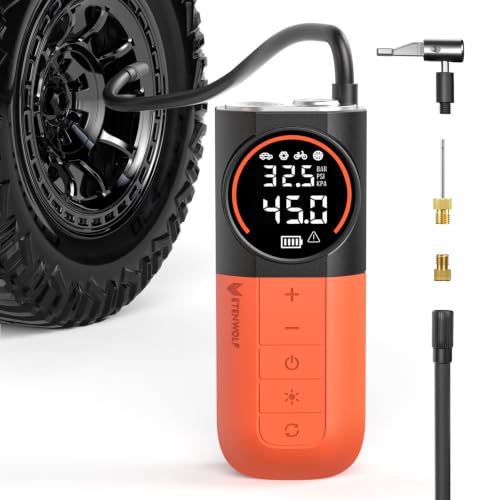
ETENWOLF S1 Tire Inflator Portable Air Compressor 160PSI

ETENWOLF Zephyr S5 Heavy-Duty Tire Inflator Portable

PORTER-CABLE Air Compressor 6-Gallon Pancake Oil-Free

Makita MAC210Q Quiet Series 1 HP 2 Gallon Oil-Free

VIAIR 400P Automatic Portable Compressor Kit Truck/SUV
The Picks, Examined More Closely
For pickups and full-size SUVs, the VORTEX S6 fills a 31-inch tire in roughly a minute, which is faster than most cordless units in its size class. The 19200 mAh battery is a real workhorse, handling multiple tire top-ups on a single charge. Compared to the smaller ZEPHYR S3 covered later, this model trades portability for raw output, so you feel the extra weight in a backpack but rarely run out of juice mid-trip.
The 160 PSI ceiling and 1.5 CFM airflow (cubic feet per minute, a measure of how fast air moves through the pump) make it capable with heavy sidewalls, not just passenger rubber. Owners commonly report the gauge holding accuracy within roughly 1 PSI, which matters when airing up beadlock tires for trail day.
A Few Highlights
- 1.5 CFM at 0 PSI fills a 31-inch tire in about a minute
- 160 PSI max handles truck and trailer sidewalls
- 19200 mAh battery covers a full day of trail top-ups
- Built-in gauge reads within roughly 1 PSI of a separate meter
- Also works on bikes, balls, and pool floats
Things To Consider
- Bigger and heavier than compact commuter inflators
- Not the right tool for stand-up paddleboards
Key Specs
Who It Suits Best
Pickup and full-size SUV owners who air down for trail runs and need fast top-ups at the trailhead.
Where Another Pick Suits Better
For 35-inch off-road tires and heavier duty cycles, the ETENWOLF VORTEX S7 has the extra motor power you want.
The S7 is the flagship cordless inflator here, built around dual 260W motors that move serious air through the hose. It targets heavy-duty trucks and overland rigs, the kind of vehicles that turn a typical inflator into a five-minute wait. Stepping up from the S6 below doubles the battery to 38400 mAh, which matters when you are airing up four 35-inch tires after a long desert run.
For overlanders, the air output translates to shorter time kneeling in the dust. For daily drivers, it is more inflator than you need, and the size can feel excessive in a sedan trunk.
The Upside
- Dual 260W motors move air faster than single-motor units
- 38400 mAh battery handles repeated heavy fills
- Built for 35-inch and larger off-road tires
Worth Noting
- Bulkier than commuter-focused inflators like the ZEPHYR S3
- Not suited to inflatable stand-up paddleboards
- Premium positioning means it is overkill for compact sedans
- Stored unit needs a dedicated cargo spot, not a glove box
Made For
Overlanders, off-road enthusiasts, and heavy-duty truck owners who routinely air down for technical terrain.
Consider Something Else When
Daily commuters topping up a single sedan will find the ETENWOLF ZEPHYR S3 a lighter, more practical carry.
The ZEPHYR S3 is the size of a thermos and sized for the kind of inflation that comes up weekly. It fills a 26.3-inch tire in roughly a minute, which covers most crossovers and sedans without making the user wait around. Compared to the bigger S6 above, this one trims weight and motor count for daily-driver practicality.
The 7800 mAh battery is the smallest in the lineup, but for a commuter car that is more than enough between charges. The pump is also rated for triple the lifespan of an ordinary cordless unit, which softens the long-term replacement worry.
Where It Excels
- Light enough for a center console or door pocket
- 1.25 CFM fills a 26.3-inch tire in about a minute
- Long motor lifespan reduces replacement frequency
Points To Note
- Not designed for 31-inch and larger truck tires
- Smaller battery than the VORTEX models
- Lacks a power bank output for charging other devices
Quick Facts
Right Fit For
Sedan, hatchback, and small-SUV drivers who want a grab-and-go inflator for monthly pressure checks.
Skip It When
Pickup and off-road owners should look at the ETENWOLF VORTEX S6 for the extra airflow they need.
The S1 is the entry point of the lineup, designed for motorcycles, bicycles, and the occasional car tire. It moves 20 liters per minute (the volume of air it pushes at zero pressure), filling a 195/65R15 from 30 to 35 PSI in about 60 seconds. The 5200 mAh battery is the smallest in the roundup, so heavy truck owners should look elsewhere.
For city riders and bike commuters, the compact shell is the appeal. It slips into a pannier or under a motorcycle seat, ready for a roadside top-up.
What It Does Well
- 20 L/min airflow handles small tires quickly
- 160 PSI max covers most passenger and two-wheeler specs
- Compact shell fits a backpack or saddlebag
- Useful for sports balls and casual inflatables
- One of the lighter inflators in this roundup
Room For Improvement
- Not suited to large truck or trailer tires
- Battery capacity is modest for repeated heavy use
Best Suited To
Bike commuters, motorcyclists, and city dwellers who want a low-cost inflator for small-volume rubber.
Look Elsewhere When
Truck and SUV owners will find the ETENWOLF Zephyr S5 a better match for their larger tire volumes.
The Zephyr S5 sits in the middle of the ETENWOLF range, sized for SUVs and crossovers rather than heavy trucks. It inflates a 235/55R20 tire from 30 to 35 PSI in under a minute, which is plenty for most family vehicles. The 15600 mAh battery can handle around 30 fills per charge, so a full day of car-side maintenance is realistic.
Beyond inflation, the S5 doubles as a portable power bank for phones and small electronics. That dual role matters for campers and road-trippers, who can leave a separate battery pack at home. Compared to the ZEPHYR S3, the trade-off is weight: this one earns its larger battery with a chunkier shell.
Standout Benefits
- 1.5 CFM handles SUV tires in under a minute
- 15600 mAh battery covers up to 30 fills per charge
- Built-in power bank for phones and small electronics
Trade Offs
- Heavier than the smaller ZEPHYR S3
- Charging time is longer given the larger battery
- Bigger shell takes up more trunk space
- Not the right tool for 35-inch off-road tires
Core Details
Who Will Love This
SUV and crossover owners who camp, road-trip, or just want one device to handle both tire pressure and phone charging.
A Better Fit Elsewhere
Full-size off-roaders with 35-inch tires should reach for the ETENWOLF VORTEX S7 instead.
Switching categories, the PORTER-CABLE C2002 is a 6-gallon pancake compressor built for trim work, finish nailers, and small spray jobs. The pancake design (a wide, flat tank that sits low to the ground) keeps the unit stable on uneven shop floors, and the rubber feet reduce walking vibration. At 150 PSI max with 2.6 SCFM at 90 PSI (standard cubic feet per minute, a measure of how much air the pump delivers at a given pressure), it cycles fast enough for brad nailers and light impact tools.
Compared to the Makita MAC210Q covered next, this is louder and heavier, but the 6-gallon tank offers longer runtime between cycles. The oil-free pump (which means no lubricant in the compression chamber) also means no fluid changes, a real plus for low-maintenance shop use.
Useful Touches
- 6-gallon pancake tank stays stable on the shop floor
- Oil-free pump cuts maintenance to occasional draining
- 2.6 SCFM at 90 PSI keeps brad nailers cycling smoothly
- Water drain valve simplifies tank moisture removal
- Low-amp 120V motor runs on standard household circuits
A Few Limitations
- Louder than the Makita MAC210Q
- Heavier and bulkier than cordless tire inflators
- Not designed for continuous high-demand air tools
- 6-gallon tank is small for framing or roofing nailers
Feature Snapshot
Perfect Match For
Trim carpenters, hobby woodworkers, and homeowners who need a stable workhorse for finish nailers and light painting.
Reach For A Different Pick When
Apartment dwellers and shared-space users will appreciate the lower noise of the Makita MAC210Q.
The Makita MAC210Q is the low-noise option in this roundup, part of the brand’s Quiet Series and rated at 60 dBA. That is roughly the level of a normal conversation, which makes it usable indoors without driving family members out of the room. The 2-gallon tank is small, so the unit is best for trim nailers, staplers, and detail work rather than heavy framing.
For most home workshops, the 60 dBA rating is the main draw. The oil-free pump and 1 HP motor keep maintenance light, and the small footprint fits on a bench or shelf.
Useful Strengths
- 60 dBA rating supports indoor and apartment use
- Oil-free pump removes oil-change maintenance
- Compact 2-gallon footprint fits tight workspaces
Honest Caveats
- 2-gallon tank cycles often during heavier use
- Not designed for high-demand framing or roofing nailers
Built With In Mind
Apartment dwellers, condo owners, and home-workshop hobbyists who need to keep noise down for neighbors and family.
Swap It Out When
For longer runtime between cycles, the PORTER-CABLE C2002 offers a larger 6-gallon tank, though at higher noise levels.
The VIAIR 400P is the only 12V wired option here, drawing power from a vehicle’s battery via alligator clips. The direct-drive gearless motor (a motor that drives the pump without belts or gears, reducing wear points) is built for off-road punishment, and the kit ships with a carrying case for trail storage. At 150 PSI with support for tires up to 35 inches, it covers most overland setups.
Because it runs from a 12V source, runtime is tied to the vehicle’s battery. Most owners idle the engine during long fills to keep voltage steady. Compared to the cordless VORTEX S7, the trade-off is corded reliance in exchange for unlimited runtime as long as the engine is running.
Practical Advantages
- Direct-drive gearless motor reduces wear points
- Supports tires up to 35 inches
- Carrying case keeps the kit trail-ready
- Automatic shutoff function adds convenience
- Maintenance-free operation over the motor’s life
- Compact enough to mount under a truck bed or in a cargo drawer
Possible Compromises
- Requires a 12V source, so cordless convenience is lost
- Alligator clips and hose are extra items to manage on the trail
Feature Overview
Whose Shelf It Belongs On
Truck, SUV, and overland owners who want a rugged, vehicle-powered inflator for trail and roadside use.
Not Your Match When
Drivers who want cordless convenience and no vehicle dependence will prefer the ETENWOLF VORTEX S7.
What To Weigh Before Buying a Quiet Compressor
Noise matters more than most spec sheets admit, so the first thing to check is the rated decibel level. A 60 dBA workshop compressor (like the Makita covered above) sits in conversational territory, while a 75 to 80 dBA unit can wake a sleeping child through a closed door. For tire inflators, the sound is short and intermittent, so total volume is less of a concern than it is for shop models.
Airflow tells you how fast the unit works. CFM (cubic feet per minute) and SCFM (standard cubic feet per minute) describe the volume of air the pump pushes at a given pressure, and higher numbers mean quicker fills. A 1.5 CFM inflator is fast for tires, while a workshop compressor needs at least 2 to 3 SCFM to keep brad nailers cycling smoothly.
Portability and power source decide where the unit can live. Cordless inflators offer grab-and-go convenience for cars and trails, while 12V wired units like the VIAIR 400P run indefinitely from a vehicle battery. Workshop compressors plug into a 120V outlet, and a 6-gallon pancake tank keeps runtime long between cycles.
Battery capacity and tank size both translate to fewer interruptions. A 15000 mAh or larger battery covers a full day of tire top-ups, while a 6-gallon workshop tank handles hours of trim nailing. The right balance depends on how often you reach for the unit and how far you are from a power source.
Key Considerations Across These Picks
Common Shopping Slip Ups
A common miss is buying a high-CFM tire inflator for a small commuter car, paying for airflow that the tires cannot use. Match the tool to the tire size, not the other way around. Another trap is assuming all “quiet” compressors refer to the same noise scale. Always check the dBA rating, since the difference between 60 dBA and 80 dBA is huge in practice.
What The Higher Tier Buys
Stepping up to a premium model typically buys larger batteries, dual motors, and longer motor life expectancy. The ETENWOLF VORTEX S7’s dual 260W motors, for example, cut fill times significantly over single-motor designs. For workshop units, the upgrade usually means a longer tank warranty and quieter operation, both of which pay off over years of use.
Frequently Asked Questions
How loud is a quiet compressor in decibels?
Most “quiet” workshop compressors are rated between 60 and 70 dBA, roughly the volume of normal conversation. Cordless tire inflators are louder in short bursts but rarely run long enough to disturb neighbors.
What does CFM mean on an air compressor?
CFM stands for cubic feet per minute, a measure of how much air the pump delivers at a given pressure. Higher CFM ratings mean faster tire fills and smoother cycling for pneumatic tools.
Can a quiet compressor run pneumatic tools like nail guns?
Yes, as long as the CFM rating meets the tool’s requirements. Finish nailers typically need 2 to 3 SCFM, so a 6-gallon pancake compressor with 2.6 SCFM handles them comfortably.
How long do cordless tire inflator batteries last?
Most modern lithium-ion cells in this category retain useful capacity for several years of regular use. Storage in moderate temperatures and avoiding full discharges help extend battery life.
Is an oil-free pump better than an oiled one?
Oil-free pumps are lower maintenance since they require no oil changes, but they tend to run slightly louder and may have a shorter lifespan. Oiled pumps are quieter and more durable, at the cost of routine lubrication.




