


Stripping an old table or smoothing a fresh cabinet door can feel like a race between progress and fatigue, and a sloppy tool will leave swirl marks you’ll notice every time the light hits. Random orbit sanders take the swirls out of sanding by spinning the pad while orbiting it in tiny circles, blending the motion so scratches never line up in one direction. After sorting through specs, motor draw, dust handling, and grip comfort, these nine picks cover the most common workshop needs without overpromising.
The Main Contenders

SKIL 1/4 Sheet Palm Sander with Pressure Control (7292-02)

DEWALT 5-Inch Variable Speed Random Orbit Sander (DWE6423)
DEWALT 5-Inch Random Orbit Sander Kit (DWE6421K)

DEWALT 5-Inch Random Orbit Sander (DWE6421)

DEWALT 20V MAX Cordless Random Orbit Sander (DCW210D1)

Makita XOB01Z 18V LXT 5-Inch Random Orbit Sander

DEWALT 5-Inch Replacement Sander Pad (DW4388)

SKIL 5-Inch Random Orbital Sander with Cyclonic Dust Box (SR211601)
SKIL 4-in-1 Multi-Function Detail Sander (SR232301)
Taking A Closer Look At The Options
The SKIL 7292-02 is a quarter-sheet palm sander rather than a true random orbit, and that distinction matters up front. A random orbit sander spins and orbits simultaneously to hide scratch patterns, while this palm-style unit vibrates in tight orbits, which is gentler for fine work and small repair patches. For someone patching a scratch on a dresser or smoothing a drawer face, the lighter motion is often easier to control.
The 2.0-amp motor pulls enough power for typical home projects without feeling heavy in the hand. Pressure control feedback helps new users learn the feel of how much force actually moves material, and the clear-view dust canister takes the guessing out of emptying time.
A Strong Showing
- Pressure feedback helps prevent gouging on thin veneer
- Clear dust canister makes it obvious when to empty
- Compact palm grip fits smaller hands comfortably
- Built-in vacuum port pairs with a shop vac for cleaner work
Things To Consider
- Quarter-sheet format won’t cover a tabletop as fast as a 5-inch random orbit
- Not a true random orbit, so deeper scratch removal is slower
Quick Facts
Made For
Newcomers handling small furniture repairs and trim touch-ups who want forgiving feedback rather than aggressive stock removal.
Consider Something Else When
The DEWALT 5-Inch Random Orbit Sander (DWE6421) suits you better if you need to flatten large panels fast.
Step up from the SKIL palm sander and the world changes: the DWE6423 brings a true 5-inch hook-and-loop pad, a 3-amp motor, and a variable-speed dial running roughly 8,000 to 12,000 OPM (orbits per minute). That speed range means you can slow it down for fine sanding on veneer and crank it up for stripping thick paint. The lower the OPM, the gentler the cut, which keeps heat low and reduces the chance of burning through a finish.
A low-profile housing and rubber overmold grip help when working on a tabletop or inside a cabinet. Owners commonly report that the separate counterweight keeps vibration manageable during long sessions, and the one-handed dust bag swaps out fast between grits.
A Few Strong Suits
- Variable speed dial adapts to delicate and aggressive work
- Low-profile body reaches closer to the workpiece
- Counterweight design reduces hand fatigue over long sessions
- Hook-and-loop pad swaps sandpaper in seconds
Worth Noting
- Corded design limits mobility around large projects
- Heavier than cordless alternatives for overhead sanding
Feature Snapshot
Right Fit For
Home woodworkers refinishing furniture or smoothing large panels who want speed control without swapping tools.
Look Elsewhere When
The DEWALT 20V MAX Cordless Random Orbit Sander (DCW210D1) makes more sense for shop setups where cord management is a constant frustration.
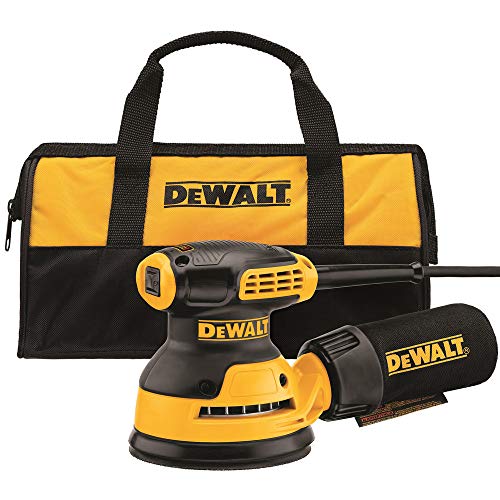
Functionally, the DWE6421K is the single-speed sibling to the DWE6423 reviewed above. The kit version ships with a hard case, the dust bag, and a starter pack of sanding discs, so you can pull it out of the box and start sanding. At a fixed 12,000 OPM, there is no dial to think about, which simplifies the experience for first-time owners.
The 3-amp motor handles stock removal on hardwoods and softwoods equally well, and the rubber overmold grip stays secure during extended sessions. If you already own DEWALT cordless tools, the yellow-and-black styling fits a familiar shop aesthetic, and the dust port accepts a 1-1/4 inch vacuum hose for cleaner indoor work.
Points In Its Favor
- Carrying case keeps accessories organized between projects
- Fixed 12,000 OPM removes guesswork for new users
- Counterweight reduces vibration transfer to the wrist
Trade Offs
- Lacks variable speed for fine finishing on delicate surfaces
- Kit weight with case adds bulk for transport
Best Suited To
Workshop owners who want a turnkey sanding kit and don’t need the variable speed dial found on the DWE6423.
A Better Fit Elsewhere
The SKIL 5-Inch Random Orbital Sander (SR211601) works better for hobbyists who prioritize a built-in cyclonic dust box over a hard case.
The DWE6421 is the bare-tool version of the kit reviewed above, sold without a case or accessories. It runs at a single 12,000 OPM speed, which keeps the price lower and the controls dead simple. For most weekend projects like refinishing a bookshelf or smoothing a deck rail, that single speed is plenty.
The shorter housing lets you get close to vertical surfaces, and the rubber overmold grip absorbs enough vibration to keep wrists comfortable during a full afternoon of sanding. Pair it with a shop vac through the dust port and the mess stays manageable even indoors.
Positive Takeaways
- Lower price than the kit version for shoppers who already own accessories
- Counterweight and overmold grip reduce fatigue
- 5-inch pad covers broad surfaces quickly
Small Caveats
- No variable speed for fine finishing work
- Sandpaper and dust bag sold separately
Who Should Grab It
DIYers handling frequent medium-sized projects who already have a vacuum and a stash of 5-inch discs on hand.
Skip It When
The DEWALT Variable Speed Random Orbit Sander (DWE6423) fits better for finish work where you want to dial down the OPM on soft woods.
The DCW210D1 trades the cord for a 20V MAX battery, which is a meaningful upgrade if your shop lacks convenient outlets or you work on job sites. The brushless motor stretches runtime and holds speed under load, so the pad doesn’t bog down when pressure increases. The variable-speed dial runs 8,000 to 12,000 OPM, mirroring the corded DWE6423 and giving you the same control over finish quality.
At 5 inches, the pad covers the same surface as the corded models, and the dust port accepts the same vacuum hose. The kit ships with a 2.0Ah battery, charger, and a storage bag, which is enough to get started without buying extras.
Notable Gains
- Cordless freedom for job sites and stairwells
- Brushless motor holds speed under pressure
- Variable speed matches the corded DWE6423
- Storage bag simplifies transport
Points To Note
- Battery adds weight compared to corded models
- Runtime depends on battery capacity and grit choice
- Higher upfront cost than the corded DWE6421
Built With In Mind
Existing 20V MAX tool owners who want a cordless sander that shares batteries with their drill and impact driver.
Not Your Match When
The DEWALT 5-Inch Random Orbit Sander (DWE6421) suits you better for stationary shop work where outlet access is easy and weight matters less.
The Makita XOB01Z stands out for its three-speed selector offering roughly 7,000, 9,500, and 11,000 OPM, which is more granular than most competitors. That range lets you match the orbit speed to the material: lower for soft pine, higher for tough urethane finishes. The tool comes as a bare unit, so you’ll need an 18V LXT battery and charger to run it, and that adds to the total cost unless you already own Makita LXT gear.
Once running, the XOB01Z delivers up to 40 minutes of runtime on a single charge under typical conditions, which is enough for most furniture refinishing sessions. The pad accepts hook-and-loop 5-inch discs, and the dust port pairs with Makita’s vacuum attachments for cleaner work.
Everyday Perks
- Three-speed dial offers finer control than two-step competitors
- Comfortable ergonomics for long refinishing sessions
- Shares batteries with the broader 18V LXT system
Factors To Consider
- Battery and charger sold separately
- Less common in casual DIY shops than DEWALT
Perfect Match For
Existing Makita 18V LXT users who want a cordless random orbit sander that fits an existing battery ecosystem.
Another Choice May Suit
The DEWALT 20V MAX Cordless Random Orbit Sander (DCW210D1) is a better entry point for shoppers who don’t already own Makita batteries.
The DW4388 isn’t a sander at all, and that’s the point. It’s a 5-inch hook-and-loop replacement pad designed to refresh older DEWALT sanders, including the D26450, D26451, D26451K, D26453K, and D26456 models. If your current sander’s pad has lost its grip or warped from heat, swapping in a fresh pad can make an aging tool feel new again.
The pad features an eight-hole pattern that aligns with DEWALT’s dust collection system, so dust still routes into the bag or vacuum. The hook-and-loop surface accepts standard 5-inch discs, so you keep using the sandpaper you already own.
Why It Works Well
- Restores grip on worn sanders without buying a new tool
- Eight-hole pattern preserves dust collection efficiency
- Compatible with common 5-inch hook-and-loop discs
Possible Compromises
- Only fits specific older DEWALT models, not the DWE6421 series
- Not a standalone sander, so it solves a narrow problem
The Right Fit
Owners of legacy DEWALT sanders (D26450 through D26456) whose hook-and-loop pad has finally worn smooth.
Where Another Pick Shines
For a brand-new sander rather than a replacement pad, the DEWALT 5-Inch Random Orbit Sander (DWE6421) is the more relevant starting point.
The SKIL SR211601 leans into one feature most competitors gloss over: a cyclonic dust box. Instead of a simple bag, the box uses swirling airflow to separate dust from the airstream, which means the filter stays cleaner longer and you can keep sanding without constant filter taps. The variable-speed dial spans roughly 7,000 to 13,000 OPM, so you can match the cut to anything from soft pine to tough lacquer.
The 5-inch pad accepts hook-and-loop discs, and the kit includes three sanding sheets to get you started. Vibration control helps during long sessions, and the dust port accepts a vacuum hose for projects where you want even less airborne debris.
Advantages To Know
- Cyclonic dust box keeps the filter from clogging mid-project
- Wide variable-speed range handles many materials
- Vibration control reduces hand fatigue over long sessions
Where It Is Less Suited
- Corded design limits mobility on large outdoor projects
- Plastic dust box can crack if dropped on a concrete floor
Who Will Love This
Home refinishers working indoors who want less filter maintenance and cleaner air during long sanding sessions.
Reach For A Different Pick When
The Makita XOB01Z 18V LXT Random Orbit Sander is a better fit for cordless tool users who already own 18V batteries.
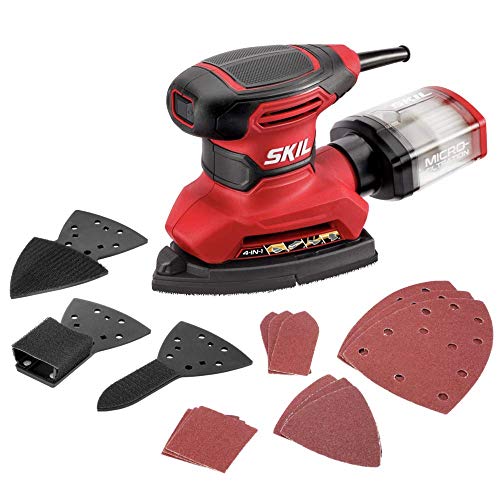
The SR232301 closes the list as a detail sander, a different tool category from the random orbit sanders above. Detail sanders use small, pointed pads to reach into corners, edges, and tight profiles where a 5-inch round pad can’t fit. The 4-in-1 design includes three quick-change attachments plus the base, so you can swap between a finger attachment, a contour pad, and a flat detail pad without grabbing a tool.
The 1.2-amp motor runs at 13,500 OPM, which is plenty for trim work and small furniture repairs. A micro-filter dust box and a 1-1/4 inch vacuum port give you two ways to manage dust, and the kit includes 12 sanding sheets so you can start working right out of the box.
Benefits That Matter
- Four attachments cover corners, edges, and contours
- Quick-change system requires no extra tool
- 12 included sanding sheets add immediate value
Details To Watch
- Smaller pads mean slower coverage on large flat surfaces
- Not a true random orbit sander, so it can’t replace the picks above for big projects
Whose Shelf It Belongs On
Homeowners handling trim work, window frames, and small craft projects where a 5-inch round pad would be too large.
Swap It Out When
The SKIL 5-Inch Random Orbital Sander (SR211601) is a stronger match for anyone refinishing tabletops or cabinet doors where broad coverage matters more than corner access.
What To Weigh Before Choosing Random Orbit Sanders
Match The Pad Size To The Project
Pad size is the single biggest factor in how fast a sander covers a surface. A 5-inch round pad is the most common choice for furniture, cabinets, and doors, balancing speed with control. Smaller palm-style pads work well for tight repairs and detail work, while larger 6-inch pads speed up big flat panels but add weight and require more skill to keep flat.
Decide Between Corded And Cordless
Corded sanders deliver consistent power and unlimited runtime, which matters for full-day refinishing sessions. Cordless models trade some runtime for mobility, letting you sand stairs, job sites, and areas without nearby outlets. If you already own a battery platform like DEWALT 20V MAX or Makita 18V LXT, a cordless sander that shares those batteries is the practical choice.
Variable Speed Adds Real Versatility
Single-speed sanders work fine for most projects, but variable-speed dials let you slow the orbit for fine grits and delicate veneers. Lower OPM (orbits per minute) reduces heat buildup, which is the main cause of finish burning. For finish sanding on softwoods or between coats of paint, a variable-speed model earns its higher cost.
Dust Control Affects Indoor Use
Dust collection is more than a convenience. Fine sanding dust is a respiratory irritant, and good dust management means less cleanup, better visibility of your work, and longer pad life. A built-in dust box works for short sessions, while a vacuum port connected to a shop vac handles longer projects more cleanly.
Key Considerations Across These Picks
Where Shoppers Go Wrong
One common slip is choosing the cheapest sander in the lineup, then realizing it lacks a dust port for vacuum hookup. Without dust extraction, indoor projects turn into cleanup nightmares and the filter clogs after a few minutes. Another mistake is overlooking pad compatibility: not every 5-inch sander accepts every 5-inch disc, and the wrong hole pattern can leave dust swirling instead of collecting.
Shoppers also tend to underestimate vibration. A sander that feels fine for five minutes can leave wrists aching after an hour. Counterweight designs and rubber overmold grips matter more than the marketing suggests, especially for anyone refinishing multiple pieces in a single weekend.
Why Top Tier Costs More
Higher-tier sanders earn their premium through brushless motors, variable-speed dials, and refined dust systems. A brushless motor holds speed under load, which means consistent scratch patterns and fewer re-sanded spots. Variable-speed dials expand the range of materials a single tool can handle, from soft pine to tough exotics. For occasional projects, a single-speed corded model is plenty, but frequent users and pros quickly feel the difference a refined tool makes.
Frequently Asked Questions
What Is The Difference Between A Random Orbit Sander And A Regular Orbital Sander?
A random orbit sander spins the pad while orbiting it in a tight circle, producing scratch-free finishes on most surfaces. A standard orbital sander vibrates in fixed orbits, which is gentler for fine work but leaves more visible scratch patterns.
Can Random Orbit Sanders Remove Paint?
Yes, with coarse-grit discs (40 to 80 grit) and a slower speed setting, random orbit sanders strip paint from wood, metal, and even some plastics. Multiple passes and fresh discs usually work better than aggressive pressure on a single pass.
What Grit Sandpaper Should I Start With?
For raw wood, start with 80 grit to remove mill marks and imperfections, then move to 120, 180, and 220 for smoother finishes. Between coats of paint or polyurethane, 220 to 320 grit scuffs the surface just enough for the next coat to bond.
How Do I Prevent Swirl Marks?
Keep the sander moving in overlapping circles, avoid pressing down hard, and let the pad’s weight do the work. Switching to a finer grit before you think the surface is ready usually produces a cleaner final result than one aggressive pass.
Do I Need A Vacuum For Dust Collection?
A shop vac connected through the dust port is the cleanest option for long sessions, but a built-in dust box handles short projects adequately. For indoor refinishing, the vacuum route keeps the air noticeably cleaner and the filter from clogging mid-project.




