


A random orbital palm sander earns its place the day you start a refinishing project and realize your old sheet sander leaves swirl marks behind. These compact tools combine a spinning disc with a tight orbital pattern, blending cutting speed with a finish clean enough for stain or clear coat. The nine picks below cover corded workhorses, cordless convenience, and dual-mode heavy hitters so you can match the sander to the job.
A Side-By-Side Look

DEWALT DWE6423 5-Inch Variable Speed Random Orbit Sander
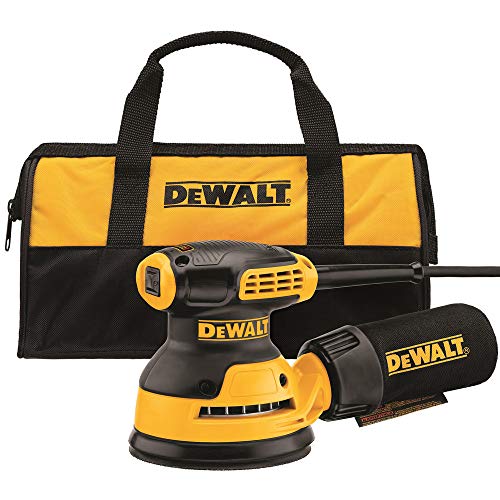
DEWALT DWE6421K 5-Inch Random Orbit Sander Kit

DEWALT DWE6421 5-Inch Palm Random Orbit Sander

DEWALT DWE6423K 5-Inch Variable Speed Sander Kit

DEWALT DCW210D1 20V MAX Cordless Random Orbit Sander

Makita BO5041K 5-Inch Random Orbit Sander

BOSCH ROS10 5-Inch Palm Random Orbit Sander

BOSCH GET75-6N 6-Inch Dual-Mode Random Orbit Sander

BOSCH ROS20VSC 5-Inch Palm Random Orbit Sander
The Picks, Examined More Closely
The DEWALT DWE6423 is the sander you reach for when you don’t want to think about the sander. A 3-amp motor drives a 5-inch hook-and-loop pad at a user-adjustable 8,000 to 12,000 orbits per minute, so you can slow it for delicate veneer work or open it up for paint stripping. The low-profile body keeps the pad close to the workpiece, which matters when you’re sanding the inside of a cabinet or the lip of a tabletop.
Compared to the single-speed DWE6421 kit below, this version trades simplicity for control. The separate counterweight design is the kind of detail you only appreciate after an hour of finish sanding, when vibration stays manageable and your hand doesn’t go numb. The rubber overmold grip absorbs sweat, and the dust bag stays attached with a one-handed lock. For most home workshops, this is the do-everything pick.
A Few Strong Suits
- Variable speed dial covers 8,000–12,000 OPM, useful across grit progressions and material types
- Low-profile housing gets the pad close to vertical or recessed surfaces
- Counterweight balance reduces fatigue during long finish-sanding sessions
- Hook-and-loop pad swaps discs in seconds, no tools required
- Locking dust bag stays secured mid-grit change, keeping the mess contained
Trade-Offs To Weigh
- Corded design means dragging an extension cord across the shop or jobsite
- Dust bag fills quickly on heavy removal work, so you may need to pause and empty it
Key Specs
Who It Suits Best
Shops that need one sander for furniture refinishing, cabinet work, and prep coats will find this DWE6423 covers all three without swapping tools.
Where Another Pick Suits Better
You work on jobsites without power outlets, so the cordless DEWALT DCW210D1 is a better match for you.
The DWE6421K strips back the variable-speed dial and ships everything a first-time sander owner needs in a hard case. You get the same 5-inch hook-and-loop pad, the same 3-amp motor, and a fixed 12,000 OPM orbit rate that handles most wood, primer, and paint tasks. The kit format includes the dust bag and a carrying case, so the sander stays organized in a crowded toolbox.
Where the DWE6423 above gives you a dial, this DWE6421K gives you simplicity. There’s nothing to set wrong, which matters if you’ve never sanded before or you’re handing the tool to a less experienced helper. The shorter body and rubber overmold grip mirror its variable-speed sibling, so handling feels familiar. For furniture flips, deck rail touch-ups, and weekend refinishing, the kit is hard to beat on practicality.
What Earns Its Place
- Single-speed design means no learning curve, just plug in and sand
- Carrying case keeps the sander, dust bag, and extra discs together
- Counterweight balance keeps vibration reasonable during extended runs
Honest Caveats
- No speed adjustment, so aggressive stock removal on soft pine can leave visible swirl marks if you linger
- Hard case adds bulk that may not suit a tight shelf or shared toolbox
Right Fit For
New DIYers and homeowners who want a complete, ready-to-go kit for furniture refinishing and trim prep will find the DWE6421K approachable.
Skip It When
You already own a DEWALT 20V battery platform, so the cordless DCW210D1 makes more sense than a second corded tool.
The DWE6421 is the bare-tool version of the kit above, sold without the carrying case or extra accessories. It’s the same 3-amp motor, the same 12,000 OPM fixed speed, and the same low-profile 5-inch pad that has made this DEWALT platform a workshop standard. For owners who already have a stash of hook-and-loop discs, the case and dust bag feel redundant.
What’s left is a straightforward sander for the kind of work most home shops actually do, like sanding between coats of polyurethane, knocking down raised grain on a cutting board, or prepping a door for repaint. The rubber overmold grip and counterweight design are identical to the kit version, so the in-hand feel is familiar. In our view, the main trade-off shows up when you need portability: without a case, the sander rolls around in a drawer.
Where It Delivers
- Same proven motor and pad as the kit version, just without the bundled extras
- Compact body fits comfortably in one hand for overhead or vertical work
- Hook-and-loop pad accepts the same 5-inch discs used across the DEWALT line
- Dust port accepts both the included bag and a 1-1/4 inch vacuum hose
Points To Keep In Mind
- No carrying case, so storing the sander with its cord tidy takes some planning
- Single-speed operation may feel limiting if you alternate between hard and soft woods
Built With In Mind
Workshop owners with a drawer or shelf already set up for power tools, who just want the sander itself without accessories, will appreciate the DWE6421’s straightforward packaging.
A Better Fit Elsewhere
You need variable speed for fine finishing on figured wood, so the DEWALT DWE6423 is a more capable choice for you.
The DWE6423K takes the variable-speed motor from the DWE6423 above and packages it with a hard case, dust bag, and a starter set of accessories. It’s the most complete kit in DEWALT’s corded 5-inch line, suited to a workshop where the sander comes out for cabinet builds, refinishing, and the occasional drywall patch.
Having variable speed matters more than beginners might expect. The low end of the 8,000 OPM range keeps the pad from grabbing on heat-sensitive finishes, while the top end chews through old paint and rough-sawn boards. The counterweight and grip design are unchanged from the rest of the DWE642x family, so the kit feels familiar if you’ve already used a DEWALT sander. For dedicated shop space, the case earns its keep by keeping discs and accessories together.
What Pays Off
- Variable speed dial spans the full 8,000–12,000 OPM range, useful across grit changes
- Hard case protects the sander during transport and keeps accessories organized
- Counterweight design tames vibration during extended finish-sanding sessions
Small Caveats
- Heavier than bare-tool models, which may tire out users doing overhead work
- Corded only, so a long extension cord is mandatory for garage or basement use
Feature Snapshot
Best Suited To
Garage and small pro-shop owners who want the variable-speed motor plus organized storage will find the DWE6423K well matched to their workflow.
Look Elsewhere When
You need to sand away from power outlets, so the battery-powered DEWALT DCW210D1 fits your situation better.
The DCW210D1 swaps the cord for a 20V MAX battery, and that single change reshapes where and how you sand. The brushless motor, meaning a design with no carbon brushes to wear out, runs the 5-inch pad at the same 8,000 to 12,000 OPM range as DEWALT’s corded DWE6423, and a variable-speed dial on the back lets you set the orbit rate to match the material. The kit includes a 2.0Ah battery, a charger, and a storage bag, so the sander is ready for jobsites, decks, and projects far from an outlet.
The honest read is that runtime depends on the work. Light finish sanding on furniture stretches a charge across a full afternoon, while heavy paint removal on a deck will drain a 2.0Ah pack in well under an hour. For shop owners already on the 20V platform, that means swapping batteries between cuts. For everyone else, the included pack is enough for small projects. The dust port and one-handed locking bag match the rest of DEWALT’s line, so consumables stay consistent across tools.
Positive Points
- Brushless motor delivers corded-class performance without the cord drag
- Variable speed dial covers the full 8,000–12,000 OPM range
- Battery and charger included, so the sander works out of the box
- Compatible with the wider DEWALT 20V battery ecosystem
Points To Note
- 2.0Ah battery limits runtime on aggressive stock removal, so a spare pack helps for big jobs
- Heavier than corded equivalents because the battery adds weight over the base
Quick Facts
Who Should Grab It
Jobsite carpenters and remodelers who already run 20V MAX tools will find the DCW210D1 slots cleanly into an existing battery setup.
Swap It Out When
Your sanding stays in a stationary shop with outlets nearby, so the corded DEWALT DWE6423K saves the cost of a battery system.
The Makita BO5041K is a long-standing favorite among finish carpenters and furniture makers, and the spec list explains why. A 3-amp motor drives the 5-inch pad across a wide 4,000 to 12,000 OPM range, broader than most corded competitors. That low-end range matters when you’re sanding sealer coats or working with thin veneers where heat and friction can scorch the surface.
The ergonomic rubberized palm grip and matching side handle let you two-hand the sander for better control on large panels, which you can’t do with single-grip palm sanders like the DEWALT DWE6421. The kit ships with a hard case and a dust bag, so it’s ready for transport between shop and site. The trade-off shows up in price: this is one of the more expensive 5-inch corded sanders in the category, and the wider speed range matters most to users who actually adjust it.
Strengths Worth Knowing
- Wide 4,000–12,000 OPM range handles delicate finish work and heavy removal in one tool
- Dual gripping points improve control on large flat panels
- Hard case and dust bag included in the kit
- Rubberized palm grip stays comfortable in extended use
Worth Noting
- Higher price point than most 5-inch corded sanders in this list
- Wider speed range is wasted on owners who always run full speed
Made For
Finish carpenters and dedicated woodworkers who adjust speed for each grit and material will get the most from the BO5041K’s broad range.
Another Choice May Suit
You mainly sand flat-pack furniture and home projects at a fixed pace, so the DEWALT DWE6421K kit is a more economical fit.
The BOSCH ROS10 keeps things simple: a 5-inch pad, a single-speed motor, and one feature that sets it apart, an integral pad dampening braking system. That brake stops the pad quickly when you lift the sander off the workpiece, preventing the swirl marks that show up when a spinning disc lingers on bare wood. For first-time refinishers, that single detail can save a finish coat.
Compared to the variable-speed DEWALT and Makita options above, the ROS10 is stripped down. There’s no speed dial, and the motor runs at a fixed orbit rate suitable for general sanding and polishing. The palm-style grip is comfortable for short sessions, though the lack of a side handle makes two-handed control harder on big surfaces. For light home repair, occasional furniture work, and polishing smaller items, the ROS10 covers the basics at a lower cost.
Everyday Wins
- Pad brake prevents swirl marks when lifting the sander off the work
- Lower price point than most variable-speed competitors
- Compact palm-grip body fits comfortably in smaller hands
- Dust port accepts both the included canister and a vacuum hose
A Few Limitations
- Single-speed operation, so no fine-tuning for soft or figured wood
- No side handle, so two-handed control on large panels is limited
Spec Overview
Whose Shelf It Belongs On
Homeowners tackling light refinishing and small repair projects will appreciate the ROS10’s straightforward operation and swirl-resistant braking.
Reach For A Different Pick When
You sand large furniture panels often, so the two-handed Makita BO5041K gives you better control on big surfaces.
The GET75-6N is the outlier in this list, and on purpose. The 6-inch pad covers more area per pass, and a mode switch flips the tool between standard random-orbit sanding and a turbo mode for aggressive stock removal. In turbo mode, the sander removes material at roughly five times the rate of a standard orbital, which is the kind of speed that turns a floor refinishing job from a weekend into a day.
The catch is size and control. The 6-inch pad and heavier body make the GET75-6N less comfortable for one-handed detail work, and it covers more than you want on small parts. Where it shines is on large, flat surfaces: tabletops, doors, cabinets, and hardwood floors. If your sanding is mostly on smaller items like the projects the DEWALT DWE6423 handles, the extra capacity goes unused. For shops that do both detail and heavy work, the dual-mode design earns its place.
A Favorable Mix
- Dual-mode switch toggles between finish sanding and aggressive stock removal
- 6-inch pad covers large flat surfaces faster than 5-inch models
- Turbo mode dramatically reduces time on paint and finish stripping
Less-Strong Areas
- Larger pad makes one-handed detail work awkward on small parts
- Heavier body causes fatigue faster on overhead or extended sessions
- Higher price than the 5-inch options in this list
Perfect Match For
Floor refinishers and shop owners who tackle large flat panels will find the GET75-6N’s dual-mode design and 6-inch pad well suited to their workload.
Not Your Match When
You mostly sand furniture, cabinets, and smaller trim pieces, so the lighter DEWALT DWE6423 stays more comfortable for your typical day.
The BOSCH ROS20VSC fills a gap that pure woodworkers don’t always think about: polishing. The variable-speed dial runs from a low 7,500 OPM up to 12,000 OPM, which means you can slow the pad down for buffing out a clear coat or speeding up for finish sanding. The hook-and-loop pad uses over 35,000 hooks to grip discs firmly, so a polishing pad stays attached even when the sander runs at high speed.
Where the ROS20VSC differs from the DEWALT DWE6423 above is in feel and intent. The 2.5-amp motor is a touch lighter, but for polishing and fine finishing that tradeoff doesn’t hurt. The dust collection canister works for sanding, and the vacuum port is a real asset when you’re working indoors. For auto-detailing shops, guitar finishers, and woodworkers who want one tool for both sanding and polishing, the variable speed is the feature that makes the difference.
Advantages To Know
- Variable speed from 7,500 to 12,000 OPM supports both sanding and polishing tasks
- High-hook-count pad grips discs and polishing pads firmly at speed
- Vacuum port compatibility makes indoor work cleaner
Softer Spots
- 2.5-amp motor feels modest compared to the 3-amp DEWALT and Makita options
- No side handle, so two-handed control on large panels is limited
Who Will Love This
Auto-detailers and finish-focused woodworkers who alternate between sanding and polishing will appreciate the ROS20VSC’s variable speed and firm pad grip.
Where A Sibling Pick Shines
You need raw sanding power for stock removal, so the DEWALT DWE6423’s 3-amp motor handles that workload more comfortably for you.
What to Weigh Before Choosing a Random Orbital Palm Sander
Power, Speed, and How They Connect
Corded sanders in this category run on motors between 2.5 and 3 amps, and that range matters more than the headline number. A 3-amp motor maintains torque when you press the pad against the workpiece, which keeps the orbit rate from sagging under load. Variable-speed models, like the DEWALT DWE6423 or Makita BO5041K, let you drop the orbit rate for heat-sensitive finishes and push it up for stock removal. The trade-off is cost and complexity: fixed-speed models are simpler and usually less expensive.
Pad Size and the Work You Do
The 5-inch pad is the category standard for a reason. Discs are easy to find, the pad fits comfortably in a palm grip, and the size handles most furniture, cabinet, and trim work. The 6-inch pad on the BOSCH GET75-6N covers more area per pass, which speeds up large flat surfaces like tabletops and floors, but it makes detail work awkward. Match the pad to your most common project size rather than the largest one you might tackle.
Dust Collection and Indoor Use
Palm sanders throw fine dust into the air, and how the tool handles that dust affects both cleanup and finish quality. Every sander in this list ships with a dust bag, and most accept a vacuum hose through the same port. For indoor refinishing, connecting to a shop vac keeps the air clearer and the workpiece cleaner between grit changes. Empty the bag mid-job on heavy removal, because a full bag drops suction and throws dust back at the pad.
Corded vs Cordless Trade-Offs
Corded sanders deliver continuous power, and you’ll never wait on a battery to charge. Cordless models like the DEWALT DCW210D1 free you from extension cords and outlets, which matters on decks, jobsites, and any project far from a wall plug. The honest trade-off is runtime: a 2.0Ah battery handles small projects but drains on heavy stock removal. Choose cordless if portability is part of your routine, and corded if your sanding happens in one spot.
Key Considerations Across These Picks
Common Shopping Slip Ups
Palm sanders look similar, so it’s easy to focus on price and miss the details that change the experience. One frequent misstep is buying a single-speed model for fine finishing, then discovering the high orbit rate burns through thin veneers. Another is assuming a dust bag is enough for indoor work, when a vacuum hookup would have kept the air clearer. The fix is matching speed range, pad size, and dust collection to your specific projects before adding to cart.
Why Top Tier Costs More
Premium sanders in this list, like the Makita BO5041K and BOSCH GET75-6N, earn their higher price through wider speed ranges, dual-mode operation, and refined ergonomics. Those features matter most to users who adjust their technique for different materials and who sand for hours at a stretch. If your sanding is the occasional furniture flip, a mid-tier DEWALT DWE6423 or BOSCH ROS20VSC delivers the core experience without paying for capacity you won’t use.
Frequently Asked Questions
What is OPM, and how much do you need?
OPM stands for orbits per minute, the number of times the sanding pad moves in a tight circle each minute. For most home projects, anything between 8,000 and 12,000 OPM covers rough sanding through finish work. Variable-speed models let you drop below 8,000 OPM for delicate materials, which prevents burning and swirl marks.
Can a random orbital sander remove paint?
Yes, and it’s one of the faster ways to strip paint from flat wood surfaces. Use a coarse grit (40–60) disc and keep the pad moving to avoid gouging. For layers of old paint on detailed trim, a chemical stripper is usually faster and less risky to the underlying wood.
What’s the difference between a palm sander and a regular orbital sander?
A random orbital palm sander spins the pad in a circle while moving it in an offset orbit, producing a scratch pattern that doesn’t repeat. A standard orbital (sheet) sander moves the pad in a simple back-and-forth or circular pattern, which can leave visible swirl marks. The random orbital design is the better choice for finish work.
How often should I empty the dust bag?
Empty the bag whenever it looks about half full, because a packed bag drops suction and throws dust back at the workpiece. On heavy paint removal, that may mean pausing every 10 to 15 minutes. Connecting a shop vac through the same port reduces how often you need to stop.
Are hook-and-loop discs universal across 5-inch sanders?
Most 5-inch random orbital sanders use the same hook-and-loop disc pattern, so discs from one brand generally fit another. The exception is the hole pattern for dust collection, which varies by brand. Match the hole count and layout to your sander, or use a disc punch to add holes if needed.




