


A recip saw only performs as well as the blade clamped in its shoe. Pick the wrong tooth pattern or the wrong length and a five-minute pruning job turns into an hour of binding, smoking frustration, the kind of weekend that makes you question every tool purchase. The right blade, by contrast, chews through nail-embedded lumber, slices thick-wall pipe, and trims root balls without wandering off line.
This list covers nine options across demolition, metal, aerated concrete, pruning, and general renovation work. The picks range from carbide-tipped specialty blades built for abrasive masonry to long Japanese-tooth blades made for outdoor cleanup. Each entry below spells out the materials it cuts, the shank it fits, and the kind of work it handles best, so you can match the blade to the job instead of guessing at the lumber rack.
The Shortlist At A Glance

Diablo Demo Demon Carbide Reciprocating Blades 3-Pack

Bosch 10x EXPERT Aerated Concrete S1241HM Blade
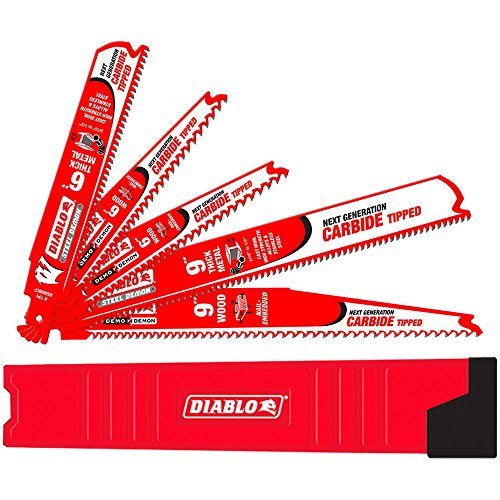
Diablo Steel Demon and Demo Demon 5-Piece Set
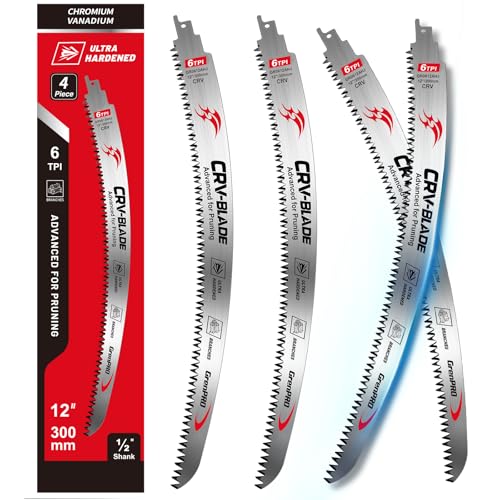
GRENPRO 4-Pack Japanese Teeth 15-Inch Blades
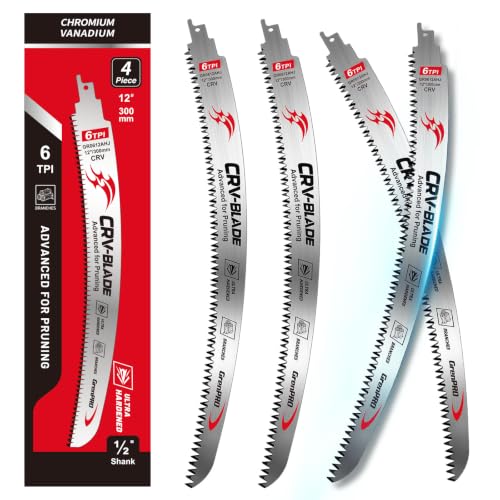
GRENPRO 4-Pack Japanese Teeth 12-Inch Blades

GRENPRO 6 Pack 15-Inch Arc Edge Pruning Blades

GRENPRO 34-Piece Reciprocating Saw Blade Set

GRENPRO 26-Piece 9-Inch Bi-Metal Blades

GRENPRO 3-Pack Carbide 6-Inch 8 TPI Blades
A Closer Look At Each Pick
Twelve inches of cut depth and a 9 TPI (teeth per inch) tooth pattern make this Diablo blade a workhorse for general demolition. TPI is simply how many teeth sit along each inch of blade edge; lower numbers mean coarser, faster cuts, which is exactly what you want when slicing through framing lumber studded with nails. The carbide-tipped construction, where tungsten carbide is brazed onto a steel body, holds an edge far longer than standard bi-metal when the going gets rough.
The three-pack format spreads the cost across multiple tear-down sessions, and a universal 1/2-inch shank fits the saws most homeowners and contractors already own. Renovation crews pulling subfloor or breaking down pallets will find it pulls double duty on wood and lighter metal.
Useful Strengths
- Carbide tips resist wear from nails, bolts, and occasional masonry grit
- Long 12-inch body reaches inside stud bays and across wide lumber in one pass
- 9 TPI geometry balances speed and finish for mixed debris loads
- Three-blade pack reduces the chance of mid-job downtime on long teardowns
- Standard shank slips into most corded and cordless recip saws without adapters
Things To Weigh Up
- General-purpose design means it is not optimized for stainless or high-alloy steel
- Coarser cut leaves a rougher edge than fine-tooth blades on finished trim work
Feature Snapshot
Made For
Contractors and serious DIYers tearing out subfloor, framing, or pallet wood on weekends that turn into full days.
Consider Something Else When
The Bosch 10x EXPERT Aerated Concrete S1241HM Blade serves masons cutting AAC blocks far better than this general-purpose design.
Aerated concrete, also sold under names like Ytong, Siporex, and AAC (autoclaved aerated concrete), eats ordinary wood blades in seconds. Bosch’s EXPERT S1241HM uses a carbide configuration that is engineered specifically for that lightweight, porous block. The ten-pack format suits trades that run through AAC blocks on every new build or addition.
Compared to the Diablo Demo Demon 3-Pack that just preceded it, this blade is far narrower in scope. It does one job, cutting AAC, and it does it with precision straight lines and minimal chipping. Builders framing window openings or trimming lintels will appreciate the clean kerf, which is the channel the blade cuts into the material.
The Upside
- Carbide tooth geometry tailored to the abrasive dust AAC produces
- Ten-pack format lowers per-blade cost on high-volume job sites
- Cuts straight, finished edges that need little patching
- Standard S-shank fits every Bosch recip saw and most major-brand reciprocating saws
Trade Offs
- Specialized design performs poorly on wood, metal, or standard masonry
- Sold through global marketplaces, where warranty handling can take longer than domestic listings
Whose Shelf It Belongs On
Masons and remodelers working with AAC block who need predictable, clean cuts across multiple jobs.
Reach For A Different Pick When
The Diablo Demo Demon Carbide 3-Pack is the smarter buy for mixed wood-and-nails demolition.
Three Demo Demon blades and two Steel Demon blades in one box cover roughly 90 percent of what a renovation or auto-recycling shop encounters. The Demo Demon side chews through nail-embedded framing; the Steel Demon side handles thick-wall pipe, cast iron, and stainless steel. Switching between them takes a few seconds, no tool required.
Where the previous Bosch blade is hyper-focused, this kit leans the other way. The trade-off is specialization: no single blade in the pack is the absolute best at any one task, but together they remove the need to keep a drawer full of separate blades. For someone starting from scratch, that matters.
Good Reasons To Consider
- Covers both nail-embedded wood and thick metal in a single purchase
- Carbide-tipped teeth handle rebar and embedded fasteners without immediate dulling
- Eliminates the guesswork of building a blade kit from individual packs
- Handy for plumbers, electricians, and general remodelers who switch materials hourly
Where It Is Less Suited
- Two of the five blades are wood-focused, which feels heavy if your work skews metal
- Premium carbide pricing puts this kit above basic bi-metal options
Right Fit For
Tradespeople and serious DIYers who tear into framing one hour and cast iron the next, and want one box to cover both.
Skip It When
GRENPRO 34-Piece Reciprocating Saw Blade Set is the better value pick for users who need finer-tooth options and storage organization.
Japanese teeth refer to a triple-chip tooth geometry borrowed from industrial metal cutting, where the tooth layout alternates between flat rakers and tall cutters for aggressive, fast chip removal. On a 15-inch blade, that pattern chews through logs up to roughly 300mm in diameter without bogging down. Landscapers clearing storm damage and homeowners splitting firewood will both find it useful.
Stepping away from the metal-focused Diablo kit, this blade is all about wood, wet or dry, fresh or seasoned. Length is the headline feature: 15 inches lets you crosscut a thick trunk in one stroke instead of rolling the log and resetting.
Advantages To Know
- Reaches across logs and thick branches that shorter blades cannot span
- 6 TPI (teeth per inch) geometry clears chips fast, reducing heat buildup
- Handles wet green wood without binding the way finer-tooth blades often do
- Four-pack offers replacements for the inevitable tooth strike against dirt or stone
Soft Spots
- Long body can feel whippy in tight spots or overhead cuts
- Aggressive tooth pattern leaves a rough cut surface unsuitable for finish carpentry
Who Will Love This
Property owners trimming large limbs, processing firewood, or clearing storm debris where reach and speed matter more than finish.
Another Choice May Suit
The GRENPRO 4-Pack Japanese Teeth 12-Inch Blades offer a more controllable mid-length option for general backyard pruning.
The 12-inch sibling to the 15-inch GRENPRO pruner above trades a bit of reach for better control. Twelve inches is the sweet spot for most backyard shrubs and small-to-medium tree limbs, where excessive blade length actually works against you. You can hold the cut flatter, see the kerf line, and avoid the wobble longer blades develop when pushed hard.
The same 6 TPI triple-chip tooth geometry carries over, so the cutting feel is consistent if you own both lengths. Most homeowners will reach for this size more often than the 15-inch version.
Where It Excels
- 12-inch length balances reach with control in overhead and tight cuts
- Same fast-clearing 6 TPI pattern as the longer 15-inch version
- Cuts logs up to roughly 250mm in diameter, enough for most residential trees
- Four-pack covers a full pruning season with spares on hand
Honest Caveats
- Cannot span the largest logs that the 15-inch model handles
- Wood-only tooth design will dull quickly if it touches stone or masonry
Best Suited To
Homeowners managing medium-sized trees, hedges, and routine seasonal pruning where maneuverability matters more than maximum reach.
Look Elsewhere When
The GRENPRO 6 Pack 15-Inch Arc Edge Pruning Blades are a stronger match when you need extra reach and storage organization together.
The arc-edge tooth profile on this 15-inch blade curves slightly across the cutting edge instead of running flat. That subtle curve follows the natural growth rings of branches more closely, which reduces the grab-and-bind effect that straight blades sometimes show on curved limbs. CR-V steel (chromium-vanadium alloy steel) is the body material, valued for toughness and resistance to flexing.
Six blades plus a hard storage case is the practical pitch here. The case keeps the stack organized in a garage or truck, and the larger count is friendly to crews that lose blades to buried nails, fence wire, or simply leaving them at the last job site.
Practical Advantages
- Curved cutting edge tracks the curve of branches more naturally
- Hard CR-V steel body resists bending during heavy crosscuts
- Six-pack with case suits crews and repeated seasonal use
- 15-inch length reaches across substantial limbs in a single pass
Worth Bearing In Mind
- Arc geometry is optimized for wood and may chatter on dense, knotty hardwoods
- Six-pack cost is higher up front than a smaller count, even with a lower per-blade rate
Perfect Match For
Landscapers and homeowners who want an organized, longer-blade pruning solution they can pull from a case and put straight to work.
Swap It Out When
The GRENPRO 4-Pack Japanese Teeth 12-Inch Blades are a better value for smaller gardens and tighter cuts where 15 inches is overkill.
Thirty-four blades covering 4, 6, and 9-inch lengths, with tooth counts running from 3 TPI all the way up to 24 TPI, plus a specialized pruning blade. TPI (teeth per inch) tells you how fine or coarse a blade cuts: low numbers rip fast, high numbers leave a smoother edge. That range lets one kit cover rough firewood, thin sheet metal, copper pipe, plastic, and pruning in a single carry pouch.
Compared to the Diablo 5-Piece Set that came before it, this kit is broader and cheaper per blade, but each individual blade is not as tough. The 6-inch bi-metal pieces are designed for metal 0.7 to 8mm thick and pipes from 5 to 100mm in diameter, which covers most residential plumbing and HVAC work.
Positive Takeaways
- One purchase replaces a year of buying individual blades
- Zippered pouch keeps the full set organized and portable
- Cuts firewood up to 175mm and branches up to 180mm with the wood-focused pieces
- Bi-metal construction handles everyday metal and wood without complaint
Room For Improvement
- Quantity does not equal durability; heavy demolition work chews through these faster than carbide-tipped options
- The variety can feel overwhelming for a first-time user who just needs one or two blades
Who Should Grab It
Homeowners and hobby renovators who want one organized kit to handle whatever the next project throws at them, from pruning to plumbing.
Where A Sibling Pick Shines
The Diablo Steel Demon and Demo Demon 5-Piece Set handles extreme metal and nail-embedded wood more confidently when carbide construction matters.
Nine inches is the most common general-purpose length for reciprocating saws, the size that fits comfortably in tight mechanical spaces, inside engine bays, and under sinks. GRENPRO pairs 6 and 12 TPI bi-metal teeth in a 26-piece count, and bi-metal simply means two steels welded together for flexibility plus a hard cutting edge. The 0.04-inch blade thickness adds stiffness for straighter cuts in pipe and thin metal stock.
Compared to the larger 34-piece kit, this pack narrows the focus to one length but doubles down on that length’s versatility. It fits the workflow of plumbers, electricians, and auto hobbyists who repeatedly need a 9-inch blade ready to go.
What Makes Sense
- 26 pieces at one useful length means spares are always within reach
- Bi-metal construction tolerates bending without snapping
- Works with virtually all corded and cordless reciprocating saws on the market
- Heat-resistant body handles the friction of extended metal cutting
Smaller Limitations
- Single 9-inch length cannot reach into deep cavities the way 12-inch blades do
- Bi-metal edges wear faster than carbide when cutting stainless or high-alloy steel
The Right Fit
Tradespeople and serious DIYers who run their recip saw hard on plumbing, auto, and light renovation work and need a steady supply of fresh 9-inch blades.
Not Your Match When
The GRENPRO 3-Pack Carbide 6-Inch 8 TPI Blades are the smarter purchase for heavy stainless, rebar, and high-alloy steel work.
Six inches of cut, 8 TPI spacing, and carbide teeth that hold an edge in stainless steel, hardened steel, rebar, and high-alloy construction metal. Where bi-metal blades glaze over after a few cuts in tough alloys, carbide keeps slicing. The aggressive 8 TPI geometry removes material quickly without choking on chips, even in heavy stock.
Following the broader 26-piece bi-metal kit, this carbide set serves the narrower but harder-to-handle end of metal cutting. Auto shops cutting exhaust, fab shops trimming rebar, and demolition crews breaking down structural steel are the core audience.
What Pays Off
- Carbide teeth dramatically outlast bi-metal in stainless and high-alloy work
- Aggressive 8 TPI spacing clears thick chips without binding
- Short 6-inch body fits in tight spots where longer blades cannot reach
- Three-pack is sized to the realistic replacement rate of a hard-working metal-cutting blade
Factors To Consider
- Carbide construction carries a higher upfront cost per blade than bi-metal
- Specialized tooth design is overkill for wood, plastic, and softer metals
Who It Suits Best
Auto technicians, ironworkers, and fab-shop users who need clean cuts in tough alloys where bi-metal blades wear out in minutes.
Where Another Pick Suits Better
The Diablo Steel Demon and Demo Demon 5-Piece Set covers more material types and may be the better everyday choice for general contractors.
What To Look For Before Choosing A Blade
Match The Tooth Count To The Material
Tooth count is the single biggest decision in any recip blade. Coarse blades in the 3 to 8 TPI range are built for fast cuts in wood, plastic, and thick metal. Fine blades from 14 to 24 TPI deliver smoother edges in sheet metal, pipe, and finish work. As a rough rule, pick at least three teeth in contact with the material at all times for a clean cut and a calmer blade.
Versatility usually means buying a kit. The GRENPRO 34-Piece Set above spans that range in one pouch, which removes the guessing game for homeowners who do not want to memorize a TPI chart.
Pick The Right Length For The Job
Blade length should be at least an inch longer than the deepest cut you expect to make. A 6-inch blade handles most plumbing and auto work. A 9-inch blade is the everyday general-purpose length. Twelve to fifteen inches reach inside stud bays, across thick branches, and through deep structural members.
Longer blades can wobble in tight spaces and are harder to control on curved cuts. For pruning shrubs, the 12-inch GRENPRO often feels more accurate than the 15-inch version.
Consider Tooth Material And Body Construction
Bi-metal blades weld a hard cutting edge to a flexible spring-steel body, and they are the everyday workhorse. Carbide-tipped blades cost more but last far longer in abrasive and high-alloy materials. The Diablo carbide-tipped packs and the GRENPRO carbide set reviewed above are aimed at users who hit nails, rebar, or stainless steel often enough to justify the upgrade.
Specialty blades, like the Bosch aerated-concrete pack, do one job extremely well and are worth owning only when that job comes up regularly.
Check The Shank Compatibility
Most modern reciprocating saws use a 1/2-inch universal shank. A few older or industrial saws use a different fitting. Confirming shank type before buying eliminates the frustration of receiving blades that will not click into the tool.
Key Considerations Across These Picks
Pitfalls Shoppers Hit
Reaching for the cheapest blade in the bin is the most common mistake. Budget bi-metal wears out quickly in nail-embedded wood and abrasive materials, and the cost of replacement blades adds up faster than buying one good carbide set. The second common error is using a fine-tooth blade on thick stock, which causes binding and overheating.
Blade length mismatches also create problems. A blade that is too short cannot finish the cut, and a blade that is too long is harder to control. Match the length to the deepest cut you expect, with a small margin for safety.
What The Higher Tier Buys
Carbide-tipped blades cost more per blade but outlast standard bi-metal many times over on tough materials. The Diablo carbide-tipped packs and the GRENPRO carbide set both target users who hit nails, rebar, or stainless regularly. For occasional weekend work, the upgrade rarely pays back. For daily or heavy use, the higher tier is the only tier that makes sense.
Frequently Asked Questions
What Does TPI Mean On A Recip Saw Blade?
TPI stands for teeth per inch, and it tells you how fine or coarse the blade cuts. Lower TPI numbers cut faster but leave rougher edges, while higher TPI numbers cut slower and leave smoother results. Match the TPI to the material, with at least three teeth engaging the work at all times for the cleanest cut.
Are Carbide-Tipped Blades Worth The Higher Cost?
Carbide-tipped blades last significantly longer than bi-metal when cutting abrasive materials like nail-embedded wood, masonry, or stainless steel. For occasional use, bi-metal is more cost-effective, but for heavy demolition or metalwork, carbide saves both time and money over the long run.
Can One Blade Cut Both Wood And Metal?
Some blades, like the Diablo 5-Piece Set above, are designed for mixed-material versatility. Most dedicated blades, however, perform best on one material type, and switching blades per material gives cleaner cuts and longer blade life.
How Do I Know Which Shank Fits My Saw?
The vast majority of modern reciprocating saws use a 1/2-inch universal shank. The product listings above all confirm compatibility, and the Bosch S1241HM also uses the standard S-shank. Check your saw’s manual or the old blade to confirm the shank type before buying.
How Long Should A Recip Saw Blade Last?
Blade life depends on the material being cut, the operator’s technique, and blade quality. A quality bi-metal blade can last through dozens of wood cuts but may dull in a single session cutting hardened steel. Carbide blades extend that lifespan dramatically, often by many times the bi-metal equivalent.




