


A smooth wall isn’t a paint trick, it’s a roller trick. The right nap, frame, and tool care decide whether your second coat hides the first or fights it. Whether you’re refreshing cabinets, rolling out primer on a basement remodel, or chasing bubbles out of fiberglass, the right toolset matters more than the paint brand. This roundup covers cleaners, covers, and specialty rollers that help you start clean, stay clean, and lay down an even film every time.
How The Shortlist Stacks Up

Purdy Contractor Brush and Roller Cleaner

PinStone 8-in-1 Paint Brush Comb and Roller Cleaner

CoatPro Twools 4-Inch Microfiber Roller Covers (24 Pack)

CoatPro Twools Microfiber Roller 4-Inch 3/8-Inch Nap (40 Pack)

FVIEXE Fiberglass Roller Tools Kit (5-Piece)

LemonRoad 18-Piece Cabinet Paint Brush and Roller Set (2-Inch)
LemonRoad 18-Piece Cabinet Paint Brush and Roller Set (4-Inch)

LemonRoad 20-Piece Cabinet Paint Brush and Roller Set
Why These Options Stand Out
Keeping a brush and roller clean between coats is the cheapest insurance against a streaky wall, and this Purdy tool makes that step faster. The stainless steel scraping blade pulls semi-dried paint out of bristles and roller fibers in a few strokes, and the soft thumb pad on top gives you leverage without the handle digging into your palm during a long cleanup.
It’s a single-purpose tool, but the kind of single-purpose tool that earns a permanent spot in the kit. Most DIYers will find it earns its keep the first time they finish a Friday-evening wall and need the roller ready to roll again on Saturday morning.
The Value In It
- Stainless steel blade resists rust, even when the tool gets stored slightly damp between sessions.
- Cushioned thumb grip reduces hand fatigue during long cleanup jobs.
- Compact form slides into a tray or bucket caddy without taking up room.
- Works on both brushes and roller covers, so you carry one tool instead of two.
Things To Consider
- Single-purpose: it cleans, it does not apply paint, so it is a complement to a roller rather than a substitute.
- Metal blade means you must wipe and dry it after use to keep it looking new, especially in humid garages.
Whose Shelf It Belongs On
Anyone painting multiple rooms in a single weekend and hoping to reuse quality brushes and rollers between coats.
Look Elsewhere When
The PinStone 8-in-1 Paint Brush Comb and Roller Cleaner Tool makes more sense if you also want scraping and putty functions in a single tool.
Where the Purdy tool is a specialist, the PinStone 8-in-1 is a multitasker. One end combs dried paint out of bristles and roller fibers, while the other end flips into a putty scraper, a can opener, a bottle opener, and a straight-edge gouger. For renters patching nail holes and refreshing trim in the same afternoon, it removes a few small tools from the bag.
The trade-off is build feel. Lightweight steel makes it easy to carry, though in our view the lighter body flexes more than the Purdy blade when you are really leaning on it. For touch-ups and casual jobs, the flexibility is a non-issue.
Useful Highlights
- Eight functions in a single tool reduce what you carry into a project.
- Roller comb end fits 2-inch, 4-inch, 9-inch, 12-inch, and 18-inch covers.
- Putty and scraping edges handle small drywall fixes between paint sessions.
- Useful can and bottle opener built in for opening paint cans without a screwdriver.
Worth Noting
- The thinner steel blade flexes more than a dedicated scraper under heavy pressure.
- So many functions mean no single function feels as refined as a specialist tool.
Right Fit For
Renters, handypeople, and hobby painters who want one pocket tool to handle prep, cleanup, and the occasional paint can.
Skip It When
The Purdy Contractor Brush and Roller Cleaner is a better match for pros who prioritize a stiffer, more focused cleaning blade.
Microfiber covers lay down a smoother film than foam at the same nap length, especially on latex paints. This CoatPro Twools pack gives you 24 four-inch microfiber covers plus a frame, which is a smart way to stock a workshop for a multi-room repaint without juggling laundry between coats.
The four-inch size suits small panels, cabinet faces, and tight wall sections behind toilets or radiators where a nine-inch roller feels clumsy. Swap covers often and the nap stays consistent, which is where the smoothness actually comes from.
Why It Works Well
- High-density microfiber holds more paint and releases it evenly, reducing lap marks.
- Twenty-four covers let you rotate to a fresh sleeve whenever the nap loads up.
- Four-inch width reaches trim, edges, and narrow panels where larger rollers overflow.
- Compatible with standard mini-roller frames so you can use your existing handle.
Points To Keep In Mind
- A 24-pack assumes you actually go through covers; smaller jobs may leave unused sleeves sitting around.
- Microfiber sheds slightly on first use, so a quick lint-rolling pass on the cover before the first stroke is widely recommended.
Made For
Multi-room painters, landlords, and DIYers who want a steady supply of clean covers ready to swap mid-project.
Consider Something Else When
The LemonRoad 18-Piece Cabinet Paint Brush and Roller Set (4-Inch) is a better fit if you need brushes, trays, and cups in the same order.
A 3/8-inch nap is the workhorse length for lightly textured drywall, and 40 covers is the kind of supply that lets a small crew roll for days without a wash station. The extra nap height carries more paint into the valleys of orange-peel texture, which helps the second coat hide the first instead of highlighting the surface profile.
Compared to the 24-pack above, the bigger count and slightly longer nap make this set more of a volume play. Landlords, flippers, and remodelers who routinely knock out several rooms at once will feel the difference; weekend touch-up painters will probably leave sleeves on the shelf.
What Helps Most
- 3/8-inch nap covers light orange-peel and knockdown textures in fewer passes.
- Forty covers stretch across multiple rooms or several color changes without mid-project washing.
- Same four-inch format as the smaller CoatPro pack, so handling stays consistent between jobs.
Honest Caveats
- Longer nap can leave a faint stipple on perfectly smooth drywall; you may want a shorter nap for that surface.
- Buying 40 covers at once is overkill for a single accent wall or one-piece furniture refresh.
Best Suited To
Painters working through full-room or whole-house runs on lightly textured walls where a single sleeve would load up too fast.
A Better Fit Elsewhere
The CoatPro Twools 4-Inch Microfiber Roller Covers (24 Pack) makes more sense for a smaller scope where bulk is unnecessary.
Fiberglass work has its own definition of “smooth finish”: a wet-out laminate with no trapped air and full resin saturation. The FVIEXE kit ships five rollers of different widths and shapes, each tuned to a different part of the layup. Two larger rollers handle thicker laminates, two smaller rollers chase out the tiny bubbles in thin coats, and a corner roller gets into the seams where bubbles love to hide.
For a tub or shower refinish, boat patch, or custom fiberglass project, this kit is purpose-built. A standard paint roller from the wall section of the hardware store simply is not engineered for resin work, and a wrong tool here shows up as delamination weeks later.
Features That Help
- Five roller shapes cover flat panels, narrow strips, and inside corners in one kit.
- Smaller rollers work well for detail patches where a full-size paddle would smear resin.
- Corner roller reaches seam areas where air pockets commonly form during layup.
- Heat-tolerant construction suits the warmer working window of curing resin.
Trade Offs
- Specialty tool: a paint roller from the wall section cannot substitute, but this kit is also useless for latex walls.
- Resin cleanup requires acetone or similar solvent before the rollers harden, so plan for that step.
Feature Snapshot
Perfect Match For
Boat owners, tub refinishers, and DIYers tackling fiberglass or carbon-style repair projects where bubble-free wet-out is non-negotiable.
Reach For A Different Pick When
The CoatPro Twools microfiber covers make more sense if your project is a wall refresh instead of a resin layup.
Cabinet painting is a different beast than wall painting. The panels are small, the edges are sharp, and brush marks show up under kitchen lights like a fluorescent audition. The LemonRoad 18-piece kit leans into that with a 2-inch format, high-density foam mini rollers, round sponge applicators, and a 9.5-inch round brush for inside corners and profiles.
Because the kit ships with mixing cups, sticks, a tray, and a tray liner, you can open the box and start the first coat within minutes. For a first-time cabinet refresher, that “everything is in here” simplicity is the actual draw.
The Good Stuff
- Two-inch high-density foam rollers leave minimal stipple on cabinet panels and doors.
- Round sponge applicators handle recessed panel details and moulding edges.
- Four 20-ounce mixing cups and four sticks support color matching and small batches.
- Tray liner cuts cleanup to a single peel-and-toss step after the job.
Less Ideal Details
- Foam rollers suit smooth cabinets but can load up on heavy latex; you may find yourself replacing heads mid-door.
- 2-inch width is slow on anything larger than a standard cabinet door.
Who Should Grab It
First-time DIYers refreshing a kitchen’s worth of cabinet doors and drawer fronts who want a complete starting kit in one box.
Where Another Pick Suits Better
The LemonRoad 18-Piece Cabinet Paint Brush and Roller Set (4-Inch) is the better choice if you want a slightly larger roller footprint for bigger panels.
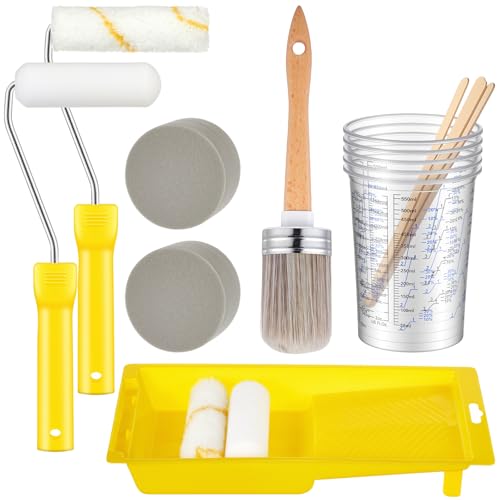
The 4-inch cousin of the previous kit trades a bit of corner maneuverability for faster coverage on flat cabinet panels. You get microfiber rollers, foam mini rollers, a 4-inch paint tray, the same 9.5-inch round brush, and the same mixing setup. The microfiber head is the key upgrade for cabinet work, since it lays down thinner, more even coats than foam on most enamel paints.
For homeowners who want to move quickly across a full cabinet suite without sacrificing the corner detail tools, this kit hits a useful middle ground between the smaller 2-inch set and a full-size wall painting kit.
A Few Highlights
- Microfiber rollers lay down smoother finishes on enamel and alkyd paints than basic foam.
- Two roller frames and four heads let you switch between foam and microfiber without stopping.
- 4-inch tray matches the roller width, so loading is consistent and quick.
- Same round brush, sponges, cups, and sticks as the 2-inch kit keep the workflow familiar.
Practical Considerations
- 4-inch width is a tight squeeze on narrow cabinet rails and inside face frames.
- Microfiber covers shed a few fibers on first use, so a quick wipe before the first stroke is helpful.
Who Will Love This
DIYers tackling flat-panel cabinet doors and drawer fronts who want a faster roller footprint than 2-inch kits offer.
Not Your Match When
The LemonRoad 20-Piece Cabinet Paint Brush and Roller Set is a better fit if you also want nitrile gloves and a polish sponge in the box.
The 20-piece LemonRoad kit is the most complete cabinet-focused set in the roundup. It adds nitrile gloves for stain and enamel work, a polish sponge block for finishing pass sheen correction, and extra mixing cups. Two roller frames and four high-density foam heads let you keep going when one set is still wet from a previous color.
For a whole-kitchen cabinet makeover where you’ll be sanding, painting, and polishing across multiple days, the extras justify the larger kit. For a single dresser refresh, you’re paying for gloves and a polish block you may not reach for.
Useful Strengths
- Nitrile gloves keep hands clean during stain and enamel stages.
- Polish sponge block smooths the final cured coat for higher-sheen finishes.
- Four foam heads support color changes or extended sessions without mid-job washing.
- Round sponges handle detail profiles and recessed panel areas that rollers miss.
A Few Limitations
- Foam-centric setup is less efficient on large flat doors compared to the 4-inch microfiber kit.
- Gloves and polish block are unused weight for quick single-piece projects.
Built With In Mind
Homeowners committing to a full multi-day kitchen cabinet project who want every consumable in a single delivery.
Swap It Out When
The LemonRoad 18-Piece Cabinet Paint Brush and Roller Set (4-Inch) is a leaner choice for a fast single-room refresh.
What Separates A Good Roller From A Streaky One
Nap length is the first decision, and it is the one most often mismatched to the surface. A short nap (1/4 inch or less) puts down thin, smooth films on flat doors and smooth drywall. A medium nap (3/8 inch) is the everyday choice for lightly textured walls, where it reaches into the surface profile without leaving a heavy stipple. Anything longer than 1/2 inch belongs on stucco, brick, and heavy texture, where you actually want the paint to grab and fill the peaks and valleys.
Material matters as much as length. Foam lays down the smoothest film on glossy enamels and cabinets, but it loads up fast on heavy latex and can leave bubbles if you press too hard. Microfiber carries more paint and releases it evenly, which makes it forgiving on walls. Woven and knit covers are the workhorses for big rooms, since they hold up to repeated loading and washing.
Frame and handle feel decide whether your hand gives out before the wall does. A short 4-inch frame gives you corner access for cabinets and trim. A standard 9-inch frame covers most walls efficiently. Extendable poles turn ceiling work from a yoga session into a manageable stretch, and for tall stairwells they are not optional. Look for threaded handles that accept standard poles, since proprietary connections will frustrate you later.
Cleaning is half the project. A quality cover deserves a quality cleaner, which is where the Purdy and PinStone tools in this roundup earn their place. Dried paint on a reusable cover is the leading cause of streaky second coats, and a quick comb-and-rinse between sessions keeps the nap consistent. Foam heads are usually best treated as disposables, since squeezing them tends to tear the cells apart and undo the smooth finish you bought them for.
Finally, match the kit to the job. A bulk microfiber pack is wasted on a single cabinet. A specialty fiberglass kit is wasted on drywall. The right tool for a smooth finish is the one that matches both the surface and the scale of the work, not the most expensive option on the shelf.
Key Considerations Across These Picks
Wrong Turns To Avoid
Buying a long-nap roller for smooth drywall is the most common mistake. The extra nap height doesn’t add coverage, it adds texture. You will end up sanding the stipple off before the second coat, which costs more time than the cheap cover saved you.
Another frequent slip is reusing a foam cover after a long break. Foam that has stiffened, even slightly, will drag and leave visible lines. Treat foam as a one-job consumable, and save yourself the frustration.
Where The Extra Money Goes
Higher-tier kits in this category tend to add genuine consumables rather than fancier handles. Nitrile gloves, polish blocks, extra mixing cups, and a deeper roller count all reduce how many store runs you make mid-project. The premium on the 20-piece LemonRoad kit is essentially paying for project continuity, not better paint performance.
Frequently Asked Questions
What nap length gives the smoothest finish on cabinets? A 1/4-inch nap or a high-density foam roller is the safest bet. Both lay down a thin, even film that minimizes stipple, which is what shows up as orange peel under cabinet lighting.
How often should I replace a roller cover? Swap microfiber covers every room or two, and treat foam as single-use. A cover that has gone dry, stiff, or fuzzy is a cover that is about to leave marks on your wall.
Can I use one roller for primer and paint? Not without a thorough wash. Primers and finishes have different chemistries, and a cover that still holds primer will release grit into your topcoat and dull the sheen.
Do I need a specialty kit for fiberglass repair? Yes, for any wet layup that uses resin. Standard paint rollers do not have the density to push out air bubbles, and the wrong tool can leave delamination that shows up weeks later.
Is microfiber better than foam for cabinets? For most enamel and alkyd paints, yes. Microfiber releases paint more evenly and resists the tearing that foams suffer on heavy coats. Foam still has a place on very small, very smooth pieces where every pass counts.




