


Hanging shingles on a re-roof, fastening underlayment before a storm rolls in, or just needing a quicker way to lay down sheathing, a pneumatic roofing nailer takes a brutal, repetitive job and makes it survivable. The picks below cover a spread of scenarios: dedicated coil roofing nailers for shingle work, cap nailers for underlayment, and a few coil/siding tools that double up for both roofing and exterior trim. Each one is built around the 70-120 PSI range most small compressors already deliver, so setup stays simple. Here’s the lineup.
The Leading Options At A Glance

Metabo HPT Pneumatic Roofing Nailer NV45AB2 (16 Degree)

Maxparts NVH45 15 Degree Coil Roofing Nailer
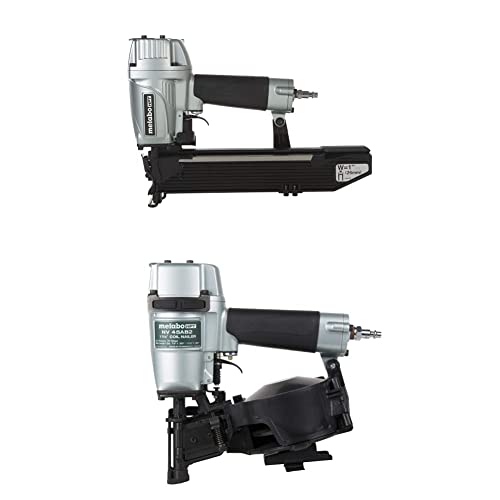
Metabo HPT N5024A2 Stapler and NV45AB2 Combo
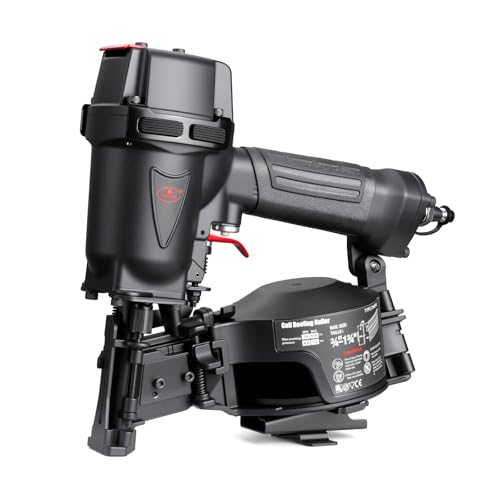
AEROPRO 15 Degree Coil Roofing Nailer 3/4″ to 1-3/4″

toolant Pneumatic Roofing Coil Nailer 15 Degree

STINGER CN100B Pneumatic Cap Nailer

Maxparts CN70 Pneumatic Siding Nailer 1-3/4″ to 2-3/4″
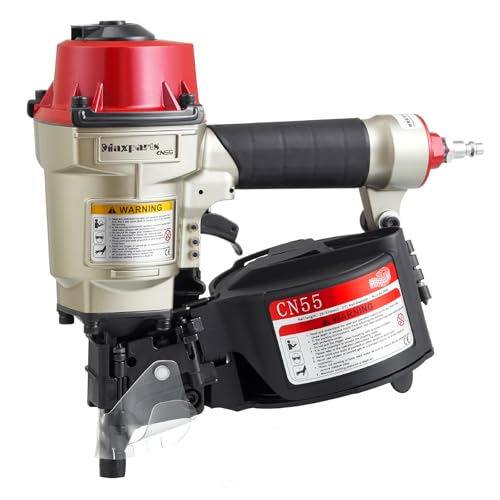
Maxparts CN55 Pneumatic Siding Nailer 1″ to 2-1/4″
The Details Behind The Selections
Metabo HPT’s NV45AB2 is the kind of tool most working roofers default to and never look back. It drives 16-degree wire-collated nails through asphalt shingles, insulation board, and the underlayments that go down before a shingle layer. Compared to the value-focused picks lower on this list, it brings a more mature depth-of-drive system and a reputation for holding up on job after job.
For anyone re-shingling a garage, a mid-size home, or running a small crew, this sits in the sweet spot between capability and weight. The tool-free depth adjustment makes switching between shingle thicknesses painless, and most standard pancake compressors in the 70-120 PSI range feed it without drama.
A Few Strong Suits
- Drives nails flush in asphalt shingles without crushing them, which matters for warranty compliance.
- Tool-free depth dial saves real time when you switch from 3-tab to architectural shingles.
- Side-loading magazine cuts reload downtime on long runs across a roof face.
- Light enough overhead to use on a ladder without wearing out your shoulder by lunch.
Trade Offs
- Like most dedicated roofing nailers, it’s not a great fit for thicker cedar or shake shingles.
- The 16-degree nail angle locks you into a specific collation format, so cheaper generic coils may not always feed smoothly.
Key Specs
Whose Truck It Belongs On
Full-time roofers and serious DIYers re-shingling a home, where balance and reliability matter more than price.
Where A Sibling Pick Shines
The Maxparts NVH45 is a friendlier option for first-timers who only need a nailer for one weekend project.
The Maxparts NVH45 is a 15-degree coil nailer aimed at the DIY roofer who only needs a tool a few times a year. Where the Metabo HPT NV45AB2 is a daily-driver workhorse, this one keeps things simple: a balanced body, a sensitive trigger for controlled placement, and a 120-nail coil capacity so you spend more time nailing and less time reloading.
It’s the right fit for sheds, small outbuildings, and weekend repairs. You won’t get the same level of refinement as the higher-end models, but for one-off projects the trade-off feels reasonable.
The Good Stuff
- Lightweight build reduces arm fatigue when you’re working off a ladder.
- 120-nail coil capacity covers a full shingle square before you reload.
- Drives 7/8″ to 1-3/4″ full-head coil nails, covering most asphalt shingle jobs.
- Sensitive trigger helps with placement around valleys and rake edges.
Points To Note
- The brand is less proven than the legacy names, so warranty service may take more patience.
- Some users report the magazine can stick if the coil isn’t seated perfectly, so alignment matters on each reload.
Best Suited To
Homeowners tackling a single shingle repair or building a small detached structure.
Look Elsewhere When
Roofing professionally, where the Metabo HPT NV45AB2’s build quality and long-term support pay off more.
This Metabo HPT bundle pairs the NV45AB2 roofing nailer from pick 1 with the N5024A2 wide-crown stapler, so you get two tools in one kit. The stapler handles 16-gauge, 1-inch wide crown staples, which is the format used for house wrap, roofing felt, and certain insulation board attachments. The combo also ships with safety glasses.
For roofers who already use staples for underlayment and nails for shingles, bundling saves a separate purchase. The N5024A2 has a long track record with pros and the side-loading magazine keeps things moving during the felt-laying phase of a job.
Advantages To Know
- Two tools for the price of buying them separately, which adds up fast.
- Wide-crown stapler is purpose-built for underlayment and felt attachment.
- Side-loading magazine speeds up staple reloads during repetitive runs.
- Safety glasses included, so the kit is genuinely ready to use out of the box.
Worth Noting
- You’re paying for two tools, so this only makes sense if you actually need both.
- The N5024A2 is great for staples, but it’s not a substitute for a finish nailer on trim.
Feature Snapshot
Who Should Grab It
Working roofers and remodelers who run both staples and nails on the same jobsite, and want one purchase to cover both.
Not Your Match When
You only need a nailer for shingle work, where the standalone Metabo HPT NV45AB2 is the cleaner buy.
AEROPRO’s 15-degree coil nailer is built for people who spend full days on a roof. The 5.5-pound body keeps the gun from dragging you down over a long shingle run, and the 120-nail capacity means you finish a full square of shingles between reloads. The toolless depth-of-drive is the kind of detail that sounds small until you’re 30 feet up adjusting for a thicker shingle.
It runs in the same 70-120 PSI window as the other picks here, so you don’t need a special compressor. For shingle-heavy work, the firing rate and reliability hit a comfortable middle ground.
Features That Help
- 5.5 lb body is light enough for overhead ladder work without wearing out your wrist.
- 120-nail coil cuts reload stops roughly in half compared to smaller magazines.
- Tool-free depth adjustment handles shingle thickness changes in seconds.
- Cylinder-valve drive delivers consistent shots without bogging down.
Honest Caveats
- Brand support and parts availability trail the legacy names.
- Some users notice occasional misfires if the air supply dips under 80 PSI, so a steady compressor matters.
At A Glance
Made For
Roofers and serious DIYers laying down multiple shingle squares in a single day.
Swap It Out When
You need underlayment-grade cap nails, where the STINGER CN100B is the more specialized tool.
toolant’s 15-degree coil nailer leans into crew-level volume. The body is built around 3-nails-per-second firing and a 120-nail coil, so the rhythm on a big re-roof stays unbroken. Compared to the AEROPRO above, the toolant positions itself more toward contractors who run a gun from sunup to sundown.
The 70-120 PSI operating range keeps compressor requirements reasonable, and the tool’s stance is balanced enough to keep a one-handed grip comfortable during long rows of shingles.
Points In Its Favor
- 120-nail coil reduces reload stops during large re-roofs.
- 3 nails per second firing keeps production moving on the steeper pitches.
- Drives 3/4″ to 1-3/4″ coil nails, covering most shingle and underlayment jobs.
- Accepts coils that fit other 15-degree guns, so fasteners stay easy to source.
Small Caveats
- Heavier than some DIY-focused picks, so it can wear out a less-experienced user by mid-afternoon.
- Long-term durability reports are still building since the brand is relatively new.
Right Fit For
Working roofers and small crews who need a coil nailer that holds up under daily production schedules.
Consider Something Else When
You mostly handle small repair patches, where the lighter Maxparts NVH45 makes more sense.
The STINGER CN100B isn’t a shingle nailer, it’s a cap nailer, and that’s exactly the point. Cap nails are the preferred fastener for synthetic roofing underlayment because the plastic cap spreads holding force and resists wind-uplift better than a bare nail. Where the coil roofing nailers above excel at shingle work, this one excels at the felt-or-synthetic layer that goes on first.
It fires around 5 cap nails per second at proper PSI, and the magazine holds 200 caps and 200 nails so you cover a lot of roof before the next reload. If you do any synthetic underlayment installation, this is the right tool for that specific phase.
Bright Spots
- 200-cap and 200-nail magazine means long stretches of underlayment between reloads.
- 5 nails per second firing keeps felt and synthetic underlayment jobs moving quickly.
- Specifically designed for cap-style fasteners, so misfeeds are uncommon in normal use.
- Well-suited for both roofers and deck builders working with house wrap.
Things To Consider
- Not a shingle nailer, so you’ll still need a coil roofing nailer for the top layer.
- Cap fastener cost adds up on big roofs, so plan for consumable expenses.
Feature Card
Who It Suits Best
Roofers and deck builders who install synthetic underlayment or house wrap and need a cap-specific tool.
Reach For A Different Pick When
You’re only fastening asphalt shingles, where the Metabo HPT NV45AB2 handles the main shingle layer properly.
Maxparts’ CN70 sits at the heavier end of this list, driving 15-degree flat wire collated nails from 1-3/4″ up to 2-3/4″. That’s longer than most shingle nailers reach, which makes it a smart pick for thicker siding, fiber cement, and the fascia boards that often get tacked up alongside a re-roof project.
It works in the same 70-120 PSI window as the other pneumatic picks here, so you don’t need anything special on the compressor side. The 15-degree flat wire collation is a slightly different format than the coil roofing nails above, so plan your fastener purchases accordingly.
A Strong Showing
- Handles longer nails (up to 2-3/4″) for thicker siding and trim attachment.
- Rapid-fire cycle keeps production moving on long runs of exterior trim.
- Industrial-grade motor and components support daily use on job sites.
- 15-degree collation is widely available from major fastener brands.
A Few Limitations
- Heavier than the dedicated shingle nailers above, which adds up over a long day.
- Not designed for the tight pattern work shingle nailers do, so it’s a complement, not a replacement.
Perfect Match For
Roofers and remodelers installing thick siding, fiber cement, or deep fascia boards where longer nails matter.
A Better Fit Elsewhere
For pure asphalt shingle work, the Metabo HPT NV45AB2 or AEROPRO delivers the right format and lighter feel.
The Maxparts CN55 trims down the CN70’s reach for lighter trim and siding work. Where the CN70 pushes into 2-3/4″ fasteners, this version stops at 2-1/4″, which is more than enough for most soffit, fascia, and lap siding applications. The shank and head diameter specs also tighten a touch, leaving cleaner holes in thinner stock.
It’s a sensible second-tool companion to a roofing nailer: same 70-120 PSI pressure range, same 15-degree flat wire collation, and a lighter overall feel for the smaller-scale jobs that come up around a roofing project.
Why It Works Well
- 1″ to 2-1/4″ range covers most soffit, fascia, and lap siding work.
- Rapid-fire cycle supports a productive pace on long trim runs.
- Same pressure range as the heavier picks, so no special compressor needed.
- Slimmer shank diameter reduces splitting in thinner trim boards.
Potential Compromises
- Not a roofing nailer, so it can’t handle the shingle layer itself.
- Smaller fastener format may limit reach on thicker subfascia or structural trim.
Key Product Details
Who Will Love This
Roofers and remodelers who also do trim, soffit, and lap siding, and want a versatile companion to a shingle nailer.
Where Another Pick Suits Better
For pure shingle work, the AEROPRO coil nailer handles the main roofing layer with the right fastener format.
Picking The Right Roofing Nailer For The Job
A roofing nailer that feels right for a one-day shed project can feel painfully slow on a full re-roof. The attributes below shape the experience more than any single number on the box, and they line up with how the picks above are positioned.
Match the nailer to the fastener, not the other way around. Roofing nails come in coil format, and the angle of the collation (15 or 16 degrees) determines which gun accepts which coil. The Metabo HPT NV45AB2 and AEROPRO both use 15-degree wire-collated nails, while the Maxparts siding models use flat wire collated stock for a different fastener format. Pick a tool that matches the nails you can actually buy locally, or you’ll burn time hunting specialty coils.
Weight and balance matter more than raw power. Holding a nailer overhead on a ladder for two hours makes a 5.5-pound gun feel like a feather and a 7-pound gun feel like a brick. The AEROPRO and Maxparts NVH45 lean toward lighter use, while the CN70 trades weight for the longer fastener reach that thick siding and fascia demand. Most small compressors in the 70-120 PSI range feed every pick here, so you don’t need to upgrade your air setup.
Underlayment is its own tool. The STINGER CN100B exists because cap nails behave differently from shingle nails, and that’s worth respecting. If you install synthetic underlayment, the cap format prevents wind uplift better than bare nails, and a purpose-built cap nailer saves more time than trying to make a shingle gun fake it.
Durability and brand support still count. The Metabo HPT picks come with a deeper parts and service network than the newer entrants. For a one-time weekend project, that gap matters less. For daily use, it matters a lot.
Key Considerations Across These Picks
Wrong Turns To Avoid
The most common mistake is buying a siding nailer and expecting it to handle asphalt shingles. Siding nailers and roofing nailers use different fastener formats, magazine geometries, and depth settings, so the overlap is limited. The other trap is underestimating how much an underpowered compressor affects nail depth, since a small-tank compressor that cycles constantly will deliver inconsistent PSI, and inconsistent pressure shows up as nails driven too deep or too shallow.
When Paying More Pays Off
The jump from a budget coil nailer to a Metabo HPT or higher-cycle model usually buys you better depth-of-drive refinement, smoother feeding on cheaper coils, and a longer service life under daily use. For a weekend shed, the premium isn’t worth chasing. For a working roofer, it tends to pay for itself in fewer jams and less downtime over a season.
Frequently Asked Questions
What PSI do I need to run a roofing nailer? Most coil roofing nailers, including all the picks above, work comfortably in the 70-120 PSI range that a standard 6-gallon pancake compressor delivers. Staying in the upper half of that range gives you the most consistent nail depth.
Can a roofing nailer drive staples too? Only if the tool is specifically built for both, like the Metabo HPT N5024A2 wide-crown stapler paired with the NV45AB2 in the combo kit. A dedicated shingle nailer won’t accept staples without a major internal swap.
What’s the difference between 15-degree and 16-degree roofing nails? The angle refers to how the nails are collated in the coil. Both work for asphalt shingles, but each tool accepts one angle only, so you need to match your nail purchase to your gun. Mixing angles won’t feed.
How often should I oil a pneumatic roofing nailer? A few drops of pneumatic tool oil before each workday is the common practice among roofers. It keeps the O-rings lubricated and the firing cycle consistent, especially on hot roofs where the air line carries warm, less-humid air.
Is a cap nailer necessary if I already own a roofing nailer? For synthetic underlayment and high-wind zones, cap nails hold better than bare shingle nails because the plastic cap spreads the holding force. A dedicated cap nailer like the STINGER CN100B handles that phase more efficiently than a shingle gun.




