


A rotary laser saves real time on site, whether you’re setting forms for a slab, checking grade on a long driveway, or running a level line around a finished room. The category splits quickly though: cheap red-beam units feel fine indoors, green-beam and dual-slope models earn their keep on bigger outdoor work, and a few heavy hitters are basically surveying tools in a hard case. This list gathers nine rotary lasers that span entry-level DIY through contractor-grade kits, with notes on where each one actually fits in your workflow.
A Snapshot Of The Selections

Spectra Precision LL300N Self-Leveling Rotary Laser with HL450 Receiver

Johnson Level & Tool 99-028K Dual Slope Rotary Laser System

VEVOR Green Rotary Laser Level 2000ft Kit with Tripod and Staff

VEVOR Red Rotary Laser Level 1650ft Kit with Tripod and Staff

VEVOR Rotary Laser Level 2000ft Green Cross Line
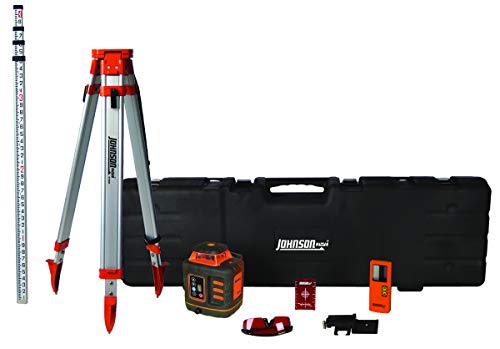
Johnson Level & Tool 99-027K Self-Leveling Rotary Laser System

ROYTOOL Self Leveling Rotary Laser

Johnson Level & Tool 40-6502 Manual-Leveling Rotary Laser

VEVOR Rotary Laser Level Kit, 984ft 360-Degree Red Horizontal
The Picks, Examined More Closely
The Spectra Precision LL300N has been a fixture on contractor sites for years, and it earns that reputation through sheer toughness. The self-leveling mechanism (a built-in compensator that settles the beam on a true horizontal plane within seconds) keeps setup quick, while the hard-shell case stands up to truck beds and rainstorms without complaint. Compared to the green-beam VEVOR models further down this list, the LL300N trades a little visibility for proven durability.
For crews running grade work on a parking lot or setting forms on a long foundation, the HL450 receiver reads the beam at distances a line-of-sight human never could. You’ll spend less time walking back and forth to the unit and more time moving material.
Useful Touches
- One-button self-leveling speeds up daily setup, which matters on tight pour schedules.
- IP66-rated shell shrugs off dust and driving rain on real outdoor sites.
- “Hard hat” rotary housing protects the spinning head from drops and bumps.
- HL450 receiver extends workable distance well past visual line of sight.
Worth Noting
- The kit ships without a tripod, so budget for one if you don’t already own it.
- Red beam becomes harder to see in direct sunlight without the receiver in hand.
Key Specs
Built With In Mind
Working contractors who need a self-leveling rotary that handles weather, drops, and daily truck-bed transport without babysitting.
Reach For A Different Pick When
The VEVOR Green Rotary Laser Level 2000ft Kit is a better match for users who want a green beam and a tripod bundled in the box.
The Johnson 99-028K is the pick for crews who do more than just find level. It self-levels horizontally and vertically, which means the same unit sets forms in the morning and lays out drywall track by afternoon. The dual-slope function (a mode that lets you set a planned grade on each axis independently) takes the math out of drainage work, driveway pans, and parking-lot grade.
For most framers and concrete contractors, this is the kind of tool that quietly replaces a transit. You can dial in a slope on site without dragging out a calculator or second-guessing your readings.
Bright Spots
- Dual-slope mode handles site drainage and ramp work without manual math.
- Vertical self-leveling makes fence layout and partition walls noticeably faster.
- Hard-shell contractor case keeps the kit together between job sites.
Trade Offs
- More setup modes than a basic horizontal unit, so first-time users face a small learning curve.
- Red beam still benefits from a detector in bright outdoor conditions.
Whose Shelf It Belongs On
Concrete, site-work, and framing crews who need grade setting plus vertical layout from the same kit.
Look Elsewhere When
Simpler flat-site work without slope requirements may be handled just as well by the Johnson Level & Tool 99-027K Self-Leveling Rotary Laser System at a friendlier price point.
The green beam on this VEVOR is the headline feature, and it earns the attention. Green wavelengths register roughly four times brighter to the human eye than red, so the beam holds up in conditions where a red unit would wash out. That alone changes how you work outside on bright afternoons. The kit also ships with a tripod and a 5 m staff, which removes the usual accessory scramble.
Where the Spectra LL300N above leans on its receiver for long-range work, the VEVOR’s green line often stays visible to the naked eye at a useful working distance. You can sight off it without pulling a detector out of your pocket every time.
A Favorable Mix
- Green beam stays readable in daylight over longer stretches than red alternatives.
- Bundled tripod and 5 m staff let you start a layout job straight from the box.
- IP66 housing handles dust storms and sudden rain on exterior work.
- Remote control adjusts speed and scanning without walking back to the unit.
A Few Limitations
- Ships in three separate packages, so plan for staggered delivery before scheduling the job.
- NiMH battery pack needs charging overnight before big days on site.
Feature Snapshot
Right Fit For
Site contractors and landscapers running long outdoor runs where a red beam would disappear in daylight.
Skip It When
Indoor-only remodelers get more value from the VEVOR Rotary Laser Level 2000ft Green Cross Line, which adds a cross-line mode for finished rooms.
This is the red-beam sibling to the green VEVOR above, and the case for buying it is the bundle. Tripod, 5 m staff, receiver, and the laser itself all arrive together, so a first-time owner doesn’t have to chase accessories from three different listings. The red beam trades some outdoor visibility for a friendlier entry point on indoor and shaded-site work.
You can stretch to about 1650 ft of working distance, which is plenty for residential foundations, small commercial pads, and landscape grading on a single property.
The Helpful Details
- Complete accessory bundle cuts the shopping list to one purchase.
- Includes a laser detector and tinted glasses for outdoor readability.
- IP66 housing matches the heavier-duty models in the line.
Honest Caveats
- Red beam washes out faster than green in direct sun, so outdoor work leans on the receiver.
- Also ships in three separate packages, which can stretch out delivery timelines.
Best Suited To
First-time rotary buyers who want a turnkey kit without sourcing a tripod and staff separately.
Where Another Pick Suits Better
Regular outdoor crews may prefer the VEVOR Green Rotary Laser Level 2000ft Kit, where the green beam reduces reliance on the detector.
Most rotaries are site tools. This VEVOR splits the difference by adding a cross-line mode, which gives you a fixed plumb and level reference on a wall without the head spinning. That single addition makes it useful for interior trim, cabinetry layout, ceiling grid work, and tile planning in the same day you use it for a patio pour.
The green beam carries the same daylight advantage as the other VEVOR green units, and the IP66 housing plus 5/8″ tripod thread fit standard accessories you may already own.
Practical Advantages
- Dual function covers both spinning outdoor and fixed cross-line interior work.
- Green beam stays readable indoors at greater distances than red units.
- 5/8″ mount thread works with most contractor tripods already on the truck.
Possible Compromises
- Cross-line accuracy on long indoor runs is rarely as crisp as a dedicated line laser.
- Composite housing feels lighter than the all-metal contractor-grade units.
Feature Card
Made For
Finish carpenters, tile setters, and remodelers who jump between interior layout and exterior flatwork within the same week.
Not Your Match When
Heavy outdoor grading without interior cross-line needs is better served by the Spectra Precision LL300N, which has a more rugged build for daily site abuse.
The 99-027K is a wide-field horizontal specialist. With a 2000 ft working diameter, it covers large slabs, long curb runs, and big shop floors without moving the unit. There is no slope mode, which sounds limiting until you realize that on most flat-pour work you’d never touch slope anyway.
Builders who want a “set it and forget it” rotary for big horizontal layout will find this a calmer tool than the slope-equipped Johnson 99-028K above.
What Helps Most
- 2000 ft working diameter reaches across full warehouse and parking-lot layouts.
- IP66 construction holds up on dusty, dry jobsites.
- Hard-shell case simplifies transport between the shop and the field.
Where It May Fall Short
- No slope function, so drainage and ramp work needs a different tool.
- Red beam, like other red units, fades in direct afternoon sunlight without the receiver.
Who It Suits Best
Concrete flatwork crews, warehouse builders, and large-shop owners who only need level, not grade.
Consider Something Else When
Drainage and ramp projects belong with the Johnson 99-028K, which adds the dual-slope function this model lacks.
The ROYTOOL is positioned as a turnkey leveling kit, aimed at one-person operation on smaller jobs. For homeowners building a deck, setting a fence line, or running a perimeter for a shed pad, the simplicity is the selling point. You turn it on, the unit self-levels, and you start working.
It is not a contractor’s daily driver, but it does cover the gap between a basic line laser and a full professional rotary without much fuss.
What Makes Sense
- One-person operation keeps the learning curve short.
- Class IIA laser rating falls within standard consumer-tool safety thresholds.
- Hard-shell case keeps the kit organized between uses.
Some Limits To Know
- Working range and accuracy are tailored to residential-scale jobs rather than commercial sites.
- Long outdoor runs in direct sun will benefit from a separate detector, which may not be in the base kit.
Quick Facts
Perfect Match For
DIY remodelers and homeowners tackling deck, fence, and shed-pad projects who want a real rotary without pro-grade pricing.
A Better Fit Elsewhere
Active tradespeople running daily layout work will outgrow this quickly and should step up to the Spectra Precision LL300N or the Johnson 99-027K.
The 40-6502 is the manual-leveling entry in Johnson’s line, and that one word changes the feel of the tool. Instead of a compensator finding level on its own, you center the bubble vials by hand, which sounds old-fashioned but actually keeps the unit lighter and more affordable. For interior and shop work where the unit sits on a known flat surface, manual leveling is fast and predictable.
You also get a 90-degree split beam in vertical mode and a scan line that moves in either direction, which sounds like a lot of features in a budget tool.
Where It Delivers
- Scan modes in both directions let you simulate a laser line for focused layout.
- Vertical mode with 90-degree split beam covers plumb and square layout.
- Manual leveling avoids the cost of an electronic compensator.
Less-Strong Areas
- Manual leveling means you trust your eye on the bubble vial, so tripod stability matters more than with self-leveling units.
- Limited spec detail in the listing means you may want to confirm the included accessories before relying on a specific use case.
Who Should Grab It
Shops, garages, and DIYers doing interior layout who don’t need a self-leveling compensator and want to keep the cost down.
Swap It Out When
Frequent outdoor or fast-paced site work is better handled by the self-leveling ROYTOOL, which automates the level step.
Closing the list is a more compact VEVOR kit, tuned for remodels and additions rather than full commercial sites. The 984 ft working distance is shorter than its big siblings, but in practice that covers most residential rooms, garages, and single-story additions without any trouble. The kit includes the tripod, receiver, remote, scale, and a toolcase, so it lands as a ready-to-work package.
For a homeowner adding a room or a small contractor running interior buildouts, this is a sensible step up from a line laser without crossing into site-tool pricing.
What It Does Well
- Tripod, receiver, remote, and staff scale all included in the case.
- Self-leveling with manual override handles slightly uneven floors.
- Variable rotation speeds and scan angles fit a range of layout tasks.
What To Weigh
- IP54 rating is a step below the IP66 VEVOR models, so it tolerates dust and splashes but not heavy rain.
- 984 ft range is shorter than the larger VEVOR kits, which matters on open commercial sites.
Technical Highlights
Made For
Homeowners running room additions and small contractors doing interior buildouts who want a complete kit in one case.
Swap It Out When
Bigger open-site grading calls for the VEVOR Green Rotary Laser Level 2000ft Kit, which triples the working range and adds an IP66 seal.
What Matters Most Before Choosing Rotary Lasers
Beam Color and Visibility
Red diodes are cheaper to produce and have powered rotary lasers for decades. Green diodes are roughly four times more visible to the human eye at the same power, which matters most in bright outdoor light or over long indoor runs. For shaded-site and indoor work, red is often enough. For open-sky grading or long sight lines, green earns its higher cost.
Self-Leveling vs. Manual
Self-leveling units use an internal compensator (a small pendulum or electronic sensor that finds true level within a set range, usually ±3 to ±5 degrees) to settle the beam automatically. Manual units rely on bubble vials and your eye. Self-leveling wins on speed and accuracy for daily site work. Manual still has a place in shops and on stable interior floors where the cost savings are real.
Range, Accuracy, and Slope
Working range is the maximum distance the receiver can detect the beam, not the distance you can see it. Match the range to your largest expected job, then add headroom. Accuracy is stated as a tolerance over a distance, like ±1/8 inch at 100 ft, and tighter numbers justify premium pricing. Slope mode is a separate function that lets you set a planned grade on one or two axes, which matters for drainage, ramps, and parking-lot work.
Accessories and Build
A rotary that ships without a tripod, staff, or detector is only part of the purchase. Bundled kits save time but check that the accessories match your workload. IP66 ratings handle real weather on outdoor sites, while IP54 is fine for covered work. For crews who drive the truck to every site, hard-shell cases and reinforced heads pay for themselves in downtime avoided.
Key Considerations Across These Picks
Pitfalls Shoppers Hit
A common mistake is buying a red-beam rotary for full-day outdoor work and then relying on the naked eye to read it. Direct sun washes red out fast, and the receiver becomes mandatory. Another slip is assuming any rotary handles slope. Several of the units here, including the Johnson 40-6502 and 99-027K, are level-only, so grade work needs a different pick. Finally, ignoring IP ratings leaves you with a dead unit after the first real rainstorm.
Where The Extra Money Goes
The jump from a budget rotary to a contractor-grade unit pays for three things: a tougher compensator that survives daily transport, a sealed housing that shrugs off weather, and a more precise beam that holds accuracy over longer runs. For crews who use a rotary every day, those upgrades return the cost in reduced downtime and fewer callbacks. For occasional use, the mid-tier VEVOR kits hit the practical balance for most projects.
Frequently Asked Questions
What is a rotary laser used for?
A rotary laser projects a 360-degree level or plumb reference line around a room or job site. It speeds up concrete forming, drywall track layout, fence alignment, ceiling grid installation, and any task that needs a level or plumb line longer than a standard spirit level can reach.
Are green beam rotary lasers worth the higher cost?
For outdoor work in daylight and long interior sight lines, yes. Green beams are easier to see with the naked eye, so you spend less time waving a detector. For covered or shaded work, a quality red-beam unit performs just as well for less money.
How far can a rotary laser reach?
Entry-level rotaries reach a few hundred feet with a detector. Mid-range kits cover around 1000 to 2000 ft. The exact number depends on the receiver, ambient light, and how clean the air is between the unit and the target.
Do I need a tripod and staff with my rotary laser?
Most owners do. A tripod sets the unit at a working height, and a staff (a graduated measuring rod) lets you read the beam at any elevation. Bundled kits like the VEVOR 1650 ft and 984 ft models include both, which saves a separate purchase.
Can a rotary laser handle rain on a real job site?
Units with an IP66 rating are sealed against dust and powerful water jets, so they handle rain and wash-downs without issue. IP54 models tolerate splashes but should be sheltered from sustained rain. Always check the rating before leaving any rotary out in weather.




