


Corners fight back. A standard 5-inch random orbit pad simply cannot reach the inside angle of a cabinet, the lip of a picture frame, or the seam where trim meets drywall, so most finish work ends up looking fine in the center and ragged at the edges. The picks below pair compact sanding tools with the right abrasive sheets and detail blocks, giving you a real way to clean up those tight zones without gouging or rounding over your crisp lines.
How The Shortlist Stacks Up

DEWALT Palm Sander 1/4 Sheet 14,000 OPM (DWE6411K)

DEWALT Random Orbit Sander Variable Speed 5-Inch (DWE6423)
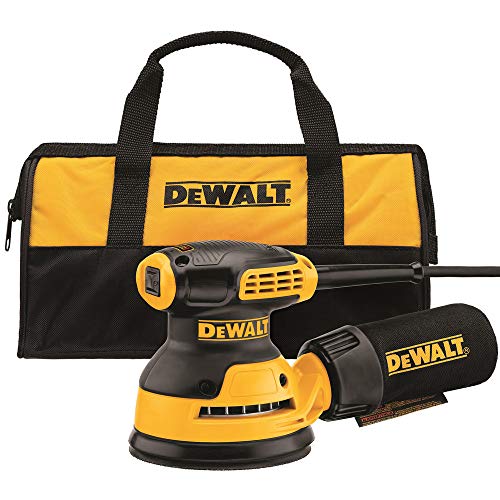
DEWALT Orbital Sander Kit 5-Inch 3 Amp 12,000 OPM (DWE6421K)

DEWALT Orbital Sander 5-Inch 12,000 OPM (DWE6421)

DEWALT 20V MAX Orbital Sander Cordless 5-Inch (DCW210D1)

20 PCS Wet Dry Sandpaper 120-2000 Grit Sheets

180 PCS Mini Detail Sanding Kit with Finger Blocks

30 PCS Wet Dry Sandpaper 80 Grit Sheets

45 PCS Wet Dry Sandpaper 80-5000 Grit Sheets
A Closer Look At Each Pick
The quarter-sheet footprint is what makes this palm sander earn a slot on a corners list. Its 1/4-sheet pad slips into inside corners where a 5-inch random orbit simply cannot follow the angle, and the squared edges let you sand right up to a line without rounding it over. You feel the difference most on face frames, cabinet sides, and the inside of built-in shelves, where a circular pad would leave a soft arc you have to fix by hand later anyway.
A 2.3-amp motor drives the pad at 14,000 OPM (orbits per minute), which is brisk enough for finish sanding on softwoods and gentle on hardwoods when you stay light. The shorter-than-average body keeps your hand closer to the work, and a rubber overmold grip absorbs some of the buzz that otherwise makes long sessions tiring. Compared to the random orbit picks lower on this list, this tool sacrifices speed for shape, trading the swirl-free finish of a round pad for access.
Noteworthy Benefits
- Square pad reaches into inside corners where round pads leave a relief arc
- 14,000 OPM output handles typical finish work without bogging on softwood
- Rubber overmold grip reduces hand fatigue during long trim sessions
- Compact body height keeps your wrist closer to the workpiece for control
- Low-profile design helps when sanding face frames flush to a stile
Things To Consider
- Quarter-sheet format means you cut standard sheets down rather than buying pre-cut
- Pad shape leaves visible scratch patterns that random orbit sanders hide better
Who It Suits Best
Anyone sanding trim, face frames, or cabinet boxes where a square edge matters more than a swirl-free finish will appreciate the access this tool delivers.
Where Another Pick Suits Better
If your project is a wide tabletop or door slab where flatness and finish quality dominate, the DEWALT DWE6421K 5-inch random orbit will feel like a smoother experience.
Variable speed is the headline feature on this 5-inch random orbit, and it changes how the tool behaves across materials. A 3-amp motor spins the pad anywhere from 8,000 to 12,000 OPM, which lets you back off when sanding sealer or veneer and push harder on bare oak or MDF. The hook-and-loop pad swaps abrasive discs in seconds, so you move from 80 to 220 grit mid-project without hunting for a wrench.
Where this model shines on a corners list is the low-profile head, which gets the pad close to the workpiece and lets you sand up to a shoulder or return without the motor housing blocking your line of sight. The rubber overmold grip and separate counterweight keep the tool planted during slower speeds, when random orbits tend to wobble. For a strictly corner-focused workflow, the square pad on the DWE6411K still wins, but the DWE6423 covers the rest of the project between those tight angles.
A Favorable Mix
- Variable speed dial adjusts from 8,000 to 12,000 OPM for different materials
- Hook-and-loop backing changes discs without tools
- Counterbalance design reduces wobble at lower speeds
- 5-inch pad covers wide panels fast between detail work
Trade Offs
- Corded design means dragging an extension cord across the shop
- Round pad cannot follow inside corners without relief cuts
- Variable speed adds a small cost premium over single-speed siblings
Feature Snapshot
Made For
Finish-focused woodworkers and refinishers who want one tool to span coarse stock removal through fine grit prep on flat surfaces and broad edges.
Swap It Out When
Shoppers working primarily on trim, face frames, or inside corners will find the DWE6411K palm sander more useful as a primary tool.
This is the kit version of the DWE6421, and the kit matters because it ships with the dust bag and a carrying case ready to go. The tool itself runs a 3-amp motor at a fixed 12,000 OPM, which is a sensible middle ground for finish sanding on common cabinet and trim woods. You give up the variable speed of the DWE6423, but you also skip the price premium for a feature many casual users never adjust past the factory setting.
The hook-and-loop pad accepts standard 5-inch discs, and the dust bag locks on with one hand so you can empty it without setting the tool down. Pair this sander with a square pad tool like the DWE6411K, and you have a kit that handles both flat panels and inside corners, with the same dust collection family. For most home shop projects, you will find the single-speed operation simpler to teach and harder to misuse.
Key Advantages
- 3-amp motor sustains 12,000 OPM under typical finish-sanding loads
- Hook-and-loop pad swaps 5-inch discs without tools
- One-handed dust bag attachment speeds up cleanup
- Shorter body height improves control near edges
Points To Note
- Single fixed speed limits fine-tuning on heat-sensitive finishes
- Corded only, so a long extension cord is part of the deal
Right Fit For
Weekend refinishers and new homeowners tackling a dresser, a door, or a small set of cabinets will find the all-in-one kit a low-fuss starting point.
Look Elsewhere When
If you are already deep in the 20V MAX battery platform, the DEWALT DCW210D1 cordless sander fits your existing charger setup without dragging a cord across the room.
The bare-tool DWE6421 strips out the dust bag and case to focus on the sander itself, which makes it the right shape for owners who already own a dust extractor or have spare bags from other DEWALT sanders. The motor and pad are identical to the kit version, so you get the same 12,000 OPM random orbit performance in a slimmer box. The savings over the DWE6421K tend to show up for repeat customers who treat the kit accessories as clutter.
For corner-focused work, this sander is a flat-panel workhorse between the tight zones you finish with a palm sander or hand block. The rubber overmold grip and short body height keep the tool planted when you bear into a heavy grit pass, and the counterweight reduces the wrist buzz that builds up across a long refinish. Owners commonly pair this tool with the DWE6411K palm sander to cover both the broad faces and the inside angles on furniture projects.
Real-World Strengths
- Tool-only pricing trims cost for owners who already own accessories
- Counterbalance and rubber grip cut vibration on long sessions
- Hook-and-loop pad accepts any standard 5-inch disc
- 3-amp motor handles sealed finishes without bogging
Honest Caveats
- No dust bag or case means you supply your own collection setup
- Single-speed motor lacks the finesse of the DWE6423 variable-speed model
Best Suited To
Existing DEWALT owners adding a second sander to their kit, or anyone pairing a palm sander for corners with a random orbit for flats without doubling up on accessories.
Not Your Match When
First-time shoppers without a dust extractor or spare bags will save frustration by choosing the DWE6421K kit version instead.
Cutting the cord is the whole point of this 20V MAX sander, and the brushless motor is what makes that practical. A 2.0Ah battery ships in the box along with a charger and storage bag, so you can run a small refinish on a single charge and top up between sessions. The variable speed dial spans 8,000 to 12,000 OPM, matching the corded DWE6423, and you get the same hook-and-loop 5-inch pad for quick disc changes.
For corner work specifically, the cordless format is most useful on staircases, installed cabinets, and exterior trim where running power and managing a cord is its own problem. The trade-off is that any random orbit still leaves an arc at the inside angle, so you will still reach for a hand block on the tightest zones. You may find the 2.0Ah pack limiting on heavy stock removal, but for finish passes it holds up well.
Reasons It Performs
- Brushless motor preserves battery life across finish passes
- Variable speed dial matches pace to grit and material
- Hook-and-loop pad accepts any standard 5-inch disc
- Storage bag and battery ship in the box
Where It May Fall Short
- 2.0Ah battery may run short on extended heavy-grit sessions
- Added cost over corded models for the battery platform
Quick Facts
Perfect Match For
Shops already running 20V MAX batteries who want a sander they can grab and walk to any room without unwinding a cord.
Reach For A Different Pick When
Shoppers without 20V MAX batteries will get more value from the corded DWE6421K, which skips the battery and charger overhead.
Sheets, not a tool, but no corners list is complete without the right abrasive. This 20-pack covers grits from 120 up to 2000, which means you can prep a freshly stripped surface, walk it through intermediate smoothing, and finish into a polish without changing brands mid-project. The sheets are silicon carbide, an abrasive grain that stays sharp longer than aluminum oxide under hand pressure and resists tearing when wet.
Wet or dry use is the practical win: dry sanding handles the bulk of the work, and a quick dip turns the same sheet into a finishing tool for between-coat scuffing on lacquer or conversion varnish. Cut into smaller pieces, the sheets slip behind finger blocks for corner work, which is the real bridge between the power tools on this list and the tightest detail zones. The 120 lower bound means this is not the pack to grab for stripping paint off a deck, but for finish prep it hits a useful middle.
The Case For It
- Grit range from 120 to 2000 covers prep through polish
- Silicon carbide grain cuts cleanly and resists tearing
- Works wet or dry for different finish workflows
- Cuts easily into strips for finger sanding blocks
Some Limits To Know
- Does not include any coarse 80-grit sheets for heavy stock removal
- 20-sheet count runs out fast on full-room projects
Whose Shelf It Belongs On
Finishers and refinishers working through a multi-step clear coat or a polished surface will find this range saves buying two separate packs.
A Better Fit Elsewhere
For pure paint stripping and heavy leveling, the 80-grit Pihemum 30-pack will get the job done in fewer sheets per square foot.
This is the kit that actually solves the problem the rest of the list only flirts with. The 180-piece set includes a compact micro sanding block plus 9 grits from 80 up to 1000, color-coded by stage so you reach for red (coarse), yellow (medium), or grey (fine) without squinting at the back of a sheet. The blocks give your fingers a flat backing, which is the difference between cleaning up a corner and accidentally rounding it over with bare fingertips.
Hook-and-loop backing on the block lets you swap sheets in seconds, so the workflow is closer to using a tiny random orbit than hand-sanding with a loose sheet. Woodworkers commonly reach for kits like this on picture frames, jewelry boxes, and dollhouse trim, anywhere a 5-inch pad is too wide to fit. It is the right scale for the actual job of finishing a corner, and a sensible companion to any of the power sanders above.
Standout Benefits
- Color-coded grit system removes guesswork mid-project
- Hook-and-loop block swaps sheets without tools
- 180 sheets stretch across multiple small projects
- Mini scale fits inside the tightest inside corners
Practical Considerations
- Hand-sanding pace is slower than any powered sander on this list
- Sheets are small, so large flat panels are not the target use case
Feature Rundown
Who Will Love This
Hobbyists, model makers, and furniture repair enthusiasts working on picture frames, drawers, or trim profiles will get more use from this kit than from any full-size sander.
Skip It When
Shoppers focused on broad panels and doors will want the Pihemum 45-pack, which has the sheet sizes to keep up with full-face work.
Eighty grit is the workhorse for stripping, and this 30-pack leans into that single job. Each sheet is silicon carbide with an electro-coated surface, a manufacturing process that distributes grit evenly so the sheet cuts at the same rate across its full face rather than wearing into hot spots. For a corner-focused project, that consistency matters: an inconsistent sheet cuts more on one edge and leaves the inside angle uneven.
The sheets are waterproof, which sounds odd for coarse work but pays off when you need to sand between coats on a sealed surface or knock down dust nibs with a damp sheet. Tear resistance is the other practical detail, since coarse grits tend to rip when you bear into a stubborn spot. Pair this pack with the detail kit above, and you have a system that goes from heavy stock removal on the flats to corner cleanup without changing brands.
What Makes Sense
- 80 grit handles paint stripping and heavy leveling
- Silicon carbide grain resists tearing under pressure
- Waterproof construction supports wet sanding workflows
- Electro-coated grit distribution cuts evenly across the sheet face
Worth Bearing In Mind
- Single-grit pack means buying a separate set for finish sanding
Built With In Mind
Refinishers starting a stripped table or cabinet project who need bulk coarse sheets before they ever touch a fine grit will appreciate the focus.
Another Choice May Suit
For projects that skip straight to finish work, the 20-pack 120-to-2000 grit range saves buying sheets you will not use.
Where the 30-pack commits to coarse work, this 45-pack spans the entire journey from 80 grit to a 5000-grit polish. Fifteen grits in one box means a single purchase covers stripping, smoothing, sealing prep, and a final mirror pass on hard finishes. For corner-focused refinishing on a table edge or a wooden jewelry box, that range is the difference between three separate orders and one shelf-stable kit.
The sheets are the same silicon carbide, electro-coated construction as the smaller packs, so cut quality stays consistent across grits. You will find the 5000-grit end is genuinely useful on conversion varnish, high-gloss poly, or even stone and metal touch-ups, which broadens this pack beyond pure wood. The 45-sheet count is leaner than the detail kit, but the wider grit range justifies the trade-off for full-project workflows.
Positive Takeaways
- Grit range from 80 to 5000 covers the full refinish cycle
- Silicon carbide grain works on wood, metal, and stone
- Wet or dry use fits into multiple finish workflows
- Single purchase replaces several smaller packs
Potential Compromises
- Fewer sheets per grit than dedicated single-grit packs
- Upper grit range sits unused on most wood-only projects
Spec Overview
Who Should Grab It
Refinishers and restorers handling varied projects from raw wood to glossy sealed surfaces will keep this pack on the bench for months.
Where A Sibling Pick Shines
For tight corner hand work, the 180-piece Pihemum detail kit with finger blocks gives you a better physical interface and more sheets per grit.
What To Weigh Before Choosing Sanders For Corners
Pad Shape and Corner Access
The single biggest decision on a corners list is pad shape, because it determines where the tool can actually reach. Square or rectangular pads slip into inside angles, but they leave visible scratch patterns you have to follow up with a finer grit. Round pads cover flats faster and hide swirl marks better, but they leave an arc at the inside corner that you end up cleaning up by hand anyway. Many finishers end up owning one of each shape for that exact reason, treating the sander for corners and the sander for flats as separate tools with separate jobs.
Orbit Speed and Variable Control
OPM, or orbits per minute, is the speed the pad cycles against the workpiece, and the right pace depends on the material. Higher OPM removes stock faster but generates more heat, which can burnish sealer or scorch thin veneer. Variable speed dials like the one on the DWE6423 and the DCW210D1 let you back off on delicate passes and push harder on bare stock, and the trade-off is a small price premium over single-speed siblings.
Corded Versus Cordless
Corded sanders deliver consistent power for as long as you can plug them in, which matters for full-day refinish sessions. Cordless sanders buy you mobility for stairs, installed cabinetry, and exterior trim, but battery life becomes a real constraint on heavy-grit work. The honest read is that cordless makes sense if you already own the battery platform, and corded makes more sense for a stationary bench setup.
Abrasive Compatibility
Hook-and-loop pads, a backing system that grips abrasive discs via tiny hooks, are the modern default on 5-inch random orbits and the detail kit here, and they let you swap grits in seconds. Older clamp-style pads hold sheets with metal clips and still work, but they take longer to change and the clips can bend. Match the pad system to the abrasive inventory you already own, or plan to standardize on one system across your sandpaper stash.
Mistakes Worth Dodging and When Paying More Pays Off
Pitfalls Shoppers Hit
The most common corner mistake is buying a 5-inch random orbit and expecting it to finish an inside angle, which it cannot do without leaving a soft arc. Another frequent miss is ignoring dust collection: a 5-inch pad fills a standard dust bag fast, and once it clogs the motor runs hotter and the abrasive loads up with debris. Finally, do not skip the finer grits on corners, because any scratch you leave at 80 grit will telegraph through paint and most clear coats at the angle where light catches the joint.
When Paying More Pays Off
The premium models on this list earn their keep with brushless motors (which run cooler, last longer, and stretch battery life) and variable speed dials that matter on heat-sensitive finishes. For a single weekend project, the bare-tool DWE6421 covers the same work for less money. For a shop that sands weekly, the upgrade to the DWE6423 or the DCW210D1 pays back through longer motor life and fewer burned finishes.
Frequently Asked Questions
What is the best sander type for inside corners?
A square or rectangular pad sander, like the DEWALT DWE6411K, follows the inside angle without leaving a soft arc behind. For the tightest profiles, a finger sanding block with detail sheets reaches where any power tool cannot.
Can a random orbit sander get into corners?
A standard 5-inch random orbit can sand up to a corner but cannot reach the inside angle, since the round pad leaves a relief arc. You typically pair it with a palm sander or a finger block for the inside angle itself.
What grit sandpaper should I use for corner finishing?
Most wood finishes look best when you step through 120, 180, and 220 grit, and then scuff between coats with 320 or finer. Higher grits like 5000 only matter on glossy sealers or non-wood surfaces.
Is a cordless sander powerful enough for refinishing?
A 20V MAX brushless sander has the power for finish sanding, sealer prep, and between-coat scuffing on typical projects. Heavy stock removal at coarse grits will drain a 2.0Ah battery faster than fine finish passes, so pack a spare for big jobs.
Do I need a special sander for trim and molding?
Trim and molding reward a low-profile sander with a short body height, since the motor housing blocks your line of sight at the joint. Pair a low-profile random orbit with a palm sander for inside corners, and the trim work moves quickly.




