


Stripping paint from wood rewards the right tool and punishes the wrong one. Old latex drips gummy-load an aggressive disc, while lead-era varnish laughs at anything less than serious cutting action. You’ll spend hours chasing swirls with a weak pad, then burn through your arm in minutes with an overpowered one. The eight picks below cover tight moldings, broad tabletops, and everything between, so you can match the tool to the project instead of guessing your way through it.
The Leading Options At A Glance

POLIWELL Micro Sander Kit 3.5” x 1” Mini Sander

DEWALT Orbital Sander Kit, 5-Inch, Variable Speed (DWE6423K)

DEWALT 20V MAX Orbital Sander Cordless, 5-Inch (DCW210D1)

DEWALT Orbital Sander, 5 Inch Palm Sander Tool, 12,000 OPM (DWE6421)
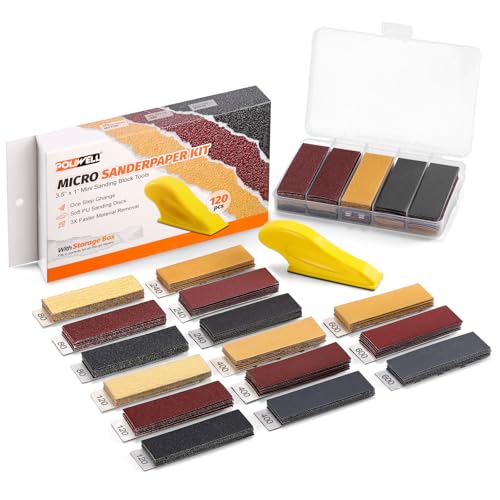
POLIWELL 120Pcs Micro Detail Sandpaper Kit with Hand Sanding Block

Windspeed 2+70 Pcs Mini Detail Sander Set for Crafts

Sanding Mouse Mini Finger Sander with 50 Pre-Assorted Grits

Gioventù Dustless Electric Drywall Vacuum Sander, 950W 8.5A
A Deeper Look At The Lineup
Stripping paint from a turned chair leg or a window sash with a full-size orbital turns into a juggling act. The POLIWELL Micro Sander Kit is built for exactly that awkward middle ground, slipping between balusters where a 5-inch pad cannot follow. The polyurethane foam body sits comfortably under your index finger, and the slim profile reaches into corners a power sander simply overruns.
You get 50 sheets of aluminum oxide paper in five grits, enough to take thick paint off, then refine the wood without restocking mid-project. It’s a manual tool, so your arm provides the cutting power, and that pace suits detail work far better than any plug-in sander would.
What Works In Its Favor
- Flexes into tight spaces where even compact orbitals like the DEWALT DWE6421 cannot reach.
- Five-grit range covers aggressive paint removal down to a smooth finish coat.
- Lightweight foam grip reduces hand fatigue during long detail sessions.
- Aluminum oxide abrasive lasts through multiple paint layers.
- Cost-effective way to start a refinishing project without a power tool commitment.
Things To Consider
- Manual sanding is slow on broad surfaces, so large tabletops will test your patience.
- Foam grips can degrade after heavy contact with solvent-based strippers, so wiping the tool after each session helps.
Whose Shelf It Belongs On
Anyone restoring vintage furniture with intricate moldings or restoring window frames with narrow muntins.
Where Another Pick Suits Better
Refinishers tackling a full dining table should reach for the DEWALT Orbital Sander Kit, 5-Inch, Variable Speed (DWE6423K) instead, since its 5-inch hook-and-loop pad covers flat surfaces in a fraction of the time.
Variable speed matters more in paint removal than most guides admit. Slow the pad on gummy latex and the disc loads up fast; push it on stubborn alkyd and you’ll scorch soft pine before the paint surrenders. The DEWALT DWE6423K runs a 3-amp motor from 8,000 to 12,000 OPM, so you can dial aggression to the coating rather than fighting it.
Compared to the cordless DEWALT DCW210D1 coming up next, this corded kit trades a bit of mobility for consistent power across long sessions. The shorter body keeps the pad close to the workpiece, which improves control on vertical panels where a top-heavy sander drifts.
What Earns Its Place
- Variable speed dial lets you match OPM to paint type, reducing gumming on latex.
- Counterweight design and rubber overmold grip reduce vibration during extended stripping work.
- Low profile brings the pad closer to the workpiece for better leverage on doors and cabinet sides.
- Hook-and-loop pad swaps discs quickly when moving between coarse and fine grits.
Worth Noting
- Corded design limits reach, so extension cords become part of the kit on big projects.
- The included dust bag is functional but fills quickly during heavy paint removal, requiring frequent emptying.
Key Product Details
Right Fit For
Homeowners refinishing cabinets, doors, and flat furniture pieces who want a plug-in workhorse that handles long sessions.
Not Your Match When
Stripping paint in a detached garage without nearby outlets is easier with the DEWALT 20V MAX Orbital Sander Cordless, 5-Inch (DCW210D1), since its battery pack frees you from extension-cord management.
Cords and paint strippers mix badly, both physically and in terms of dust. The DEWALT DCW210D1 runs on a 20V MAX battery, so you can carry it to a backyard fence post, a porch swing, or a barn door without dragging an extension across the floor. The brushless motor sustains 8,000 to 12,000 OPM, the same band the corded DWE6423K covers, so cordless no longer means compromised cutting.
The trade-off shows up in runtime. A 2.0Ah battery handles a small chair project comfortably, but for full table tops you’ll want a second pack charged and ready, since paint removal chews through amp-hours faster than finish sanding does.
Everyday Advantages
- Brushless motor delivers corded-class OPM without voltage drop.
- Variable speed dial mirrors the DWE6423K range, so the learning curve between tools is short.
- Portability opens up outdoor pieces like shutters, rails, and garden furniture that are awkward to bring to a shop.
- Comes with battery, charger, and storage bag, so it’s ready to work out of the box.
Trade Offs
- Battery runtime shrinks under heavy paint load, so extended stripping sessions need a backup pack.
- Heavier than corded equivalents once the battery is mounted, which adds fatigue during overhead work.
Who Should Grab It
Shed restorers, deck furniture refinishers, and anyone tackling outdoor projects far from a power outlet.
A Better Fit Elsewhere
Workshop-based refinishers with a dedicated bench and outlet will find the DEWALT Orbital Sander, 5 Inch Palm Sander Tool, 12,000 OPM (DWE6421) lighter and simpler, since it skips variable speed and battery weight in favor of one-task reliability.
Sometimes the right tool is the simpler one. The DEWALT DWE6421 drops the variable speed dial and sticks to a fixed 12,000 OPM, the same output the DWE6423K tops out at. For most paint-stripping tasks on softwoods and stable hardwoods, that single speed is plenty, and one less control means one less thing to think about mid-stroke.
The 3-amp motor is identical to its variable-speed sibling, and the counterweight plus rubber overmold grip carry over too, so vibration stays manageable even during the long, even passes that flat-panel paint removal demands.
Features That Help
- 3-amp motor with 12,000 OPM handles typical paint layers without bogging down.
- Counterweight and overmold grip reduce hand numbness during multi-hour sessions.
- Compact height improves control on vertical surfaces like cabinet doors and paneling.
- Locking dust bag collects paint chips so the workspace stays manageable.
Honest Caveats
- Single-speed design cannot slow down for heat-sensitive finishes, so caution is needed on veneer.
- Hook-and-loop pad wears faster under heavy paint load and may need periodic replacement.
At A Glance
Best Suited To
Shop owners and hobbyists running repeat paint-stripping jobs who want a reliable, no-fuss workhorse.
Skip It When
Restoring a varied collection of pieces with different paint types points you toward the DEWALT Orbital Sander Kit, 5-Inch, Variable Speed (DWE6423K), since its adjustable OPM handles both gummy latex and brittle varnish.
New to refinishing? The hardest part is usually knowing which grit to grab next. The POLIWELL 120-piece kit solves that by including 24 sheets each of 80, 120, 240, 400, and 600 grit, enough of each to work through a small project from stripped wood to pre-stain surface. The included hand block gives the abrasive backing so it cuts evenly instead of digging in.
It’s a companion to a power sander, not a replacement, since 120 sheets of hand paper won’t outpace a 5-inch orbital on broad surfaces. Where it shines is the trim work around a table edge or the corners a power pad can’t quite clean.
Notable Upsides
- Wide grit range removes the guesswork for first-time refinishers.
- Storage box keeps each grade separated, which prevents mix-ups mid-project.
- Hand block promotes even pressure, reducing the swirls beginners often leave behind.
- Lower per-sheet cost than buying individual packs at a hardware store.
Points To Note
- Paper-only kit assumes you already have a sanding block compatible with 3.5 x 1 inch sheets, though one is included here.
- Hand sanding pace is slow for projects larger than a side table.
Quick Facts
Made For
First-time refinishers picking up a small chair or frame project who want one purchase to cover the full grit sequence.
Another Choice May Suit
Crafters who want a powered finger tool should consider the Windspeed 2+70 Pcs Mini Detail Sander Set instead, since it pairs handles with sandpaper for faster detail work.
Two handles, one hobby, zero excuses. The Windspeed set ships a long-handle and a short-handle finger sander, so deep carvings get the reach they need and shallow reliefs get the control they demand. Pair that with 70 sheets across 40, 60, 80, 120, 150, 220, and 400 grit, and you can strip, shape, and smooth a small wooden sign without swapping tools.
The aggressive grits in the lower range (40 and 60) come in handy when old paint has built up in decorative grooves, where a power sander would bridge across the detail. Manual pressure lets you direct the cut exactly where it’s needed.
Bright Spots
- Long and short handles cover both deep recesses and flat trim in one purchase.
- Seven grit grades tackle everything from thick paint to pre-finish smoothing.
- 40 and 60 grit sheets handle paint that finer papers just polish over.
- Compact enough to toss in a craft drawer without dedicating shelf space.
Potential Drawbacks
- No included storage beyond the packaging, so grit organization requires your own solution.
- Lightweight handles can flex under heavy pressure on stubborn paint.
Who Will Love This
Model makers, sign painters, and small-project woodworkers who need precision more than raw speed.
Look Elsewhere When
Stripping paint from a large cabinet face points you to the DEWALT 20V MAX Orbital Sander Cordless, 5-Inch (DCW210D1), which covers broad surfaces in far less time.
Picture a 2.5 by 1 inch mouse of a sander, and you get the Sanding Mouse Mini. The size is the feature: small enough to slide between stair balusters, thin enough to reach into shutter slats, and shaped to follow the curve of a chair rung. Owners of older homes with original woodwork tend to appreciate that profile most.
You get 50 hook-and-loop strips in five grits (80, 120, 150, 220, and 400), enough to handle a small project end to end. The hook-and-loop attachment makes grit swaps fast, which matters when you keep switching between stripping and smoothing on the same piece.
A Strong Showing
- Slips into gaps where even a 5-inch orbital pad can’t follow.
- Hook-and-loop strips change quickly, keeping workflow steady.
- Five-grit selection covers paint removal through pre-finish prep.
- Lightweight design reduces hand fatigue during detail-heavy work.
Some Limits To Know
- Strip area is tiny, so flat panels take far longer than a power sander would.
- Hook-and-loop backing wears with heavy paint load, so replacement strips should be budgeted.
Perfect Match For
Restorers of antique staircases, louvered doors, and slatted furniture where most of the paint hides in narrow gaps.
Swap It Out When
Prepping a wide flat surface like a tabletop calls for the DEWALT Orbital Sander, 5 Inch Palm Sander Tool, 12,000 OPM (DWE6421), which clears the same paint in a fraction of the passes.
Paint dust is the part nobody talks about until it covers the dining room. The Gioventù Drywall Vacuum Sander addresses that directly with a built-in extraction system and a 950W motor that drives nine variable speeds, so the dust that would normally settle into every surface crack ends up in the vacuum instead.
It’s marketed for drywall, but the same motor and disc geometry handle paint removal on large wood panels, ceiling beams, and built-in cabinetry. For whole-room refinishing, the integrated capture saves hours of post-project cleanup compared to a standard random-orbit sander.
Everyday Wins
- Built-in vacuum system captures fine particles at the source.
- 950W motor provides enough torque for heavy paint layers.
- Nine speed settings cover both aggressive stripping and fine finishing.
- Reduces airborne dust, which helps in occupied homes and finished basements.
A Few Limitations
- Larger and heavier than handheld random-orbit sanders, so arm fatigue builds faster on overhead work.
- Designed primarily for flat surfaces, so it won’t reach into tight moldings where the Sanding Mouse Mini excels.
Feature Snapshot
Built With In Mind
Whole-room refinishing projects and homeowners concerned about dust settling into adjacent living spaces.
Reach For A Different Pick When
Tight detail work on a single chair or cabinet door is better handled by the Sanding Mouse Mini Finger Sander, since its profile fits where this vacuum sander cannot.
What To Weigh Before Choosing Your Paint-Stripping Tool
Match the Sander Type to the Project Shape
Random-orbit sanders like the DEWALT DWE6423K and DWE6421 handle broad, flat surfaces efficiently, since the 5-inch pad covers ground quickly and the orbital motion resists leaving visible swirl marks. Detail sanders and finger blocks (the POLIWELL Micro Sander Kit, Windspeed set, and Sanding Mouse Mini) exist for the opposite problem, namely the grooves, slats, and moldings where a power pad overruns the work. Most paint-stripping jobs involve both kinds of geometry, so owning or combining a powered orbital with a manual detail tool is a common route among restorers.
Mind the Speed, the Grit, and the Dust
Orbital speed, measured in OPM (orbits per minute), affects how aggressively the abrasive cuts. Higher OPM removes paint faster but generates heat, which can scorch thin veneer or load up the disc on gummy latex. Variable-speed sanders like the DEWALT DWE6423K let you slow down for delicate layers and ramp up for heavy buildup. For dust, integrated vacuum systems (like the Gioventù unit) capture particles before they spread, while lock-on dust bags on corded sanders help but require frequent emptying during paint work.
Power Source Affects Where You Can Work
Corded sanders deliver consistent power for long sessions, which matters when stripping a dining set, but the cord limits where you can take the tool. Cordless sanders like the DEWALT DCW210D1 free you to work outdoors, in basements without nearby outlets, or on pieces too large to bring inside, though you trade some runtime for that mobility. Manual detail tools sidestep both concerns but trade your arm for the privilege.
Common Traps When Shopping For Paint-Stripping Sanders
Pitfalls Shoppers Hit
Reaching for the most aggressive sander first is the most common mistake, since high OPM on a delicate wood species can burn through veneer before the paint surrenders. Buying only one type of tool is another trap, since paint hides in places no single sander reaches. Finally, ignoring dust management turns a one-day project into a week of cleanup, especially in homes with HVAC systems that pull particles into every room.
When Paying More Pays Off
Premium sanders in this category earn their higher tier through better vibration damping, more consistent speed under load, and integrated dust extraction. The DEWALT DWE6423K costs more than the single-speed DWE6421, but the variable speed extends abrasive life and reduces burned finishes on softwoods. The Gioventù vacuum sander sits at the top of the list, since its sealed dust capture justifies the cost for anyone working indoors in an occupied home. For occasional projects, a manual detail kit or a basic palm sander handles the work without the premium. For repeat use, the upgrade pays back in time saved and finishes preserved.
Frequently Asked Questions
What grit sandpaper works best for removing paint from wood?
Start with 60 to 80 grit for thick paint layers, then move to 120 to 150 grit to smooth the wood before any finish goes on. Skipping grits leaves scratch marks that show through stain and paint.
Can a random-orbit sander remove paint without damaging the wood underneath?
Yes, with the right grit sequence and steady pressure, since the orbital motion sands evenly without leaving directional scratches. Going too coarse or pressing too hard risks gouging, so lighter passes with finer paper are safer.
Is a cordless sander powerful enough for paint removal?
Modern brushless cordless sanders like the DEWALT DCW210D1 deliver the same OPM range as corded models, so power is rarely the issue. Runtime is the practical limit, so a second battery helps on larger projects.
Should I use a chemical stripper before sanding paint off wood?
For very thick or多层 paint, a chemical stripper softens the coating so the sander removes it faster and with less disc loading. For one or two thin coats, sanding alone is usually enough and avoids the cleanup that comes with chemical strippers.
How do I keep paint dust under control while sanding?
Work in a ventilated space, wear a dust mask, and use a sander with a dust bag or built-in vacuum like the Gioventù unit. Hanging plastic sheeting around the work area also keeps dust from migrating to other rooms.




