


Trim work lives or dies on the prep. Crown, baseboards, door casings: the difference between a pro-level paint job and a DIY patch job almost always traces back to how smooth the surface was before the brush went anywhere near it. Random orbit sanders handle flat faces fast. Detail and finger sanders chase the tight corners, profiled edges, and ridges where a 5-inch pad simply cannot reach. Add a longboard sanding roll for the long stretches, and the trim project becomes genuinely manageable.
This list covers both ends: full-size random orbit sanders from DEWALT, Makita, and Festool, plus a tiny detail sander and a longboard sandpaper roll that pairs with sanding blocks or boards. Corded and cordless options are both represented, so you can pick the platform that fits your shop.
A Fast Comparison Of The Options

DEWALT 20V MAX Cordless 5-Inch Orbital Sander (DCW210D1)

DEWALT 5-Inch Palm Sander (DWE6421)

Makita XOB01Z 18V LXT Cordless Random Orbit Sander (Tool Only)

DEWALT DWE6423 5-Inch Variable Speed Random Orbit Sander
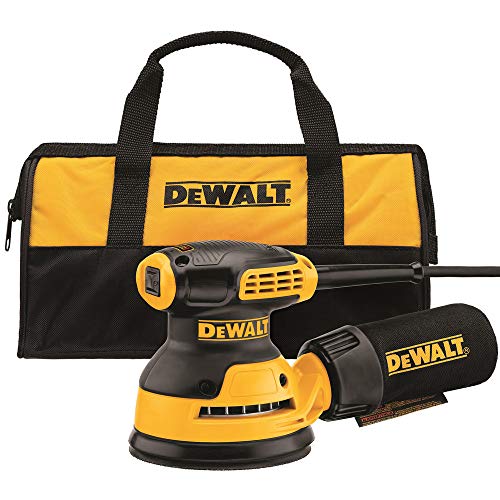
DEWALT DWE6421K 5-Inch Corded Orbital Sander Kit

Makita BO5041K 5-Inch Random Orbit Sander

Festool ROTEX RO 150 FEQ-Plus 6-Inch Sander

Sanding Mouse Mini Finger Sander with 50 Grits

Dura-Gold Gold PSA Longboard Sandpaper 320-Grit Roll
Meet The Standout Selections
Cordless sanders earn their keep on trim because you rarely have a clean outlet within reach of a long baseboard run. The DEWALT DCW210D1 ships with a 2.0Ah battery and charger in the box, so it works as a starter tool or a complement to an existing 20V MAX kit. The brushless motor (a brushless motor uses electronic controls instead of carbon brushes, which generally means longer life and cooler running) keeps the pad speed steady under load, which matters when you’re knocking down a heavy coat of primer.
OPM stands for oscillations per minute, basically how fast the pad moves in a tiny orbit. A variable-speed dial running 8,000 to 12,000 OPM lets you ease off when working across thin profile edges and dial back up for flattening face grain. Compared to the corded DWE6421 below, you trade infinite runtime for the freedom to walk a room without a cord catching on a miter saw stand.
Where It Delivers
- Brushless motor with a wide 8,000-12,000 OPM speed range, so you can match speed to the workpiece and the grit
- Hook-and-loop pad (hook-and-loop means hook-fastener paper sticks on like Velcro, no adhesive needed) for fast disc swaps between grits
- Battery and charger included, useful if you are new to the 20V MAX platform
- One-handed locking dust bag, which keeps your second hand free to hold a flashlight into the corner
- Rubber overmold grip area that helps when you are leaning into a long run of baseboard
Worth Noting
- 2.0Ah battery gives shorter runtime than larger 5Ah packs, so a spare is useful for whole-house jobs
- Replacement hook-and-loop discs cost more than plain PSA adhesive paper (PSA, or pressure-sensitive adhesive, is the stick-on style)
- The included storage bag is soft-sided, so it does not protect the tool on a rough job-site shelf the way a hard case would
Built With In Mind
Trim carpenters and remodelers already running DEWALT 20V MAX who want one battery platform across their drills, impacts, and sanders.
Consider Something Else When
Shoppers without an existing 20V MAX setup should look at the corded DEWALT DWE6423, since it skips the battery outlay and runs all day on any outlet.
The DWE6421 is the older sibling in DEWALT’s 5-inch random orbit family, and you can usually tell because it has fewer buttons. A 3-amp motor delivers a single 12,000 OPM speed with no dial, so there is nothing to fiddle with mid-pass. The shorter housing and rubber overmold grip keep it comfortable for overhead sanding of door casings and ceiling trim.
For trim, the trade-off is speed control. Unlike the variable-speed DCW210D1 above, you cannot slow the pad for delicate profile edges. The separate counterweight (an internal balance that smooths the orbit pattern) does help cut vibration, which matters on a long sanding session. You will appreciate that the one-handed dust bag still works the same way as the more expensive models.
What Helps Most
- Simple single-speed operation removes any learning curve for first-time users
- Low-profile body gets you closer to the workpiece on tight inside corners
- Counterweight design tends to keep the orbit smooth, which helps finish quality
- Hook-and-loop pad accepts standard 5-inch discs from any hardware aisle
Trade Offs
- Fixed 12,000 OPM is on the fast side for finishing passes on soft pine trim
- No bag or case included, so you may want a small tote to keep the cord from tangling
- Corded design ties you to outlet placement, unlike the cordless DCW210D1
Feature Snapshot
Right Fit For
DIYers and weekend renovators who want a no-fuss 5-inch sander for occasional trim and furniture work.
Skip It When
You need a battery platform to roam, in which case the DEWALT DCW210D1 is the cordless upgrade worth stretching for.
The XOB01Z is Makita’s take on the cordless 5-inch random orbit sander, and the obvious appeal is the three-speed switch on the back of the housing. You step between 7,000, 9,500, and 11,000 OPM with a thumb slide, which is genuinely useful on trim where you move between heavy stock removal on a door frame and a light scuff on a finished face. The “tool only” suffix means the battery and charger are sold separately.
Run time on a single 18V LXT charge lands around 40 minutes, which is enough for a typical room of baseboard and casing. If your shop is already blue, you probably already own the batteries. The ergonomics lean toward a slimmer grip than DEWALT’s DWE6421, which is a personal feel thing you really have to hold both to judge.
What Stands Out
- Three-speed selector gives you 7,000 / 9,500 / 11,000 OPM, so the same tool handles rough and finish passes
- 40-minute runtime on a single 18V LXT battery covers most room-sized trim jobs
- Slim grip circumference helps in overhead sanding of door headers
- Pad brake stops the spin quickly when you set the tool down between strokes
Points To Keep In Mind
- Battery and charger sold separately, so total cost climbs if you are new to the 18V LXT platform
- 40-minute runtime is shorter than a corded session, so a spare battery is a smart add-on
- Hook-and-loop pad is the standard 5-inch size, so finding discs is easy but aftermarket pad replacements vary in quality
Who Should Grab It
Makita 18V LXT owners adding a cordless sander to an existing drill and impact setup, particularly trim carpenters who already have spare batteries on the truck.
Look Elsewhere When
You want a kit-ready sander out of the box, since the DEWALT DCW210D1 ships with a battery and charger included.
If you sand trim for a living, the DWE6423 is probably the sander you actually want on the bench. It is a corded model, so runtime is never the question. A 3-amp motor drives a 5-inch pad through a variable 8,000 to 12,000 OPM range, which is the same motor DNA as the DCW210D1, just tethered to the wall. The hook-and-loop pad swap and counterweight design carry over from the older DWE6421.
Where this one earns its place is the variable-speed dial up front, which the DWE6421 does not have. You can dial down to 8,000 OPM for soft pine profiles and crank back up to flatten a heavy layer of joint compound on a baseboard run. Low-profile design keeps the pad close to the workpiece, which helps on inside corners where a tall housing would block your line of sight.
Bright Spots
- Variable 8,000-12,000 OPM dial gives you speed control the single-speed DWE6421 lacks
- 3-amp motor provides steady power under load, even on long trim runs
- Counterweight design and rubber overmold grip help reduce fatigue during full-day sanding
- Hook-and-loop pad accepts any 5-inch hole-pattern disc you already own
Small Caveats
- Corded only, so you need an outlet or extension cord within reach of every work area
- No case or bag included, so storage on a crowded shop shelf is your problem to solve
- Dust bag is small, so emptying it frequently is part of the routine on big jobs
Key Product Details
Made For
Workshop owners and trim carpenters who want corded reliability and a variable-speed dial for switching between heavy stock removal and fine finishing.
Another Choice May Suit
Mobile remodelers without easy outlet access get more flexibility from the DEWALT DCW210D1 cordless model.
The DWE6421K is essentially the DWE6421 we already covered, but bundled as a kit with a carrying case and a dust collection adapter. Same 3-amp motor, same 12,000 OPM single-speed performance, same counterweight design. The kit form is the version you want if you are buying your first random orbit sander and do not already own accessories.
For trim work specifically, the included hard case pays off the moment you start hauling the sander up a ladder or loading it into a trunk. The dust port adapter is the other quiet win, because it lets you hook a shop vac up to the tool instead of relying on the small cloth bag. Owners commonly report that connecting a shop vac dramatically reduces airborne dust when sanding inside finished rooms.
A Favorable Mix
- Carrying case and dust port adapter included, so you can plug into a shop vac from day one
- 3-amp motor and 12,000 OPM cover the typical trim sanding workload
- Lower-profile housing gets the pad close to the workpiece in tight corners
Honest Caveats
- Single speed, so no dial to slow things down on delicate profile edges
- Hard case adds bulk compared to a soft bag, which may be overkill for small shop storage
Who Will Love This
First-time sander shoppers who want the tool, case, and dust port adapter in one purchase, without shopping for accessories separately.
Where A Sibling Pick Shines
Anyone wanting speed control should step up to the DEWALT DWE6423, which adds a variable 8,000-12,000 OPM dial to the same basic platform.
Makita’s BO5041K is a corded 5-inch sander with a 3-amp motor and one of the widest speed ranges on this list, running 4,000 to 12,000 OPM. The dial on the back lets you slow the orbit down for fine sanding of finished trim, which is a real advantage when you are working across clear-coated profiles and do not want to burn through the surface. The rubberized palm grip and top handle are classic Makita ergonomics, comfortable even on long sanding sessions.
Where this sander earns its keep is on the lower end of the speed range. The DEWALT DWE6423 only goes down to 8,000 OPM, so the BO5041K has a real edge when you are hand-sanding a stained piece and need the gentlest possible touch. The trade-off is that the housing is a bit larger than DEWALT’s, which can block your view on inside corners.
Notable Gains
- Wide 4,000-12,000 OPM range, the broadest dial of any sander in this list
- 3-amp motor handles heavy stock removal without bogging down
- Rubberized palm grip and top handle reduce fatigue on long trim runs
- Variable speed dial enables finishing passes on stained or sealed trim
Some Limits To Know
- Slightly taller housing compared to DEWALT’s low-profile models, which can affect sight lines in inside corners
- Corded only, so you need an outlet nearby for any trim run
- 5-inch pad still cannot reach the deep valleys on ornate profile edges
Quick Facts
Best Suited To
Trim carpenters and finish carpenters who want a slow-speed option for sanding stained or sealed wood without burning through the finish.
Swap It Out When
You mostly sand inside corners and tight profiles, where the compact DEWALT DWE6423 has a sight-line advantage.
The Festool ROTEX RO 150 is the outlier on this list, and a category of its own. The 6-inch pad covers a wider area per pass than the 5-inch DEWALT and Makita models, which speeds up work on long trim runs. What makes it special is the multi-mode switch: a single lever flips between aggressive rotary mode for material removal and random orbit mode for fine finishing. Two tools in one body, basically.
The Festool Protector around the pad is a thoughtful detail on trim. The pad shroud extends past the edge of the sanding disc, which means you can sand right up to a wall or window casing without the pad accidentally grinding into the adjacent surface. The FastFix system lets you swap pads without tools, so you can move from a hard pad to a soft interface pad in seconds. None of the 5-inch models above have that level of edge control.
What Earns Its Place
- Dual-mode action: aggressive rotary for fast stock removal, random orbit for fine finishing
- 6-inch pad covers more area per pass, so long trim runs go faster
- Festool Protector shroud lets you sand right up to edges without damage
- FastFix tool-less pad swap for moving between hard and soft interfaces
Things To Consider
- Premium price tier, well above the 5-inch DEWALT and Makita options
- Heavier than a 5-inch sander, which can wear you out during overhead work
- Festool-branded discs and accessories cost more than standard 5-inch hook-and-loop
Perfect Match For
Pros and serious woodworkers who want one tool that handles both rough material removal and fine finishing on door panels, large trim assemblies, and built-ins.
Not Your Match When
Occasional DIYers on a budget get more value from the DEWALT DWE6421, since the ROTEX’s premium features only pay off on frequent, high-stakes finish work.
The Sanding Mouse is a different kind of tool entirely. It is a fingertip-sized detail sander designed to reach where a 5-inch random orbit sander physically cannot. On ornate colonial or craftsman-style trim, the valleys between profiles are too narrow for a full pad, and hand-sanding them with a folded sheet is tedious. The Sanding Mouse fits in your hand like a thick marker and vibrates a small abrasive pad against the workpiece.
It ships with 50 hook-and-loop abrasive strips in five grits: 10 each of 80, 120, 150, 220, and 400. That assortment is useful because the same tool handles rough stock removal on a profiled edge and final scuffing before finish. This is a tool you keep in your apron pocket for the parts of the job the big sanders cannot do.
Benefits That Matter
- Tiny footprint fits between balusters, into profile valleys, and along routed edges
- 50 assorted grit strips included, so you can start a project without buying consumables
- Hook-and-loop strips swap in seconds, no adhesive backing to fuss with
- Lightweight, so it does not tire out your hand during detail work on a full day of trim
A Few Limitations
- Small pad covers very little area per pass, so it is not a tool for sanding flat faces
- Not a substitute for a full random orbit sander on large trim runs
- Power output is modest compared to corded 5-inch models, so deep material removal is slow
Whose Shelf It Belongs On
Trim carpenters and restorers who regularly work on profiled or historic moldings where a 5-inch pad is too big for the geometry.
Reach For A Different Pick When
Most of your sanding is on flat door faces or wide baseboards, where the DEWALT DWE6423 covers ground much faster.
No random orbit sander does its best work without the right abrasive under it, and the Dura-Gold Gold PSA roll is a smart complement to any tool on this list. The roll is 2-3/4 inches wide by 20 yards long, so you can cut it down to fit a longboard sanding block, a hand-sanding block, or a custom profile tool. PSA means pressure-sensitive adhesive: peel and stick the cut piece to whatever you are using as a backing.
At 320 grit, this is a finishing-grade abrasive. It is the grit you reach for after a random orbit sander has done the heavy flattening, when you want to scuff the surface for primer or burnish a coat of finish between coats. The aluminum oxide abrasive with zirconia alumina fusion is built for long life, so the roll tends to last across multiple trim projects rather than a single weekend.
Strong Points
- 20-yard roll lets you cut custom lengths for any block or profile tool you already own
- PSA backing sticks firmly to standard longboard sanding blocks
- 320 grit is the right finishing grade for scuffing between coats or prepping for primer
- Aluminum oxide with zirconia alumina fusion is built for clog resistance and long life
Details To Watch
- 320 grit is too fine for stock removal, so it pairs with a power sander rather than replacing one
- 2-3/4 inch width does not fit every sanding block on the market, so check your block dimensions first
- PSA adhesive loses tack over many uses, so high-volume shops eventually replace the backing pad
Who It Suits Best
Tradespeople and DIYers who already own a longboard sanding block and want a finishing-grade abrasive that adapts to multiple block sizes.
A Better Fit Elsewhere
Anyone without a longboard block should look at hook-and-loop disc packs for the DEWALT DWE6421K, since the abrasive will mount directly to the sander pad.
What Matters Most Before Choosing Sanders For Trim
Speed Range and Variable Control
Random orbit sanders spin their pads at thousands of oscillations per minute. Variable-speed models, like the Makita BO5041K and DEWALT DWE6423, let you slow the orbit for fine finishing or speed it up for heavy material removal. A single-speed sander like the DEWALT DWE6421 keeps things simple but limits your control. Trim carpenters who move between rough sanding of unfinished profiles and finishing passes on stained wood usually benefit from a wider OPM range.
Pad Size and Geometry
A 5-inch pad handles most trim sanding. The Festool ROTEX RO 150 steps up to 6 inches for faster coverage on long runs. Detail work on profiled or routed edges calls for a finger sander like the Sanding Mouse, because a full-size pad cannot reach into the valleys. Pair the right pad size with the geometry of your trim, and a 30-second test pass usually tells you whether the tool fits.
Corded vs Cordless
Corded sanders like the DWE6421 and BO5041K run as long as you have power. Cordless models like the DEWALT DCW210D1 and Makita XOB01Z trade runtime for mobility. Trim work that takes you up ladders, across rooms, and away from outlets often favors cordless, even if you pay more for the battery platform.
Dust Collection
Trim sanding happens inside finished homes, so dust control is not optional. One-handed locking dust bags collect a lot of the mess. A shop-vac-ready dust port, like the one in the DEWALT DWE6421K kit, cuts airborne dust dramatically. For most homeowners, a vacuum hookup is the single biggest comfort upgrade you can add to any sander.
Hook-and-Loop vs PSA Pads
Hook-and-loop (Velcro-style) pads swap discs quickly, which is the standard on every sander in this list. PSA, or pressure-sensitive adhesive, is stick-on paper. It costs less per disc and is common on sanding blocks and longboard rolls, but it is slower to swap. Pick hook-and-loop on a power sander you use often, and PSA on hand-held blocks.
Key Considerations Across These Picks
Common Shopping Slip Ups
The most common mistake is buying a sander that is too big for the job. A 5-inch random orbit sander is the right tool for flat trim faces, but it cannot reach the valleys on a profiled colonial casing. Shoppers who skip a detail sander for that geometry end up hand-sanding with a folded sheet, which is tedious. Conversely, buying only a finger sander leaves you sanding flat faces by hand for hours. The right kit usually pairs both.
Another slip is ignoring the battery situation. Cordless sanders like the DEWALT DCW210D1 and Makita XOB01Z work best when you already own the battery platform. Buying the tool-only version without spare batteries on hand cuts your run time to whatever is left in that single pack. A spare 5Ah battery generally triples the practical workday of any cordless sander.
Where The Extra Money Goes
Premium sanders like the Festool ROTEX RO 150 cost more because they do more. The dual-mode action (rotary plus random orbit) replaces two separate tools, the edge-protecting pad shroud prevents rework on adjacent surfaces, and the FastFix pad system lets you change interfaces in seconds. None of that is necessary for a single weekend project, but for a trim carpenter running these tools daily, the time saved adds up fast.
Higher-tier models also tend to have better vibration damping, which is a real ergonomic factor. Sanding trim is repetitive, and a sander that transmits less sting into your hand at the end of an 8-hour day is worth the upcharge. The counterweight designs in DEWALT and Makita sanders are the same idea at a lower price point, so you do get some of that benefit in mid-tier picks like the DWE6423.




