


Cedar decking rewards careful fastener choices. The tannins in cedar react with plain steel, leaving dark streaks around every screw head, and outdoor exposure punishes fasteners that lack proper coating. Stainless steel and epoxy-coated screws solve both problems, but picking the right length, thread pattern, and head style for your specific boards takes a bit of homework. DIYers building a new deck and homeowners replacing a few rotted boards both need fasteners that hold tight, seat cleanly, and survive years of rain and sun without bleeding rust down the face of a premium wood board.
The Lineup, Simplified

Wensilon #12 x 2 Black Hex Exterior Lag Screws
Deck Plus Deck Screws #10 x 2-1/2in Tan

Deck Plus Wood Screws #8 x 2in Tan

Deck Plus Deck Screws #10 x 3in Green

Deck Plus Wood Screws #10 x 3in Tan

Wensilon #10 x 3″ Deck Screws Bronze

Wensilon #10 x 3″ Black Deck Screws
Wensilon #10 x 3″ 304 Stainless Steel Deck Screws

LIONMAX Deck Screws 3-Inch 25 lb Bulk
The Details Behind The Selections
Where most deck screws finish a board face, lag-style fasteners like these Wensilon hex heads are built to anchor ledger boards, posts, and structural framing. The #12 shank measures 5.5 x 50mm, which lands at roughly a 2-inch working length and delivers real holding power through thick cedar members. A black rust-resistant coating keeps the head from flashing on darker stains, and the integrated washer face spreads clamping load across softer cedar fibers.
You won’t use these by the box on the decking surface, but they earn a spot on any deck project where a structural connection matters. Compared to the Deck Plus #10 x 2-1/2in tan screws later in this list, these are heavier, slower to drive, and aimed at a different job: framing and load-bearing attachments rather than face-fastening deck planks.
What Pays Off
- Hex head (six-sided socket) design delivers maximum torque transfer without bit slip during structural driving.
- Self-tapping serrated tip eliminates pilot holes on most cedar connections, saving setup time on the jobsite.
- Washer-head face distributes clamping load, reducing the chance of crushing softer cedar at attachment points.
- Carbon-steel core with a rust-resistant coating handles outdoor exposure on ledger boards and posts.
Points To Keep In Mind
- Only 43 pieces per pound, so the count runs low for any large framing job, which may mean buying multiple units.
- Black coating is decorative-grade; for high-corrosion coastal settings, the 304 stainless option later in the list outlasts it.
Right Fit For
DIYers framing deck stairs, securing ledger boards, or anchoring pergola posts where lag-style grip matters more than face-fastening speed.
Reach For A Different Pick When
You need face-fastening screws for 5/4 cedar deck boards, where the Deck Plus #10 x 2-1/2in Tan gives a cleaner, faster install.
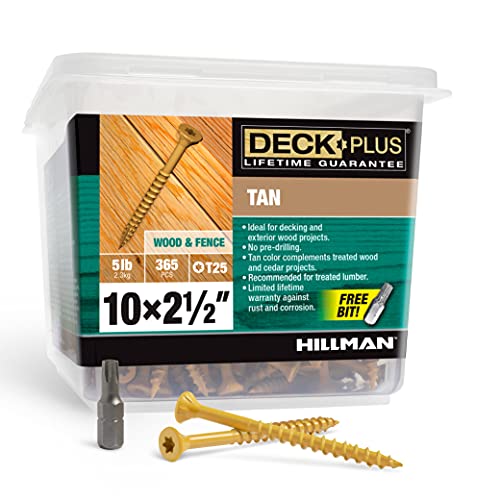
Deck Plus’s tan-headed #10 x 2-1/2in screw is the everyday workhorse for cedar deck surfaces, and it shows up here for good reason. At 365 pieces per 5-pound box, you get enough fasteners for roughly 75 to 100 square feet of 5/4 cedar decking, depending on joist spacing. The tan epoxy coating blends with the warm tones of new cedar, and the four-layer corrosion protection holds up through rain cycles and pressure-treated lumber contact.
A self-drilling point and coarse thread pair up to cut pilot-hole work on most cedar boards, so installs move fast. The Torx star drive (a six-lobed bit pattern that grips tighter than a Phillips) keeps the bit engaged under heavy driving torque. For homeowners resurfacing a tired cedar deck or building a new platform, this is a practical anchor pick.
Where It Helps
- Tan color blends with cedar and other light woods, hiding screw heads on visible deck surfaces.
- Four-layer epoxy coating resists corrosion from pressure-treated lumber contact and weather exposure.
- Self-drilling tip with coarse thread pattern eliminates most pilot-hole work on standard cedar boards.
- Torx star drive grip prevents cam-out (bit slipping out of the screw head) during high-torque driving sessions.
Trade Offs
- Tan tone may stand out on darker stained cedar, so matching stain color matters for a finished look.
- 5-pound box weight is awkward for one-handed carry up ladders on multi-level builds.
Key Specs
Made For
Homeowners resurfacing cedar decks or building new platforms where tan-toned fasteners blend with natural wood and one box covers the average project.
Look Elsewhere When
You need a longer shank for thick 2x cedar rails, where the Deck Plus #10 x 3in Tan reaches deeper for a stronger bite.
Thinner cedar planks and trim boards call for a slimmer shank, and the Deck Plus #8 x 2in delivers without over-driving into soft wood. The #8 gauge (a smaller diameter than the #10 used elsewhere in this list) leaves a cleaner entry hole in 1x cedar, and the 2-inch length sinks deep enough into standard joists without bottoming out. The tan epoxy finish keeps the head from flashing against light wood tones.
You get 625 pieces per 5-pound box, which is plenty for fascia, privacy screens, and planter box projects. Compared to the heavier #10 x 2-1/2in Deck Plus screws, this is the better fit when board thickness and split risk matter more than raw holding power.
A Few Highlights
- Slimmer #8 shank reduces splitting risk on thin cedar trim and 1x planks.
- Self-drilling point eases installation on narrow boards where pilot holes are awkward to drill.
- 625-piece count per box handles large trim and accessory projects without frequent restocking.
- Tan coating matches light cedar tones and resists the tannin staining common with plain steel screws.
Some Limits To Know
- Shorter 2-inch length provides less bite into joists, so it suits trim and thin boards more than structural deck surfaces.
- Smaller head profile can be harder to spot for future board replacement work.
Feature Snapshot
Best Suited To
Finish carpenters and DIYers fastening cedar trim, fascia boards, and thin planks where a smaller shank prevents splits and a clean look matters.
Skip It When
You need structural hold on a deck surface, where the Deck Plus #10 x 2-1/2in Tan grips thicker boards with more authority.
The green-toned Deck Plus #10 x 3in is built for outdoor wood projects where the fastener needs to disappear against vegetation or pressure-treated framing. The 3-inch shank sinks into thicker stock like 2×4 rails, joist doubling, and privacy screen frames without bottoming out. A four-layer epoxy coating in green blends with landscaping palettes and helps the head hide on stained green-tinted lumber.
For cedar specifically, this color choice is less natural-looking than the tan options earlier in the list, so it’s a smarter fit when you’re fastening substructure or framing rather than the visible deck surface. The 310-piece count per 5-pound box matches a mid-sized framing job.
Points In Its Favor
- 3-inch length provides solid grip into 2x framing and doubled joist configurations.
- Green epoxy coating blends with pressure-treated lumber and outdoor landscaping settings.
- Self-drilling tip and coarse thread eliminate most pilot holes on standard framing lumber.
- Corrosion-resistant finish handles contact with pressure-treated chemicals without bleeding rust.
Honest Caveats
- Green color stands out against natural cedar, so it works best on framing rather than visible deck surfaces.
- Smaller piece count per box than shorter Deck Plus options, so framing jobs may need multiple boxes.
Who Should Grab It
Builders fastening deck substructure, fence framing, or pergola beams where a green head disappears into treated lumber and the longer shank reaches deeper into thicker stock.
Consider Something Else When
You want the head to vanish on natural cedar face boards, where the tan Deck Plus #10 x 2-1/2in offers a closer color match.
Where the 2-1/2in Deck Plus handles standard 5/4 deck boards, the #10 x 3in tan version is the answer for thicker cedar stock. The extra half-inch of shank reaches into 2x cedar rails, stair treads, and doubled joist configurations with enough bite to hold without bottoming out. The tan epoxy finish sits naturally against cedar grain and the four-layer coating stands up to weather without bleeding tannin stains.
At 310 pieces per 5-pound box, the count is generous enough for one large deck surface or a full set of stairs. The Torx star drive and self-drilling point work the same way as the shorter version, so transition between sizes on a single project feels familiar.
Notable Gains
- 3-inch shank reaches into thick cedar rails and stair treads where shorter screws bottom out.
- Tan coating matches natural cedar and resists tannin-driven staining around the head.
- Four-layer epoxy barrier handles outdoor moisture cycles and pressure-treated lumber contact.
- Self-drilling tip keeps installation fast on most cedar without pre-drilling every hole.
Points To Note
- Over-driving is a real risk on dense cedar, so adjusting drill clutch settings matters.
- Longer shank means slight protrusion risk on thinner boards where it can punch through the back face.
Perfect Match For
Homeowners building cedar staircases, bench seating, or thick rail systems where standard-length screws lack reach and the tan tone needs to blend with the wood surface.
A Better Fit Elsewhere
You are fastening standard 5/4 deck boards, where the Deck Plus #10 x 2-1/2in Tan keeps the screw from punching through the back of thinner stock.
Wensilon’s bronze-coated #10 x 3″ deck screw takes a different visual angle from the tan Deck Plus options. The bronze tone reads warmer against cedar with reddish or amber stains, hiding the head on richer finishes. A four-layer epoxy coating over heat-treated carbon steel handles the same outdoor exposure as competing picks, and the included T25 star bit means you can start driving without hunting for a compatible driver.
Serrated threads under the head help reduce board mushrooming (the raised bump that forms when a screw pulls wood fibers upward) on softer cedar. At 137 pieces per 2-pound box, the count is sized for smaller repair jobs or finishing work rather than a full build. For a complete deck, you’d likely need multiple boxes.
The Practical Payoff
- Bronze finish pairs well with stained cedar in warm or amber tones, hiding the head on finished surfaces.
- Four-layer epoxy coating and heat-treated steel handle weather exposure and pressure-treated contact.
- Serrated threads under the head reduce mushrooming on softer cedar boards during driving.
- Included T25 bit lets you start the project without sourcing a separate driver.
Where It May Fall Short
- 137-piece count per box is small for full-deck coverage, so larger builds mean buying multiples.
- Bronze tone contrasts on gray or weathered cedar, where tan or stainless would match better.
Who It Suits Best
Homeowners completing a cedar deck repair or staining project with warm-toned finishes who need a smaller batch and an included driver bit.
Swap It Out When
You need to cover a full deck surface in one purchase, where the LIONMAX 25 lb bucket handles a complete build with extras on hand.
Dark-stained cedar and black composite boards present a problem: a tan or bronze screw head becomes a polka-dot pattern across the deck surface. The Wensilon #10 x 3″ black deck screw solves that by vanishing against dark finishes. The 3-inch shank handles 2x cedar and standard 5/4 composite stock, and the four-layer epoxy coating over heat-treated steel provides the same outdoor protection as the bronze sibling earlier in this list.
A T25 star drive and self-drilling tip keep the install moving, and the included driver bit means no extra trips to the hardware store. For dark-stained cedar, charred-wood finishes (shou sugi ban), or composite decking, the head color does most of the work in making a clean installation look intentional.
Everyday Advantages
- Black head color disappears on dark stains, charred finishes, and composite deck boards.
- Four-layer epoxy coating handles weather and pressure-treated lumber contact without bleed.
- 3-inch length reaches into 2x cedar and standard composite thicknesses for solid hold.
- Included T25 bit matches the included fasteners for fast project startup.
Smaller Caveats
- 137-piece count per box suits a small repair or single section rather than a full deck.
- Black coating is decorative, so it still relies on the carbon-steel core rather than full stainless protection.
Built With In Mind
Homeowners working with dark-stained cedar, charred wood finishes, or black composite boards where screw head color needs to vanish into the surface.
Another Choice May Suit
You’re near the coast or in a wet climate, where the Wensilon 304 Stainless option provides full-body corrosion resistance rather than coated protection.
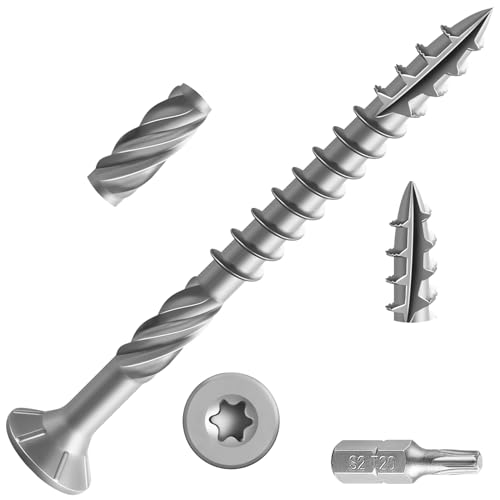
Coastal builds, pool decks, and humid climates punish ordinary coated screws. The Wensilon 304 stainless deck screw addresses that head-on. 304 stainless steel is a chromium-nickel alloy that resists rust at the molecular level, not just on the surface, so even when the head gets scuffed during installation, the underlying metal keeps its integrity. The 3-inch #10 shank handles 2x cedar framing and standard deck board thicknesses.
A bronze epoxy coating on top of the stainless adds a finished look that blends with cedar grain. The T25 star drive and self-drilling tip install the same way as the carbon-steel Wensilon options, but the body of the fastener survives decades of exposure. For homeowners close to saltwater or in regions with constant humidity, the upgrade in material is worth the higher per-piece cost.
What Stands Out
- 304 stainless steel body resists rust through the entire fastener, not just the surface coating.
- Handles coastal salt air, pool-splash zones, and high-humidity climates without bleed-through.
- Bronze finish layer adds visual warmth against cedar grain tones.
- 3-inch length reaches into thick cedar and standard deck board configurations for solid bite.
What To Weigh
- Stainless costs more per piece than coated carbon-steel options, so large builds add up quickly.
- 151 pieces per box suits a small to mid-sized deck; full builds may require multiple boxes.
Key Specs
Whose Shelf It Belongs On
Coastal and waterfront property owners, or anyone building near pools, sprinklers, or humid regions where ordinary coated screws stain the deck face over time.
Where A Sibling Pick Shines
You are building a small inland deck on a budget, where the bronze Wensilon #10 x 3″ with carbon-steel core offers similar visual results at a lower per-piece cost.
When the project is a full deck, a large fence run, or a wraparound porch, the small 2-pound and 5-pound boxes from earlier picks mean dozens of trips to the retailer. The LIONMAX 25-pound bucket solves that with 1700 pieces of #10 x 3″ tan deck screws in one container, ready for an entire build. The reusable bucket also doubles as storage for offcuts and hardware between phases of the work.
The tan coating is rated through 1500 hours of salt-spray testing, which signals serious protection against coastal and humid exposure. Three T-25 star drive bits ship in the bucket, so a worn bit mid-project doesn’t stop the work. For contractors and serious DIYers running a full deck build, the per-piece cost drops and the convenience factor jumps.
Positive Takeaways
- 1700-piece count covers an entire deck or fence build with extras left for future repairs.
- 25-pound reusable bucket doubles as jobsite storage and keeps fasteners organized between project phases.
- Three included T-25 bits mean a spare is always available if the primary bit wears mid-project.
- Tan epoxy coating rated through 1500 hours of salt-spray testing for serious corrosion resistance.
Potential Compromises
- 25-pound bucket is heavy to carry onto upper-level decks or distant job sites.
- Bulk format is overkill for a small repair, leaving most of the supply unused for months.
Feature Rundown
Right Fit For
Contractors and DIYers running a full deck build, large fence run, or multi-section project where buying in bulk saves trips and per-piece cost.
Not Your Match When
You only need a few dozen screws for a small repair, where the Wensilon 2-pound boxes offer better storage and less leftover inventory.
Picking The Right Fastener For Your Cedar Project
Cedar rewards fastener choices that account for tannin reaction, board thickness, and climate exposure. Tannins are the natural compounds in cedar that bleed dark stains around plain steel screws, so any fastener going into visible cedar needs a coated or stainless body to keep the deck face clean.
Match Length To Board Thickness
Standard 5/4 cedar deck boards (which actually measure about 1 inch thick) work with 2-1/2 inch screws, since the fastener needs to sink at least 1 inch into the joist below. Thicker 2x cedar rails and stair treads need a 3-inch screw to reach the framing without bottoming out in the board. Picking shorter than the board-plus-joist depth leaves the connection weak, while going too long risks punching through the back of thinner stock.
Choose Coating Based On Climate
Coated carbon steel handles most inland climates, especially when paired with a four-layer epoxy system rated for outdoor exposure. Within 10 to 15 miles of saltwater, near pool splash zones, or in regions with constant humidity, 304 stainless steel resists corrosion at the metal level rather than just the surface. The visual cost of stainless is higher per piece, but the structural cost of rust bleed down a cedar face lasts decades.
Size Shank To Board Density
Slimmer #8 shanks reduce splitting on thin cedar trim and 1x planks, but they offer less holding power than #10 screws on wider deck surfaces. A 1x cedar fence board can split around a #10 shank near the end of a board, while a 5/4 deck board handles a #10 with room to spare. Match the gauge to the board density rather than defaulting to the largest screw available.
Pick Head Color For The Finish
Tan screws blend with natural cedar, bronze tones match warmer stains, green disappears into treated lumber, and black vanishes against dark finishes. The head color matters as much as the coating performance, because visible screw heads become polka dots on an otherwise clean deck surface. Choose the tone that matches the finished look you want, not the raw wood color, since stains change the visible surface significantly.
Key Considerations Across These Picks
Common Shopping Slip Ups
The most frequent mistake in this category is buying plain zinc or unfinished steel screws because they cost less per box. Once those fasteners meet cedar tannins and weather, the rust bleed down the board face becomes permanent and nearly impossible to remove without sanding. Match the coating tier to the project exposure, and skip the cheapest option for any visible cedar work.
What The Higher Tier Buys
Moving from coated carbon steel to 304 stainless roughly doubles the per-piece cost but removes the rust-bleed risk entirely and extends fastener life well past the cedar boards they hold. For inland decks with a 10-year expected lifespan, coated options are usually enough. For waterfront builds, humid climates, or premium cedar work intended to last 25 years or more, stainless earns its higher price through decades of clean board faces.
Frequently Asked Questions
Do you need special screws for cedar decking?
Cedar contains natural tannins that react with plain steel, leaving dark stains around screw heads. Coated deck screws or stainless steel fasteners prevent this reaction and keep the deck face clean over time.
How long should screws be for 5/4 cedar deck boards?
Standard 5/4 cedar boards run about 1 inch thick, and a 2-1/2 inch screw gives roughly 1 inch of bite into the joist below, which is the minimum for solid hold. Longer 3-inch screws work for thicker stock or doubled joist configurations.
Can you use coated deck screws near the ocean?
Coated carbon-steel screws handle most climates but struggle within a few miles of saltwater, where constant salt exposure breaks down epoxy layers over time. 304 stainless steel is the better pick for coastal builds and pool deck areas.
What is the difference between Torx and Phillips deck screws?
Torx star drives (a six-lobed bit pattern) grip the screw head with more contact surface than Phillips, which means less bit slip during high-torque driving. For deck work where lots of screws go in fast, Torx reduces stripped heads and cam-out.
Should cedar deck screws be pre-drilled?
Most self-drilling deck screws with a sharp tip and coarse thread pattern eliminate pre-drilling on standard cedar boards. Pre-drilling still helps near the ends of boards where splitting risk runs higher, especially with denser cedar varieties.




