


Hanging cement board in a tub surround or tiling a laundry-room floor looks straightforward until the wrong fastener snaps halfway through the second sheet. The right screws for cement board are corrosion-resistant, counterseat cleanly below the surface, and drive without stripping in dense, abrasive material. You want fasteners sized for the board thickness and the stud spacing underneath, with heads that do not telegraph through tile.
The list below focuses on screws commonly recommended for cement board installation alongside the broader family of sheet-metal and concrete fasteners, so you can match each pick to the specific substrate you are actually fastening into. Nine options, each with a clear job.
A Side-By-Side Look

Wensilon 300pcs #8×3/4 Self-Tapping Screws 410 Stainless Steel Truss Head

Wensilon 300Pcs #8×3/4 Self-Tapping Screws 410 Black Stainless Steel Truss Head

Wensilon 250 pcs #8×1 Black Truss Head Wood Screws Zinc Oxide

Deck Plus Wood Screws #10 x 3in 5lb Box 310 Pieces Tan

Wensilon 300Pcs #8×3/4 Hex Washer Head Self Drilling Screws 410 Stainless Steel TEK

Wensilon 300Pcs #8×3/4 Black Hex Washer Head Self Drilling Screws 410 Stainless Steel TEK

Wensilon 30 PCS 3/16 x 1-1/4 Slotted Hex Concrete Screws Anchor Blue Hexagon Head
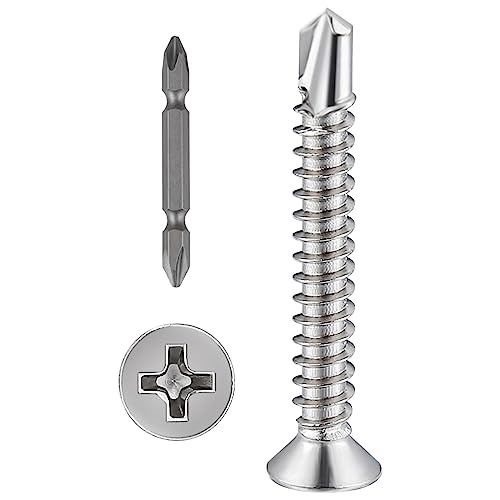
Wensilon 250pcs #8×1-1/4 Self-Tapping Screws 410 Stainless Steel Flat Head

Wensilon 250pcs #8×1-1/4 Self-Tapping Screws 410 Black Stainless Steel Flat Head
Taking A Closer Look At The Options
A tub surround redo or a basement laundry-wall backer is the typical job where this Wensilon 300-pack earns its keep. The 410 stainless steel body resists corrosion in moisture-prone rooms, while the low-profile truss head seats cleanly against cement board without punching through the facing mesh. At #8 x 3/4″, the length is right for standard 1/2-inch backer over wood or light-gauge metal framing, which covers most residential installs.
Drive feel is consistent with most import-grade self-tapping screws: predictable thread engagement, and the 410 stainless holds up under impact drivers when you keep the clutch dialed in. You may want a hex driver bit on standby, since the included drivers can wear faster than aftermarket options. The bulk packaging makes it a sensible shop-staple choice for anyone who tiles more than one room a year.
Where It Excels
- 410 stainless steel construction fights rust in shower and bath installs where cheaper zinc-plated screws commonly stain grout lines over time.
- Truss head geometry spreads clamp load across the backer face, reducing the chance of pull-through on softer gypsum-core boards.
- Self-tapping point reduces pre-drilling on metal studs up to about 20-gauge, saving real time on wall-to-wall installs.
- 300-count packaging covers roughly 75 to 100 square feet of wall coverage at standard 8-inch-on-center fastening patterns.
Things To Consider
- 410 stainless is magnetic and slightly less corrosion-resistant than 304 stainless in highly chlorinated or coastal environments.
- Owners commonly report bit cam-out if the included driver is reused past a single project, so plan on replacement bits for larger jobs.
Key Specs
Who It Suits Best
Homeowners tackling a single bathroom or kitchen backer-board install who want a corrosion-resistant fastener in a quantity that absorbs small miscounts without a second trip to the store.
Where Another Pick Suits Better
Remodelers anchoring backer to poured concrete or block should reach for the Wensilon Slotted Hex Concrete Screws, since self-tapping sheet-metal screws are not designed to bite into masonry.
The black-oxide sibling to the previous pick trades a clean silver finish for a darker tone that disappears under dark grout, slate, or stained-wood transitions. The geometry, count, and 410 stainless substrate are otherwise identical, so the same corrosion profile applies. For jobs where exposed screw heads on a feature wall would be visually distracting, this variant earns the small premium over the plain finish.
One practical note: the black oxide coating tends to wear off at the driving tip after a few hundred fasteners, exposing the silver substrate beneath. On hidden backer installs the wear is invisible, but plan accordingly if any screws will remain visible after the tile is set.
Benefits That Matter
- Black finish helps the heads recede into dark grout joints, slate, or matte tile without telegraphing bright spots through the surface.
- Same 410 stainless corrosion resistance as the silver version, suitable for tub surrounds and bathroom wet zones.
- Truss head profile prevents the through-mesh punch-through that plagues flat-head screws on cement board.
- 300-piece pack matches the same coverage area as the standard version, so planning math stays simple.
Worth Noting
- Black coating wears off the driving tip with extended use, revealing silver steel on jobs that exceed 200 fasteners per pack.
- Storage in humid shop environments can leave light surface oxidation on the finish, which may transfer to fingertips during install.
Made For
Tile setters working with charcoal, matte black, or dark natural stone who want fastener heads that visually disappear in the final surface.
Look Elsewhere When
Installers fastening backer to metal framing in a high-volume production setting should choose the Wensilon Hex Washer Head TEK Screw, which is purpose-built for sheet metal without pre-drilling.
Step out of metal framing and into dimensional lumber, and the math changes. This Wensilon pack uses carbon steel with a black phosphate coating rather than stainless, which trades corrosion resistance for higher tensile strength and a more aggressive bite in softwood studs. The 1-inch length adds reach over the previous two picks, making it a better match for 5/8-inch backer board or for two-layer plywood-plus-backer subfloor assemblies.
The zinc-oxide finish is acceptable for dry-area installs behind tile, but it is not a wet-zone fastener. Use it in a powder room, on a kitchen floor over a plywood subfloor, or anywhere the screw stays inside the building envelope away from direct water exposure.
A Few Strong Suits
- Carbon steel core drives deeper grip into fir, pine, and OSG studs than stainless fasteners of the same gauge, reducing spin-out on denser lumber.
- Black phosphate coating reduces driver slippage during high-torque runs, which is helpful on long fastening sessions.
- 1-inch length accommodates 5/8-inch backer or stacked subfloor-plus-backer builds that shorter 3/4-inch screws cannot fully engage.
- 250-count pack aligns with mid-size room remodels, where 300 pieces would leave a meaningful surplus to store.
Trade Offs
- Carbon steel construction means these screws are not rated for prolonged moisture exposure, so they are wrong for shower walls or exterior tile.
- Black phosphate coating can leave a faint residue on light-colored tile during install, which requires a quick wipe before grouting.
Best Suited To
Dry-area remodelers fastening cement board to wood studs in kitchens, laundry rooms, and entryways where stainless corrosion resistance is not required.
Skip It When
Anywhere the backer board will see persistent moisture, like a curbless shower or steam-room wall, the Wensilon 410 Stainless Truss Head Screw is the safer pick.
The Deck Plus box steps outside the cement-board-fastener category in name, but it earns a place here for subfloor-to-backer transitions. A 3-inch length and #10 shank give the screw the reach to pass through cement board, thinset, plywood, and still bite 1 inch or more into the joist below. The tan epoxy coating is built for pressure-treated lumber contact, so it tolerates the alkaline chemistry that destroys plain zinc screws inside PT wood.
For a tub-deck subfloor, a porch-to-interior tile transition, or any assembly where the screw passes through multiple layers before reaching structural framing, the extra length pays for itself in pull-out resistance. A Torx drive head (the star-shaped pattern that resists cam-out better than Phillips) is the small quality-of-life upgrade that makes a 310-piece box less of a wrist workout.
Useful Highlights
- 3-inch shank drives through cement board plus thinset plus subfloor, anchoring the entire stack to the joist in a single pass.
- Tan epoxy coating tolerates direct contact with pressure-treated lumber chemistry that would strip plain zinc finishes.
- Self-drilling point paired with coarse threads reduces the need for pilot holes in softwood and PT assemblies.
- 5-pound pail (310 pieces) suits a full bathroom subfloor plus underlayment without a refill run mid-project.
Points To Keep In Mind
- Length is overkill for standard 1/2-inch backer-over-stud installs, and the screw tip can protrude through thin framing if not measured carefully.
- Tan finish is not designed to be hidden under tile and will read as visible specks if the head sits above the backer face.
Key Specs
Who Should Grab It
Contractors building up a tub-deck subfloor, tile-over-plywood transition, or any multi-layer assembly that needs long-shank structural anchoring through cement board.
Another Choice May Suit
For a simple 1/2-inch backer install on standard studs, the Wensilon 410 Stainless Truss Head 3/4-inch screw handles the job without the over-penetration risk of a 3-inch fastener.
Switching from wood to metal framing changes the fastening problem entirely, and that is where the TEK-style (a self-drilling screw tip with a fluted cutting edge) screw earns its slot. The integrated drill point chews through 20- to 25-gauge metal studs without a separate pilot step, and the hex washer face seals tight against the backer surface. The 410 stainless body is the same corrosion-resistant grade found on the earlier truss-head picks.
The trade is the drive system: a hex socket instead of a Phillips or Torx means a different bit is required, and hex bits tend to wobble in budget impact drivers. For a small bathroom wall the inconvenience is minor, but on a long production run, the bit-swapping adds up.
Good Reasons To Consider
- Integrated drill-tip (the TEK flutes at the screw point) cuts through light-gauge metal studs without pre-drilling, saving a full step on every fastening location.
- Hex washer face distributes clamp load over a wider footprint than a Phillips head, reducing the chance of backer crush.
- 410 stainless steel construction handles bathroom and laundry-wall moisture without the rust staining that affects plated screws.
- 300-count packaging is sized for a typical metal-framed bathroom or kitchen backer wall.
Possible Compromises
- Hex drive bits are not interchangeable with the Phillips or Torx bits commonly used on other picks, so a second driver set is needed on the job.
- On thicker-gauge metal studs above 20-gauge, the drill tip can bog down, requiring pilot holes that defeat the time-saving purpose.
Right Fit For
Commercial remodelers and DIYers attaching cement board to light-gauge metal framing where a self-drilling tip eliminates the pre-pilot step on every screw.
Reach For A Different Pick When
Wood-stud installs are better served by the Wensilon Carbon Steel Wood Screw, which bites into dimensional lumber more reliably than a TEK point.
Combine the black finish of pick two with the TEK drill point of pick five and you land at this hybrid. It is the right call for dark tile or stone installed over metal framing in a wet zone, where the silver finish would telegraph through the grout and a Phillips head would be more likely to cam-out on the metal stud. The same 410 stainless substrate and #8 x 3/4-inch sizing carry over from the standard TEK version.
Practical reality: the black coating on a hex washer face receives more tool contact during install than a recessed Phillips head, so the finish wears faster at the drive socket. On a 300-piece bathroom install the cosmetic impact is minor, but it is worth knowing if the head will remain visible after the tile is set.
Features That Help
- Black oxide finish hides fastener heads in dark grout and stone, eliminating silver “sparkle” through narrow grout joints.
- TEK drill point bypasses pilot holes on light-gauge metal studs in the same pass as fastening, cutting install time on commercial jobs.
- Hex washer face seals firmly against backer-board surface, reducing the chance of moisture wicking under the head in shower applications.
Less Ideal Details
- Black coating wears off at the drive socket faster than on recessed-head screws, since the hex bit makes direct metal-on-coating contact.
- Two specialty attributes stacked together push the per-piece cost above the basic TEK screw, which may not justify the upgrade on a hidden-fastener install.
Quick Facts
Who Will Love This
Tile setters working in modern dark-finish bathrooms or commercial wet zones who want a single fastener that handles both metal framing and visually quiet grout lines.
Swap It Out When
Budget-focused wood-frame installs are better matched by the Wensilon Carbon Steel Wood Screw, which costs less per piece and grips lumber more effectively than a TEK point.
Concrete, brick, and block substrates demand a different fastener entirely, and this Wensilon pack steps into that role. The blue rust finish over hardened carbon steel resists the alkaline chemistry inside cured concrete, and the hex washer face spreads the clamp load across brittle masonry without spalling (chipping or flaking at the surface) the substrate. A 3/16-inch diameter is on the smaller end of concrete-screw sizes, which keeps the pilot hole modest.
Note that 30 pieces is a small count compared to the 250- and 300-piece packs elsewhere in this list, but concrete screws are typically used in lower volumes per project. A basement wall or a single masonry wainscot will not eat through a 300-pack the way a tub surround will eat through 1-1/4-inch sheet-metal screws.
What Works In Its Favor
- Hardened carbon-steel construction with a blue rust finish tolerates direct contact with cured concrete and mortar without corroding.
- Hex washer head design spreads clamp load across masonry surfaces, reducing the risk of surface spalling during fastening.
- 3/16-inch diameter requires a smaller pilot hole than common 1/4-inch concrete screws, simplifying bit selection on a hammer drill.
Worth Bearing In Mind
- Slotted hex drive is less common than Torx or standard hex, so a matching bit is required and may not be in a typical homeowner driver set.
- 30-piece count suits one or two masonry walls, not a full basement perimeter, so larger projects need multiple packs.
Perfect Match For
Homeowners anchoring backer-board panels or furring strips to poured-concrete basement walls or block garage interiors where a sheet-metal screw would strip out immediately.
Skip It When
Standard wood or metal-stud framing is in play, where the Wensilon 410 Stainless Truss Head Screw drives cleanly without requiring a pilot hole.
The flat-head version of the Wensilon self-tapping line moves the seating profile from above-surface (truss) to flush (flat). On cement board, a flat head is not the standard recommendation because the countersink can punch through the cement-board facing mesh, but it is the right call where the screw will be hidden by a layered finish like a tile backer that is itself being covered by a panel. The 1-1/4-inch length also reaches deeper than the 3/4-inch truss version.
The 410 stainless substrate matches the rest of the Wensilon line, and the 250-piece count lands between the smaller wood-screw pack and the 300-piece wall packs. A spare driver bit should be on hand since flat-head Phillips bits wear faster under the higher torque required to countersink into cement board.
The Good Stuff
- Flat head profile sits flush with the substrate, ideal for layered assemblies where a protruding truss head would interfere with the next material.
- 1-1/4-inch length handles thicker backer installations and double-layer framing scenarios that 3/4-inch screws cannot reach.
- 410 stainless steel construction maintains the same corrosion resistance expected from the rest of the Wensilon line.
Honest Caveats
- Countersinking into cement board can tear the facing mesh on harder boards, leaving a ragged hole that requires a mesh patch.
- Flat-head Phillips drive requires higher driving torque than a truss head, which accelerates bit wear on long runs.
Built With In Mind
Finish carpenters and remodelers fastening backer board under a second surface layer where a flush-mounted fastener head is required to keep the build-up flat.
Where A Sibling Pick Shines
For a standard backer-only tile install, the Wensilon Truss Head Screw avoids the mesh-tear risk that a flat head introduces on cement board.
The closing entry pairs the flat-head geometry and longer reach of the previous pick with the black oxide finish of the dark-finish variants, completing the visual-coverage set. Where the screw remains visible after the project is finished, this version reads as a discrete dark dot rather than a bright stainless spot, which matters on dark tile, charred-wood feature walls, or matte-black fixtures where silver would catch the eye.
The same flat-head caveat applies: countersinking into cement board risks tearing the facing mesh, so this screw is best reserved for jobs where the head will be hidden by a subsequent finish layer. The 410 stainless substrate keeps corrosion performance in line with the silver flat-head sibling.
The Helpful Details
- Black oxide finish keeps visible fastener heads quiet in dark tile, charred wood, and matte-black fixture designs.
- Flat-head seating allows the next finish layer to lay flat without working around a protruding truss head.
- 1-1/4-inch reach accommodates thicker backer and multi-layer framing scenarios.
Practical Considerations
- Countersink tear-out risk on cement board mesh is the same trade-off as the silver flat-head, requiring care during driving.
- Black finish shows wear at the Phillips drive recess more visibly than silver finishes, which can telegraph use on partial packs.
Whose Shelf It Belongs On
Remodelers finishing a dark-themed bathroom, fireplace surround, or feature wall where exposed fastener heads need to disappear into the surrounding palette.
Not Your Match When
Standard tile-over-backer installs on wood or metal studs are better served by the Wensilon Truss Head version, which avoids countersink mesh tear-out entirely.
What Matters When Picking Screws For Cement Board
Match the fastener to the framing material first
The substrate behind the backer board dictates almost everything else. Wood studs accept a wider range of screws and reward aggressive thread profiles, while metal studs need a self-drilling TEK tip or a pre-drilled pilot to avoid screw spin-out. Concrete and block substrates require a separate category of hardened concrete screws that bite into masonry instead of cutting threads in metal.
The single biggest mistake on a cement-board install is using drywall screws, which corrode quickly in wet environments and snap under the lateral load that tile movement creates. Spend the small premium for the right substrate-matched fastener and the assembly will outlast the tile.
Head geometry controls the visible result
Truss heads sit above the backer surface and are the standard recommendation for tile underlayment because they spread load without punching through the cement-board mesh. Flat heads countersink below the surface and are appropriate only when a second finish layer will cover the screw head. Hex washer heads combine a wide face with high drive torque and are typical on metal-stud or production installs.
For most homeowners tiling a bathroom, the truss head remains the safest default, since it tolerates the inevitable slight overdrive without compromising the substrate.
Length, corrosion grade, and count round out the decision
Standard 1/2-inch backer over studs calls for a 1-1/4-inch screw for wood framing and a 3/4-inch screw for metal framing. Stainless steel (300-series or 410-grade) belongs in any wet zone, while coated carbon steel is acceptable in dry areas at a lower cost. Count sizing matters less than it seems: a typical 75 to 100 square foot wall uses 200 to 300 screws at 8-inch centers, and buying a slightly larger pack leaves insurance for the inevitable dropped fastener and stripped head.
Key Considerations Across These Picks
Common Shopping Slip Ups
The most common slip is reaching for drywall screws because they are familiar and inexpensive, then discovering the heads corrode within months in a shower environment. The second most common is grabbing any screw with “stainless” in the name without checking the grade, since 410 stainless behaves differently from 304 stainless in coastal or chlorinated settings. A third pattern is under-buying on count, then discovering the included driver bit strips halfway through the second sheet.
What The Upgrade Tier Buys
Higher-tier fasteners in this category pay for tighter manufacturing tolerances, which means more consistent thread depth and fewer stripped heads per pack. Coatings also improve: a 4-layer epoxy or a true 304 stainless upgrade adds years of service life in a wet environment. For a single bathroom, the mid-tier is the smart buy. For a whole-house tile project, the upgrade math flips, since saving two stripped screws per room compounds quickly.
Frequently Asked Questions
Can I use drywall screws on cement board?
No. Drywall screws are made of low-grade steel with a corrosion-prone finish that deteriorates in any environment that sees moisture. Cement board is typically installed behind tile, where water exposure is constant, and drywall screws snap or rust-stain through the grout within months. Use a substrate-matched screw rated for the framing material and the moisture level of the room.
What size screw do I need for 1/2-inch cement board over wood studs?
A 1-1/4-inch screw is the common specification for fastening 1/2-inch cement board into dimensional lumber studs, giving roughly 3/4 inch of thread engagement in the wood. For metal studs, a 3/4-inch self-drilling TEK screw is the typical match, since metal framing does not need the same thread depth for pull-out resistance.
How far apart should screws be on cement board?
The typical fastening pattern is every 8 inches along the studs for walls, and every 6 inches for ceilings or floor applications. Edges of the board should land on a stud, and the screws should sit about 3/8 inch in from the panel edge to avoid blowout. Check the cement-board manufacturer’s installation guide for the pattern specific to your brand.
Do I need to pre-drill for cement board screws?
Pre-drilling is not required for wood or light-gauge metal studs when using a self-tapping or TEK screw. Concrete, brick, or block substrates always require a pilot hole drilled with a hammer drill and a masonry bit matched to the screw diameter. Skipping the pilot on masonry will either snap the screw or prevent it from fully seating.
Will one box of 250 to 300 screws cover a full bathroom?
A standard 5-by-8-foot bathroom wall uses roughly 100 to 150 screws at 8-inch centers, and a tub surround typically adds another 50 to 75. A 250-piece pack handles the walls comfortably with a small surplus for mistakes, and a 300-piece pack covers the surround as well. For a full floor plus walls, plan on doubling up.




