


Pressure-treated lumber is a different animal than kiln-dried framing stock. The chemicals that help the wood shrug off rot and termites also chew through ordinary zinc-plated steel in a season or two, so pairing the right fastener with the right project keeps your deck, pergola, or raised bed from developing bleed stains or wobbly joints a few summers in. Choosing screws for pressure treated wood is really about matching corrosion resistance, thread design, and head style to how the wood moves outdoors.
This guide walks through nine fastening options across pocket-hole joinery, standard deck builds, and heavy structural framing, so you can match the right screw to the right job and avoid the most common outdoor failure modes.
Your Options, Compared

Kreg Blue-Kote Pocket-Hole Screws 1-1/2-Inch 100 Count

Kreg Blue-Kote Pocket-Hole Screws 1-1/4-Inch 100 Count

Kreg Blue-Kote Pocket-Hole Screws 2-1/2-Inch 250 Count

Wensilon #10 x 3-Inch Black Deck Screws (137 Pack)
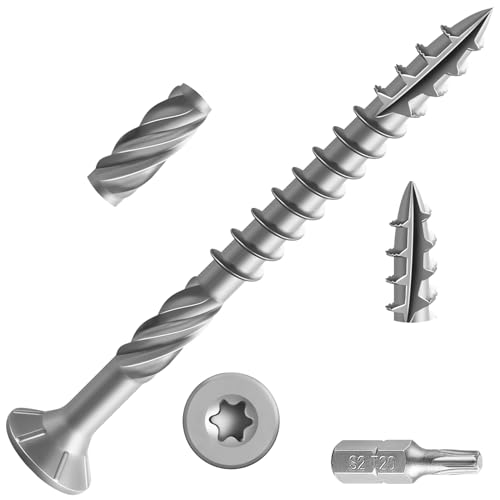
Wensilon #10 x 3-Inch 304 Stainless Deck Screws (151 Pack)

Wensilon #10 x 3-Inch Deck Screws Bronze (137 Pack)

Deck Plus #10 x 3-Inch Wood Screws 5lb Box (310 Pieces)

Power Pro Premium Exterior Wood Screws #10 x 3-Inch 66 Pack

Grip-Rite #9 x 3-Inch Exterior Screws 1lb Box (PrimeGuard)
More Details On Our Top Picks
The 1-1/2-inch Kreg Blue-Kote sits in that sweet spot for outdoor cabinetry and bench builds where the stock is a true 3/4 inch and you want the screw to bite fully without bottoming out in the pocket. Blue-Kote is Kreg’s three-layer anti-corrosion finish, designed for moist environments like under-sink vanities and exterior storage units, so it pairs well with pressure-treated lumber that hasn’t fully dried.
For most weekend woodworkers building a planter box or a backyard workbench, this length handles the bulk of those joints. If you’re working with thicker 2x material, you’ll likely step up to the 2-1/2-inch version covered later.
Real Benefits
- Coarse thread bites cleanly into softwood without splitting the end grain.
- Maxi-Loc flat-bottom head seats flush in standard Kreg pocket holes, reducing wobble.
- Blue-Kote coating holds up to incidental moisture better than plain zinc screws.
- 100-count pack is a manageable size for one or two weekend projects.
Trade-Offs To Consider
- Blue-Kote is rated for moisture, not direct ground contact or saltwater exposure.
- Limited to Kreg-style pocket-hole jigs, so it’s a specialty fastener, not a framing screw.
Right Fit For
Woodworkers building outdoor cabinets, storage benches, or workbenches out of pressure-treated lumber and softwood plywood who already own a pocket-hole jig.
Consider Something Else When
For structural framing where you need a 3-inch deck screw, swap to the Wensilon #10 x 3-Inch Deck Screws Bronze pack, which is built for through-thickness decking connections.
Step down to the 1-1/4-inch Kreg Blue-Kote when you’re joining 1/2-inch or 5/8-inch panels, like the thin plywood skins on a small outdoor storage box. That shorter shank prevents blowout on the back face, which is a common complaint with longer screws in thinner stock.
It uses the same Blue-Kote finish and coarse-thread geometry as the 1-1/2-inch sibling above, so the corrosion story is identical. The honest read is that this is a niche size that earns its keep on specific projects, not an everyday fastener.
Reasons It Performs
- Short shank prevents tip blowout on 1/2-inch panels.
- Same corrosion-resistant Blue-Kote coating as the longer Blue-Kote variants.
- Coarse thread grips softwood and plywood without pre-drilling.
Worth Noting
- Too short for any 3/4-inch or thicker stock; you’ll bottom out before the joint pulls tight.
- Still limited to pocket-hole jig applications.
- Coating isn’t a substitute for stainless steel in coastal environments.
Best Suited To
Woodworkers assembling thin-panel outdoor boxes, side tables, or small storage projects from 1/2-inch and 5/8-inch plywood.
A Better Fit Elsewhere
For thicker stock, the Kreg Blue-Kote Pocket-Hole Screws 1-1/2-Inch 100 Count offers a more versatile length for general 3/4-inch assemblies.
The 2-1/2-inch Kreg Blue-Kote steps up to thicker assemblies, like joining 2×2 frames to 4×4 posts on an outdoor storage rack. The 250-count box covers the kind of volume you hit once you start building multiple matching pieces, such as a row of garden stools or a complete set of Adirondack chairs.
It still uses the same Maxi-Loc head and Blue-Kote coating family as the shorter variants, so the corrosion story stays consistent across a project that mixes multiple screw lengths. For most homeowners, this is the size you reach for when 3/4-inch plywood just isn’t thick enough.
Good Reasons To Consider
- Long shank reaches through 2x framing into mating members without pre-drilling.
- 250-count bulk pack lowers the per-screw cost for shop production runs.
- Maxi-Loc head resists cam-out under high torque.
Some Limits To Know
- Overkill for thin panels where a 1-1/4-inch screw would do the job.
- Requires a Kreg jig set to the deeper material thickness.
Feature Snapshot
Whose Shelf It Belongs On
Active hobbyists and small-shop builders producing multiple outdoor projects from 2x and 4x pressure-treated framing.
Look Elsewhere When
For standard deck board fastening where you don’t need pocket-hole geometry, the Deck Plus #10 x 3-Inch Wood Screws 5lb Box is a more traditional pick.
The Wensilon black deck screw is the option to grab when the head color matters. On dark composite decking, mahogany, or stained cedar, a bronze or bright screw telegraphs through the finish, while the black epoxy head blends in and stays visually quiet. The 3-inch length drives through 5/4 deck boards into standard joists without bottoming out.
Like the other Wensilon entry further down, this uses a T25 star drive (a six-lobed driver that grips better than Phillips or slotted heads) and a multi-layer epoxy coating to fight rust. The catch is that the black head can show scratches if you set the bit wrong, so a fresh driver bit helps on long runs.
Everyday Advantages
- Dark head color disappears on composite, stained cedar, and dark-painted trim.
- Multi-layer epoxy coating resists the corrosive chemicals in pressure-treated lumber.
- T25 star drive reduces cam-out and stripped heads on long drives.
Honest Caveats
- Black coating can chip at the drive recess under high torque.
- Not a substitute for stainless steel in salt-air coastal settings.
Made For
Homeowners installing dark composite decking, ipe, or stained cedar who want a fastener that won’t interrupt the visual line of the board.
Swap It Out When
For full coastal exposure where salt spray is a daily reality, the Wensilon #10 x 3-Inch 304 Stainless Deck Screws (151 Pack) is a better corrosion hedge.
When the project sits near the ocean, a pool, or any environment with constant humidity, 304 stainless steel is the smart call. Stainless costs more per box, but the chemistry simply doesn’t break down the way epoxy-coated carbon steel does, so fastener staining and structural rust streaks become a non-issue over the life of the deck.
The bronze-toned 304 Wensilon screw keeps the same T25 star drive and 3-inch reach as its coated siblings, so driving feel and hole geometry are familiar if you’ve used them before. The honest read is that on most inland projects this is overkill, but on coastal builds it’s the right fastener to reach for from day one.
What It Does Well
- 304 stainless resists rust and bleed staining even in salt-air and poolside settings.
- Compatible with pressure-treated lumber containing the more aggressive ACQ (alkaline copper quaternary) treatments.
- Bronze tone blends well on cedar, redwood, and tropical hardwood decking.
Trade-Offs To Consider
- Stainless is softer than hardened steel, so it can shear if overdriven.
- Higher upfront cost than epoxy-coated carbon steel screws.
Feature Snapshot
Who Will Love This
Homeowners and contractors building in coastal zones, around pools, or anywhere rust stains would be visually unacceptable.
Reach For A Different Pick When
For a dry inland deck on a tight budget, the Wensilon #10 x 3-Inch Deck Screws Bronze 137 Pack delivers the same drive and length for less.
The bronze-coated Wensilon is the middle-of-the-road pick for general-purpose deck work. It uses a four-layer anti-corrosion coating on heat-treated steel, which is a meaningful step up from single-layer zinc plating in contact with modern pressure-treated lumber. The serrated threads bite aggressively into the board face, which helps reduce the “screw pop” that plagues smooth-thread screws as the wood expands and contracts.
For most suburban backyards sitting somewhere between desert-dry and oceanfront, this screw covers the bases without the price jump to stainless. The T25 star drive (a six-lobed bit that grips deeper than a Phillips) keeps cam-out rare on long drives.
What Pays Off
- Four-layer coating handles the copper-based preservatives in modern pressure-treated lumber.
- Serrated threads reduce board separation and improve pull-out strength.
- Star drive geometry keeps the bit engaged under high torque.
Points To Note
- Bronze tone is visible on dark decking, where the black version looks cleaner.
- Not rated for direct saltwater or constant submersion.
Perfect Match For
DIYers building a standard pressure-treated deck, fence, or pergola in a typical inland climate with seasonal rain.
Not Your Match When
For dark-stained or composite decking where head color matters, the Wensilon #10 x 3-Inch Black Deck Screws (137 Pack) blends in better.
Deck Plus ships in contractor-sized 5-pound boxes, which is roughly 310 screws depending on length. That’s enough to fasten down a 12×16 deck with a couple of boards to spare, so this is the box you grab when you’re not making three hardware-store runs mid-project. The 4-layer epoxy coating is specifically formulated for direct contact with pressure-treated lumber.
The self-drilling point pairs with coarse threads to skip the pilot-hole step on most softwood species. For most homeowners tackling a full deck replacement, that combination saves real time across hundreds of fasteners. Worth noting: the tan finish is fairly visible, so if the look matters you may want to plug or counterbore.
The Practical Payoff
- 5-pound box covers full-size deck projects without mid-job restocking.
- 4-layer epoxy coating is designed for pressure-treated lumber compatibility.
- Self-drilling point reduces pre-drilling on softwood species.
- Star drive (Torx) head resists cam-out on long, deep drives.
Room For Improvement
- Tan finish contrasts visibly on dark or stained decking.
- 5-pound box is heavy to haul home in a single trip.
- May split on hardwood species like ipe or dense tropical lumber.
Key Specs
Who Should Grab It
DIYers and small contractors taking on a full deck replacement, large fence run, or other high-volume pressure-treated project.
Where Another Pick Suits Better
For small repair jobs or single-board replacements, the Power Pro Premium Exterior Wood Screws 66 Pack is a more reasonable buy.
Power Pro’s exterior screw earns its place on smaller, more detail-oriented jobs. The 66-pack is sized right for fixing a few wobbly deck boards, replacing a railing section, or assembling a small outdoor bench. The bronze epoxy coating looks clean and countersinks smoothly, so the finished result looks tidy even on visible trim.
It also has a serrated thread near the tip that helps the screw start without a wandering point, which is genuinely useful on slick planed lumber. For most homeowners doing touch-up work around a deck rather than a full build, this smaller pack is the practical size.
What Makes Sense
- Right-sized 66-pack suits single-board repairs and small fixes.
- Bronze epoxy coating offers a clean visual finish on visible trim.
- Serrated lead threads prevent wandering on smooth lumber faces.
Soft Spots
- Not enough quantity for a full deck build, you’ll burn through the box.
- Per-screw cost runs higher than bulk boxes on a unit basis.
Built With In Mind
Homeowners doing small repairs, board replacements, or weekend carpentry on pressure-treated outdoor projects.
Skip It When
For full deck builds, the Deck Plus #10 x 3-Inch Wood Screws 5lb Box is sized for the job.
Grip-Rite is a familiar name in contractor supply yards, and the #9 x 3-inch exterior screw in the PrimeGuard coating is a classic deck-frame fastener. The slightly thinner #9 shank (compared to the #10 picks above) drives faster and reduces the risk of splitting near board ends, which is a common issue on dense pressure-treated 2x stock.
The Phillips bugle head countersinks cleanly, leaving a smooth finish that accepts paint or stain without snags. The 1-pound box is sized for a single deck section or a fence panel, so it suits weekend builds without committing to a 5-pound contractor box. For most budget-conscious DIYers framing a small structure, this is a sensible everyday pick.
A Few Highlights
- PrimeGuard coating is rated for direct contact with pressure-treated lumber.
- #9 shank reduces end-grain splitting on dense 2x boards.
- Bugle head countersinks flush for a paint- or stain-ready surface.
- Sharp point penetrates quickly without a separate pilot hole.
Points To Keep In Mind
- Phillips drive is more prone to cam-out than star or Torx (six-lobed) drives under heavy torque.
- 1-pound box runs out fast on larger projects.
Feature Snapshot
The Right Fit
Budget-minded DIYers framing a small deck, building a fence, or assembling a basic pressure-treated shed.
Another Choice May Suit
For projects where strip-out is a concern, a star-drive screw like the Wensilon #10 x 3-Inch Deck Screws Bronze keeps the bit engaged more reliably under heavy torque.
What Matters Most Before Choosing Screws For Pressure Treated Wood
Corrosion Resistance Is the First Filter
Modern pressure-treated lumber uses copper-based preservatives like ACQ (alkaline copper quaternary) and CA (copper azole) that are far more aggressive on metal than the older CCA (chromated copper arsenate) formulations. A plain zinc-plated interior screw will start streaking rust within a season and may fail structurally within a few years. Epoxy-coated, hot-dip galvanized, or stainless steel screws are the categories worth sticking to for any exterior or ground-contact project.
Match the Head and Drive to the Tool and the Finish
Star or Torx drives (six-lobed bits) hold better than Phillips under high torque, which matters on long screws driven into dense pressure-treated 2x lumber. Bugle heads countersink flush for a clean look on deck boards, while trim heads sit nearly flat for visible trim. The head style also affects how the screw looks once installed, so consider whether you can live with visible bronze dots across the deck surface.
Length Should Match the Combined Material Thickness
A common rule is that the screw should penetrate the lower board by at least 1 inch, ideally more. For 5/4-inch decking on 2x joists, a 3-inch screw is the standard. For 2x decking on 2x joists, step up to 3-1/2 inches. Too short risks the screw backing out as the wood moves; too long risks hitting the back of the joist or bottom of the board.
Thread Design Affects Holding Power
Coarse threads bite aggressively into softwood and plywood, which covers most pressure-treated applications. Serrated threads near the tip reduce the torque needed to start the screw and minimize board separation on deck faces. Fine threads work better on hardwoods or metal, but for typical pressure-treated lumber builds, coarse is the way to go.
What To Watch When Buying Screws For Pressure Treated Wood
Wrong Turns To Avoid
One common slip-up is grabbing whatever box of exterior screws is on the shelf without checking the coating type. Not all “exterior” screws are pressure-treated rated, and the difference shows up as rust streaks and fastener failure a year or two down the line. Another trap is under-buying on quantity. A typical 12×16 deck takes 2,500 to 3,500 screws, and running out mid-project usually means a rushed trip to a different store where the available screw may not match the one you started with. Finally, don’t mix stainless and coated fasteners in the same connection, since galvanic corrosion (a chemical reaction where one metal eats the other) can accelerate rust on the less-noble metal in the presence of moisture.
Where The Extra Money Goes
The jump from epoxy-coated to 304 stainless roughly doubles the per-screw cost, and 316 stainless goes higher still. That extra money buys chemistry that simply doesn’t corrode, even in salt air or constant moisture. For an inland deck in a moderate climate, epoxy-coated screws are usually the practical choice. For coastal builds, pool surrounds, or any structure where fastener staining would be visually unacceptable, the upgrade to stainless pays for itself in avoided rework. Higher-tier boxes also tend to include a matched driver bit, which is a small but real convenience on multi-day builds.
Frequently Asked Questions
Do I really need special screws for pressure treated wood?
Yes, the copper-based preservatives in modern pressure-treated lumber corrode standard zinc-plated screws within a season or two, leading to rust streaks and joint failure. Coated, galvanized, or stainless screws rated for treated lumber are required for any lasting outdoor build.
What is the best screw length for a standard deck board?
For 5/4-inch decking fastened to 2x joists, a 3-inch screw is the standard choice, since it leaves roughly 1-1/2 inches of thread in the joist for solid holding. Step up to 3-1/2 inches for 2-inch nominal decking, and down to 2-1/2 inches for thinner profile boards.
Is stainless steel worth the extra cost for a backyard deck?
In most inland climates, epoxy-coated screws handle treated lumber well enough to last the life of the deck. In coastal areas, around pools, or anywhere salt or constant moisture is in play, stainless steel is the smarter investment because the extra upfront cost avoids rust bleed and structural failure down the line.
Can I use deck screws in a pocket-hole jig?
Standard deck screws have heads and shoulders that don’t seat properly in Kreg-style pocket holes, so they can leave proud fasteners or split the workpiece. Pocket-hole screws are designed with the specific head and shank geometry that pocket jigs expect, so it’s worth using the right fastener for that application.
How many screws does a typical deck need?
A rough rule of thumb is about 350 screws per 100 square feet of decking at standard 16-inch-on-center joist spacing, two screws per board per joist. A 12×16 deck (192 square feet) therefore falls in the 600 to 700 screw range, which is why a 5-pound box rarely covers a full build.




