


Treated lumber fights back. The chemicals that keep rot and insects out also corrode ordinary steel within a season, leaving you with staining, weakened joints, and fasteners that snap when you try to back them out. The right screw changes the whole build, and the wrong one quietly ruins an otherwise solid deck. This roundup covers nine fastener options engineered to survive contact with pressure-treated wood, wet soil, salt air, and the kind of projects you actually do at home.
A Side-By-Side Look

Wensilon #12 x 2 Black Hex Exterior Lag Screws (43PC)

Wensilon #12 x 2 Yellow Hex Exterior Lag Screws (98PC)

Kreg Blue-Kote Pocket-Hole Screws (100 Count)

Wensilon #10 x 3″ Deck Screws Bronze (137PC)

Wensilon #10 x 3″ Black Deck Screws (137PC)
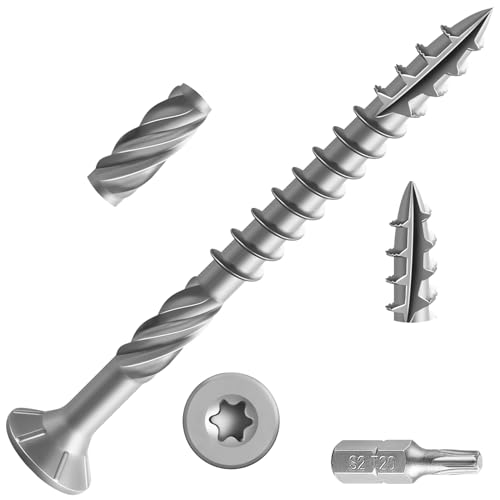
Wensilon #10 x 3″ 304 Stainless Deck Screws (151PC)

Wensilon #8 x 1″ Deck Screws Bronze (560PC)
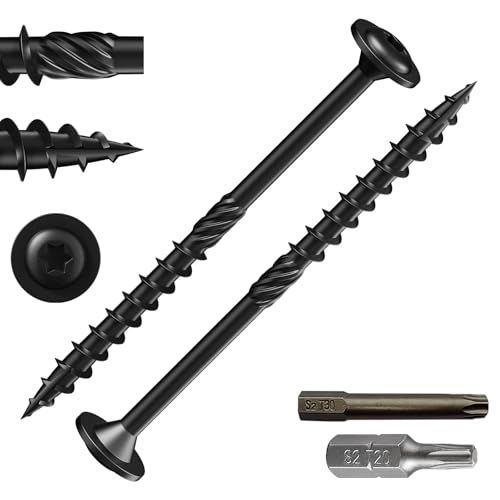
Wensilon #10 x 3 Black Lag Screws (60PC)

Wensilon #10 x 3 Yellow Lag Screws (2 lbs)
More On The Choices That Made The List
Ledger boards, pergola beams, and the sort of joints you really don’t want to fail are exactly where a #12 lag earns its keep. At roughly 5.5x50mm with a hex washer head, this screw delivers serious bite without forcing you to pre-drill pilot holes, which is a quiet timesaver on a Saturday build.
The carbon steel core is wrapped in a black rust-resistant coating, aimed at resisting the corrosive effect of modern pressure-treated lumber. If you’ve ever pulled a deck apart and found the original fasteners half-eaten, the upgrade path to a coated lag like this one tends to make sense. You’ll need a hex driver or socket that fits a #12 head, so plan on that if your drill kit is mostly Torx (a star-shaped bit pattern) or Phillips (a cross-shaped bit pattern) only.
Benefits That Matter
- Self-tapping tip skips the pilot hole in most softwoods and treated lumber, cutting setup time on each joint.
- Hex washer head spreads load across the surface, reducing the chance of the head pulling through thin boards.
- Deep thread profile gives strong holding power, which matters for ledger-to-house and beam-to-post connections.
- Corrosion-resistant coating targets the chemicals in ACQ (alkaline copper quaternary, a common wood preservative) treated lumber that eat plain steel.
Trade-Offs To Consider
- The 43-piece count runs out fast on bigger decks, so larger projects may need a second box or the 98-piece sibling later in this list.
- Coated carbon steel is a step up from zinc, but in salt-air coastal settings, 304 stainless typically outlasts it.
- Hex heads sit taller than flush-mount screws, which can matter for visible faces like stair stringer caps.
Feature Snapshot
Built With In Mind
DIYers building a deck, pergola, or fence who want one screw for ledger, beam, and post connections without juggling two fastener types.
Swap It Out When
You live within a mile or two of saltwater and need maximum corrosion life, where the Wensilon 304 stainless option below is the smarter call.
Same #12 x 2″ hex lag, but the yellow-coated 98-count box is aimed at people who measure a deck in square feet, not boards. The yellow coating makes the screws easy to spot against green or brown lumber, which helps in low light and speeds up inventory checks mid-build.
If the black version above feels like the right tool in the wrong size, this one keeps the same self-tapping thread, hex head, and carbon steel core. Builders commonly report the yellow finish hides scuffs better than bare or black heads once the structure has aged a season or two. For anyone running a small fence crew or wrapping up a backyard project in a weekend, the larger count usually beats buying two of the smaller 43-piece boxes.
Strong Points
- 98-piece box covers a full deck rail or a longer fence run without mid-project reorder.
- Yellow coating stays visible on the work surface, which is a real plus when sweeping up dropped fasteners.
- Same hex washer head and serrated threads as the black version, so drive feel and holding power are consistent.
- Self-tapping tip removes the pilot-hole step on most softwoods, shaving time off each connection.
Possible Compromises
- The bright yellow head stands out on natural wood and stain-grade cedar, so it’s a poor cosmetic match for visible finish work.
- Coated carbon steel still does not match 304 stainless in salt-air or constant-wet environments like docks.
- Hex drive means another bit in the kit if your drill only ships with Phillips and Torx drivers.
Who Will Love This
Contractors and serious DIYers building a full fence, a multi-level deck, or any project where running out of fasteners mid-joist is the enemy.
Where Another Pick Suits Better
You’re focused on outdoor furniture with hidden joinery, where the Kreg Blue-Kote pocket screws reviewed later offer a cleaner pocket-hole approach.
Pocket-hole joinery is its own world, and treating it like a deck-fastener problem usually ends badly. The Kreg Blue-Kote line is built specifically for outdoor projects that use pocket holes, with a 1-1/2″ length and coarse thread tuned for softwoods, plywood, and treated lumber. The blue coating is a three-layer finish designed to resist corrosion in damp environments.
The Maxi-Loc head is the part most people miss. It seats flat against the pocket-hole face and resists wiggling loose under repeated load, which matters on chairs, benches, and planters that flex every time someone sits down. If your build style leans toward Kreg jigs, Adirondack chairs, and patio cabinetry rather than 2x framing, this screw is a quiet specialist that beats reaching for a general-purpose deck screw.
What Earns Its Place
- Coarse thread bites cleanly into softwoods and plywood, which are the most common pocket-hole materials.
- Maxi-Loc flat-bottom head distributes load and stays seated, important for joints that flex under weight.
- Blue-Kote coating is rated for outdoor and treated lumber use, so the screws can stay in the finished project without staining the surrounding wood.
Things To Weigh
- Specialty size and head, so this is not a substitute for structural framing lags or deck-face screws.
- Pairing with non-Kreg pocket-hole jigs may require adjusting depth settings since the head geometry is brand-specific.
- Outdoor-rated, but buried in soil or submerged, even coated screws tend to age faster than 304 stainless equivalents.
Quick Facts
Perfect Match For
Anyone running a Kreg jig or comparable pocket-hole system to build outdoor chairs, planters, sheds, and patio cabinetry from 2x and plywood material.
Not Your Match When
Your project is structural framing like a deck substructure, where the Wensilon #12 hex lag from item one carries far more load.
The classic 3″ deck screw is the workhorse of most backyard builds, and this bronze-coated Wensilon lands in the sweet spot for 5/4 deck boards going into 2x joists. The Torx T25 star drive (a six-pointed star-shaped bit that grips the head firmly under torque) is a noticeable upgrade from the Phillips screws many people grew up with, since it rarely cam-outs even under impact driver pressure.
A four-layer epoxy coating handles the corrosion side, and heat-treated steel underneath resists shearing when you sink a screw near the end of a board. For a standard pressure-treated deck with composite or cedar surface boards, this is a sensible everyday choice, especially if you want the bit included instead of hunting one down in the toolbox.
Positive Points
- T25 star drive and included bit means the bit is on hand when the original gets lost, and it rarely strips under high torque.
- Serrated threads bite into the board and reduce the chance of the screw backing out over seasonal movement.
- Four-layer epoxy coating targets outdoor corrosion, a real step up from basic zinc-plated deck screws.
- 137-count at 2 lbs. typically covers a single small-to-medium deck without a mid-project restock.
Points To Keep In Mind
- Coated carbon steel is a solid middle ground, but pool surrounds, salt air, or constant irrigation push it toward a stainless upgrade.
- 3″ length is right for 5/4 boards on 2x joists, but thicker composite or dense hardwoods may need a longer screw.
- Driving too fast can still shear the head at the neck, so a steady, moderate trigger pull pays off.
Right Fit For
Homeowners building a standard backyard deck and wanting a reliable deck screw that won’t strip out halfway through the project.
Look Elsewhere When
Your deck sits near a pool or within sight of saltwater, where the Wensilon 304 stainless option later in this list will outlast the coated version.
The bronze screw above is the safe pick, and this black version is the same screw with a different outfit. On dark-stained cedar, black composite boards, or charcoal-toned decking, a black head almost disappears into the board, which matters for visible faces like picture-frame borders and stair treads.
Mechanically, you’re getting the same #10 x 3″ dimensions, T25 star drive, heat-treated steel, and four-layer epoxy coating. If you’ve ever noticed a deck where the screw heads catch the sun like little bronze dots, the matte black finish is the easy fix. The trade-off is that black can show chalky oxidation sooner than bronze in some climates, so a yearly rinse is worth building into the maintenance routine.
Bright Spots
- Matte black head blends into dark composite and stained boards, so the fastener stops being a design feature.
- Same T25 drive and four-layer coating as the bronze version, so you get the same drive feel and corrosion resistance.
- Included T25 bit means the project can start without a separate trip to the hardware store.
Some Limits To Know
- On light or natural wood tones, the dark head becomes more visible, which defeats the cosmetic point.
- Like other coated carbon steel screws, the black coating can chalk in highly exposed locations over time.
- For structural connections, this is a face screw, not a lag, so it shouldn’t replace a true structural fastener.
Best Suited To
Homeowners installing dark composite decking, picture-frame borders, or black-stained cedar who want fasteners that fade into the background.
Consider Something Else When
You’re working with natural cedar or a light-toned board, where the bronze version above tends to blend better than a black head.
When the environment is the main threat, 304 stainless steel is the right answer. This Wensilon screw takes the same #10 x 3″ T25 deck-screw format and upgrades the body itself to stainless, which means the corrosion resistance isn’t just a coating that can wear off, it’s the metal. Coastal decks, boardwalks, dock approaches, and pool surrounds are where this version earns its keep.
The bronze-tone epoxy coating on top of the stainless is partly cosmetic and partly an extra barrier. You trade a bit of drive softness compared to hardened carbon steel for a screw that should still be intact when the boards around it finally rot. The 151-count is also slightly higher per 2 lbs. than the coated versions, which is a small but real value bump for the price gap.
A Favorable Mix
- 304 stainless body resists rust from the inside out, even if the outer coating wears through.
- Same T25 star drive and #10 x 3″ sizing as the other Wensilon deck screws, so drive feel stays familiar.
- Higher piece count per 2 lbs. than the carbon steel siblings, a quiet perk for larger deck surfaces.
- Strong match for treated lumber, cedar, and redwood in wet or coastal environments.
Details To Watch
- 304 stainless is softer than heat-treated carbon steel, so a careful driving speed helps avoid snapped heads on tough boards.
- Costs noticeably more per box than coated carbon steel, which can sting on a tight budget.
- For direct saltwater submersion or constant spray, 316 stainless is the next step up, but 304 is the practical ceiling for most residential builds.
Core Details
Right Fit For
Coastal and poolside builds, dock approaches, and any project where fastener failure is a much bigger problem than a higher upfront cost.
Look Elsewhere When
You’re framing a substructure that will be hidden, where the Wensilon #12 hex lag from item one is a smarter use of budget for hidden structural work.
Sometimes a deck screw is overkill and a 1″ trim screw is the right tool. This 560-count Wensilon jar is aimed at fastening thin trim, lattice, fence pickets, and cap rails where a long screw would blow out the back of the workpiece. The T20 star drive is a size down from the T25 used on the structural deck screws, so a matching T20 bit is in the box.
The shorter #8 shank with the same four-layer epoxy coating handles the same treated-lumber environment as the longer siblings. Where this really shines is high-volume trim and accent work, like running a few hundred screws of lattice across a fence line without stopping to reload. The trade-off is no extra length to bite deep into framing, so it stays in the trim-and-detail lane.
What Makes Sense
- 560-count jar supports long trim runs and lattice panels without constant refills.
- Short 1″ length is the right scale for thin trim, fence caps, and detail boards that would split with a longer screw.
- Same epoxy coating system as the longer Wensilon deck screws, so corrosion resistance is consistent across the build.
Things To Weigh Up
- Too short for any structural or joist-hanging use, so this is a complement to longer screws, not a replacement.
- Smaller T20 drive is a different bit from the T25 used on the #10 deck screws, so plan a small bit-storage upgrade.
- Very dense hardwoods may still need a pilot hole at 1″ to avoid splitting the trim piece.
Perfect Match For
Anyone doing a lot of trim, lattice, or cap-rail fastening on a fence or pergola where the 560-count jar is the difference between a smooth project and a frustrating one.
Not Your Match When
You’re fastening structural 2x members where a 3″ or longer screw like the Wensilon #10 from item four is the appropriate length.
This #10 x 3″ lag lands in the middle of the lag-screw range: beefier than a deck screw, lighter than a #12, and just right for many pergola and post-to-beam connections. The star drive system, paired with an included T25 bit, makes for fast seating without the bit walking out of the head, which is a real time-saver when you’re sinking 60 of them in a row.
The black-coated washer head gives solid bearing area, and the self-tapping tip removes the pilot-hole step in most softwoods and standard treated lumber. For homeowners tackling a single pergola, a small deck addition, or a fence gate frame, the 60-piece count is a sensible size that doesn’t leave a half-empty box to dry out in the garage.
Useful Strengths
- Self-tapping design skips pre-drilling in most softwoods, which keeps the project moving without a second step per joint.
- Star drive and included T25 bit mean fewer stripped heads and a backup bit right in the box.
- Washer head spreads load across the wood surface, which is helpful for softer posts and rails.
Practical Considerations
- 60-piece count is sized for a single project; bigger builds will need multiple boxes or a sibling pack.
- Coated carbon steel is well-suited to standard outdoor builds, but for coastal exposure a stainless lag is the longer-life option.
- Hardwoods and dense engineered lumber may still want a pilot hole, despite the self-tapping design.
Who Will Love This
DIYers tackling a single pergola, gazebo, or post-and-beam project who want a serious lag screw without committing to a 100-count contractor box.
Swap It Out When
You’re framing a full deck substructure with many connections, where the higher-count 98-piece Wensilon yellow lag from item two is a better fit.
The yellow-coated 2-lb sibling to the black lag above, this version is built for the bigger structural weekend. The 2-lb pack gives a substantially higher piece count than the 1-lb option, which matters when you’re working through dozens of post, beam, and rafter connections on a pergola or carport.
The yellow finish is the same high-visibility trade-off as the hex lag: easier to spot dropped screws in the grass, but it stands out on stain-grade lumber. Mechanically, you’re getting the same self-tapping tip, washer head, and rust-resistant coating as the black lag. If your project list includes a long pergola roof or a multi-post structure, the larger pack size usually beats buying two of the 1-lb boxes.
Why It Works Well
- 2-lb pack covers larger structural projects without a mid-build box swap.
- High-visibility yellow finish helps with cleanup at the end of a long build day.
- Self-tapping design and included star-drive bit keep installation moving on each connection.
Where It May Fall Short
- Yellow head stands out on natural or stained wood, which matters if the lag is visible on a finished face.
- Coated carbon steel is a workhorse, not a coastal-grade fastener, so very wet or salt-exposed sites call for stainless.
- Bulk pack may be more than a single small project needs, leaving leftover inventory to store properly.
Feature Card
Best Suited To
Homeowners planning a long pergola, carport, or multi-post structure where a 2-lb pack matches the scale of the project.
Consider Something Else When
The lag will be visible on a stained or natural-wood finish, where the black-coated version from item eight keeps a lower profile on the surface.
What Matters Most Before Choosing Screws For Treated Lumber
Corrosion Resistance Is the Foundation
Modern pressure-treated lumber is far more aggressive toward steel than older CCA (chromated copper arsenate) treated wood, so a plain zinc screw can fail in a few seasons. Coated carbon steel, ceramic coatings, and 304 stainless are the three common tiers, with each step up extending the realistic service life in wet, coastal, or chemical-heavy environments. Your local climate and how close the structure sits to water or salt should drive the choice before anything else.
Match the Screw to the Joint
A 1″ trim screw is wrong for a joist, and a 3″ structural lag is wrong for a thin cap rail. Diameter, length, and head style all need to fit the material thickness and the load path, with most building guidance suggesting the screw penetrates at least 1″ into the denser base material. For ledger boards, posts, and beams, a structural lag is the correct scale, while deck boards and trim call for a deck screw.
Drive Style Changes the Experience
Phillips drives strip out under impact drivers, and that frustration adds up across a deck. Torx (star) and hex drives maintain engagement under higher torque, and many coated screws ship with a matching bit in the box. For larger projects, the drive style quietly affects how long the build takes and how many screws you waste to stripped heads.
Buy for the Whole Project, Not the Sample
A 43-piece box looks fine in the store and disappears by the second deck rail. Counting connections and adding 10-15% overage is a habit that saves a mid-project hardware run. The bulk packs on this list exist for exactly that reason, and using one box per project stage tends to beat mixing multiple small boxes.
Key Considerations Across These Picks
Common Buying Slip-Ups
The classic mistake is buying ordinary interior screws for an outdoor build, then watching them bleed rust stains down the boards within a season. Another recurring trap is mixing coated and stainless fasteners on the same project, which leads to galvanic corrosion (a chemical reaction that eats the less-noble metal when two different metals touch in the presence of moisture) at every contact point. Picking one tier and staying there keeps the structure aging evenly.
What The Higher Tier Buys
Stepping from coated carbon steel to 304 stainless roughly doubles or triples the upfront cost per box, but it pushes the realistic service life from a handful of years to decades in the same setting. For a backyard deck, the upgrade pays off when the boards eventually need replacement, because the screws often come out reusable rather than snapped or rusted into the joist. The premium is also most justified in coastal, poolside, or chemical-treated environments, where the cheaper tiers visibly fail first.




