


Framing a deck, shed, or backyard structure only feels solid when the fasteners do their job. The wrong screw snaps mid-drive, corrodes after one wet season, or splits the lumber before it ever takes a load. Most DIYers and weekend builders run into the same wall: the box at the hardware store is full of options that all look similar, but the difference between a hex lag, a structural connector screw, and a coated deck screw actually matters a lot once you’re 30 boards into a project. The picks below cover the main categories you’d reach for on a wood framing job, from heavy structural lags to bulk deck screws for subframe work, with notes on where each one earns its place and where a different pick suits you better.
The Essentials At A Glance

Wensilon #12 x 2 Black Hex Exterior Lag Screws (1 lb)

Wensilon #12 x 2 Yellow Hex Exterior Lag Screws (2 lbs)

Simpson Strong-Tie SD9212R500 Connector Screws (Box of 500)

Wensilon #10 x 3″ Deck Screws Bronze (2 lbs)

Wensilon #10 x 3″ Black Deck Screws (2 lbs)
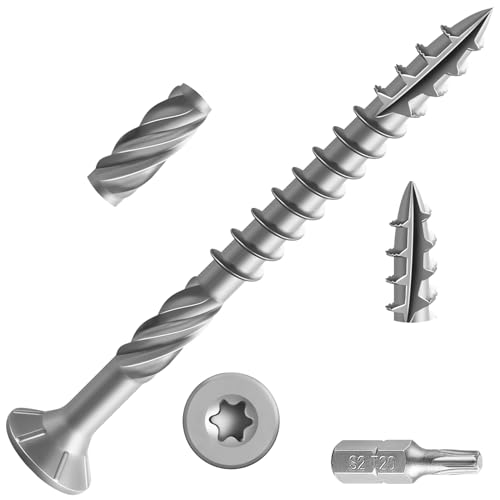
Wensilon #10 x 3″ 304 Stainless Deck Screws (2 lbs)

Wensilon #8 x 1″ Deck Screws (2 lbs)
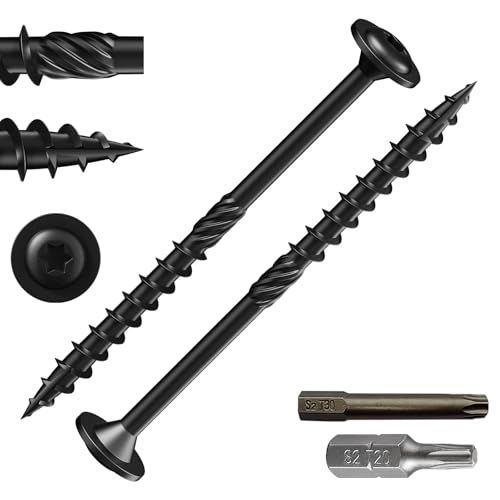
Wensilon #10 x 3″ Black Lag Screws (1 lb)

Wensilon #10 x 3″ Yellow Lag Screws (2 lbs)
Why These Options Stand Out
The Wensilon #12 x 2 black hex lag opens this roundup for good reason. It’s the kind of screw you reach for when a framing joint actually carries load, like a ledger board on a shed, a beam-to-post connection, or a heavy header tie. The hex head (a six-sided drive that grips with a socket or nut driver rather than a Phillips bit) takes serious torque without camming out, and the 2-inch length gives you enough bite into pressure-treated lumber for most residential framing scenarios.
Carbon steel core with a black anti-corrosion coating is the package you want for outdoor structural work. The self-tapping tip and serrated thread profile are built to cut into dense wood without a pilot hole, saving you real time on a long deck day. You may find the 1-pound pack (43 pieces) runs short on a full deck build, so plan your counts before you start. Compared to the Simpson Strong-Tie entry later, this is a general-purpose structural lag rather than a connector-specific screw, and that distinction matters if your project involves metal joist hangers.
Everyday Perks
- Hex head design holds a socket driver without slipping, so you can sink it flush without chewing up the recess.
- Self-tapping point means no pilot hole on most softwoods and pressure-treated lumber, which speeds up framing by minutes per screw.
- Black coating helps the screw blend into dark deck stains and shadow lines rather than flashing silver.
- Carbon steel body delivers the shear strength residential framing loads demand.
- Washer-style head spreads clamping force, reducing the chance of the head pulling through softer boards.
Worth Noting
- 1-pound count of 43 pieces disappears quickly on bigger framing jobs, so you’ll likely need a second box.
- Hex drive requires a matching socket or nut driver bit, which isn’t always in a basic drill kit.
- For metal connector hardware like joist hangers, a dedicated connector screw handles the spec better.
Who It Suits Best
This fits homeowners and DIYers framing a small deck, pergola, or shed who want one screw type that handles ledger attachments and beam ties without specialty bits.
Consider Something Else When
For metal Simpson Strong-Tie joist hangers and brackets, the Simpson Strong-Tie SD9212R500 Connector Screws are engineered for that specific hole geometry and load rating.
The yellow-coated version of the previous Wensilon lag is essentially the same screw with two practical differences: a brighter finish and a 2-pound count that roughly doubles your piece count. That yellow zinc-style coating stands out against wood grain, which actually helps on a busy jobsheet where you’re counting fasteners in a partially used deck ledger.
The hex drive, self-tapping tip, and carbon steel core carry over unchanged, so you get the same torque resistance and load performance as the black version above. The trade-off is visibility: yellow won’t blend into stained or painted finishes, so on visible trim or dark deck boards, the black-coated pick above looks cleaner. In our view, this 98-piece pack makes more sense for a full deck frame or outbuilding where you’re sinking dozens of screws per side and don’t mind a little color contrast on hidden structural members.
Notable Gains
- 98-piece count covers a full small-to-medium deck frame without a mid-project hardware run.
- Bright yellow finish makes screws easy to spot on the ground or in a fastener pouch.
- Same hex head torque performance as the black-coated sibling, so no compromise on drive quality.
- Self-tapping tip and deep thread profile reduce pre-drilling on most softwoods.
- Bulk pack lowers the per-screw cost compared to buying two 1-pound boxes.
Trade Offs
- Yellow finish shows on visible deck boards and trim, so it’s better suited to hidden structural connections.
- At 2 pounds, the box is heavier to lug up a ladder or around a deck for solo builders.
- Still a general structural lag, not engineered for stamped metal connector holes.
Made For
This works for homeowners framing a complete deck substructure or shed who want one bulk box and don’t need the screw to disappear visually on the final surface.
Skip It When
For dark-stained or visible deck boards where the screw head needs to blend, the Wensilon #10 x 3″ Black Deck Screws deliver a cleaner look in the same outdoor rating range.
The Simpson Strong-Tie SD9212R500 is a different animal from the structural lags above. It’s a 1/4-inch hex connector screw designed specifically for Simpson’s own line of joist hangers, straps, and framing anchors, and it’s the only screw the brand has tested and approved for that role. If your framing plan includes metal connectors anywhere in the structure, this is the fastener that keeps the engineering on the page.
The shank is sized to drop into the pre-punched holes on Simpson’s connectors, and the 0.370-inch integrated washer head seats flush without crushing the metal. Type 316 stainless steel (a marine-grade alloy with high nickel content) handles coastal and treated-lumber exposure, which is why this screw shows up on pergolas, deck ledgers, and outdoor stair stringers. At a 500-count box, this is sized for whole-house framing rather than weekend repair. Owners commonly report the included hex bit wearing after heavy use, so a spare T25 or 1/4-inch hex driver is worth keeping on hand.
A Strong Showing
- Brand-tested and approved for Simpson Strong-Tie connectors, which keeps your structural engineering valid.
- Type 316 stainless construction handles coastal salt air and pressure-treated lumber without bleeding rust.
- Stamped head lets you visually confirm a Simpson screw was used during inspection.
- 500-piece box is sized for multi-day framing projects, not single repair jobs.
- Optimized heat treatment improves ductility, so the screw flexes slightly under shock load instead of snapping.
Points To Note
- Higher piece count and stainless material raise the cost per screw compared to coated carbon lag screws.
- Specialized role means this is a supplement to, not a replacement for, a general framing lag.
- Included hex bit may wear down on a full box of 500 screws, so plan a backup driver.
Best Suited To
This is built for builders and serious DIYers using Simpson Strong-Tie metal connectors on a deck, porch, or framed structure where code-listed fasteners are part of the plan.
Not Your Match When
For general wood-to-wood framing without metal connectors, the Wensilon #12 x 2 hex lag screws are a more cost-effective structural choice.
Wensilon’s bronze-coated #10 x 3-inch deck screw is a different category from the structural lags above. This is the workhorse fastener for subframe assemblies, like running joist hangers into ledger boards, fastening blocking between joists, or attaching deck boards to the framing underneath. The 3-inch length gives you enough thread engagement to pull two 2x members tight without bottoming out.
The four-layer epoxy coating is the headline feature. Multiple coating layers add up to better corrosion resistance than single-dip zinc, which matters on pressure-treated lumber that can eat through bare screws in a season. Star drive (a six-pointed Torx-style recess that resists cam-out far better than Phillips) keeps the bit seated under high torque, and the serrated threads under the head reduce the wood splitting as the screw clamps. In our view, bronze blends better with cedar and redwood than black, so this is your default for visible deck surfaces. You may find the included T25 bit wears before the box empties on a large project.
Bright Spots
- Four-layer coating holds up against pressure-treated lumber chemicals and outdoor moisture.
- Star drive prevents cam-out, so you can drive fast without stripping the recess.
- Serrated threads under the head pull boards tight without splitting softer wood fibers.
- 137-piece 2-pound box covers a meaningful chunk of a deck subframe in one purchase.
- Bronze tone blends with cedar, redwood, and natural-pressure-treated lumber finishes.
Honest Caveats
- Not a substitute for structural lags or connector screws on load-bearing joints.
- Star drive requires the matching T25 bit, which wears down on a full box of screws.
- Coating is robust but not stainless, so it’s not the right pick for direct saltwater exposure.
Who Will Love This
DIY deck builders assembling subframes and running deck boards on cedar, redwood, or pressure-treated lumber will find this their most-used screw in the box.
Look Elsewhere When
For coastal or poolside framing where salt and chlorine attack standard coatings, the Wensilon #10 x 3″ 304 Stainless Deck Screws hold up far longer in those conditions.
The black-coated sibling to the bronze deck screw is the same fastener with a different color choice. The mechanics (heat-treated steel, four-layer epoxy, T25 star drive, serrated threads) carry over from the bronze version, but the dark finish changes how the screw reads on the final surface. On black-stained decking, dark composite boards, or trim painted in deep tones, this screw virtually disappears once seated.
For framing on a subframe that will be hidden anyway, color doesn’t matter, and you’d save a few dollars with the bronze version above. Where the black finish earns its keep is on visible deck boards, fascia trim, and any surface where a bright silver or bronze head would interrupt the line of the build. Same caveats as the bronze: not a structural lag substitute, included T25 bit wears with extended use, and the coating is rust-resistant rather than fully stainless.
What Earns Its Place
- Black finish blends into dark deck stains, composite boards, and shadow lines for a cleaner visible surface.
- Star drive resists cam-out, which matters on long deck runs where bit wear is a real time cost.
- Heat-treated steel core handles the torque of dense lumber without snapping mid-drive.
- Serrated threads reduce wood splitting on deck board edges and trim.
- Same 137-piece count as the bronze version, so coverage per box is consistent.
Some Limits To Know
- Black finish doesn’t suit natural cedar or redwood the way bronze does, so it’s a worse match for those woods.
- Not rated as a structural lag, so use it for surface fastening, not ledger or beam connections.
- Epoxy coating eventually shows wear at the drive recess after many screws seated.
Perfect Match For
Homeowners building dark-stained decks, composite deck surfaces, or any visible wood framing where screw heads need to stay out of the visual line.
A Better Fit Elsewhere
For natural cedar or redwood builds where the screw should disappear into warm wood tones, the Wensilon #10 x 3″ Bronze Deck Screws are a closer color match.
The 304 stainless version of the Wensilon deck screw steps up the corrosion resistance significantly. Where the bronze and black versions rely on an epoxy coating to slow rust, this screw is stainless through and through, which means the head and shank can sit in standing water, salt air, or constantly damp soil without staining the surrounding wood. The trade-off is the price per piece, and the slightly lower piece count at 151 versus 137 in the coated versions.
This is the right pick for coastal decks, pool surrounds, dock framing, and any project within a mile or two of saltwater where standard coated screws bleed rust stains down the deck boards within a year or two. 304 stainless is also the safer call for projects using newer alkaline copper quaternary (ACQ) pressure-treated lumber, which is more aggressive on coatings than older CCA treatments. Same star drive and T25 bit as the other Wensilon deck screws, so the workflow stays consistent across screw types. Owners commonly report the included bit is fine for a few hundred screws but worth replacing for a full deck project.
Notable Upsides
- 304 stainless core resists rust in coastal air, pool surrounds, and constantly wet environments.
- Compatible with modern ACQ pressure-treated lumber, which eats through standard coatings.
- Star drive with T25 bit keeps the workflow familiar from the coated Wensilon deck screws.
- Serrated threads grip without splitting on most softwood deck boards.
- Won’t bleed rust stains down cedar or redwood surfaces over time.
Where It Is Less Suited
- Higher cost per piece than coated alternatives, which adds up on large framing runs.
- For direct marine submersion, 316 stainless holds up better than 304.
- Stainless is softer than heat-treated carbon steel, so high-torque runs can chew up the head faster.
Whose Shelf It Belongs On
Homeowners within sight of saltwater, around chlorinated pools, or building with modern ACQ-treated lumber will get the longest service life from this stainless upgrade.
Reach For A Different Pick When
For inland, dry-climate deck builds where budget matters more than maximum corrosion resistance, the Wensilon #10 x 3″ Bronze Deck Screws deliver solid outdoor performance at a lower cost per piece.
The #8 x 1-inch deck screw is the smallest screw in this roundup, and it earns its spot for a different reason: the 560-piece count makes it the bulk fastener for light framing tasks where a 3-inch screw would be overkill. Think furring strips, subfloor sheathing patches, lattice panels, cedar trim, and small outdoor fixtures. The short length reduces the risk of the screw poking through the back of thin material, which is a real issue with longer fasteners.
The Torx drive system (a six-lobed star recess similar to the T25 on the longer deck screws, here sized as T20) gives you the same cam-out resistance, and the bronze epoxy coating holds up in outdoor use. The trade-off is the smaller diameter: a #8 shank doesn’t have the shear strength for structural connections, so this stays in the trim and light-duty lane. For most outdoor trim projects around a deck, this screw is a better fit than reaching for a structural lag by mistake.
The Value In It
- 560-piece count in a 2-pound box covers a lot of small fastening tasks before you need to reorder.
- 1-inch length prevents blow-through on thin trim, lattice, and sheathing material.
- Torx T20 drive reduces cam-out on long screw runs.
- Bronze epoxy coating handles outdoor moisture and pressure-treated lumber.
- Small diameter and short length leave a cleaner visible result on trim work.
What To Weigh
- Not rated for structural framing connections, so don’t substitute it for a lag screw.
- Smaller head means lower clamping force on thicker materials.
- T20 bit wears down faster on dense lumber, so backup bits help on big jobs.
The Right Fit
Workshop tinkerers and trim carpenters who need a high-volume box of outdoor-rated short screws for small framing and finishing tasks will get the most out of this pack.
Swap It Out When
For any ledger, beam, or joist connection where shear strength matters, the Wensilon #12 x 2 Black Hex Exterior Lag Screws are the appropriate step up.
The Wensilon #10 x 3 black lag sits in the middle of this roundup by design. It’s a structural screw, but a step down in diameter and torque from the #12 hex lag that opens the list. The 3-inch length adds reach for deeper joints like beam-to-post connections, while the star drive (T25, the same as the longer deck screws) keeps the bit inventory simple across your project.
The self-tapping tip and carbon steel body are built for the same heavy-duty framing scenarios as the #12, just with a slightly slimmer shank that suits medium-load situations: small outbuildings, pergola beams, deck pergola cross-members. The black coating blends into dark framing and is rust-resistant for outdoor use. The 60-piece, 1-pound pack is sized for one or two medium projects rather than a full deck frame. You may find the included T25 bit short for high-volume drives, but for occasional structural fastening, this lag earns its place in the kit.
Positive Points
- 3-inch length reaches into deeper beam and post connections where a 2-inch screw would bottom out.
- Star drive with included T25 bit simplifies bit changes between lag and deck screw work.
- Self-tapping tip removes the need for a pilot hole on most framing lumber.
- Black coating blends with dark stained framing and resists outdoor corrosion.
- Washer-style head spreads load over the wood surface for better holding power.
Practical Considerations
- 60-piece count is on the small side for a full framing project.
- Slimmer shank than the #12 hex lag, so it suits medium loads rather than heavy structural ones.
- Coating is rust-resistant, not stainless, so it’s not the call for marine environments.
Built With In Mind
DIYers and weekend builders handling medium-load framing tasks like pergola beams, small shed walls, or fence post caps will find this lag strong enough without overpaying for a heavier screw.
Another Choice May Suit
For heavy ledger and beam work where maximum shear strength is the priority, the Wensilon #12 x 2 Black Hex Exterior Lag Screws are the stouter choice.
The yellow-coated version of the #10 x 3 lag closes out the list. It carries the same dimensions, star drive, and self-tapping tip as the black #10 above, but the bright yellow finish and 2-pound pack change the use case. At roughly twice the piece count, this is the box for a multi-day framing project where you don’t want to run out of structural fasteners halfway through.
The yellow finish isn’t just cosmetic. On a messy jobsheet with sawdust, offcuts, and grass, a bright screw head is much easier to spot than a dark one, which matters when you’ve dropped a handful and don’t want to leave fasteners in the lawn. The trade-off is visibility on finished surfaces, so this stays in the structural, hidden-connection lane rather than on visible trim. Same caveat as the smaller pack above: this is a medium-duty structural lag, not a substitute for the heavier #12 hex on the heaviest framing joints.
Practical Pluses
- Yellow finish makes the screws easy to spot on a busy jobsheet, reducing lost-fastener waste.
- 2-pound pack covers a full medium framing project without a mid-project reorder.
- Star drive with T25 compatibility keeps bit changes simple.
- Self-tapping carbon steel body handles softwood and pressure-treated framing.
- 3-inch length suits beam and post connections where reach matters.
Trade-Offs To Consider
- Bright finish shows on visible surfaces, so it suits hidden structural members rather than finish work.
- Medium-duty rating falls short of the #12 hex lag for the heaviest joints.
- Coating is rust-resistant, not stainless, for marine or coastal exposure.
Who Should Grab It
Contractors and serious DIYers running multi-day framing projects where visibility on the jobsheet and piece count both matter will appreciate this bulk pack.
Where Another Pick Suits Better
For visible framing members where the screw head should disappear, the Wensilon #10 x 3″ Black Lag Screws (1 lb) keep the same build with a darker finish.
What To Know Before Choosing Screws For Wood Framing
Matching Screw Type To The Joint
A framing project uses different fasteners in different places, and mixing them up leads to either wasted money or weak joints. Structural lags, like the #12 hex and #10 star drive lags in this list, are made for load-bearing wood-to-wood connections: ledgers, beams, posts, and headers. Connector screws, like the Simpson Strong-Tie SD9212R500, are engineered to fit the pre-punched holes on metal joist hangers and framing anchors, and only those screws carry the listed load rating for that hardware. Deck screws in the #10 x 3 size handle surface fastening: deck boards, blocking, and subframe assemblies where shear strength matters less than corrosion resistance and clean appearance.
The honest read is that most framing jobs need at least two of these categories. A typical deck frame uses structural lags on the ledger and beam, connector screws in the metal hangers, and deck screws on the surface boards. Buying one screw for all three roles is a common shortcut that costs strength where it counts.
Length, Diameter, And Head Style
Length controls how deep the screw bites into the receiving lumber. For a typical 2x-to-2x framing joint, the screw should penetrate at least 1 to 1.5 inches into the second board, so a 2.5- to 3-inch screw is the right call. Diameter (the #8, #10, #12 number on the screw) controls shear strength, and going up one gauge roughly doubles the load capacity. Head style is more about workflow: hex heads take the highest torque, star drive (Torx) prevents cam-out under heavy load, and Phillips or slotted heads are common but prone to stripping.
Corrosion Resistance And Material
Indoor framing in dry climate can use any screw. Outdoor framing, pressure-treated lumber, and coastal projects need corrosion resistance that goes beyond a basic zinc coating. Epoxy-coated carbon steel handles most outdoor use for years, 304 stainless is the step up for salt and chlorinated environments, and 316 stainless is the marine-grade option. Using the wrong coating on pressure-treated lumber, especially modern ACQ treatments, is one of the fastest ways to see rust bleed down a deck board within a single season.
Picking The Right Level For Your Build
Pitfalls Shoppers Hit
A common trap is assuming one screw box covers the whole framing project, which usually means structural joints get undersized fasteners or visible surfaces get ugly lag heads. Another is buying coated carbon steel for a coastal deck to save money, then watching rust streaks form within a year. Pre-drilling when the screw is self-tapping slows you down and can actually split the wood if the pilot is too large. Mixing screw lengths on the same joint is also a frequent error: if two boards are joined, the screw length should be measured against the receiving board, not the combined thickness, or you risk bottoming out or blowing through the back.
What The Higher Tier Buys
Stepping up to stainless steel or a Simpson Strong-Tie connector screw isn’t just a price premium, it’s a service-life upgrade. Stainless screws last 10 to 20 years in coastal conditions where coated screws fail in 3 to 5, and connector screws carry a tested load rating that generic lags don’t. For a small interior repair, premium materials are wasted money. For a 20-year deck, an oceanfront pergola, or any project involving ACQ pressure-treated lumber, the upgrade is the difference between a structure you maintain and a structure you rebuild. The honest trade-off is that for most inland, dry-climate builds, a quality coated carbon steel screw is the sensible middle of the road.
Frequently Asked Questions
What Size Screw Should I Use For 2×4 Framing?
For 2×4-to-2×4 connections, a #10 or #12 screw in the 2.5- to 3-inch range gives you enough penetration and shear strength for typical residential framing loads. Use a structural lag for load-bearing joints and a deck screw for surface fastening.
Can I Use Deck Screws For Framing?
Deck screws work for blocking, subframe assemblies, and surface fastening, but they’re not a substitute for structural lags or connector screws on load-bearing joints like ledgers, beams, or joist hangers, where shear strength and code-listed fasteners matter.
What’s The Difference Between A Lag Screw And A Construction Screw?
A lag screw is a heavy-duty fastener with a hex or star head, a washer-style face, and a thick shank designed for structural load-bearing joints. A construction screw is a broader category that includes structural and general-purpose fasteners, often with a star or Phillips drive and a slightly slimmer shank.
Do I Need Stainless Screws For Pressure-Treated Lumber?
Modern ACQ pressure-treated lumber is more corrosive than older CCA treatments, so epoxy-coated or stainless screws are the safe call. Coated carbon steel lasts several years in most climates, while stainless lasts much longer and avoids rust bleeding down visible surfaces.
How Many Screws Per Framing Joint?
That depends on the load and the screw rating, but a common rule is two structural screws per connection point for ledgers and beams, and one deck screw every 8 to 12 inches along a deck board. Always check your local code for joist hanger fastening schedules, which specify exact screw counts per hole.




