


A self-centering dowel jig takes the most tedious part of joinery, the math, and gets it out of your way. The body of the jig slides over your workpiece and the drill bushing lands in the exact middle of the board thickness every time, so you stop chasing the centerline with a ruler and a pencil. For weekend builders assembling cabinets, picture frames, or shelving, that translates to joints that actually seat flush instead of fighting you at glue-up. The picks below cover handheld kits, self-clamping benchtop models, and one specialized tool for floating shelves, with notes on which one fits your shop and your patience level.
A Snapshot Of The Selections

ELEON Self Centering Dowel Jig with Elongated Jaws

Milescraft 1333 DowelJig Kit

GOINGMAKE Dowel Jig Kit with Quick Positive Stop

3 in 1 Dowel Jig Kit with Clamp Board

Milescraft 1332 Joint Mate Dowel Jig
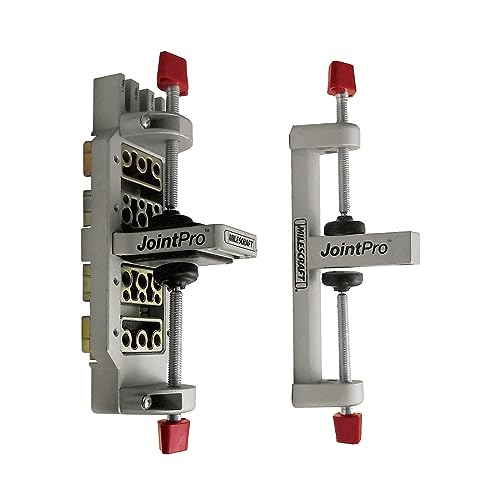
Milescraft 1311 Joint Pro All Steel Doweling Jig

Floating Shelf Installation Dowel Jig Kit

Milescraft 1334 Joint Master Aluminum Doweling Jig
A Deeper Look At The Lineup
The ELEON stands out for sheer clamping reach. With an opening that spans up to 6.7 inches, this jig slides onto boards that would refuse to fit in most of the handheld options further down the list, which makes it a natural pick for thick tabletops, wide face frames, or laminated panels where a smaller jaw simply can’t grip.
The elongated jaw design also holds the workpiece more securely than short-faced clamps tend to, so the drill bushing stays aligned as the bit enters the wood. Pair that with the aluminum body and a set of interchangeable bushings, and you get a tool that behaves more like a shop fixture than a portable accessory.
Noteworthy Benefits
- Extra-wide clamp handles thick or unusually wide stock that smaller jigs can’t grab.
- Elongated jaws keep the workpiece stable during drilling, reducing drift on dense hardwoods.
- Aluminum body resists flex, so the bushing stays perpendicular to the board face.
- Multiple bushings let you pick the dowel diameter that matches your joint plan.
Honest Caveats
- The wider body adds bulk, so it feels less nimble in tight corners than a slim handheld.
- Some users may find the larger footprint overbuilt for small picture-frame work.
Key Specs
Who It Suits Best
Woodworkers assembling wide furniture pieces, laminated panels, or any project where a standard handheld jaw simply won’t open far enough.
Where Another Pick Suits Better
For quick corner joints on smaller boards, the Milescraft 1333 DowelJig Kit is lighter and easier to maneuver one-handed.
The Milescraft 1333 is the kind of jig you hand to a first-time builder and watch them succeed on the first try. It clamps onto the workpiece one-handed thanks to its self-centering jaws, and the included hardened steel bushings cover the three dowel sizes you’re most likely to reach for: 1/4 inch, 5/16 inch, and 3/8 inch. No measuring tape, no centerline math, no trial-and-error drilling.
Where the ELEON leans into wide-format work, the 1333 stays compact and forgiving. It’s well suited to corner joints on face frames, edge joints on small boxes, and the kind of repair work where you just need two holes to line up without a lot of ceremony.
A Strong Showing
- One-handed operation leaves your other hand free to hold the workpiece steady.
- Three common bushing sizes cover the majority of home-shop dowel projects.
- Hardened steel bushings resist wear from repeated bit insertion.
Points To Keep In Mind
- Not designed for very thick or wide stock that exceeds its jaw span.
- Lacks the self-clamping benchtop stability of the Joint Pro or Joint Master models.
Right Fit For
Beginners and hobbyists who want fast, accurate dowel joints on standard 3/4-inch stock without investing in a benchtop fixture.
Skip It When
You need to drill six matching holes in a single setup; the Milescraft 1311 Joint Pro handles that workload with more rigidity.
GOINGMAKE built this kit around a simple productivity promise: drill three accurate holes in one setup. The positive stop locks the jig at a repeatable position on the workpiece, and the included hardened bushings let you handle a useful spread of dowel diameters without swapping tools. If you’ve ever drilled one hole, slid the jig, drilled another, and hoped the spacing matched, you’ll appreciate the stop feature right away.
Compared to the 1333’s single-hole handheld approach, this one leans toward batch work where consistency matters more than portability. The centerline pointer also helps when you want to align the jig to a pencil mark rather than the board edge.
What Works In Its Favor
- Drills three holes in a single setup, which speeds up repetitive face-frame and carcass work.
- Positive stop delivers consistent hole spacing across multiple workpieces.
- Centerline pointer simplifies alignment to existing marks or layout lines.
Trade Offs
- Three-hole layout is fixed, so you can’t drill just one hole without exposing the others.
- Bushing count and sizes may exceed what casual users actually need.
Quick Facts
Made For
Builders running small production runs of cabinets, drawers, or shelving where identical hole spacing across many pieces saves real time.
Consider Something Else When
You only need one or two holes per joint; the Milescraft 1333 DowelJig Kit is simpler and more compact for that workload.
The Jectse 3-in-1 leans into versatility on a budget. It bundles an adjustable drill guide, a self-centering dowel jig, and a dedicated clamp board so you don’t have to chase your workpiece around the bench with locking pliers. The forged tool steel bushings are sized for common metric dowel diameters, which suits anyone building with 6mm, 8mm, or 10mm stock.
Where the GOINGMAKE is about drilling many holes in a row, this kit is about owning one tool that handles corner, edge, and surface drilling without forcing you to buy separate jigs for each. The included clamp board is the quiet hero: it keeps both boards stationary while you work, which is something you don’t realize you needed until you’ve fought a wobbly setup for the third time.
Real-World Strengths
- Three jig functions in one kit reduce the need to buy separate corner, edge, and surface tools.
- Dedicated clamp board frees both hands and keeps workpieces from shifting mid-drill.
- Tool steel bushings hold up to repeated use without flaring out.
Where It May Fall Short
- Metric-only bushing sizes may not match imperial dowel stock common in North American lumber.
- Adjustable components take longer to set up than a fixed handheld like the 1333.
Best Suited To
Hobbyists who want one affordable kit that handles multiple joint types without filling the shop drawer with single-purpose jigs.
Look Elsewhere When
You drill dowel joints daily and want the rigidity of a steel-bodied benchtop jig; the Milescraft 1311 Joint Pro is built for that pace.
The 1332 takes the same handheld DNA as the 1333 and adds a removable fence. That fence sounds like a small thing until you try to drill a series of edge joints at a uniform offset from a reference face: the fence locks against the board edge, the jig self-centers, and the holes land in identical positions every time. It’s a quiet upgrade that makes repeat work feel almost automatic.
It still uses the same three hardened steel bushing sizes as the 1333, and the self-centering pins do the alignment work so you don’t have to measure. The main difference is control: where the 1333 is grab-and-go, the 1332 is for when you care about the exact position of every hole.
Why It Works Well
- Removable fence locks to the board edge for repeatable, uniform hole positions.
- Self-centering pins handle alignment, eliminating manual centerline marking.
- Works for corner, edge, and surface joints without swapping jigs.
Worth Noting
- Fence adds a small setup step versus the simpler 1333.
- Handheld format still can’t match the clamping force of a benchtop jig like the Joint Pro.
Feature Snapshot
Perfect Match For
Woodworkers building multiple identical joints, such as a run of cabinet doors or drawer boxes, where each hole needs to land in the same place.
Another Choice May Suit
You mostly drill one-off repair joints; the Milescraft 1333 DowelJig Kit is lighter and faster for single-hole work.
The Joint Pro is the heavy hitter of the lineup. Its all-steel body doesn’t flex when you lean into the drill, and the self-clamping jaws hold both workpieces at once, which means your hands stay clear of the bit. The interchangeable bushing blocks let you drill up to six matching holes per setup, so long rails, stretchers, and wide face frames line up without a second pass.
Compared to the handheld 1333 and 1332, the Joint Pro trades portability for repeatability. It’s the kind of jig you bolt down to the workbench and leave there. For pros running cabinetry or furniture production, that stability shows up in faster glue-ups and fewer joints that fight you at assembly.
The Upside
- All-steel construction resists flex, keeping holes perpendicular under heavy drilling pressure.
- Self-clamping jaws secure both boards at once, leaving your hands free.
- Drills up to six matching holes per setup for stronger, multi-dowel joints.
Some Limits To Know
- Heavier and less portable than handheld jigs like the 1333.
- Steel body costs more than plastic or aluminum alternatives.
Who Should Grab It
Professional woodworkers and serious hobbyists who run repetitive dowel joints and want benchtop-level accuracy without a custom fixture.
Not Your Match When
You need a jig you can toss in a tool bag for on-site repairs; the Milescraft 1333 DowelJig Kit is far easier to carry.
Every other jig on this list is built for joining two boards together. This one solves a different problem: drilling perfectly level, perfectly spaced holes in a wall so floating shelf rods sit hidden inside the shelf. The aluminum body keeps the guide rigid against the drywall or stud, and the steel drill sleeve produces a clean 1/2-inch hole matched to the standard floating shelf pin.
The anodized orange finish isn’t just for looks: it resists corrosion if the jig lives in a damp garage or basement workshop. For anyone hanging a row of floating shelves and tired of measuring each bracket by hand, this kit collapses the job into a repeatable, level process.
Positive Points
- Aluminum body holds the sleeve steady for clean, straight 1/2-inch holes.
- Hardened steel drill sleeve resists wear from repeated bit passes.
- Anodized finish protects against corrosion in damp shop environments.
Practical Considerations
- Single-purpose tool that won’t help with general edge or corner joinery.
- Limited to floating shelf rod installations, so its usefulness drops sharply outside that workflow.
Whose Shelf It Belongs On
Anyone installing multiple floating shelves who wants the rods to land at consistent heights without re-measuring each one.
Reach For A Different Pick When
Your main need is joining boards edge-to-edge or corner-to-corner; the Milescraft 1334 Joint Master handles those joints far more broadly.
The Joint Master sits at the intersection of rigidity and versatility. Its all-aluminum body resists the flex that plastic jigs tend to develop over time, and the retractable edge stops automatically align the boards so the dowel pins land in the same position on mating pieces. You get the benchtop feel of the steel Joint Pro without the full weight.
It accepts the same 1/4, 5/16, and 3/8-inch dowel sizes as the other Milescraft models, and the centering spacers simplify setup when you switch between stock thicknesses. For most home shops, this is the one jig that handles edge, corner, and surface joints without forcing you to plan around a specialty tool.
Strengths Worth Knowing
- Aluminum body stays rigid under drill pressure without the weight of all-steel jigs.
- Retractable edge stops auto-align boards, so pin position stays consistent across joints.
- Handles edge, corner, and surface joints with one fixture.
- Hardened steel bushings hold tight tolerances through repeated use.
Possible Compromises
- Aluminum costs more than plastic-bodied jigs in the same category.
- Benchtop form factor isn’t as grab-and-go as handheld options like the 1333.
Spec Overview
Who Will Love This
Home woodworkers who want a single benchtop jig that handles most dowel joint styles without buying multiple specialized tools.
Swap It Out When
Your projects involve very wide or thick stock; the ELEON Self Centering Dowel Jig with Elongated Jaws offers a much larger clamp opening.
What Matters Most Before Choosing a Self-Centering Dowel Jig
Clamping Style And Workpiece Size
Handheld self-centering jigs like the Milescraft 1333 and 1332 excel at one-handed operation on standard 3/4-inch stock, but they struggle with wide panels or thick workpieces. A self-clamping benchtop jig such as the Joint Pro or Joint Master grips both boards at once, which speeds up assembly and keeps your hands away from the bit. The widest jobs call for something like the ELEON with its extended jaw reach.
Bushing Sizes And Dowel Compatibility
Most home-shop projects use 1/4-inch, 5/16-inch, or 3/8-inch dowels, and the Milescraft lineup covers all three. The Jectse 3-in-1 ships with metric bushings, which suits European-style dowel stock but may not align with imperial lumber. Always check the included bushing sizes match the dowel pins you already own before committing to a kit.
Joint Types You Actually Build
Edge joints, corner joints, and surface joints each demand different jig geometry. A handheld unit handles corners and edges well but can wobble on flat surface work. A self-clamping benchtop jig covers all three with predictable results, which matters for furniture builders running the same joint style repeatedly. Specialty tools like the Floating Shelf Kit solve one specific problem and don’t pretend to be generalists.
Build Material And Long-Term Durability
Aluminum and steel bodies outlast plastic under repeated drilling pressure, especially with hardwoods. Plastic jigs can flex enough to walk the bushing slightly off-perpendicular, which translates to joints that don’t seat flush. Owners commonly report that upgrading from plastic to aluminum or steel was the moment their dowel joints stopped needing filler at glue-up.
Smart Choices Before You Commit
Common Slip Ups To Avoid
Choosing a jig based on bushing count alone is a trap: more bushings matter only if you actually use those dowel sizes. Skipping a test fit on scrap wood leads to the classic mistake of drilling the first joint perfectly and discovering the spacing is wrong on every piece that follows. Finally, assuming a handheld jig will behave like a benchtop fixture sets you up for drift on dense stock, where the lighter body just can’t hold its position under drill pressure.
Where The Extra Money Goes
Higher-tier jigs like the Milescraft Joint Pro and Joint Master cost more because the body is metal instead of plastic, the bushings are hardened steel, and the clamping mechanism holds both boards at once. That combination pays off in joints that seat flush the first time, less time spent reaming out tight holes, and a tool that survives years of shop use without the slop that develops in budget plastic jigs. Paying more makes sense once you build past your first few projects and start measuring success in joints that actually fit.




