


A dull pocket knife turns a clean cut into a frustrating shove, and the fix is rarely a freebie from a drawer. You need a sharpener that fits how you actually use your knife, whether that’s a weekend camp cookout or a quick EDC touch-up between errands. These nine picks cover a wide range of styles, from quick pull-through gadgets to guided angle systems and field-ready kits.
The Lineup, Simplified

Work Sharp 6000 Grit Fine Replacement Belt Kit

Work Sharp P220 Medium Grit Replacement Belts

Work Sharp Ken Onion 21-Belt Value Pack

Orange Ninja 4-Stage Kitchen Sharpener
Victorinox 10-Inch Honing Steel

Orange Ninja Pocket Field 6-in-1 Kit

Work Sharp Guided Field Sharpener
LEFUGO Cordless Electric Sharpener
Sharp Pebble 5 Precision Adjust Sharpener
Taking A Closer Look At The Options
This six-pack of fine-grit replacement belts is built for owners who already run a Work Sharp sharpener and want to push past factory edges. The 6000 grit is polish territory, so it smooths a working edge into something that glides through paper and slices tomatoes without tearing. Silicon carbide abrasive on a flexible cotton backing, cushioned by a polymer layer, gives the belt enough give to follow a blade’s geometry rather than grind flat spots into it.
You won’t use these on a beat-up, chipped edge first; that job belongs to a coarser belt like the P220 kit coming up next. Where this set earns its keep is the final pass after you’ve established your angle and want a clean, hair-whittling finish. Camp cooks and EDC carriers who touch up weekly tend to see the biggest difference, while casual users sharpening once a season may not notice the extra refinement.
Standout Benefits
- 6000 grit delivers a true polish, not just a sharp working edge
- Silicon carbide cuts cleanly without glazing on harder pocket-knife steels
- Flexible cotton backing follows blade contours, reducing flat-spotting risk
- Six-belt pack means months of routine touch-ups before restocking
- Direct OEM fit for the WSKTS and WSKTS2 platforms, so no shimming required
Things To Consider
- Useless as a first-stage sharpener; you need a coarser belt for chips and rolls
- Belt life shortens noticeably on hard steels like S35VN and D2
Quick Facts
Whose Shelf It Belongs On
Owners of a Work Sharp bench sharpener who already use coarser belts and want a proper finishing stage for pocket-knife steels.
Swap It Out When
You need to repair chips or reprofile a damaged edge; the Work Sharp P220 Medium Grit Replacement Belts are a better starting point for that work.
Step down to the coarsest end of the Work Sharp belt lineup and you land here. P220 ceramic oxide on a waterproof polyester backing is the grit to grab when a pocket knife comes back from a trip with a rolled tip or a dull, tired edge that finer belts can’t save. The abrasive is hearty enough to reprofile a bevel but not so aggressive that you’ll grind a folder into a razor blade by accident.
Compared to the 6000-grit kit reviewed above, this is the workhorse stage: it builds the geometry, then hands off to a finer belt for finishing. The waterproof backing holds up to occasional wet cleaning, which is a quiet plus for anyone who sharpens after food prep or field dressing. It’s a consumable item, so think in terms of belt life per session rather than treating it like a one-time tool.
Where It Helps
- Reprofiles edges with chips, rolls, or factory-dull angles
- Ceramic oxide abrasive stays cutting longer than aluminum oxide on hard steels
- Waterproof backing survives damp cleaning and humid shop environments
- Six belts in a pack, so multiple knives or sessions are covered
Honest Caveats
- Leaves a visibly scratchy finish that requires a follow-up finer belt
- Will not fit non-Work Sharp platforms without modification
- Ceramic grit can overheat thin blade spines if you dwell too long in one spot
Key Specs
Right Fit For
Work Sharp owners who maintain a small rotation of pocket knives and need a reliable coarse stage for routine repairs.
Skip It When
You sharpen only occasionally and want a one-step solution; the Orange Ninja 4-Stage Kitchen Sharpener is more forgiving for casual users.
The Ken Onion Bulk Bundle reads less like a single purchase and more like a full sharpening station in a box. Twenty-one belts span the grit range from P120 red for aggressive repair, through X65 and X22 grey stages, up to finer grits for finishing, all sized to fit the Ken Onion edition and earlier Work Sharp platforms. Anyone running a belt-based sharpener probably burns through belts faster than they expect, and this pack is sized to keep a serious user stocked for a long stretch.
The mix of abrasive types (ceramic oxide, aluminum oxide, and engineered X-series belts) means you can dedicate specific grits to specific jobs without robbing from your working set. Compared to the single-grit 6000 kit, the variety here lets you run an entire progression in one session. The honest trade-off is shelf space; twenty-one loose belts need a bin or organizer, and you’ll forget which stage you last replaced if you don’t label them.
Points In Its Favor
- Full grit range in one purchase, eliminating back-to-back orders
- Compatible with both current and legacy Work Sharp sharpener models
- Multiple belt types let you match abrasive to knife steel and task
- Bulk sizing lowers cost-per-belt compared to single-grit kits
Things To Consider
- Requires an existing Work Sharp sharpener to be useful at all
- Storage and labeling become a real chore with twenty-one loose belts
- May include grits you rarely use depending on your knife rotation
Who It Suits Best
Home sharpening enthusiasts who already own a Ken Onion or compatible Work Sharp sharpener and maintain a varied blade collection.
Another Choice May Suit
For beginners who don’t yet own a bench sharpener, the Work Sharp Guided Field Sharpener is a more self-contained starting point.
The Orange Ninja pulls a kitchen-drawer trick: four sharpening stages in one compact block, no power, no learning curve. Coarse carbide for straightening a rolled edge, diamond rods for working the bevel, a fine slot for polishing, and a dedicated serrated slot make it the rare pull-through that handles bread knives and pocket folders with equal confidence. The orange housing is hard to lose in a cluttered drawer, which is a small but real daily-use win.
For someone who already maintains a bench setup, this feels redundant. For the rest of us, the appeal is that you can hand it to a partner or roommate and trust the result. The carbide stage is aggressive enough to damage a thin, hard blade if you overdo it, so lighter pressure on premium steels is the safe play. It’s a sensible household hub rather than a specialist’s tool.
A Few Strong Suits
- Four stages cover repair, sharpening, polishing, and serrated blades in one tool
- No setup, power, or practice required to get a usable edge
- Dedicated serrated slot saves you from special-order rods
- Compact footprint stores in a kitchen drawer or backpack pocket
Worth Noting
- Carbide stage can over-grind thin, hard blade steels with heavy pressure
- Fixed angles limit control compared to guided systems
Built With In Mind
Home cooks and casual pocket-knife carriers who want one tool that handles serrated and straight blades without a learning curve.
Look Elsewhere When
You want precise angle control on premium steels; the Sharp Pebble 5 Precision Adjust Sharpener covers a wider angle range.
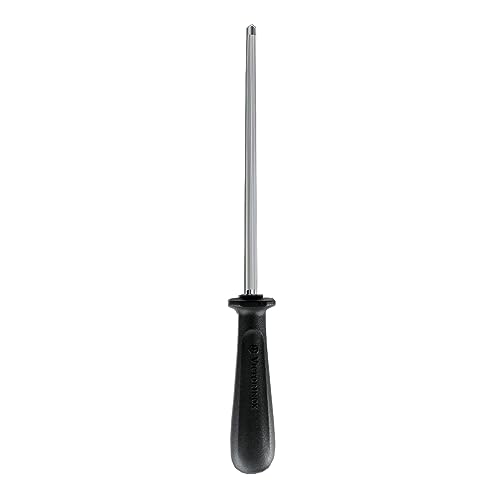
A honing steel is a different animal from a sharpener, and the Victorinox Fibrox 10-inch makes that distinction clear. It doesn’t grind away steel to create a new edge. It realigns the existing one, which matters more than people realize. Daily use of a pocket knife bends the microscopic edge of the blade over, and a few light passes on this rod roll it back to center, extending the time between actual sharpening sessions.
The chrome-plated steel construction adds a small amount of hardness and stain resistance with each pass, and the 10-inch length gives you enough reach to handle everything from a short folder to a longer fixed blade. Against the powered and diamond-rod options higher in this list, it’s a low-tech complement rather than a competitor. Most owners pair it with a pull-through or belt system rather than choosing one over the other.
Everyday Wins
- Extends time between full sharpening sessions by realigning the edge
- 10-inch length handles small folders and longer blades comfortably
- Chrome-plated steel adds minor hardness and resists corrosion
- No learning curve; gentle angled passes do the job
Trade-Offs
- Will not restore a truly dull or damaged edge, only a slightly rolled one
- Requires regular technique to avoid rounding the edge on heavy-handed strokes
Feature Snapshot
Who Should Grab It
Anyone who sharpens their pocket knife weekly and wants a fast maintenance step between deeper sharpening sessions.
Reach For A Different Pick When
Your edge is already past the point of realignment; the LEFUGO Cordless Electric Knife Sharpener can rebuild a working edge from a dull state.
The Pocket Field sharpener trades the bulk of a bench setup for a palm-sized block that still covers six sharpening tasks. A 220-grit diamond plate handles serious repair, a 600-grit plate refines the edge, and the carbide slot and guided system round out the kit for quick touch-ups on the trail. The whole thing is small enough to ride in a backpack pocket or the MOLLE webbing on a hunting pack.
Where this earns its spot over the kitchen-focused Orange Ninja is the gut-hook slot, which is a real feature for hunters dressing game in the field. It’s also the only sharpener in this list that explicitly targets EDC, hunting, and fishing knives as its main job. The trade-off is precision: palm-sized tools ask more of your hand control, and a slip on the diamond plate can scratch a polished blade face.
Real Benefits
- Six functions cover repair, refining, touch-ups, and gut-hook work
- Diamond plate stages work on serrated, straight, and specialty blades
- Compact body fits in a pack, tackle box, or large pocket
- Guided angle system adds control for less-experienced users in the field
Practical Considerations
- Palm-sized form factor demands careful hand control to avoid slips
- Diamond plates can leave visible scratches on polished blade flats
Perfect Match For
Hunters, anglers, and backpackers who need a versatile sharpener that travels and handles serrated and specialty blades.
Not Your Match When
You mostly sharpen at home on a counter; the Work Sharp Guided Field Sharpener offers a more stable platform for stationary use.
The Work Sharp Guided Field Sharpener is the answer to the “what do I bring backcountry” question. Diamond plates, ceramic rods, a leather strop, and sharpening guides all live in one compact brick, and the rotating ceramic rod exposes both coarse and fine surfaces depending on which end you flip up. The diamond plates slide out to reveal a broad-head wrench, a small but useful addition for hunters tuning broadheads in camp.
Versus the Orange Ninja Pocket Field, this trades a couple of dedicated slots for the leather strop, which most sharpening enthusiasts consider the proper way to finish a fine edge. The build feels closer to a piece of gear than a gadget, with replaceable components and a base that grips a flat surface. The ceramic rod works well for serrations where diamond plates are too aggressive.
Practical Pluses
- Full sharpening system in one block: diamond, ceramic, leather, and guides
- Removable diamond plates reveal a broad-head wrench for hunters
- Rotating ceramic rod switches between coarse and fine passes
- Compact form factor for pack, truck, or shop drawer
Room For Improvement
- Smaller diamond plate area means more strokes per sharpening pass
- Strop requires its own compound to reach a true mirror finish
Key Attributes
Made For
Hunters, sportsmen, and outdoor enthusiasts who want a single compact tool that handles knives, broadheads, and serrations on the go.
Where A Sibling Pick Shines
For dedicated kitchen work, the Orange Ninja 4-Stage Kitchen Sharpener is purpose-built for the serrated and straight blades you use at home.
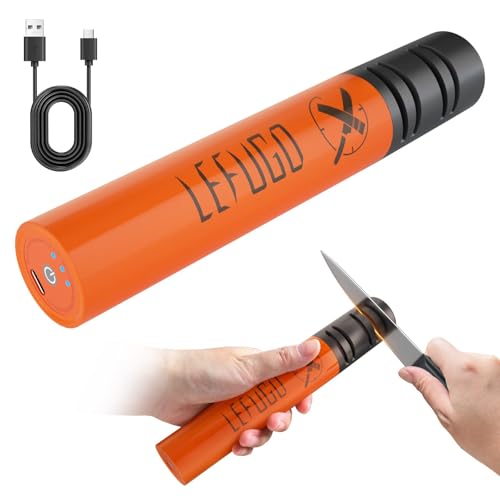
The LEFUGO pulls sharpener design into the cordless era. A rechargeable 2000mAh battery frees you from the outlet hunt, and three speed settings up to 7000 RPM give you some control over how aggressively the abrasive engages. The 1.5 by 1.5 by 8.4-inch body drops into a kitchen drawer when the job is done, so it doesn’t take over a drawer the way some electric sharpeners do.
For someone intimidated by angle guides or worn out by hand-stroking, the speed dial approach simplifies the decision-making. Push a blade through at the slowest setting for routine touch-ups, ramp up for duller folders. The honest read is that high RPM motors generate heat, and heat is the enemy of edge steel; light passes at moderate speed are the safer path on premium pocket-knife alloys.
What It Does Well
- Cordless design works anywhere on a counter, island, or dining table
- Three speed settings adapt to dull vs. lightly worn edges
- Compact footprint tucks into a standard kitchen drawer
- Rechargeable battery removes the outlet-hunt step before each session
Where It May Fall Short
- High RPM can overheat thin, hard steels without careful technique
- Battery life limits how many knives you can sharpen per charge
Best Suited To
Home users who want a fast, no-fuss electric sharpener and don’t want to learn freehand angle control.
Where Another Pick Suits Better
For users who want precise angle control, the Sharp Pebble 5 Precision Adjust Sharpener covers five angles on a manual platform.
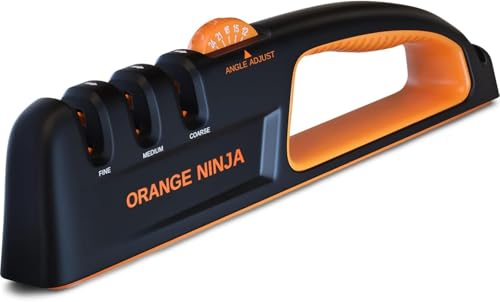
Angle is the part of sharpening that most pull-through tools ignore, and the Sharp Pebble 5 Precision Adjust is built around that single variable. Five angle settings (12, 15, 18, 21, and 24 degrees) let you match a knife’s factory edge instead of guessing. Twelve degrees suits Asian-style kitchen blades, while 20-plus degrees is closer to a heavy outdoor knife. The three-stage progression inside the unit takes you from coarse work to a clean finish.
This is the most angle-aware pick in the list, and the ergonomic handle helps a lot when you’re holding a steady position through multiple passes. The limit is the design’s scope: straight-edge blades only, so serrated folders and scissors sit this one out. For a precision-focused pocket-knife rotation, that trade-off usually makes sense; for mixed households with serrated bread knives, a different pick is the safer fit.
Everyday Perks
- Five angle settings cover most factory knife edge geometries
- Three-stage progression handles repair, sharpening, and finishing
- Ergonomic handle keeps pressure consistent across passes
- Compact size stores easily between sessions
Potential Drawbacks
- Not suitable for serrated blades or scissors
- Manual operation takes more time than powered alternatives
Spec Overview
Who Will Love This
Knife enthusiasts who know their blade’s factory angle and want a guided system that respects it on every pass.
Consider Something Else When
You regularly sharpen serrated folders; the Work Sharp Guided Field Sharpener handles serrations through its ceramic rod.
What To Weigh Before Picking Your Sharpener
Choosing sharpeners for pocket knives comes down to how the knife gets used, not just how sharp you want it. EDC folders with thin, hard steels want fine-grit finishes and gentle abrasive so you don’t grind away expensive steel. Hunting and outdoor knives take coarser repair stages and built-in gut-hook support. Kitchen pocket knives lean toward pull-through simplicity and serrated slots.
Blade geometry matters. Asian-style and slicing knives live in the 12-15 degree range, while outdoor and pocket knives often sit closer to 20 degrees. Matching the angle preserves edge life and prevents you from reprofiling a blade every time you touch it up. That’s the real case for an adjustable-angle system: it lets you match what’s already on the blade.
Portability splits the list cleanly. Bench and countertop units reward the patient owner with belt-and-rod precision, but field kits earn their keep when you’re miles from a wall outlet. Pull-through sharpeners sit in the middle, fast and forgivable but limited in the angles they can hold. For most people, a two-tool setup (a field sharpener and a bench system) covers more scenarios than any single pick.
Key Considerations Across These Picks
Pitfalls Shoppers Hit
A common trap is buying a sharpener built for kitchen knives when the real job is a hardened outdoor folder. Pull-through carbide slots can chew up premium steels, and the lack of a finishing stage leaves a working edge that’s sharp but not durable. The other common miss is ignoring serrations; a serrated folder sharpened only on a straight-edge stage will end up with a ragged, uneven tooth pattern.
Where The Extra Money Goes
Higher-tier sharpeners earn their cost with better abrasive quality, replaceable components, and angle accuracy. A ceramic-oxide belt outlasts aluminum-oxide alternatives on hard pocket-knife steels, which means fewer replacements over years of use. Adjustable-angle systems cost more upfront but eliminate the hidden cost of reprofiling blades that were sharpened at the wrong angle by a cheaper tool.
Frequently Asked Questions
How often should you sharpen a pocket knife?
Most pocket knife owners benefit from a light touch-up every few weeks of regular use, with a full sharpening session a few times a year. A honing steel, like the Victorinox 10-Inch option above, can extend the interval between deeper sharpenings if you use it weekly.
Can one sharpener handle both straight and serrated edges?
Some can, and the Orange Ninja 4-Stage and Work Sharp Guided Field both include dedicated serration-friendly stages. Pure adjustable-angle systems like the Sharp Pebble 5 Precision Adjust are built for straight edges only.
What grit works best for daily touch-ups?
For routine maintenance, a 1000-2000 grit range offers the best balance between removing material and leaving a durable edge. Anything coarser belongs in repair work, and anything finer is best reserved for finishing or polishing.
Is a honing steel the same as a sharpener?
No. A honing steel realigns an edge that has rolled over with use, while a sharpener removes steel to create a new edge. The two work together: hone often, sharpen less frequently.
Do electric sharpeners damage knife edges?
They can, especially at high RPM on thin, hard steels without careful technique. Light passes at moderate speed and proper angle control keep heat down and preserve the temper of the blade.




