


A flat tire in the driveway, a wobbly baseboard in the hallway, a nail gun that sputters halfway through crown molding: the right compressor turns those small frustrations into quick wins. This lineup covers cordless inflators for trucks, pancake tanks for trim work, and a quiet option for indoor projects. Each pick below was chosen for a specific job, so the best match is the one that fits how you actually work.
The Main Contenders

CRAFTSMAN Air Compressor Combo Kit with Brad Nails

ETENWOLF VORTEX S6 Tire Inflator Portable Air Compressor

ETENWOLF VORTEX S7 Tire Inflator for Heavy-duty Vehicle

Bostitch 3-Tool/Compressor Combo Kit
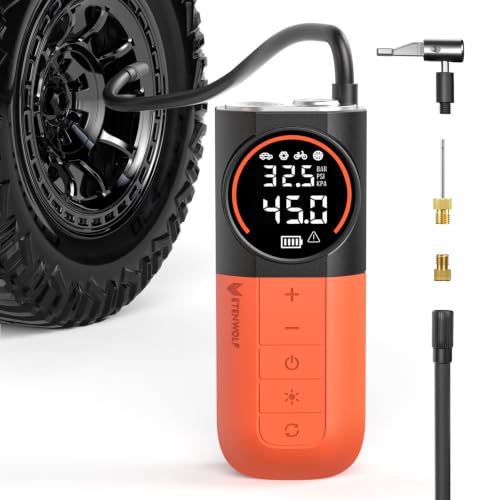
ETENWOLF S1 Tire Inflator Portable Air Compressor 160PSI

PORTER-CABLE 6-Gallon Pancake Oil-Free Air Compressor (C2002)

Makita DMP180ZX 18V LXT Cordless Inflator (Tool Only)

Makita MAC210Q Quiet Series 1 HP 2 Gallon Air Compressor

Teslong 20V Dual Cylinder Cordless Tire Inflator
The Strengths Of Each Pick
The CMEC6150 unit pairs a lightweight 150 max PSI oil-free pump (a pump that doesn’t need lubricant added between uses) with a brad nail project pack, so a first-time user gets a compressor and a fastening tool in one box. For a weekend hanging crown molding or shoe molding in a hallway, that pairing keeps the setup small and the learning curve short.
Oil-free construction means no scheduled oil changes, which is a relief for anyone who doesn’t want a maintenance log next to their tools. Indoor use only is the real constraint here, so plan to keep this in a garage, basement, or shop rather than a dusty job site.
Practical Pluses
- 150 max PSI suits brad nailers and finish staplers for interior trim.
- Oil-free pump cuts out routine lubrication steps.
- Lightweight build makes it easier to carry between rooms.
- Brad nail project pack removes the guesswork of matching fittings.
- Made in Jackson, Tennessee with globally sourced materials.
Things To Consider
- Indoor-only rating limits outdoor job site use.
- Recovery time is modest, so longer trim runs may pause between cycles.
Who It Suits Best
First-time DIYers finishing a single room of baseboards or trim who want a matched compressor and nailer without buying piecemeal.
Where Another Pick Suits Better
For ongoing workshop projects that need longer runtime, the Bostitch 3-Tool/Compressor Combo Kit offers a wider tank and tool set.
The Vortex S6 is built for the truck-and-trailer crowd, with a 19200 mAh battery and a 160 PSI ceiling aimed at heavier rubber. In a driveway before a road trip, that combo means a 31-inch tire climbs from low pressure to road-ready without dragging out a corded unit.
It also handles bicycles, balls, and pool floats when the kids are watching, so the same tool that preps a work truck in the morning can handle a Saturday afternoon of camp gear. The trade-off is size: this is a chunkier inflator than a glovebox model.
What Makes Sense
- High airflow at 0 PSI shortens the wait on big tires.
- 160 PSI ceiling covers most light-truck and SUV ranges.
- Cordless battery design removes the need for a 12V socket nearby.
- Multi-use valves cover cars, bikes, balls, and inflatables.
Points To Note
- Not rated for stand-up paddleboards, so some pool toys are out of reach.
- Larger body weight makes it less pocketable than small inflators.
- Charging between full-size truck fills may require planning.
Key Specs
Right Fit For
Pickup, SUV, and off-road owners who want cordless convenience for topping off larger tires at home or trailhead.
Look Elsewhere When
Casual car commuters may prefer the smaller ETENWOLF S1 for routine top-offs at lower cost and weight.
Step up from the S6 and you land on the Vortex S7, which doubles the battery to 38400 mAh and uses dual motors (two internal motors working in parallel) for serious airflow. For a fleet driver or overlander airing down for sand and airing back up afterward, that extra capacity matters more than any spec sheet line item.
The S7 also doubles as a roadside helper for friends with regular cars, so the tool earns its space even on days when your own tires are fine. Owners commonly report that the larger battery is the difference between finishing a four-tire airing and being stranded with a dead unit at the trail exit.
What Pays Off
- 38400 mAh battery supports multiple heavy-duty inflations per session.
- Dual-motor design pushes higher airflow into large tires.
- Targets off-road and heavy-duty pickups where corded power is impractical.
- Also handles cars, bikes, and inflatables between heavy jobs.
Honest Caveats
- Heavier than a commuter inflator, so it stays in the truck, not the pocket.
- Not designed for stand-up paddleboards.
- Charging time between heavy uses is longer than smaller units.
Whose Shelf It Belongs On
Overlanders, fleet operators, and pickup owners running 33-inch or larger tires who need cordless power on remote trips.
Swap It Out When
City drivers with sedans will find the ETENWOLF S1 lighter and easier to store without losing the basics.
The Bostitch 6-gallon pancake-style compressor (a low, flat tank shape that resists tipping) comes bundled with finish tools and is built for the kind of interior trim work that lives in garages and basements. The 150 PSI rating and 0.8 HP oil-free motor are enough for staircases, crown, and baseboard runs in a typical home.
Compared with the CRAFTSMAN kit earlier, this one trades the brad nailer for a broader tool set, which matters once a project list includes more than trim. The pancake design keeps the footprint small in a corner, and the oil-free pump means no fluid to check before starting.
Advantages To Know
- 6-gallon tank supports longer nail gun cycles before pausing.
- Oil-free pump removes a recurring maintenance step.
- Low pancake profile resists tipping in tight shop spaces.
- Tool-free adjustable exhaust directs air away from the work area.
- 3-tool kit covers more project types out of the box.
Worth Noting
- 0.8 HP motor is modest for continuous framing or roofing work.
- Noise level is typical for a pancake unit, so hearing protection is wise.
Best Suited To
Home hobbyists building out a garage workshop for interior trim, staircases, and occasional furniture projects.
Reach For A Different Pick When
For quieter indoor use in an apartment, the Makita MAC210Q keeps noise to a much friendlier level.
The S1 sits at the lighter end of the ETENWOLF family, aimed at cars, SUVs, motorcycles, and bicycles rather than 35-inch off-road rubber. With a 5200 mAh battery and 160 PSI ceiling, it covers the typical driver who wants a glovebox-friendly tool for monthly top-offs.
In a real-world morning routine, that means grabbing one small unit instead of routing a cord through a 12V outlet every time a tire light flickers. For commuters and casual road-trippers, that convenience is the whole point.
The Good Stuff
- Compact body fits in most trunk storage compartments.
- 160 PSI supports passenger car and SUV tire ranges.
- Cordless design works in any parking spot, not just near a power outlet.
- Quick top-off for bikes, balls, and motorcycles between uses.
Soft Spots
- Smaller battery means fewer fills between charges than the S6 or S7.
- Airflow is lower, so big-tire airing takes patience.
Quick Facts
Perfect Match For
Daily commuters and casual cyclists who want a portable inflator for routine pressure checks and weekend rides.
Not Your Match When
Heavy truck or off-road tire work calls for the higher airflow of the ETENWOLF VORTEX S7.
The C2002 has been a garage-shop staple for years, pairing a 6-gallon pancake tank with a low-amp 120V motor. The 150 PSI max and 2.6 SCFM (standard cubic feet per minute, a measure of how much air the pump delivers) at 90 PSI give trim and finish nailers steady recovery between cycles.
Rubber feet and a built-in water drain valve are small touches, but they show up in the weekly routine: the unit stays put on a workbench, and condensation drains quickly after a humid day. The trade-off is the familiar pancake-compressor noise, which is louder than dedicated quiet models.
Notable Upsides
- 2.6 SCFM at 90 PSI supports faster recovery between nail gun cycles.
- Low-amp 120V motor runs on standard household circuits.
- Water drain valve simplifies end-of-project moisture removal.
- Oil-free pump means no scheduled lubrication.
A Few Limitations
- Noise is typical of pancake units, louder than quiet-compressor models.
- Lacks the bundled tools that combo kits offer, so add-ons cost extra.
Made For
DIYers who already own finish tools and want a reliable shop compressor to anchor weekend projects.
Where A Sibling Pick Shines
For noise-sensitive indoor work, the Makita MAC210Q is purpose-built for quieter operation.
The DMP180ZX is a tool-only inflator, meaning it ships without a battery or charger, and that detail drives who it makes sense for. Anyone already running Makita’s 18V LXT platform (a battery system that powers dozens of tools) can drop this inflator onto an existing battery and skip the extra charger clutter.
Up to 120 PSI covers cars, bikes, and sports balls, and a backlit gauge plus auto-stop function takes the guesswork out of hitting a target pressure. It’s the kind of unit that lives in a truck door pocket between camping weekends.
Useful Strengths
- 120 PSI ceiling handles passenger car and bike inflation ranges.
- Backlit gauge improves visibility in low light or garages.
- Auto-stop function shuts off at the set pressure.
- 25-1/2 inch hose reaches valves on trucks and trailers.
- Shares batteries with the wider Makita 18V LXT system.
Worth Bearing In Mind
- Battery and charger not included, adding cost for first-time Makita users.
- Lower max PSI than truck-focused inflators in this list.
Who Should Grab It
Existing Makita 18V owners who want to round out their platform with a portable inflator without buying another battery system.
Skip It When
First-time cordless tool shoppers should consider the ETENWOLF S1, which arrives ready to inflate.
Quiet Series is more than a label: the MAC210Q runs at 60 dBA (decibels, a unit for loudness), which sits in the same range as a normal conversation. For an apartment dweller or a hobbyist working after kids are in bed, that low noise floor changes when projects can happen.
The 1 HP motor and 2-gallon tank are enough for trim, brad nailing, and small stapling jobs, though they cap the unit below the runtime of larger shop compressors. Oil-free design means no fluid changes, and the compact body fits on a closet shelf when not in use.
Everyday Advantages
- 60 dBA operation allows indoor and shared-space use.
- Oil-free pump removes routine maintenance.
- Compact 2-gallon tank fits in closets and small shops.
- 1 HP motor supports finish nailers and small spray work.
Points To Keep In Mind
- 2-gallon tank limits continuous runtime for high-demand tools.
- Not designed for framing or roofing nailers.
Feature Snapshot
The Right Fit
Apartment residents, condo owners, and indoor hobbyists who need finish-nailer power without the roar of a traditional compressor.
Consider Something Else When
Larger shop projects with long continuous runtimes are better handled by the PORTER-CABLE C2002 pancake unit.
The Teslong enters the cordless category with a dual-cylinder pump (two pistons in the same housing, doubling output per stroke) and a 20V battery that swaps out without tools. For an SUV or pickup owner juggling multiple vehicles, that swappable design turns a dead battery into a 2-second swap rather than a charging wait.
At 150 PSI max and 40 L/min free airflow, it lands between the ETENWOLF S1 and S7, covering most household tire jobs without overshooting into heavy-truck territory. Where it earns its place is the battery system: households that already own a compatible platform can extend what they have.
Positive Points
- Dual-cylinder pump speeds up inflation on larger tires.
- Tool-free battery swap keeps downtime short.
- 150 PSI covers SUV, pickup, and RV tire ranges.
- Compact body stores in a trunk or cargo area.
Practical Considerations
- Newer brand presence means long-term reliability data is still building.
- Battery ecosystem is smaller than established 18V platforms.
Built With In Mind
Multi-vehicle households with SUVs or pickups that benefit from a swappable battery and moderate-to-high airflow.
A Better Fit Elsewhere
Buyers who already own Makita 18V tools get more platform value from the Makita DMP180ZX, even as a tool-only purchase.
What Matters When Choosing A Shop Air Compressor
Tank Size And PSI Range
PSI (pounds per square inch) tells you how hard the tank can push air; tank size in gallons tells you how long it can keep pushing. For finish nailers and brad guns, 6 gallons and 150 PSI is a comfortable baseline, and a pancake shape keeps the unit from tipping on a crowded workbench. The Makita MAC210Q uses just 2 gallons because quieter operation and smaller footprint matter more to its audience than runtime.
For continuous framing work, the same 6 gallons feel small, and a wheelbarrow-style tank becomes more useful. Match the tank to the longest expected nail gun run without a pause.
Oil-Free Versus Oiled Pumps
Oil-free pumps, found on every pick in this list, skip the lubrication step that older compressors require. That makes them friendlier for occasional users and indoor setups, where spilled oil on a workbench is a real annoyance. The trade-off is generally shorter pump life under heavy daily use, which matters more to contractors than to weekend finish carpenters.
For most home and hobby use, oil-free is the more practical default and removes a maintenance item from the project checklist.
Noise, Portability, And Power Source
Compressor noise is measured in dBA, and the gap between a typical pancake unit and a quiet-compressor model like the Makita MAC210Q is the difference between garage-only and apartment-friendly. Cordless inflators sidestep the noise and outlet question entirely, trading runtime for portability.
Decide where the unit will live: a permanent workshop rewards a wired tank, while a vehicle trunk or shared parking lot calls for a cordless inflator with enough battery for several fills.
Key Considerations Across These Picks
Wrong Turns To Avoid
Buying a tank that’s too small is the most common mistake: a 2-gallon unit feels plenty until a long baseboard run forces constant cycling. The opposite error is grabbing a heavy wheelbarrow compressor for occasional trim work, which then collects dust in a corner. Match the tank to the job, not to the loudest tool you might one day own.
Another trap is overlooking the difference between a 12V plug-in inflator and a true cordless battery unit, which can be used anywhere, not just near a running vehicle.
What The Higher Tier Buys
Stepping up from a basic inflator to a heavy-duty model like the ETENWOLF VORTEX S7 buys airflow, battery capacity, and the ability to handle 33-inch or larger tires. For truck and off-road owners, that upgrade pays for itself the first time a tire needs air away from an outlet. For sedan commuters, the same money is better spent on a smaller, lighter unit that gets used weekly rather than a heavy model that stays in a closet.
Premium also buys quieter operation: the Makita MAC210Q’s 60 dBA is a real-world quality-of-life upgrade for anyone working indoors after hours.
Frequently Asked Questions
What PSI Do I Need For A Nail Gun?
Most brad nailers and finish nailers run comfortably between 70 and 120 PSI, which every pick in this list can deliver. A compressor with 150 PSI max gives you headroom for adjustments and reduces the chance of the pump running constantly.
Check your specific nailer’s manual for its recommended operating range before dialing in regulator pressure for the first time.
How Do Cordless Tire Inflators Compare To Plug-In Models?
Cordless inflators trade unlimited runtime for portability, which is the whole point for roadside or trailhead use. Plug-in 12V models run as long as the vehicle’s battery allows but tether you to a power source.
For most household tire top-offs, a cordless unit with at least a 5000 mAh battery handles a four-tire session on a single charge.
Are Oil-Free Compressors Lower Maintenance?
Yes, oil-free pumps remove the need for scheduled oil checks and changes, which simplifies ownership for occasional users. They tend to run a bit hotter under heavy daily use, but for weekend projects the trade-off strongly favors oil-free.
Storage in a dry area still matters, since moisture collects in the tank regardless of pump type.
Can I Use One Compressor For Multiple Tools?
Most home compressors support running one tool at a time, especially nailers and staplers that cycle intermittently. Trying to power two high-demand tools at once will usually stall a small tank or trip a household breaker.
Plan your workflow around one active tool at a time, and the 6-gallon tanks in this list will keep up comfortably.
How Often Should I Drain The Tank?
Draining after each heavy use session is a good habit, since moisture builds up with every cycle. The PORTER-CABLE C2002 and similar units include a dedicated drain valve at the bottom for this reason.
A quick release of the valve clears most condensation in seconds and extends the life of the tank and internal fittings.




