


A short trip through the shop-vac aisle tells you something fast: the canister you already own is only half the equation. Bags, fittings, separators, and the vacuum itself all shape how cleanly your workspace stays, and how often you wrestle with clogged filters and a motor that gave up too early. This lineup pulls together the consumables, fittings, and full vacuums that handle the dust so you can get back to the project. Garage hobbyists, weekend woodworkers, and anyone tired of drywall dust circulating through the house will find something worth a closer look.
The Essentials At A Glance

Kärcher Filter Fleece Bags 4 Pack for WD 4 to WD 6

POWERTEC 70148-P4 2-1/2 Inch Dust Control Flex Cuff, 4 Pack

POWERTEC 70362V Dust Collection Reducer 6-Inch to 4-Inch OD

CRAFTSMAN CMXZVBE38775 5-8 Gal. Shop Vacuum Dust Bags

Shop Vac 90669 Type C Replacement Filter Bags, 3-Pack

Shop-Vac 5801411 14-Gallon 5.5 Peak HP Wet/Dry Vac

Cen-Tec Quick Click Dust Collection Separator
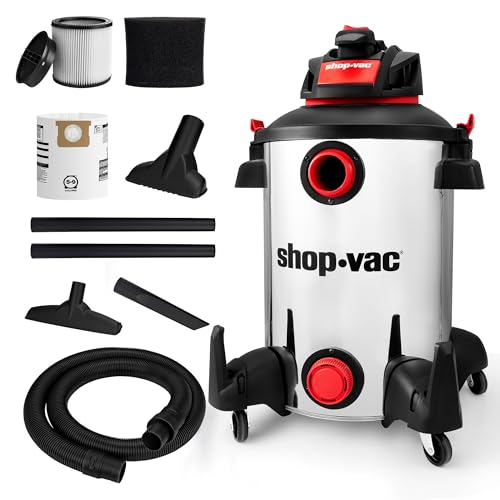
Shop-Vac 5761311 12-Gallon 6 Peak HP Wet/Dry Vac

Shop-Vac 5761011 10-Gallon 4.5 Peak HP Wet/Dry Vac
A Deeper Look At The Lineup
Anyone already running a Kärcher WD-series vacuum knows the bag situation: empty the tank, scrub the pleated filter, repeat. These fleece bags slot into the inlet and catch the fine stuff before it ever reaches the filter, which is a real relief during drywall-sanding sessions. The pack covers four changes, so for most weekend projects you can run a couple of months before restocking.
The trade-off is straightforward: these only fit Kärcher WD 4 through WD 6 models, so if your shop is built around a different brand entirely, the POWERTEC fittings later in this roundup are the better fit.
Strengths Worth Knowing
- Fleece construction acts as a first filtration stage, sparing the pleated filter from fine dust
- Keeps the motor path cleaner when vacuuming drywall dust, sawdust, and similar dry debris
- Pack of four lets you rotate through jobs without constant bag swaps
- Drop-in design installs by sliding onto the inlet, no tools needed
Things To Consider
- Compatible only with Kärcher WD 4, WD 5, WD 5/P, and WD 6 models
- Dry-use only, so wet spills need a bare tank
Feature Snapshot
Who It Suits Best
Kärcher WD-series owners who sand drywall, sweep up sawdust, or vacuum fine debris and want to extend the life of their pleated filter.
Consider Something Else When
Shoppers running a Shop-Vac-brand vacuum should look at the CRAFTSMAN CMXZVBE38775 instead, since that bag is designed for a different tank and inlet collar.
A dust collection system is only as strong as its weakest joint, and a leaky coupler is the classic weak link. POWERTEC’s flex cuffs give you a stretchable rubber sleeve that slides over two 2-1/2 inch outer-diameter ports, with steel hose clamps to lock everything down. The result is a sealed run between your collector and your tool, with no duct tape, no screws, and no fuss.
You get four cuffs in a pack, which works nicely if you are wiring up multiple machines or want spares for a future reconfiguration. In a small shop, that is usually enough to plumb a planer, a jointer, and a drum sander from one collector.
What Stands Out
- Rubber sleeve stretches to absorb slight misalignment between ports
- Steel clamps hold a tight seal under sustained suction
- Reusable design removes and reinstalls without new parts or adhesives
- Pack of four supports multi-machine hookups from a single collector
Worth Noting
- Only fits 2-1/2 inch OD connections, so it is not a universal cuff
- Not designed for PVC pipe or hard plastic fittings, which can crush under the clamps
Right Fit For
Woodworkers running 2-1/2 inch dust hose runs who want a reusable, airtight connection between collector ports and machine inlets.
A Better Fit Elsewhere
If your system mixes 6-inch main lines with 4-inch branches, the POWERTEC 70362V reducer is a more useful single fitting for that mismatch.
Most shops end up with a Frankenstein dust system at some point: a 6-inch main line out of the collector, then a step-down to 4-inch hoses that reach individual tools. POWERTEC’s reducer handles that transition in one fitting, complete with a flex cuff to seal the larger end. If you are moving from a rigid metal reducer to something that forgives a little wobble, this combo is the practical upgrade.
You will want a tape measure before ordering. The 4-inch end is 3-31/32″ nominal OD, and the 6-inch end is 5-15/16″ nominal OD, so it lines up with most rubber hose and metal ducting in that size range.
Well-Handled Touches
- Tapered reducer transitions from 6-inch to 4-inch dust hose in a single part
- Bundled 6-inch flex cuff seals the larger connection without extra adapters
- Two steel clamps included, so installation needs nothing else from the hardware store
- Helps a single collector serve tools with different inlet sizes
Trade Offs
- Stepping down a 6-inch line to 4-inch restricts airflow at the tool, which can hurt suction on long runs
- Reducer is not designed for PVC pipe or plastic fittings, so metal hose is the safer match
Made For
Hobbyist woodworkers bridging a 6-inch collector outlet to 4-inch tool hoses without buying a stack of separate adapters.
Skip It When
You only run 2-1/2 inch hoses, in which case the POWERTEC 70148-P4 flex cuff pack covers your needs more directly.
CRAFTSMAN’s 5 to 8 gallon dust bags handle the kind of mess that ruins a regular vacuum filter: cold fireplace ash, ultra-fine drywall powder, and other dry debris that would normally end up recirculating through the tank. The collar slips over the inlet port and the bag does the rest, trapping particles before they reach the pleated filter.
For most home shop-vac owners, the appeal is straightforward cleanup. When the bag is full, you pull it out, seal it, and toss it, instead of hosing down a dusty tank and hunting for a replacement filter every few sessions.
Notable Upsides
- Compatible with Shop-Vac-brand 5 to 8 gallon vacs, a common tank size in home shops
- Targets the dust that clogs standard filters fastest, including fine drywall and ash
- Sealed disposal keeps the tank cleaner and shortens filter maintenance cycles
Points To Note
- Intended for non-hazardous, non-toxic dry pickup only
- Fit is specific to Shop-Vac-brand 5 to 8 gallon models, so other brands may not match the collar
Feature Snapshot
Best Suited To
Homeowners with a Shop-Vac 5 to 8 gallon tank who vacuum fireplace ash, drywall dust, or workshop debris and want a disposable bag option.
Where Another Pick Suits Better
For a smaller 3-gallon Shop-Vac, the Shop Vac 90669 replacement bag is the closer match by tank size.
Small Shop-Vac tanks get used for everything: vehicle interiors, quick shop sweeps, and post-saw cleanup. Aftermarket Type C bags in this 3-gallon size are a low-cost way to keep that little vacuum from spitting fine dust back out. The 3-pack format keeps a few extras on the shelf for the next round of projects.
You do sacrifice some capacity for the price, and “disposable” means these are single-use, not washable. For light, regular cleanup, though, the trade-off tends to feel fair.
The Upside
- Made for Shop-Vac part number 90669 (also listed as 906-69), a widely available 3-gallon tank
- Disposable design means quick swaps with no filter cleaning step
- Three bags per pack covers several cleanup sessions
- Affordable way to add bagging to a small shop vac you already own
Minor Gripes
- Dry-use only, so wet messes still need a bare tank
- Disposable build means more waste than reusable fleece options like the Kärcher 4-pack
Who Will Love This
Owners of a 3-gallon Shop-Vac who want inexpensive replacement bags for routine dry pickup around the house or garage.
Look Elsewhere When
If your tank is in the 5 to 8 gallon range, the CRAFTSMAN CMXZVBE38775 is a better-fitting disposable bag.
When the cleanup outgrows a 10-gallon tank, you start eyeing the 14-gallon Shop-Vac. The 5801411 pairs a 14-gallon tank with 5.5 peak HP, which is enough suction to pull water out of a flooded basement corner or clear a packed workbench. A rear blower port turns it into a leaf-and-debris machine once the tank is empty.
The size means it earns its keep in a real workshop or finished basement, not a one-bedroom apartment closet. Think of it as the vacuum you bring out for project-day messes, not everyday touchups.
Notable Gains
- 14-gallon tank handles big-volume pickups without constant emptying
- 5.5 peak HP supports both wet spills and dry debris
- 3-in-1 function covers vacuuming, wet pickup, and rear-port blowing
- Large enough to anchor a workshop dust collection routine
Honest Caveats
- Bulky footprint, so storage space matters in smaller garages
- Heavier to move than the 10-gallon Shop-Vac 5761011, especially on stairs
Feature Snapshot
Putting a separator between your tools and your shop vacuum is the kind of upgrade that pays you back in filter life. The Cen-Tec Quick Click uses cyclonic action, a spinning airflow pattern that flings heavier particles outward, to drop dust and debris into a recovery bin before it ever reaches the vacuum. The result is less fine dust loading the filter, and a vacuum that stays useful far longer between filter changes.
The Quick Click mount makes it easy to attach and detach, so swapping between a shop vac and a dedicated dust collector is a reasonable afternoon project rather than a plumbing overhaul.
Real-World Strengths
- Cyclonic separation drops bulk material into a recovery bin before it reaches the vacuum
- Reduces the volume of fine dust that reaches the vacuum’s filter and bag
- Quick Click mount supports fast setup changes between tools
- Captures both bulky debris and very fine dust in a single pass
A Few Limitations
- Adds a stage to your dust path, so you need floor space near the vacuum
- Works best when paired with a vacuum strong enough to maintain CFM (cubic feet per minute, a measure of airflow volume) through the extra hardware
Perfect Match For
Shop owners who already own a quality shop vacuum and want to extend filter and bag life while running planers, sanders, or routers.
Not Your Match When
For a single-tool, light-duty cleanup with no major dust load, the CRAFTSMAN CMXZVBE38775 bags handle the basics without the extra hardware.
For a lot of homeowners, 12 gallons hits the sweet spot: enough capacity to clean up a basement after a small flood, light enough to wheel to the car without dread. The 5761311 layers in 6 peak HP and a 100 CFM blower function, so the same machine handles wet pickup, dry debris, and a quick leaf-clearing session on the driveway.
You also get onboard cord and accessory storage, plus a tank drain, which is the small detail that makes the difference between a vacuum you actually use and one that lives in the corner.
What Earns Its Place
- 12-gallon tank balances capacity and portability for most home shops
- 6 peak HP with 100 CFM airflow supports both wet and dry pickup
- 3-in-1 function: vacuum, wet pickup, and rear blower
- Tank drain simplifies water disposal after wet cleanups
Points To Keep In Mind
- Larger than a 10-gallon vac, so it needs storage room in a tight garage
- Heavier when full, which matters when hauling it up basement stairs
Feature Snapshot
Right Fit For
Homeowners who want a single vacuum that can move between basement floods, garage sawdust, and outdoor debris without swapping machines.
Swap It Out When
Shoppers with smaller storage or lighter messes may prefer the more compact Shop-Vac 5761011 10-gallon model instead.
For most apartment dwellers, condo owners, and weekend car-cleanup folks, a 10-gallon Shop-Vac covers the bases without dominating the storage closet. The 5761011 ships with 4.5 peak HP, a 90 CFM blower, and a 7-foot Lock-On hose, so you have what you need for vacuuming the car, clearing sawdust from a small workshop, or blowing leaves off a patio.
The trade-off is real: 4.5 peak HP will not move water as fast as the 14-gallon Shop-Vac 5801411, and the smaller tank fills up faster on big jobs. For the size, though, the performance is hard to argue with.
Practical Pluses
- 10-gallon tank keeps the size manageable for tight storage
- 4.5 peak HP handles typical home and garage dry pickup
- 90 CFM blower function extends usefulness to outdoor debris
- 3-in-1 design: vacuum, wet pickup, and blower in one body
Where It Is Less Suited
- Smaller tank and lower peak HP than the 14-gallon Shop-Vac 5801411
- Best for occasional use, so heavy daily jobs may outpace it
Whose Shelf It Belongs On
Homeowners with a one-car garage, a small workshop, or a vehicle they like to keep clean who need a vacuum that stores away easily.
Reach For A Different Pick When
You regularly vacuum large wet messes or have a workshop that demands bigger tank capacity, in which case the Shop-Vac 5801411 14-gallon model fits better.
What Matters When Choosing Shop Vac Dust Collections
Tank size sets the upper limit on how long you can vacuum before emptying, while peak HP (a manufacturer-rated measure of motor output, not sustained horsepower) and CFM (cubic feet per minute, the real-world airflow number) tell you how aggressively the machine pulls. A small 3 to 5 gallon vac works for quick car interiors and benchtop messes, but a basement flood or a long sanding session benefits from a 10 to 14 gallon tank with stronger airflow.
Filtration deserves equal attention to the vacuum itself. Drywall dust, cold ashes, and fine sawdust clog standard pleated filters quickly, and once a filter loads, suction drops and motor temperatures climb. Adding a fleece bag, a Type C disposable bag, or a cyclonic separator like the Cen-Tec Quick Click can dramatically extend filter life and keep your vacuum breathing cleanly for longer stretches between cleanings.
Hose and fitting compatibility is the part people forget. Dust collection systems rely on matched diameters, and a 6-inch main line that suddenly drops to a 4-inch branch needs a real reducer to maintain airflow. Reusable flex cuffs and steel clamps make these transitions airtight, while one-shot duct tape joints tend to leak and cost you suction the moment the system starts pulling hard.
Finally, think about how you actually use the space. A heavy 14-gallon vac earns its keep in a workshop that sees daily use, but for someone pulling the vacuum out of a closet once a month, the lighter 10-gallon Shop-Vac 5761011 is a friendlier match. Match the tool to the routine, not the other way around.
Key Considerations Across These Picks
Pitfalls Shoppers Hit
The most common stumble is buying a bag or fitting that does not match the tank or hose you already own. Kärcher fleece bags only fit WD 4 through WD 6, Shop-Vac Type C bags fit specific tank sizes, and POWERTEC cuffs are sized by outer diameter, so a quick check of your existing equipment before ordering saves a return trip. A 6-inch to 4-inch reducer looks universal, but it is built for metal hose, not PVC, and using it on the wrong material leads to crushed fittings.
Where The Extra Money Goes
Spending more usually buys three things: larger tanks, stronger motors, and better accessories. The jump from a 10-gallon to a 14-gallon Shop-Vac is mostly about how often you want to empty, while a higher peak HP rating shows up as faster water recovery and stronger suction through long hose runs. A separator like the Cen-Tec Quick Click adds cost up front, but it pays back through longer filter life and fewer bag changes, especially for shops that generate fine dust daily.
Frequently Asked Questions
How often should you change a shop vac dust collection bag?
You should change the bag when suction noticeably drops or the bag feels firm to the touch. For most home users running drywall or sawdust cleanup, a fleece or Type C bag lasts through a few sessions before it needs swapping.
Can you use a shop vac for both wet and dry pickup with the same bag?
No, dry-only filter bags should never be used for wet pickup. Liquids will saturate the bag and can damage the vacuum’s motor, so swap to a bare tank for any wet mess.
What is the difference between peak HP and CFM in a shop vacuum?
Peak HP is a manufacturer-rated motor output number, while CFM (cubic feet per minute) measures actual airflow. CFM is the better real-world indicator of how well a vacuum pulls debris and water, so use it as your comparison point when two models share a similar tank size.
Do dust collection reducers restrict airflow?
Yes, any reducer restricts airflow to some degree, especially when stepping from a larger main line to a smaller branch. Keeping hose runs short and using proper diameters for each tool helps maintain suction across the system.
Is a cyclonic separator worth adding to a shop vacuum?
It is worth it if you generate fine dust regularly from sanding, routing, or planing. A separator drops the bulk of the material into a bin before it reaches the vacuum, which extends filter and bag life and keeps suction steadier across long work sessions.




