


Soldering iron kits sit in that awkward middle ground between hobby gear and proper shop equipment. A weekend builder repairing a guitar jack needs something different than a tech swapping micro-SMD chips on a phone motherboard, yet both end up browsing the same wall of options. The nine kits below cover that spread, from a battery-powered cordless iron that fits in a tech bag, to a heavy-duty 2-in-1 station that anchors a serious repair bench. Every pick here was chosen for a specific kind of work, so the right one depends less on specs alone and more on what you’ll actually solder.
A Closer Look At The Lineup
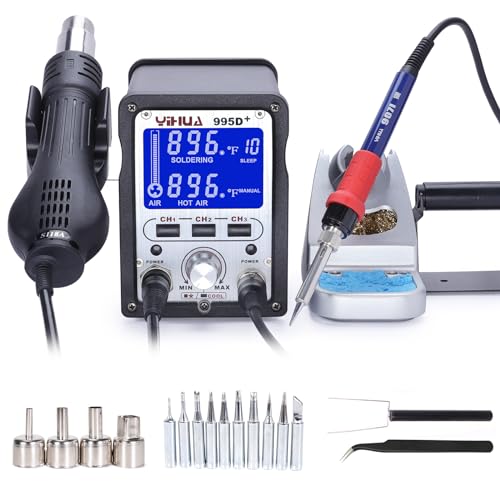
YIHUA 995D+ 2 in 1 Hot Air Rework and Soldering Iron Station

EOOKU Helping Hands Soldering Station with Magnifying Lamp

M12 REDLINK Soldering Iron Kit with LED Light
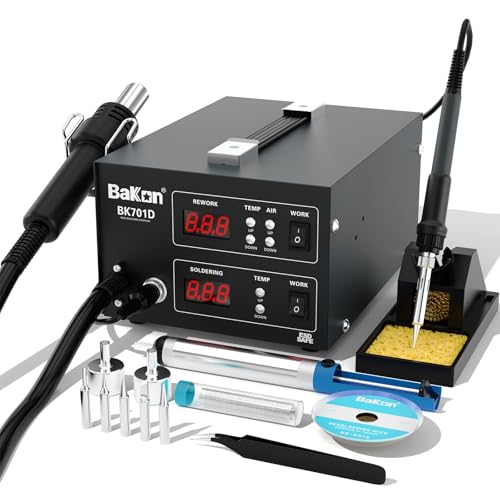
BAKON BK701D 700W 2 in 1 Soldering Station

BAKON 852D+ 2-in-1 Heat Gun and Soldering Iron Kit

YIHUA 8786D I 2 in 1 Hot Air Rework and Soldering Station
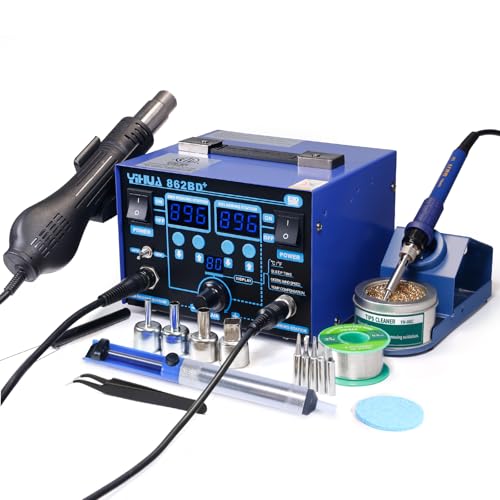
YIHUA 862BD+ SMD ESD Safe 2 in 1 Soldering Station

BAKON BK602S 2 in 1 Soldering Iron Hot Air Station
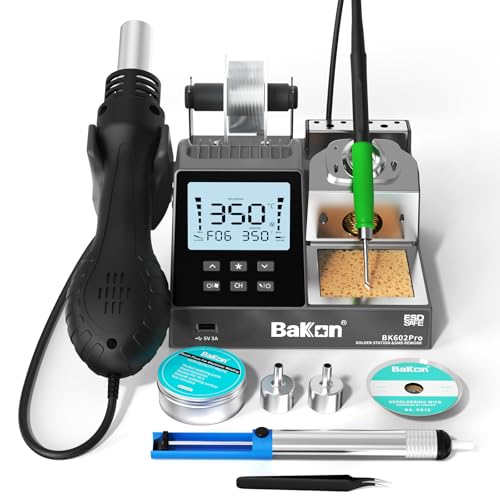
BAKON BK602Pro C210 Soldering and Hot Air Station
More On The Choices That Made The List
The YIHUA 995D+ pulls double duty as a hot air rework station and a soldering iron in one chassis, which makes it a natural fit for hobbyists juggling different project types. Three onboard temperature memories let you lock in a profile for, say, lead-free solder on one channel and a hot air reflow setting on another, then switch between them without re-dialling. The large LCD display shows both readouts at once, and a press of a button toggles Celsius and Fahrenheit for users who prefer one over the other. Compared to the entry-level BAKON 852D+ later on this list, the 995D+ trades some bundled accessories for smarter controls.
Where this unit earns its keep is in the small details: a cool-to-hot air conversion that cuts warm-up wait, a sleep mode that cools the iron when you set the handle down, and PID temperature regulation that cycles every 20 milliseconds to keep the actual tip close to the set point. ESD-safe circuitry protects sensitive components during SMD work, which matters when you’re reflowing a board with twenty-dollar chips on it.
Useful Touches
- Three temperature memory slots, so switching between rosin-core lead-free and standard solder takes a single button press instead of re-entering values.
- Dual readout LCD shows iron and hot air temperatures simultaneously, useful when troubleshooting a board with both through-hole and SMD components.
- ESD-safe design reduces the risk of static discharge damaging MOSFETs and microcontrollers during rework.
- Sleep function and °F/°C toggle extend tip life and accommodate users trained on either scale.
Things To Consider
- The accessory bundle is lighter than some 2-in-1 stations in this price bracket, so you may need to buy extra nozzles and tips separately.
- The Zilog-based control board adds features, but the menu system has a small learning curve for first-time users.
Key Advantages
Right Fit For
Multi-disciplinary hobbyists who reball GPUs one weekend and wire guitar pickups the next, and who want a single bench unit rather than two separate stations.
Skip It When
You need a fully bundled starter kit with a roll of solder and tips out of the box, in which case the BAKON 852D+ on this list ships with more accessories for a similar role.
The EOOKU helping hands station isn’t a soldering iron at all, but it pairs with one, and most people shopping for soldering kits need a stable way to hold the work. The 16.5″x10″ steel base sits flat on a bench and weighs enough to stay put when you push a hot tip into the joint. Built-in grooves along the platform slot PCBs, model parts, and small jewelry pieces in place, so you can solder with both hands free. The non-slip silicone pad layer keeps tiny components from sliding around mid-job, a small detail that saves real frustration during fine SMD drag-soldering.
The included 10X and 5X magnifying lamp clamps to the base, giving close-up work a clear focal plane. Ten or more magnetic accessories let you reconfigure the alligator arms, third-hand clips, and holders depending on the project. Where the YIHUA 995D+ handles heat, this unit handles everything around the heat, and the two complement each other on a serious bench.
Advantages To Know
- Oversized 16.5″x10″ steel base accommodates larger PCBs, model airplane parts, and jewelry pieces without overhang.
- 10X/5X magnifier lamp helps with fine-pitch QFN pads and watch movements where the naked eye loses the joint.
- Magnetic accessory system swaps clips and holders in seconds, no Allen keys required.
- Heat-resistant silicone pad layer protects the bench from accidental tip contact and keeps parts from skating around.
Worth Noting
- This is a holding platform, not a heat source, so you still need a separate iron or station to actually solder.
- The lamp arm is rigid and may need repositioning for taller assemblies like completed drone frames.
Feature Snapshot
Who It Suits Best
Hobbyists and pros who already own a soldering iron but spend more time chasing the workpiece than the joint, especially anyone working on jewelry, watch movements, or fine-pitch PCB rework.
Consider Something Else When
You want an all-in-one setup with both heat and holding in a single purchase, in which case the BAKON 852D+ bundle below ships the iron, tips, solder, and accessories together.
The M12 REDLINK soldering iron is the only cordless pick on this list, and it earns that spot by solving a specific problem: field service. HVAC techs, low-voltage installers, and auto electricians often work in ceiling cavities, behind dashboards, or on active job sites where a wall outlet is nowhere close. This iron runs on the M12 battery platform, the same one used across a wide range of professional power tools, and reaches operating temperature in under 18 seconds. The LED work light at the tip end illuminates the joint when overhead lighting is poor, which happens more often than you’d think in a dark equipment room.
The pivoting head stops in three positions, so you can angle the tip into tight harnesses without wrist strain. REDLINK intelligence tells you when the tip is ready to use and when it’s safe to pack away, removing the guesswork that usually comes with cordless heat tools. The honest read is that battery-powered irons are not meant to replace a full bench station for production work, but they fill a gap nothing else on this list addresses.
What Helps Most
- Sub-18-second heat-up time means less waiting when you’re on a ladder or in a ceiling plenum.
- Three-stop pivoting head keeps the tip oriented correctly in tight spaces like control panels and engine bays.
- REDLINK indicator light gives a clear ready-to-use and safe-to-store signal, cutting the burn risk of guessing.
- LED work light at the tip improves visibility in dim server rooms and breaker panels.
Trade Offs
- Battery and charger are often sold separately, so the true out-of-pocket cost rises once you add them.
- Continuous high-heat work drains the M12 pack faster than a wall-powered station can run.
Best Suited To
Field service technicians, mobile electronics installers, and anyone whose soldering happens away from a bench, especially those already invested in the M12 tool ecosystem.
Look Elsewhere When
You primarily solder at a fixed bench and want a full-featured 2-in-1 with hot air rework included, in which case the YIHUA 8786D I further down covers that role at a similar tier.
The BAKON BK701D is the most powerful iron on this list, with 700 watts of combined iron and hot air output. That headroom matters when you’re desoldering a ground plane on a phone motherboard or reflowing a laptop GPU, both of which pull heat out of the joint faster than a 60-watt pencil can deliver. The dual-function design runs the soldering iron and the hot air gun independently, so a tech can preheat a chip with one tool while prepping solder wick with the other. SMD work and component packages like SOIC, CHIP, QFP, PLCC, and BGA all sit comfortably in the unit’s operating envelope.
For mobile phone and laptop repair specifically, the BK701D’s hot air output is calibrated for the kind of small-package rework most people associate with microsoldering. ESD-safe circuitry protects the board during ground lifts and pad cleanups, jobs where a single static zap destroys a $200 logic board. The 700W power rating isn’t a marketing number here, it’s the difference between a clean lift and a cold joint on a heat-sinked board.
Features That Help
- 700W combined output handles heat-sinked ground planes and multi-layer boards that smaller irons can’t reflow cleanly.
- Independent iron and hot air operation lets you preheat one area while prepping another, speeding up board-level jobs.
- ESD-safe design protects delicate microcontrollers and PMICs during sensitive rework.
- Broad component compatibility covers SOIC, QFP, PLCC, and BGA packages found in phones, tablets, and laptops.
Points To Keep In Mind
- Higher wattage means a heavier unit and a larger bench footprint than the compact BAKON BK602S further down.
- The 700W draw may trip a 15-amp household circuit if other tools run on the same outlet.
Whose Shelf It Belongs On
Phone and laptop repair technicians who need genuine thermal headroom for ground planes, plus serious DIYers who regularly reflow multi-layer boards.
A Better Fit Elsewhere
You mostly work on through-hole hobby projects and small electronics, where the BAKON 852D+ offers a friendlier learning curve and a more complete starter bundle.
The BAKON 852D+ ships with one of the most complete accessory bundles in the soldering kit category. Out of the box you get a 30-gram roll of lead-free solder, five SGS-certified soldering tips, two hot air nozzles, ESD-safe tweezers, a desoldering pump, a brass cleaner, a cleaning sponge, and solder suction tape. Beginners usually end up buying these pieces piecemeal anyway, so the bundle value is real. The hot air and soldering iron functions operate from a single chassis with separate controls, and the LED digital display reports both temperatures at once. Knob-style adjustment keeps the interface simple, which matters when the user is still learning what temperatures different joints need.
Where the YIHUA 995D+ above leans into software sophistication, the 852D+ leans into out-of-box readiness. The trade-off shows up in the controls, which lack the memory presets of higher-tier YIHUA units, so you’ll dial in temperatures manually for each project. For a first station, that hands-on familiarity is actually useful, you learn what the numbers feel like.
Positive Takeaways
- Comprehensive accessory kit removes the “now I need to buy…” feeling that hits most first-time soldering station owners.
- Five SGS-certified tips cover chisel, conical, and knife profiles for varied joint types.
- ESD-safe tweezers and desoldering pump ship in the box, so you can rework and correct mistakes on day one.
- Simple knob adjustment and dual LED display keep the learning curve manageable for newcomers.
Honest Caveats
- No memory presets means you re-enter temperature values for every new project.
- The chassis is bulkier than the BAKON BK602S below, which matters on small workbenches.
Quick Facts
Who Will Love This
First-time soldering station owners and beginners who want everything needed to start a project the day the box arrives, without a follow-up shopping trip.
Reach For A Different Pick When
You want memory presets to switch between recurring jobs faster, in which case the YIHUA 995D+ earlier on this list offers that convenience at a similar level.
The YIHUA 8786D I steps up from the 995D+ with a higher tip count, dedicated dual displays, and UL-listed safety certification. Ten soldering tips and four hot air nozzles ship in the box, so you’re equipped for everything from fine-pitch QFP work to large through-hole pads. The two readouts sit side by side on the front panel, showing the soldering iron temperature and the hot air temperature in real time, which eliminates the dial-and-guess loop of single-display stations. A dual power switch lets you run just the iron, just the hot air, or both, so the unit isn’t burning energy when you’re doing a single-function job.
The PID temperature control here is the more advanced version, with high-speed monitoring and fast temperature compensation. That matters for lead-free work, which has a narrow working window and punishes slow heat recovery. ESD-safe construction protects MOSFETs, logic ICs, and the kind of components that don’t tolerate static discharge during rework. The honest read is that this unit suits users who already know what temperature profile their projects need, since the interface gives you more granular control than entry-level kits.
Noteworthy Benefits
- Ten soldering tips cover virtually every joint profile a hobbyist or tech is likely to encounter.
- UL safety certification adds confidence for users running the station for long hours in shared spaces.
- Independent power switches let you activate only the function you need, saving energy and tip wear.
- PID program with fast temperature compensation keeps the actual tip close to the set value, even under load.
Small Caveats
- The added features and tip count make the price higher than the BAKON 852D+ bundle, so it’s not the first-station pick.
- More controls mean a slightly longer setup time before the first joint is soldered.
Made For
Intermediate to advanced users who already know their way around a soldering station and want finer PID control, more tips, and dual display clarity for SMD rework jobs.
Swap It Out When
You’re just starting out and would benefit more from a simpler knob-controlled bundle than from this unit’s deeper feature set, in which case the BAKON 852D+ covers the learning phase better.
The YIHUA 862BD+ is the closest thing on this list to a “default buy” for a home bench, which is why it lands in the middle of the roundup. It comes ETL certified and ships with a 35-gram roll of lead-free solder, five SGS-certified tips, four hot air nozzles, ESD-safe tweezers, a desoldering pump, a metallic iron holder, brass wool tip cleaner, cleaning sponge, and an IC popper. That accessory list covers almost every rework task a hobbyist will run into during the first year of ownership. PID temperature regulation with a 20-millisecond cycle keeps the tip honest, and the °F/°C toggle works for both iron and hot air channels.
The 862BD+ sits between the BAKON 852D+ and the YIHUA 8786D I in terms of capability. You give up some of the dual-display finesse of the 8786D, but you gain a slightly richer accessory bundle than the 852D+. For someone who wants one station that does both jobs without a steep learning curve, this is a balanced place to land.
What Stands Out
- ETL certification and an ESD-safe design reassure users who worry about static damage to components.
- Generous 35g solder roll, four hot air nozzles, and a full rework kit make this an out-of-box-complete package.
- PID temperature cycling corrects actual tip temperature against the setpoint every 20 milliseconds.
- Brass wool cleaner and IC popper ship with the unit, which most competing kits leave out.
Room For Improvement
- Single combined display cycles between functions, not dual simultaneous readouts like the YIHUA 8786D I.
- The chassis footprint sits in the middle of the pack, not as compact as the BAKON BK602S below.
Perfect Match For
Home hobbyists and small-shop techs who want a complete kit with a safety certification, without paying for the pro-tier dual displays.
Another Choice May Suit
Your work is heavy on SMD rework and you want simultaneous dual readouts, in which case the YIHUA 8786D I one slot above is the better fit for that specific workflow.
The BAKON BK602S is the smallest 2-in-1 station in this roundup, and the design choice shows. Where the 700W BK701D above demands bench space, the BK602S crams both a soldering iron and a hot air rework gun into a compact body, freeing room for components, a parts tray, and the helping hands station reviewed earlier. The dual-switch design lets you run the iron alone, the hot air alone, or both, which keeps power draw modest during single-function jobs. Rapid heat-up means you spend less time waiting and more time soldering.
The trade-off is thermal headroom. Smaller chassis, smaller transformers, smaller thermal budget. For typical DIY circuit work, the BK602S handles the job without complaint. For repeated ground-plane rework on a phone motherboard, you may find the BK701D’s extra wattage more forgiving. The °C/°F conversion and auto-sleep function round out a unit that prioritizes a tidy bench over maximum output.
Good Reasons To Consider
- Compact body fits on small desks and shared workbenches where larger stations would crowd out components.
- Rapid heat-up gets you to working temperature quickly, which adds up over a long session.
- Auto-sleep extends tip life and saves energy when the iron sits idle between joints.
- Independent dual switches let you run only the function needed, useful for short spot-solder jobs.
A Few Limitations
- Lower thermal headroom than the 700W BK701D, so large ground planes may need extra preheat.
- Accessory bundle is lighter than the BAKON 852D+ or YIHUA 862BD+ kits reviewed earlier.
Key Attributes
Built With In Mind
Apartment-dwelling hobbyists, students, and anyone whose workbench doubles as a kitchen table, where every square inch matters.
Where A Sibling Pick Shines
You’re doing demanding phone repair with frequent ground-plane work, in which case the BAKON BK701D’s 700W output is the better match for that workload.
The BAKON BK602Pro is the most refined unit in this roundup, built around a C210 all-in-one heater core. The C210 platform is well-regarded for fast thermal recovery, meaning the tip bounces back to set temperature quickly after each joint, which matters during drag-soldering on fine-pitch QFN pads. The large LCD shows real-time power, actual and set temperatures for both the iron and the hot air side, airflow levels, and a temperature preset menu. You may not use every readout on day one, but as projects get more demanding, the menu depth earns its place.
Compared to the compact BAKON BK602S, the Pro version adds the C210 heater and the larger display, both of which are aimed at users who do precision work regularly. Auto-sleep and temperature presets bring it in line with the YIHUA 995D+ feature set, while the C210 platform differentiates it for users who care about tip platform standardization. The honest read is that this is overkill for through-hole hobby builds and just right for serious precision soldering.
Key Advantages
- C210 heater core delivers fast thermal recovery, important during drag-soldering and continuous production work.
- Large LCD consolidates real-time power, dual temperature readouts, airflow, and presets on a single screen.
- Temperature presets speed up switching between recurring jobs like lead-free reflow and standard tin-lead.
- Auto-sleep function protects the tip and saves energy during idle periods.
Practical Considerations
- The premium feature set comes at a higher cost than entry-level 2-in-1 stations like the BAKON 852D+.
- The C210 tip platform uses proprietary tips, so replacements cost a bit more than standard Hakko-style tips.
Who Should Grab It
Advanced hobbyists and small-shop technicians who do precision work on a regular basis and value the C210 platform’s thermal recovery and tip ecosystem.
Not Your Match When
You mostly solder through-hole hobby projects and don’t need the C210’s thermal precision, in which case the YIHUA 862BD+ covers the same general use case at a friendlier tier.
What Matters Most Before Choosing Soldering Iron Kits
Wattage and Thermal Recovery
Wattage is the headline number, but thermal recovery matters more in practice. A 60W iron that bounces back to set temperature quickly outperforms a 100W iron that lags. For lead-free solder and ground-plane work, look for units with PID temperature regulation, which is a control loop that compares the actual tip temperature to the setpoint and adjusts power many times per second. The YIHUA 8786D I and the BAKON 852D+ both use this approach.
2-in-1 vs Single-Function
A 2-in-1 station combines a soldering iron and a hot air rework gun in one chassis, which saves bench space and money compared to buying two separate units. Single-function tools like the cordless M12 REDLINK above focus on portability and speed. The right call depends on your work: bench-bound rework calls for a 2-in-1, while field service calls for cordless.
ESD Safety
ESD-safe (electrostatic discharge-safe) construction protects sensitive components from static damage during soldering. MOSFETs, microcontrollers, and logic ICs can be killed by a single zap. Most stations in this roundup advertise ESD-safe design, and the feature is non-negotiable for SMD rework and modern electronics.
Accessory Bundles
A complete bundle with solder, tips, nozzles, tweezers, and a desoldering pump saves the typical $30–60 in follow-up purchases. Bundles from BAKON and YIHUA tend to be more generous, while a brand like Milwaukee focuses on the core tool.
Smart Choices For First-Timers And Pros Alike
Pitfalls Shoppers Hit
First-time kit shoppers often buy the cheapest station, then discover it lacks hot air for SMD rework, or they buy a heavy 2-in-1 only to find their workbench can’t fit it. Another common miss: ignoring tip compatibility. Some stations use proprietary tips that cost more to replace than the standard Hakko-style tips used across much of the industry. Measure your bench before ordering, and check whether the tip ecosystem is standard or proprietary.
Where The Extra Money Goes
Higher-tier models like the BAKON BK602Pro and YIHUA 8786D I earn their price through faster thermal recovery, more accurate PID control, dual displays, and better build quality. The premium also covers certification (UL, ETL) and safety features like auto-sleep and ESD protection. For users who solder daily, those refinements pay back in saved time and fewer mistakes on expensive boards.
Frequently Asked Questions
What’s the difference between a soldering iron and a soldering station?
A standalone soldering iron is a single tool, often temperature-controlled internally, that plugs directly into a wall outlet. A soldering station adds a base unit with a power supply, temperature display, and sometimes a hot air rework function. Stations give finer control, support for tip changes, and features like sleep mode that pencils lack.
Do I need a hot air rework station?
Hot air rework stations are essential for removing and replacing surface-mount components like SMD chips, QFNs, and BGAs. They’re also useful for heat-shrink tubing and certain plastic repairs. If you only solder through-hole components, a hot air station isn’t required. If you work on modern electronics at all, a 2-in-1 unit is worth the modest extra cost.
What does ESD safe mean, and why does it matter?
ESD stands for electrostatic discharge, a tiny static spark that can damage sensitive electronic components without you feeling it. ESD-safe soldering tools and stations are designed to prevent that discharge from reaching the work. For SMD work, microcontrollers, and modern PCBs, ESD safety isn’t optional.
How often should I replace soldering tips?
Tip life depends on use frequency, temperature settings, and cleaning habits. With proper care, including tinning the tip before storage and using brass wool to clean it, a tip can last many months of regular use. Running the iron at unnecessarily high temperatures shortens tip life considerably.
Can a soldering iron kit handle phone repair?
Standard through-hole and small SMD work is within reach of most kits on this list. Phone motherboard repair involving micro-BGA chips and ground-plane desoldering requires genuine thermal headroom, which is where higher-wattage units like the BAKON BK701D earn their place.




