


Stained glass work sits at the meeting point of art and engineering, and the soldering iron you choose quietly decides how the rest of the project feels. A tip that struggles to stay hot turns every copper-foil seam into a waiting game, while a station that ramps up fast keeps your hands and your momentum steady. The picks below cover dedicated glass work, general electronics stations worth adapting, and the heat-resistant mats that protect the workbench underneath. Each entry speaks to a different kind of hobbyist, from weekend tinkerers to studio regulars, so you can match the tool to how you actually solder.
Your Options, Compared

YIHUA M150 Heat-resistant Soldering Mat with Multiple Storage Slots

AUORY Premium Heat Resistant Silicone Soldering Mat 13.8” x 9.8”
Esoldnic Extra Large Soldering Mat 23.7”x13.8”
Weller 70 Watt Digital Soldering Station WE1010NA

Preciva 902D V 2-in-1 SMD Hot Air Rework Station

Milwaukee M12 REDLINK Soldering Iron Kit with LED Light

Preciva 927 IV 130W Soldering Station Kit

Preciva 8786D 2-in-1 Hot Air Soldering Iron Station

YIHUA 928D-III 110W Hand Soldering Iron Bundle for Stained Glass
The Strengths Of Each Pick
For stained glass hobbyists who work in tight quarters, a workbench mat often matters as much as the iron itself. The YIHUA M150 is a soft silicone pad built to absorb the heat that comes off a copper-foil seam, and the surface doubles as a small-parts organizer so screws, tips, and jump rings don’t disappear mid-project.
Its bendable construction means you can roll it up after a session and slide it into a drawer, which is a quiet win for apartment studios. The built-in ruler also helps when you need to score foil to a consistent length without dragging a tape measure across wet flux. Compared to bare wood or plastic surfaces, the silicone layer turns accidental tip contact from a panic moment into a non-event.
Useful Highlights
- Heat-resistant silicone (rated up to 932°F) handles direct contact from hot iron tips and stray solder without scorching the bench underneath.
- Built-in storage slots keep small parts grouped, which saves time on projects with multiple copper-foil segments.
- An integrated ruler supports consistent foil cuts, useful when matching seams across a panel.
- Flexible mat rolls up for storage, so a small dining-table workspace can reset between sessions.
Things To Consider
- The 12.99 x 8.23 inch footprint is on the smaller side; large full-panel layouts may overhang the edges.
- Silicone can attract dust and fuzz from cardboard patterns, so a quick wipe-down before each session helps keep solder joints clean.
Who It Suits Best
Beginners and weekend hobbyists running smaller sun-catcher or ornament projects on a modest workbench will appreciate the organization more than the headline heat rating.
Where Another Pick Suits Better
Glass artists working on full window-sized panels should look at the Esoldnic Extra Large Soldering Mat, which offers a much roomier 23.7 x 13.8 inch surface for sprawling layouts.
Stained glass soldering often happens next to electronics repairs on the same bench, and a mat that handles both chores pulls double duty. The AUORY silicone mat sits in that middle ground, sized for medium projects but with the heat tolerance and chemical resistance to survive flux splashes and stray drips.
Where the earlier YIHUA mat leans on storage slots, this one leans on material quality. Food-grade silicone feels denser under the iron and tends to lay flat on a bench instead of curling at the corners. The gray tone also hides minor discoloration that white mats tend to show after a few soldering sessions.
A Favorable Mix
- Heat resistance to 932°F covers the typical operating range of copper-foil soldering irons without puckering the surface.
- Food-grade silicone is non-toxic, non-slip, and stays flexible when folded for transport to a class or repair event.
- Anti-corrosive surface shrugs off rosin and zinc-chloride flux residue, which is helpful for glass artists who work with both lead and copper foil.
- Mid-size 13.8 x 9.8 inch surface fits most small-to-medium panel projects without dominating a shared table.
Points To Keep In Mind
- Heavier than thinner silicone pads, so storing it rolled rather than flat takes a little more effort.
- The gray color hides flux staining well but can make it harder to spot tiny dropped beads of silver solder on the surface.
Who Will Love This
Hobbyists who split time between stained glass and phone or laptop repair will find one mat that handles both workflows without swapping surfaces.
Skip It When
Artists tackling very large window panels will want the much wider Esoldnic Extra Large Soldering Mat for a less crowded layout.
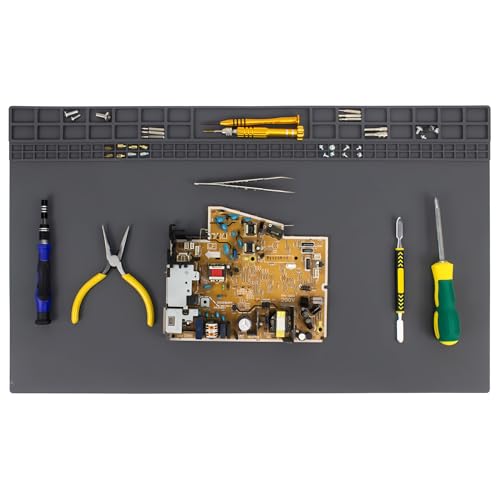
Big stained glass projects quickly outgrow compact mats, and that is where an oversized pad earns its keep. The Esoldnic Extra Large Soldering Mat stretches to 23.7 x 13.8 inches, giving a full door-panel or sun-catcher room to live on the bench without sliding off the edge every time you rotate the piece.
Compared to the AUORY mat, this one trades portability for workspace. It is the right kind of mat to leave on a dedicated studio table, where it acts more like a fitted liner than a transport accessory. The non-slip silicone also holds the glass steady while you lead a long seam, which is a small but meaningful upgrade for precision work.
A Few Highlights
- Generous 23.7 x 13.8 inch surface supports full-panel projects that would otherwise need to be moved mid-solder.
- Heat tolerance to 932°F handles extended seams without discoloring or warping.
- Non-slip silicone grips glass pieces and finished panels, reducing the need to clamp every shift.
- Premium silicone material cleans up with water and mild soap, which matters when working with lead came dust.
A Few Limitations
- The size makes it awkward for small kitchen-table workspaces, where it will overhang the edge.
- Storing it flat takes up permanent bench real estate, and rolling it up can leave curl memory that takes a day to relax.
Right Fit For
Studio artists and serious hobbyists working on full window or door-panel projects will get the most out of the extra surface area.
Not Your Match When
Traveling instructors and class attendees should reach for the smaller, more portable YIHUA M150 Heat-resistant Soldering Mat instead.
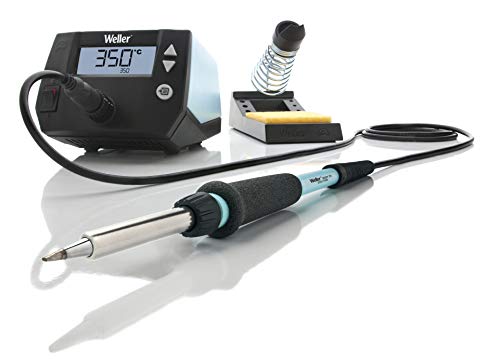
Weller has been a familiar name on stained glass benches for decades, and the WE1010NA continues that tradition in digital form. This 70W station gives the kind of steady, repeatable heat output that longer solder seams on a copper-foil panel need, without the thermal sag a small pencil-style iron can show under continuous load.
The interface is simple, which is part of the appeal. A front-panel display shows set and tip temperature, and the iron itself feels balanced in the hand for tracing long came lines. Versus the Milwaukee M12 cordless pick, this is a tethered, mains-powered station aimed at people who set up once and leave the rig in place for hours at a time.
A Strong Showing
- 70W output holds temperature steadily through extended seams, which matters on long copper-foil panel edges.
- Digital display lets you dial in a specific temperature, helpful when switching between 60/40 solder for glass and lead-free for electronics.
- Weller’s tip ecosystem is broad, so finding a chisel or conical tip that matches your preferred foil width is straightforward.
- Solid, mains-powered build is well suited to a permanent studio corner rather than a packed-away hobby box.
Honest Caveats
- It is a station, not a portable kit, so taking it to a class or friend’s garage requires some packing room.
- Replacement Weller tips tend to cost more than generic equivalents, an ownership reality to plan for over the life of the station.
Built With In Mind
Stained glass artists who already work a multi-hour session and want a station that simply stays at temperature are the clearest match here.
Look Elsewhere When
Crafters who teach mobile classes and need a grab-and-go setup will find the Milwaukee M12 REDLINK Soldering Iron Kit a more flexible travel companion.
Some stained glass artists also keep a hand in electronics work, especially those who build their own LED-lit panels. The Preciva 902D V serves both worlds by combining a standalone soldering iron and a hot air rework station in one unit, with separate power switches so you can run one side or both.
Independent temperature control for the iron (200 to 480°C) and the hot air gun (100 to 480°C) is the kind of feature that pays off when you switch between copper-foil seams and small surface-mount components. Three memory presets also let you save a glass setting, a 60/40 electronics setting, and a lead-free profile, which trims setup time on every project. Compared to the Weller WE1010NA, this trades brand pedigree for a broader feature set.
Notable Gains
- Two systems in one chassis save bench space for hobbyists juggling glass work and small electronics repairs.
- PID temperature control (a feedback loop that adjusts power to hold the set temperature) keeps the iron stable through long soldering sessions.
- Three memory presets let you store a glass profile and an electronics profile, so switching projects is just a button press.
- Adjustable airflow up to 120 L/min on the hot air side supports both gentle heat shrinking and quicker SMD rework.
Trade Offs
- More controls and displays mean a steeper learning curve than a single-purpose iron like the Weller WE1010NA.
- Hot air guns are less useful for plain glass work, so pure glass hobbyists may not tap into the full feature set.
Made For
Mixed-discipline hobbyists who split time between stained glass and electronics repair get the most from this dual station.
Consider Something Else When
Glass-only artists who never touch a circuit board will do just as well with the focused, simpler Weller 70 Watt Digital Soldering Station WE1010NA.
Stained glass does not always happen at a tidy bench, and that is where a cordless iron earns its place. The Milwaukee M12 REDLINK Soldering Iron Kit runs on the M12 battery platform, which is a familiar sight for anyone who already owns Milwaukee tools. Reaching working temperature in under 18 seconds is fast enough to match the pace of a small repair on the road.
The integrated LED light on the tip area is a thoughtful touch when you are working in a tight corner or under a partially assembled frame. A pivoting head design also helps you angle the tip into awkward spots without rotating your wrist. Compared to the Weller WE1010NA, the trade-off is shorter continuous run time per battery, but the freedom from a power cord is hard to beat for off-bench work.
Positive Takeaways
- Cordless operation means no hunting for an outlet, which is a real advantage for installations, classes, and pop-up studio events.
- Reaches working temperature in under 18 seconds, so a quick field repair is not held up by a long warmup.
- Integrated LED light illuminates the work area, useful in dimly lit homes or partially framed panels.
- Pivoting head design supports awkward angles that a fixed pencil iron handles less comfortably.
Worth Noting
- Battery run time is finite, so long full-panel sessions benefit from a second M12 battery on the charger.
- It is part of the Milwaukee M12 ecosystem, so the total cost climbs if you do not already own batteries and a charger.
The Right Fit
Mobile stained glass artists, installers, and hobbyists who already own Milwaukee M12 tools will see the lowest friction adding this iron to their kit.
A Better Fit Elsewhere
Studio-bound artists who solder at the same desk all week are better served by a mains-powered station like the Weller 70 Watt Digital Soldering Station WE1010NA.
Detail work on stained glass benefits from both magnification and a third hand, and the Preciva 927 IV ships with both. The 130W ceramic-core iron is the muscle of the kit, reaching 572°F in about 15 seconds, and the four cooling openings help it settle quickly between projects.
The 194 to 896°F range covers everything from delicate lead came seams to heavier copper-foil seams on larger panels. Three preset temperature slots also let you store a glass profile, an electronics profile, and a desoldering profile, so you are not punching numbers in for every job. Versus the Preciva 902D V, this is a soldering-focused kit with accessories, not a hot air rework combo.
Reasons It Performs
- 130W ceramic-core heating element reaches working temperature quickly, shortening the wait before the first seam.
- Adjustable temperature range from 194 to 896°F covers fine lead came work and broader copper-foil panels.
- Three preset channels save a glass profile, an electronics profile, and a desolder profile for quick switching.
- Bundled helping hands and a magnifying glass make detail work more comfortable without buying accessories separately.
Small Caveats
- The wider feature set adds more menu navigation than a basic plug-and-go iron, which may feel like overkill for a hobbyist who only solders one style.
- The included helping hands are functional rather than heavy-duty, so clamping very large panels still calls for a separate work-holding solution.
Best Suited To
Workshop hobbyists who handle detail soldering across both stained glass and electronics, and who value bundled accessories, will appreciate this kit.
Reach For A Different Pick When
Artists focused on large full-panel layouts may prefer the simpler Weller 70 Watt Digital Soldering Station WE1010NA for its no-nonsense dial-and-go workflow.
For hobbyists who already need a desoldering setup for circuit work, the Preciva 8786D folds a 40W soldering iron and a 700W hot air rework station into a single chassis. The dual LED display keeps both temperatures visible at a glance, and a cool-to-hot air conversion lets the gun blow ambient air for cooldown before storage.
The PID feedback loop (a control system that constantly checks actual temperature and adjusts power to stay on target) helps the iron hold its set temperature on longer seams. Compared to the Preciva 902D V, this unit trims some of the presets and a bit of the maximum airflow in exchange for a more compact footprint on a shared bench.
What Works In Its Favor
- Combined iron and hot air station handles both glass-related tinning and electronics rework from one power outlet.
- Dual LED displays show iron and hot air temperatures side by side, so adjustments are quick without menu diving.
- Cool-to-hot air conversion supports a safer cooldown before putting the gun away.
- Bundled tips and nozzles cover a range of soldering and SMD rework tasks out of the box.
Possible Compromises
- The 40W iron is on the lighter side compared to the Weller WE1010NA’s 70W, so heavy continuous seams can feel slower.
- Like other dual stations, the controls take a session or two to learn if you have only used a single-output iron before.
Perfect Match For
Multi-discipline hobbyists who want desoldering and SMD rework capability alongside occasional stained glass work will find this a versatile centerpiece.
Swap It Out When
Artists who solder stained glass daily and rarely touch electronics will be happier with the focused simplicity of the Weller 70 Watt Digital Soldering Station WE1010NA.
For hobbyists who want an iron that arrives ready for copper-foil work, this YIHUA bundle is built with stained glass in mind. The 928D-III 110W hand soldering iron provides the thermal headroom that wider foil seams need, and the included #1300 Type-6D compatible tips are sized for light stained glass projects up to about 6mm of copper foil pad width.
Because the tip set is chosen for glass rather than electronics, you can unbox, tin the tip, and start on a sun-catcher without shopping for additional accessories. Compared to the Weller WE1010NA, this is a simpler package that trades digital presets for a focused glass-ready setup. For first-time stained glass hobbyists, that focus removes a layer of guesswork.
Strengths Worth Knowing
- 110W output gives enough thermal headroom for steady seams on copper-foil panels up to 6mm pad width.
- Five Type-6D compatible tips sized for stained glass remove the need to source separate tips before a first project.
- Simple hand-piece design is approachable for first-time glass hobbyists who do not need digital presets.
- Bundle form keeps the entry cost consolidated, helpful for someone outfitting a new hobby corner.
Details To Watch
- No digital temperature display, so dialing in a specific temperature relies on analog feel and a bit of practice.
- Tip selection is glass-focused, so electronics work on the same iron will likely call for separately purchased tips.
Whose Shelf It Belongs On
First-time stained glass hobbyists and tinkerers building a focused glass kit will appreciate the ready-to-go tip selection and approachable design.
Where A Sibling Pick Shines
Hobbyists who split time between glass and electronics should look at the Preciva 927 IV 130W Soldering Station Kit, which ships with helping hands and a broader tip selection.
What To Weigh Before Picking A Soldering Iron For Stained Glass
Wattage And Heat Recovery
Wattage tells you how hard the iron can work before its tip temperature sags. For light copper-foil sun-catchers, 40 to 70W is plenty, but larger panels and longer seams benefit from 90W and up. Heat recovery matters as much as raw wattage, because every time the tip touches cold glass and foil, the iron has to climb back to set temperature. A higher-wattage iron recovers faster and keeps seams smooth, while a low-wattage pencil may stall mid-seam and leave a cold joint.
Tip Shape And Compatibility
The tip you choose shapes the seam. Chisel tips lay down wide beads for copper-foil panels, conical tips are easier to control on tight curves, and flat tips suit came work. Before picking an iron, check the brand’s tip ecosystem. Weller and YIHUA both have broad, well-documented tip lines, while smaller kits may limit you to a handful of included shapes. If you can see yourself switching to electronics later, a station with a standard tip family pays off.
Workbench Protection And Mats
Even the best iron drips solder occasionally, and a heat-resistant silicone mat is the cheapest insurance for the workbench underneath. Mats in the 932°F class handle direct contact from hot tips without damage. Consider surface area against your typical project size: small mats suit ornaments, oversized mats handle full window panels. Pairing a station with a mat sized to your largest project removes the worry of burning through to the wood underneath.
Station Versus Cordless Form Factor
Stationary mains-powered stations like the Weller WE1010NA deliver consistent heat and run indefinitely, which suits long studio sessions. Cordless options like the Milwaukee M12 trade runtime for portability, which is a real advantage for installers, repair techs, and traveling instructors. Think about where you actually solder most often: at the same desk, in a workshop, or on the road. The right form factor tends to be the one that matches the most common scenario, not the rarest one.
Key Considerations Across These Picks
Pitfalls Shoppers Hit
A common stumble is buying a low-wattage pencil iron for a large copper-foil panel and watching the tip sag during long seams. Another is choosing a station with a proprietary tip family, only to discover replacements are scarce or costly. Skipping a heat-resistant mat is also tempting, until the first drop of molten solder lands on a finished table. Sizing your iron, your tip ecosystem, and your mat to your actual project size avoids each of these setbacks before they happen.
Where The Extra Money Goes
Spending more on a station generally buys three things: better heat stability, a deeper tip ecosystem, and longer component life. A unit like the Weller WE1010NA holds its temperature under load, has a well-stocked tip catalog, and is built for years of regular use. For hobbyists who solder weekly, that durability is real value. For those who only fire up the iron a few times a year, a simpler bundled kit like the YIHUA 928D-III glass bundle may deliver more useful capability per dollar.
Frequently Asked Questions
What Wattage Soldering Iron Is Best For Stained Glass?
For most copper-foil work, 40 to 70 watts covers small sun-catchers, while 90 watts and above handles larger panels with longer seams. Higher wattage helps the iron recover between touches, which keeps the seam smooth and the joint strong.
Can You Use A Regular Electronics Soldering Iron For Stained Glass?
Yes, many electronics stations like the Weller WE1010NA or Preciva 902D V adapt to stained glass with the right tip. The key is using a tip wide enough to spread heat along the foil, and a wattage high enough to keep that tip hot through continuous work.
What Temperature Should I Set My Soldering Iron For Stained Glass?
Most stained glass work happens between 600 and 750°F for 60/40 solder, depending on the width of the seam and ambient room temperature. Test on a scrap piece of foil before starting the real panel, since a too-cool iron causes cold joints and a too-hot one burns the flux.
Do I Need A Special Mat For Stained Glass Soldering?
A heat-resistant silicone mat rated to roughly 932°F protects the workbench from hot tips and stray solder drops. Mats like the YIHUA M150, AUORY silicone mat, or the Esoldnic oversized mat all fit that role, with different sizes for different project scales.
Are Cordless Soldering Irons Good For Stained Glass?
Cordless irons like the Milwaukee M12 work well for small repairs, installations, and mobile classes where an outlet is hard to reach. For long full-panel sessions at a fixed bench, a mains-powered station typically delivers steadier heat without worrying about battery runtime.




