


A good soldering setup turns a frustrating repair into a clean, controlled job. Whether you’re rebuilding a vintage keyboard, fixing a drone ESC, or tinkering with a Raspberry Pi project, the right kit saves time and burned fingertips. The picks below cover everything from quick wire-splice kits to full bench stations, so you can match the gear to your work, not the other way around.
How The Shortlist Stacks Up

haisstronica 120PCS Solder Seal Connector Kit with 350W Heat Gun

haisstronica 220PCS Solder Seal Connector Kit with 350W Heat Gun

haisstronica 340PCS Solder Seal Connector Kit with 350W Heat Gun

EOOKU Helping Hands Soldering Station with Steel Base and 10X 5X Magnifier
YIHUA 926 III 60W Digital Display Soldering Iron Station Kit
YIHUA 926 III 60W LED Display Soldering Iron Station Kit

POWER PROBE Butane Soldering Kit (PPSK) with Adjustable Flame

YIHUA 926 III Soldering Iron Station Kit with 12-IN-1 Helping Hands

Againmore Carrying Case for Fanttik T1 Max Soldering Iron Kit
More Details On Our Top Picks
The haisstronica 120-piece kit sits at the entry point of this list, pairing a small heat gun with a basic assortment of solder-seal wire connectors. The 350W gun offers two heat settings, 482°F and 752°F, which is enough range for shrinking adhesive-lined connectors without scorching nearby insulation.
The bundled connectors cover AWG 26-10 wire, a practical span for most household and small electronics repairs. For first-timers who want a shortcut past stripping, twisting, and taping wires, the all-in-one format takes a lot of friction out of the job.
Notable Gains
- Dual-temperature heat gun handles both low-shrink tubing and full solder-seal activation without swapping tools.
- AWG 26-10 coverage suits most trailer, marine, and low-voltage electronics work.
- All-in-one format means no extra soldering iron is needed for basic wire splices.
- Compact kit footprint stores easily in a kitchen drawer or small toolbox.
Things To Consider
- 120 connectors runs out quickly on multi-connector harnesses, so garage users may burn through the supply.
- The mini heat gun lacks the airflow control of a bench heat station, so you may find shrouding small connectors takes a steady hand.
Feature Snapshot
Who It Suits Best
Beginners tackling one-off wire repairs around the house or in a basic electronics class.
Where Another Pick Suits Better
The haisstronica 340-piece version makes more sense if you regularly work on larger automotive or trailer wiring projects.
Stepping up from the 120-piece kit, this 220-piece bundle keeps the same 350W dual-temperature heat gun and AWG 26-10 connector range while nearly doubling the supply. The result is a kit that comfortably covers a full weekend of automotive or marine wiring without an immediate resupply run.
For DIYers who fix things on a recurring basis, the middle count hits a sweet spot. You get enough connectors to finish a tail-light rewire, a trailer plug replacement, or a dashboard accessory tap without rationing parts.
What Works In Its Favor
- 220 connectors bridge the gap between a starter pack and a full workshop supply.
- Same 482°F/752°F heat gun as the smaller kit, so there’s no learning curve if you’re already familiar with the brand.
- AWG 26-10 range covers signal, accessory, and moderate-load wiring on a single bench.
Honest Caveats
- Still lacks fine-pitch soldering capability, so it’s a splice solution, not a circuit-board tool.
- The mini heat gun cord is shorter than a full bench unit, which can limit reach under a dashboard.
Right Fit For
Garage tinkerers and shade-tree mechanics doing regular automotive accessory wiring.
Swap It Out When
Skip this one for SMD board work and reach for the YIHUA 926 III 60W Digital Display Soldering Iron Station Kit instead.
At the top of the haisstronica connector ladder, the 340-piece bundle is built for repeated, larger-scale repair work. You still get the same 350W dual-temperature heat gun and AWG 26-10 connector compatibility, so the workflow stays consistent with the smaller kits.
The jump in piece count matters most for small shops, fleet maintenance, or anyone running through harnesses on a regular basis. A bulk supply means you stop interrupting projects to reorder, which often matters more than the per-connector cost.
Where It Helps
- 340 connectors support multi-vehicle projects without mid-job restocking.
- Dual 482°F and 752°F heat settings handle low-shrink tubing and high-temp connectors in the same session.
- Same AWG 26-10 coverage as the smaller kits, so you can standardize on one connector type across the bench.
Points To Keep In Mind
- The larger box takes up more storage space than the 120-piece starter kit, which may matter in compact apartments.
- Owners commonly report that the higher heat setting can discolor thinner insulation, so holding the gun further back on delicate wiring helps.
Built With In Mind
Small auto-electric shops and serious DIYers running through connector packs on a weekly basis.
Look Elsewhere When
Reach for the EOOKU Helping Hands Soldering Station when fine PCB or jewelry-scale work is the primary task instead of wire splicing.
The EOOKU station isn’t a soldering iron, it’s the platform that makes a soldering iron usable. The 16.5″ x 10″ heavy-duty steel base arrives with a non-slip silicone pad, over ten magnetic accessories, and a combined 10X/5X magnifier for fine-pitch components.
Where the haisstronica kits handle wire splices, this is the setup you reach for when SMD resistors, drone flight controllers, or jewelry findings are on the bench. The multiple grooves and magnetic holders free both hands, which is the actual productivity multiplier here.
Everyday Perks
- 25% larger work surface than typical helping-hands stations, leaving room for boards and parts trays side by side.
- 10X/5X magnifier is genuinely useful for SMD work, not just decorative.
- Heat-resistant silicone mat protects the desk from flux splatter and stray solder drops.
Trade Offs
- The station doesn’t include an iron, so you’ll need to pair it with a separate YIHUA or similar station.
- The steel base adds real weight, which helps stability but reduces portability for mobile repair work.
Feature Snapshot
Best Suited To
Electronics hobbyists and craft solderers who want a stable, organized bench for detail-heavy jobs.
Reach For A Different Pick When
The POWER PROBE Butane Soldering Kit is a better match for field service calls where AC power is unavailable.
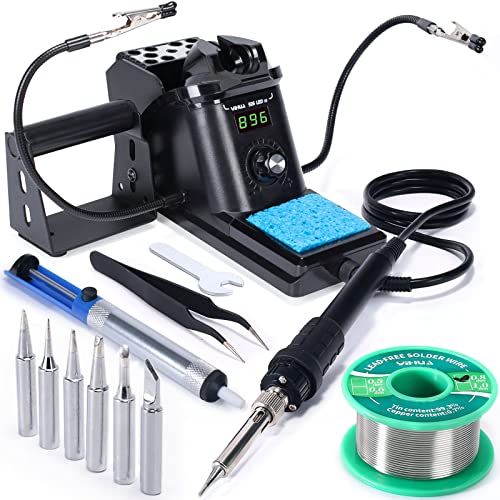
The YIHUA 926 III sits at the center of this roundup because it bundles almost everything a beginner or returning hobbyist needs in one box. You get a 60W station, two helping-hands fixtures, six extra tips, lead-free solder, a desoldering pump, and stainless tweezers.
The PID temperature control (a feedback loop that keeps the iron at a steady target heat) keeps the tip steady between 194°F and 896°F, which matters when you’re moving between large connectors and small SMD joints. Auto-sleep adds an extra layer of tip protection when you forget to switch off between sessions.
Bright Spots
- 60W output with PID control delivers fast heat-up and stable recovery on bigger joints.
- Auto-sleep extends tip life during long bench sessions.
- °C/°F toggle and calibration support make the station adaptable to recipes and repair manuals from anywhere.
- Six extra tips cover everything from through-hole to fine SMD work out of the box.
Worth Noting
- The included helping hands are functional but smaller than the EOOKU platform, so larger boards may need extra support.
Feature Snapshot
Whose Shelf It Belongs On
Students and hobbyists setting up a first real electronics bench without buying each tool separately.
Not Your Match When
The Againmore Carrying Case for the Fanttik T1 Max is the better addition if you already own a cordless iron and just need a way to transport it.
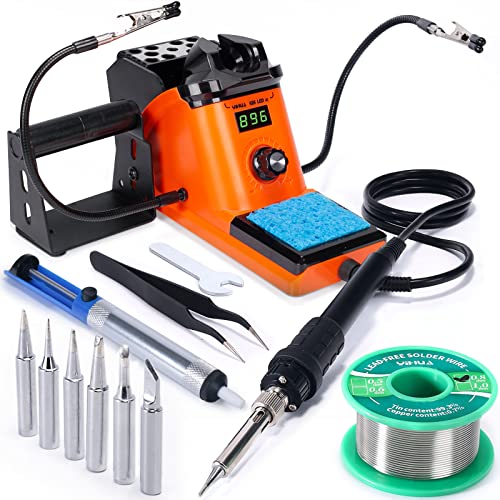
The LED-display sibling of the 926 III keeps the same 60W PID-controlled core but adds a brighter readout that holds up under direct bench lighting. If you solder in a sunlit workshop or under a strong desk lamp, the LED panel is easier to read at a glance than the standard LCD version.
The accessory kit mirrors the digital-display model: two helping hands, six tips, lead-free solder, a desoldering pump, and stainless tweezers. The difference comes down to the screen style and your lighting setup.
A Few Strong Suits
- LED display remains readable under bright workshop lighting where LCD can wash out.
- Same 194°F to 896°F PID-controlled range as the sibling model for consistent joint quality.
- Full accessory kit means no separate trips for tips, solder, or desoldering tools.
Where Another Pick Suits Better
- LED display draws a touch more standby power than the LCD version, which is negligible but worth knowing if you track every watt.
Made For
Home bench owners who solder in well-lit rooms and want the clearest possible temperature readout.
Consider Something Else When
The YIHUA 926 III 12-IN-1 Helping Hands configuration is a stronger pick if you mostly work on bare PCBs and want integrated clamps over the basic helping-hands pair.
Butane soldering changes the math for mobile and automotive work, and the POWER PROBE PPSK leans into that with electronic ignition and an adjustable flame. There is no cord and no power brick, just a refillable gas reservoir and a push-button start.
For technicians working under dashboards, in engine bays, or on jobsites without a clean AC outlet, the cordless format removes a real workflow obstacle. The kit ships with multiple tips, so it doubles as a hot-air tool, a torch, and a soldering iron depending on the job.
Strong Points
- Butane-powered operation means no outlet needed, useful for field repairs and vehicle work.
- Adjustable flame with electronic ignition offers quick start-up and heat tuning.
- Multiple tips broaden the tool’s role beyond soldering into light brazing and plastic forming.
Possible Compromises
- Butane fuel needs periodic refilling, which adds an ongoing consumable cost versus an electric station.
- Open-flame operation calls for a careful workspace, especially around fuel lines or interior trim.
Feature Snapshot
Who Should Grab It
Mobile automotive techs and field service workers who need reliable heat away from an outlet.
A Better Fit Elsewhere
The haisstronica 120-piece connector kit covers simple garage wiring repairs more economically when cordless heat isn’t required.
The third YIHUA configuration on this list swaps the standalone helping-hands pair for a 12-in-1 integrated fixture that mounts right to the station. For newcomers, this consolidation is genuinely helpful because the iron, solder dispenser, and board holder all share a single footprint.
The 60W ESD-safe iron (ESD-safe means it is designed to safely dissipate static electricity that could damage sensitive components) handles entry-level through-hole and hand-soldering projects, and PID temperature control keeps the tip steady across different joint sizes.
Benefits That Matter
- Integrated 12-in-1 helping-hands system removes the need to buy a separate work platform.
- Built-in solder dispenser keeps wire within easy reach during long sessions.
- ESD-safe design protects sensitive components during repair work.
Some Limits To Know
- Compact integrated base limits how large a board you can clamp compared with the EOOKU platform.
- Owners commonly report that the integrated clamps work best on smaller PCBs, so very large panels may need a separate fixture.
Feature Snapshot
Who Will Love This
First-time bench builders who want one consolidated kit instead of separate tools to track down.
Skip It When
The YIHUA 926 III 60W Digital Display Soldering Iron Station Kit is the better buy if you already own a solid work platform and just want a clean temperature display.
The Againmore case rounds out this roundup because no soldering kit is truly portable without a way to protect it on the move. The hard EVA shell, paired with a 900D Oxford fabric exterior, guards the Fanttik T1 Max against drops, scuffs, and light splashes during transit.
The compact 8.86″ x 6.70″ x 2.83″ footprint fits inside a larger tool bag or a backpack, and the soft interior helps keep the iron and accessories from rattling against each other. It’s a small add-on, but it changes how often you actually bring the kit along.
Everyday Wins
- Hard-shell EVA construction cushions the iron against everyday drops and bumps.
- Compact size slips into most backpacks for easy transport between jobs.
- Soft interior lining helps prevent accessories from scratching each other in transit.
What To Weigh
- Case only, the soldering iron and accessories still need to be purchased separately.
- Custom fit is designed specifically for the Fanttik T1 Max, so verify dimensions before assuming it fits your model.
Perfect Match For
Fanttik T1 Max owners who carry their soldering setup between home, work, and client sites.
Where A Sibling Pick Shines
The POWER PROBE Butane Soldering Kit is more self-contained for technicians who already need a cordless tool and don’t require a separate case.
Picking The Right Soldering Setup For Your Bench
Match The Kit To The Job, Not The Other Way Around
Wire splicing and circuit board repair are two different worlds, and the gear that excels at one can feel clumsy at the other. Solder-seal connector kits handle low-voltage wiring, trailer harnesses, and accessory taps without touching a soldering iron. A full bench station with PID control, on the other hand, is what you reach for when SMD components, through-hole boards, and small repair joints show up. Picking the wrong category usually shows up as frustration halfway through the first project, so the shortlist splits naturally into those two groups.
Power Source Changes The Workflow
Corded stations offer stable heat and unlimited runtime, which makes them the everyday workhorse for home benches. Butane kits trade that stability for true portability, which matters more than most beginners expect when fixing a car in a driveway or wiring a control panel in a tight cabinet. If your work mostly happens at a single bench, a corded station is the simpler, lower-friction choice. For mobile or field repair, the cordless option earns its keep.
Temperature Control And Tip Variety Are Where Quality Shows
A station with PID control holds its target temperature under load, which means cleaner joints and fewer cold solder points (dull, weak joints that result from insufficient heat). Look for stations with a wide temperature range, ideally covering both leaded and lead-free solder profiles, and verify the kit includes multiple tip shapes. Chisel, conical, and bevel tips cover most projects out of the box, and starting with variety means you won’t stall on a tip shape you don’t own.
Accessories Often Decide Whether The Kit Actually Gets Used
A bundled desoldering pump, lead-free solder, tweezers, and a couple of helping hands can save several separate purchases. The catch is that some kits include generic accessories that you’ll quickly outgrow, while others include genuinely useful extras. Reading the included tip count and the quality of the helping-hands fixture tells you more about real-world value than the headline feature list does.
Smart Considerations Before You Commit
Pitfalls Shoppers Hit
The most common mistake is buying a connector kit expecting to fix circuit boards with it, or buying a fine-tip station for trailer wiring and wondering why joints take forever. Solder-seal connectors and soldering stations solve different problems, and pretending otherwise wastes time on the first project. Another frequent slip is ignoring wire gauge range; a kit rated for AWG 22-14 will not handle 10-gauge battery cables, regardless of how many connectors it ships with.
What The Higher Tier Buys
Stepping up to a feature-rich station typically gets you PID temperature control, auto-sleep, calibration support, and a wider tip selection. Those features matter most when you move beyond simple point-to-point soldering into temperature-sensitive components or repeatable production work. For beginners doing a handful of repairs a month, the upgrade is often unnecessary. For hobbyists running projects weekly, the stability and tip variety alone justify the step up.
Frequently Asked Questions
What Is The Difference Between A Soldering Station And A Soldering Iron?
A soldering station is a base unit that controls the iron’s temperature, often with a digital display and PID feedback. A standalone soldering iron runs at a fixed temperature or a simple dial setting. Stations are generally more accurate and easier to swap tips on, which is why most kits at this level include a station rather than a bare iron.
Are Solder Seal Connectors As Reliable As Traditional Solder Joints?
Solder seal connectors create a solid, sealed, low-resistance joint that holds up well for low-voltage wiring repairs. For high-current circuits, fine-pitch electronics, or anything that will see repeated thermal cycling, a traditional iron and shrink tube joint is still the safer standard. Pick the method that matches the wire gauge, current load, and vibration the joint will face.
Do I Need Lead-Free Solder For Electronics Work?
Lead-free solder is the modern standard for new electronics manufacturing, and most kits now include it as the default. It requires slightly higher temperatures and a bit more practice to flow cleanly, but it avoids the health concerns of leaded solder. For learning and hobby work, either works, though lead-free is the safer long-term habit.
How Often Should I Replace Soldering Iron Tips?
With reasonable care, a quality tip can last several months of regular use. Cleaning it on a brass sponge after each session and tinning it (coating the hot tip with a thin layer of fresh solder to prevent oxidation) before storage dramatically extends life. Once a tip stops wetting (failing to melt solder evenly across its surface) even after cleaning, it is time to swap it out.
Can I Use A Butane Soldering Kit Indoors?
Butane soldering produces small amounts of combustion byproducts and consumes oxygen in enclosed spaces, so ventilation matters. Open a window or work near an exhaust fan whenever you fire up a butane tool indoors. For prolonged sessions or tight spaces, an electric station is the safer, more comfortable choice.




