


Soldering stations come in two broad flavors. Some lean into a stable, well-lit bench setup with extra hands and a magnifier for close work. Others wrap a soldering iron and a hot air rework handle into one box, so you can desolder SMDs and rework chips without swapping tools. The trick is matching the station to how you actually spend your time at the bench.
The list below mixes both types. Helping-hand style stations suit hobbyists, jewelry makers, and anyone doing through-hole circuit work. Combo hot air plus iron stations fit phone repair, laptop board fixes, and SMD-heavy electronics. Each pick is framed around real bench scenarios, the attributes that actually matter, and the trade-offs worth knowing before you commit.
A Quick View Of The Lineup

SainSmart Magnetic Helping Hands Soldering Station with 11.1 x 7.1 Inch Base & LED Magnifying Lamp
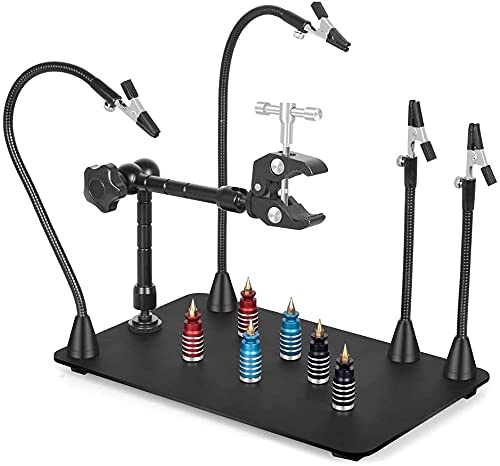
NOEVSBIG Magnetic Helping Hands Soldering Station with Heavy Duty Base & 4 PCB Holders
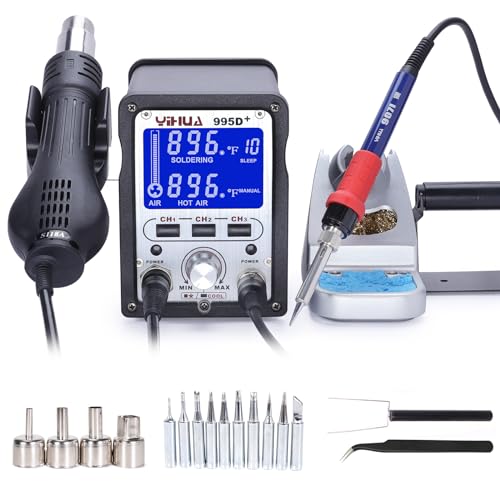
YIHUA 995D+ 2 in 1 Hot Air Rework and Soldering Iron Station with 3 Memories
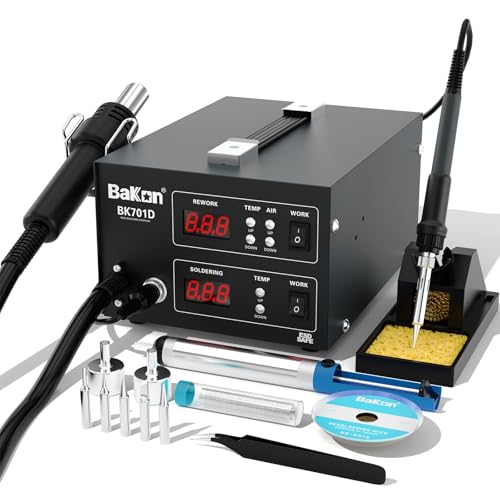
BAKON BK701D 700W 2 in 1 Hot Air Rework & Soldering Iron Station, SMD ESD Safe

BAKON 852d+ Heat Gun and Soldering Iron 2 in 1 Kit, SMD Hot Air Rework Station

YIHUA 8786D I 2 in 1 Hot Air Rework and Soldering Iron Station with 10 Tips
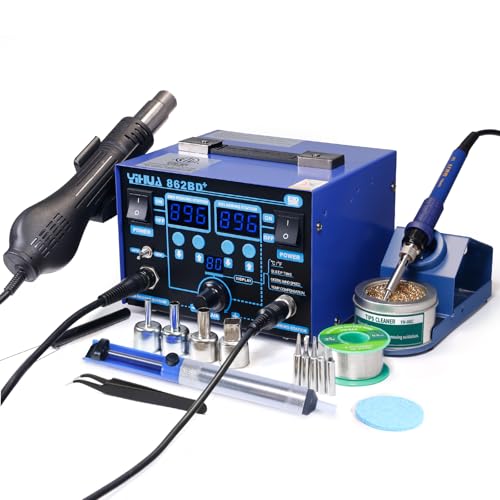
YIHUA 862BD+ SMD ESD Safe 2 in 1 Soldering Iron and Hot Air Rework Station

BAKON BK602S 2 in 1 Soldering Iron and Hot Air Rework Station, Compact Body
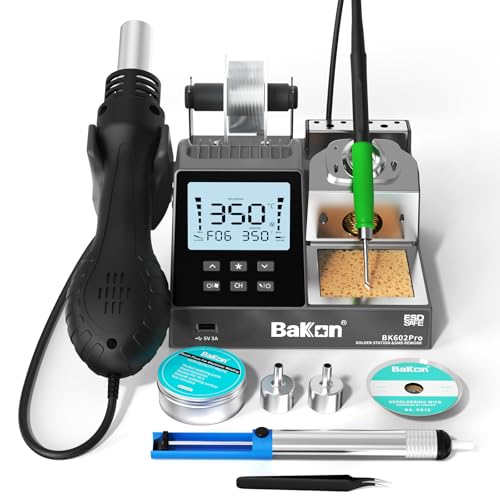
BAKON BK602Pro Soldering Station, C210 Soldering Iron & Hot Air Rework 2 in 1
The Strengths Of Each Pick
This SainSmart setup fills the role of a third hand at your bench, with four flexible metal gooseneck arms that hold small wires and components in place while you work. The 11.1 by 7.1 inch base is wider than most helping-hand tools, which matters once you start sliding in a half-finished PCB and a couple of cable harnesses at the same time. A 5X LED magnifying lamp sits on its own arm, useful for reading the small print on SMD packages.
Where the setup earns its keep is during longer through-hole projects and learning sessions, when your hands need to hold an iron and a solder spool without drifting. The four PCB pillars double as a circuit board holder. Compared to the bare-bones helping hands that come with cheaper iron kits, this is a more complete bench platform.
A Few Strong Suits
- Wide 11.1 by 7.1 inch base gives real room for boards and loose parts.
- Four magnetic gooseneck arms move independently, so two components can meet at a useful angle.
- 5X magnifier reduces eye strain on small pads and chip markings.
- PCB pillars grip a board without clamping the edges, which protects fragile traces.
- Magnetic feet let you reposition arms mid-project without drilling or gluing.
Worth Noting
- There is no built-in soldering iron or power supply, so this is a supporting tool rather than a full station.
- Magnifier brightness is fine for desk lighting, but the lens sits in one spot and is not always aligned with the work.
- Owners commonly find the arms hold position well for light parts, though heavier cables can slowly drift downward.
Made For
Hobbyists, students, and jewelry makers who need steady board support and a clear view while learning the basics of through-hole soldering.
Look Elsewhere When
You actually need heat on demand, since the BAKON BK701D 700W 2 in 1 Hot Air Rework & Soldering Iron Station bundles a real iron and hot air pen into one unit.
Where the SainSmart leans toward a lighter learning setup, this NOEVSBIG focuses on weight and grip. The base is powder-coated steel at roughly 11.4 by 7.1 inches and tips the scales around 3.3 pounds, which is what you want when the arms are pulling sideways on a half-built board. Rubber feet underneath keep the unit from skating across a glossy workbench.
You get four magnetic gooseneck arms and four PCB pillars for holding boards at the angle you need. The jaw opening of about 2.16 inches on the main clamp lets you grip thicker objects, like a small chassis or a wired module. Compared to item 1’s setup, the heavier base here is the main reason to step up.
Where It Excels
- Steel base adds real weight, so the platform stays put when arms are extended.
- Powder coating protects the base from scuffs and solder splashes over time.
- Wider 2.16 inch clamp mouth handles larger assemblies than typical alligator clips.
- Four magnetic arms and four PCB holders cover multi-board teardowns.
Points To Note
- No soldering iron or power module is included, so the station still needs a separate heat source.
- The added steel weight makes the unit less travel-friendly than lighter helping-hand tools.
- Rubber feet are useful on smooth desks but can leave marks on soft wooden surfaces if dragged.
Best Suited To
Electronics tinkerers and repair regulars working on heavier PCBs, power modules, or any build that would tip a lighter helping hand.
A Better Fit Elsewhere
Travel-focused hobbyists will find the SainSmart Magnetic Helping Hands Soldering Station with 11.1 x 7.1 Inch Base a lighter, more portable alternative.
The YIHUA 995D+ shifts the conversation from helping hands to a real heat source. It is a two-in-one station with a soldering iron on one side and a hot air rework handle on the other, sharing a single housing. The brains come from a dual-core microcomputer that drives the display and the closed-loop temperature control, refreshing every 20 milliseconds. The big LCD is easy to read from across a bench.
Where the 995D+ earns its badge is the trio of temperature memories, useful when you repeatedly switch between lead-free solder at one setting, leaded at another, and shrink-wrap or hot air at a third. You get °F and °C toggle, a sleep mode, and cool/hot air conversion. Compared to the BAKON BK701D that follows, this YIHUA has fewer bundled accessories but more onboard intelligence.
Where It Helps
- Three memory slots cut the time spent dialing in the same temperatures for recurring jobs.
- Dual-core processor drives fast, tight temperature correction, which matters on small SMD pads.
- Large LCD shows both iron and hot air values at once, so the heat is always visible.
- Cool and hot air conversion lets the rework handle double as a gentle dryer for reflow prep.
Honest Caveats
- Iron and hot air cannot run at full power simultaneously, which can lengthen back-to-back jobs.
- The accessory bundle is leaner than some peers, so you may need to add tips and nozzles.
- The interface, while clear, has a learning curve the first time you program the memory slots.
Key Specs
Right Fit For
Repair technicians and serious hobbyists who run the same handful of reflow and soldering jobs every week and want shortcuts baked into the station.
Swap It Out When
You mainly fix phones and laptops, since the BAKON BK701D 700W 2 in 1 Hot Air Rework & Soldering Iron Station pairs the dual function with a higher-wattage output tuned for small board work.
The BAKON BK701D is a workhorse tuned for board-level repair. It runs a 700W hot air side and a separate soldering iron, both fed from a single base. The two halves can be used independently, so you can leave one tool idle when the job only needs the iron, saving wear. ESD-safe design matters when you are reballing charge ports or working on motherboard circuits where static is a real risk.
The 700W rating is the headline number. Phone and laptop work pulls a lot of heat out of a small nozzle, and a high-wattage station recovers temperature faster between pads. Component coverage includes SOIC, CHIP, QFP, PLCC, BGA, and SMD. Compared to the YIHUA 995D+ above, this BAKON trades on raw heat and repair-specific tuning rather than memory presets.
The Practical Payoff
- 700W hot air output reflows BGA pads quickly without sitting on the board too long.
- Independent switch control lets the iron and hot air run on their own terms.
- ESD-safe circuitry protects sensitive phone and laptop chips during rework.
- Broad component compatibility covers common SMD packages used in mobile devices.
A Few Limitations
- Higher wattage means more heat to manage, and beginners can over-soak small components.
- Owners commonly report the included accessory set is functional but light, so budgeting for extra tips is wise.
- The unit takes up more bench space than single-purpose iron stations.
Who It Suits Best
Mobile phone and laptop repair technicians who reball chips, swap charge ports, and rework dense SMD boards on a regular basis.
Where Another Pick Suits Better
First-time builders will find the BAKON 852d+ Heat Gun and Soldering Iron 2 in 1 Kit easier to learn on, since it ships with a full accessory bundle aimed at newcomers.
The BAKON 852d+ lands as a complete practice kit, not just a station. The bundle ships with a 30g roll of lead-free solder, five SGS-certified soldering tips, two hot air nozzles, ESD-safe tweezers, a desoldering pump, an iron stand, brass wool, a cleaning sponge, and solder suction tape. Knob-based temperature adjustment keeps the learning curve low.
Compared to the heavier BAKON BK701D, this 852d+ is dialed for first projects and budget builds. The LED display gives clear readouts for both the iron and the hot air side, and the unit covers SMD rework plus traditional soldering in one housing. The honest read is that you give up some output muscle and memory presets, but you gain a ready-to-go bench on day one.
Real-World Strengths
- Accessory kit removes the need to source tips, solder, and desoldering tools separately.
- Dual display shows the iron and hot air values independently.
- Knob-based controls feel approachable for new operators.
- ESD-safe tweezers and brass wool cleaner are already in the box.
Trade Offs
- Lower wattage than the BK701D, so big BGA reballs take longer to reflow.
- Only two hot air nozzles, which limits specialty reflow work until you buy extras.
- The cleaning sponge and brass wool need occasional replacement, so plan for ongoing consumables.
Who Should Grab It
First-time solderers, students, and weekend hobbyists who want everything in one box and are willing to trade a bit of heat output for convenience.
Reach For A Different Pick When
You mostly do SMD-heavy board repair, since the YIHUA 8786D I 2 in 1 Hot Air Rework and Soldering Iron Station comes with 10 iron tips and 4 hot air nozzles for a wider task range.
The YIHUA 8786D I is a workhorse for mixed SMD days. A precision PID program cycles fast enough to keep the iron close to its setpoint, even when the tip moves between a small pad and a larger ground plane. ESD-safe design (anti-static to protect components from discharge) helps when you are working on chips you cannot easily replace.
The headline is tip and nozzle variety. Ten soldering iron tips and four hot air nozzles ship in the box, covering common SMD footprints without an immediate trip back to the store. A dual display, dual power switch, cool and hot air conversion, and a sleep function round out the package. Compared to the BAKON 852d+ above, this YIHUA trades some beginner extras for more professional tuning.
A Favorable Mix
- 10 tips and 4 nozzles cover most common SMD footprints from day one.
- Fast PID temperature correction holds setpoint under changing thermal load.
- Dual display and dual power switch give independent control over each tool.
- ESD-safe design protects sensitive components during rework.
Things To Consider
- Higher tip count means more pieces to track and store in a small bench drawer.
- No bundled solder wire, so the kit is not as ready-to-go as the BAKON 852d+.
- Air conversion modes are useful, but the workflow takes practice to coordinate between tools.
Key Specs
Perfect Match For
Workshop regulars and intermediate tinkerers who fix a variety of boards and want a broad tip selection ready to go without extra shopping.
Skip It When
You want a more compact footprint, since the BAKON BK602S 2 in 1 Soldering Iron and Hot Air Rework Station is built around a smaller body for tighter benches.
The YIHUA 862BD+ is a station designed for mixed daily use. The bundle ships with a 35g roll of lead-free solder, five SGS-certified tips, four hot air nozzles, ESD-safe tweezers, a desoldering pump, a metallic iron holder, a brass wool tip cleaner, a cleaning sponge, and an IC popper. That list is what you actually need to start a real project on day one.
A PID temperature control program cycles the heat settings to keep the iron and hot air close to their setpoints, which matters when you jump from a 0.5mm pitch IC to a heavier through-hole joint. The housing carries an ETL safety mark. Compared to the BAKON 852d+ above, this YIHUA comes with a slightly larger solder roll and the same kind of beginner-friendly accessory load.
What Works In Its Favor
- Accessory bundle covers solder, tips, nozzles, and cleaning in one purchase.
- PID temperature control keeps the iron steady across varied job types.
- ESD-safe design protects static-sensitive components on modern boards.
- IC popper simplifies chip removal without prying under the package.
Practical Considerations
- Bundle richness means more small parts to store, so a parts tray helps.
- Consumables like the brass wool and cleaning sponge need periodic replacement.
- No temperature memory presets like the YIHUA 995D+ above, so repeat setups take a few extra seconds.
Whose Shelf It Belongs On
Intermediate users who split time between hobby projects and repair jobs, and who want a balanced kit that does not force a follow-up shopping run.
Not Your Match When
You focus on fine-pitch precision rework, where the BAKON BK602Pro Soldering Station, C210 Soldering Iron & Hot Air Rework 2 in 1 has the right heater core for smaller pads.
The BAKON BK602S is built around a smaller housing than the BK701D above, which is the main reason to consider it. The whole unit is meant to free up bench real estate, so if your workspace is a corner of a desk or a shared table, this two-in-one form factor is easier to live with. A dual-switch design lets the iron and hot air sides run independently.
The station still has a built-in PID program for precision temperature control, plus auto sleep and °C/°F conversion. It is described as space-saving, allowing you to put more things on the workbench, which is a real benefit for hobbyists juggling multiple projects. Compared to the YIHUA 8786D I above, the BAKON trades tip count for a smaller footprint.
Key Advantages
- Compact body suits small workbenches and shared desks.
- Independent switch control keeps each tool idle when not in use.
- PID temperature control maintains steady heat on both tools.
- Auto sleep extends tip life during longer pauses between jobs.
Worth Bearing In Mind
- Smaller housing means fewer bundled tips and nozzles in the box.
- Lower output than the BK701D, so long reflow jobs run longer.
- Compact size can crowd the front panel, so you may need a moment to learn the button layout.
Built With In Mind
Desktop hobbyists, students, and makers working in tight spaces who still want iron plus hot air in a single, smaller housing.
Consider Something Else When
You are doing deep board repair daily and need more wattage, since the BAKON BK701D 700W 2 in 1 Hot Air Rework & Soldering Iron Station delivers higher output for tougher jobs.
The BAKON BK602Pro is a precision-focused rework station. The iron uses a C210 all-in-one heater core, which is a class of tip that integrates the heating element and sensor into the tip itself, allowing faster heat-up and more accurate response at small pads. The large LCD shows real-time power, set and actual temperatures for both the iron and the hot air side, airflow levels, and temperature presets.
Auto sleep and a temperature preset system make this a more refined choice for users who run the same fine-pitch job many times in a row. The hot air side is built for smaller SMD work rather than big BGAs. Compared to the BAKON BK701D above, the BK602Pro trades raw wattage for a smarter tip platform and a richer display.
Practical Pluses
- C210 heater core delivers quick heat-up and tight thermal control on small pads.
- Large LCD reports both set and actual temperatures, plus airflow, in one view.
- Temperature presets remove the need to re-enter favorite settings for repeat jobs.
- Auto sleep mode reduces tip wear and saves energy during pauses.
Less-Strong Areas
- Lower raw wattage than the BK701D, so large multi-chip boards heat more slowly.
- C210 tips are an upgrade part, and replacements tend to be more specialized than standard tips.
- You may find the air flow range is geared toward smaller SMD rather than heavy hot air work.
Feature Snapshot
Who Will Love This
Advanced hobbyists and small-batch technicians focused on fine-pitch SMD rework, where the C210 tip platform and detailed display make a real difference.
Where A Sibling Pick Shines
Beginners will find the BAKON 852d+ Heat Gun and Soldering Iron 2 in 1 Kit more approachable, since it ships with a fuller starter bundle and simpler controls.
What To Weigh Before Choosing A Soldering Station
Iron-Only Versus Combo Stations
A dedicated soldering iron station suits through-hole projects, wire work, and basic electronics. A two-in-one unit with a hot air handle is necessary for SMD rework, chip desoldering, and heat-shrink tasks. Choosing the wrong type shows up quickly: an iron-only setup cannot lift a QFP chip, while a combo unit may be overkill if you only solder battery leads.
Wattage And Temperature Control
Higher wattage stations recover temperature faster when the tip touches a large ground plane or a heavy copper pour. For phone and laptop work, a hot air station with enough wattage to reflow BGA pads is more forgiving than a low-wattage unit. Closed-loop PID control (a feedback system that constantly adjusts power to hold the set temperature) matters more than the headline watt number, because it keeps the tip close to the setpoint under changing thermal load.
ESD Safety And Build Quality
Modern boards carry components that static can damage in microseconds. ESD-safe stations route grounding through the iron and hot air handles, reducing the chance of an invisible failure. A heavier, sturdier base also helps when the workbench shakes or the arms are pulling sideways on a board.
Workspace And Ergonomics
A compact two-in-one fits a small desk, while a wider station may give you better cable management and reach. The size of the tip collection, the clarity of the display, and the layout of buttons all affect daily comfort. For shared benches or apartment workbenches, a smaller footprint is often the deciding factor.
Mistakes First Timers Hit And Where The Higher Tier Helps
Traps First Timers Fall Into
Buying the cheapest iron-only station is a common starting point, then discovering the iron cannot reflow SMD chips without a hot air handle. Equally common is buying a powerful combo station with no bundled tips or solder, which forces a second shopping trip. Skipping ESD-safe design is another frequent miss, since damage from static may not show up until the board is already in service.
Why Top Tier Costs More
Higher-tier stations add real value in three areas. The first is faster, more accurate temperature control, which improves solder joint quality on small pads. The second is more accessories, like ten soldering tips and four hot air nozzles, so you are ready for diverse jobs on day one. The third is a more capable heater platform, such as the C210 core in the BAKON BK602Pro, which responds faster and recovers temperature more reliably. The upgrade is worth it once you find yourself repeating the same rework tasks weekly.
Frequently Asked Questions
What Is The Difference Between A Soldering Station And A Hot Air Rework Station?
A soldering station heats a single tip for through-hole and basic SMD work. A hot air rework station pushes heated air through a nozzle to reflow pads and lift chips, which is what you need for SMD removal and reballing.
Do I Need ESD-Safe Design For Phone And Laptop Repair?
Yes, phone and laptop boards carry many static-sensitive parts, and ESD-safe design (engineered to prevent static discharge damage to components) reduces the chance of a hidden failure from a stray spark. It is one of the easier features to look for at the listing level.
How Much Wattage Do I Need For BGA Rework?
BGA work draws a lot of heat through a small nozzle, so a higher-wattage hot air station recovers temperature faster between pads. Lower-wattage units can still reflow small BGAs with patience, but the job runs longer and the risk of cold joints goes up.
Can I Use A Two-In-One Station For Basic Wiring?
Yes, the iron side of a two-in-one station works fine for basic wiring and through-hole work. The hot air side just adds capability for SMD tasks when you need it.
How Often Should I Replace Soldering Tips?
Replacement timing depends on use. Heavy daily users tend to swap tips every few months, while occasional hobbyists may keep a tip for a year or more. Stocking a few spares at the start is cheaper than waiting for a tip to fail mid-project.




