A good soldering setup quietly changes how you approach electronics work. Whether you’re repairing a laptop charging port, restoring a vintage amplifier, or wiring your first LED project, the right iron, station, or accessory saves you from cold joints, burnt pads, and the kind of frustration that ends a hobby before it starts. This lineup covers full stations, portable irons, replacement tips, and the small consumables that keep everything working as it should.
The Shortlist At A Glance

Hakko 599-029 Cleaning Wire for 599B Tip Cleaner 5 Pack

SRT12 Standard Replacement Tip 0.125″
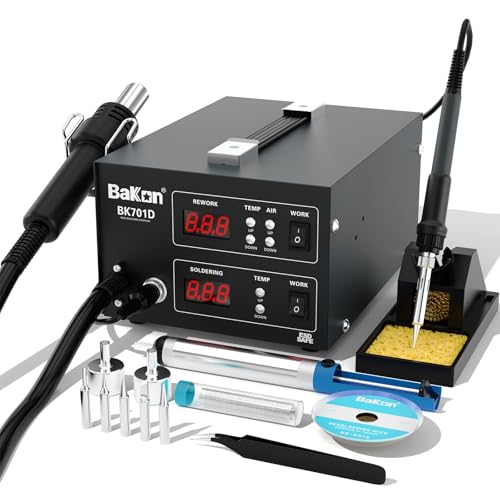
BAKON BK701D 700W 2-in-1 Soldering Station

BAKON 852D+ Heat Gun & Soldering Iron 2-in-1 Kit

FNIRSI HS-02A 100W Portable Soldering Iron Kit

BAKON BK602S 2-in-1 Hot Air Rework Station
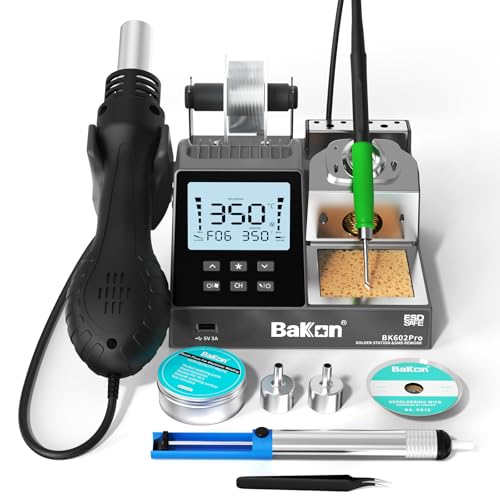
BAKON BK602Pro C210 Soldering & Hot Air Station

FNIRSI DWS-200 200W Soldering Station Kit

FNIRSI HS-03 Cordless Soldering Iron Kit
Inside Each Recommended Option
Not every soldering essential heats up. The Hakko 599-029 is a five-pack of replacement brass cleaning wire designed to drop into the Hakko 599B tip cleaner, the small countertop pot most techs keep next to their station. A dirty tip is the leading cause of failed joints, and the wire ball gently wipes oxidation (the dark tarnish that builds on hot tips) without dropping tip temperature the way a wet sponge does.
For anyone already running a 599B, this is the refill that keeps the routine going. For everyone else, the 599B itself is worth a look since this wire is what makes it useful in the first place.
A Favorable Mix
- Brass wire removes oxidation faster than a damp sponge and avoids the thermal shock that shortens tip life.
- Five-pack format means a single purchase covers months of regular bench sessions.
- Drop-in fit for the 599B cleaner, no trimming or fitting required.
Worth Noting
- Useless without the 599B housing, so this only makes sense for owners of that cleaner.
- Brass wool will collect solder splinters over time, and a quick shake-out every few weeks keeps it effective.
Key Specs
Who It Suits Best
Anyone who already owns a Hakko 599B tip cleaner and uses their station more than a few times a week.
Look Elsewhere When
You don’t yet own a tip cleaner; in that case the BAKON BK602S bundle includes its own brass cleaner and a stand to get you started.
The SRT12 is a small but exact piece of OEM (original equipment manufacturer) hardware. It is the standard replacement tip for the EDSYN DS017 SOLDAPULLT desoldering hand tool, and it also fits the PT109 and US140 models in the same family. A 3.2 mm (0.125 in) inner diameter gives it the right aperture for clearing solder from plated through-holes on most single and double-sided boards.
Desoldering tips wear out, pit, and slowly clog. Keeping a spare on hand is the cheapest insurance against a stalled rework job, particularly for repair techs who use the SOLDAPULLT weekly.
What It Does Well
- OEM fit, so no shimming or filing needed to swap it in.
- 3.2 mm aperture handles most through-hole pad sizes in consumer electronics.
- Cross-compatibility across three EDSYN hand tools means one SKU covers multiple workstations.
Points To Note
- Only useful if you already run an EDSYN DS017, PT109, or US140, since the tip is not a universal fit.
- Tip life depends heavily on cleaning between uses; a quick wipe while warm extends the interval between replacements.
Made For
Repair techs and electronics hobbyists already running an EDSYN SOLDAPULLT who want a fresh tip on the shelf before the current one gives up.
Consider Something Else When
You don’t own a desoldering hand tool yet; the BAKON 852D+ kit includes a desoldering pump among its starter accessories.
The BAKON BK701D pairs a 700W hot air rework gun with an independent soldering iron channel in one base, which is exactly the combination phone and laptop repair shops reach for daily. ESD-safe design (a circuit protection standard that prevents static electricity from damaging sensitive components) makes it appropriate for working directly on logic boards, and the dual-channel layout means you can reflow a chip with hot air on one side and clean pads with the iron on the other without swapping tools.
Compared with the smaller BAKON BK602S later in this list, the BK701D pushes more hot air wattage and targets a slightly heavier workload. For a one-off hobbyist, that’s overkill; for a bench that sees daily board-level work, it’s the right scale.
The Upside
- 700W hot air output reflows larger BGA (ball grid array) and multi-layer boards faster than lower-watt stations.
- Independent controls let the iron and hot air run at separate temperatures, or one tool can power down while the other stays active.
- ESD-safe construction suits direct logic board repair without extra grounding accessories.
Trade Offs
- Larger footprint than single-function stations, so a cramped desk may feel tight.
- Power and complexity exceed what a beginner needs for simple through-hole soldering.
Right Fit For
Independent repair shops and serious hobbyists who regularly rework SMD (surface-mount device) components on phones, laptops, and game consoles.
A Better Fit Elsewhere
Casual hobbyists soldering through-hole projects will find the BAKON BK602S a more comfortable step up from a basic iron.
The 852D+ is the kit you buy once and then stop thinking about. Inside the box, BAKON bundles a 30 g roll of lead-free solder, five soldering tips, two hot air nozzles, ESD tweezers, a desoldering pump, an iron stand, a brass cleaner, a sponge, and desoldering braid. The station itself runs a knob-controlled iron and hot air output on separate channels, with an LED display showing real-time setpoints.
For a first station, that bundle eliminates the slow drip of accessory shopping that adds up over months. For a more experienced user, it’s a useful second bench or a parts bin for restocking consumables.
The Value In It
- Comprehensive accessory bundle covers nearly every consumable a new station needs.
- Two hot air nozzles give flexibility between focused pinpoint work and broader area heating.
- LED display and knob controls keep the learning curve short for first-time users.
Honest Caveats
- The number of included tips favors variety over specialization, so serious SMD work may still call for aftermarket tips.
- Storing all the small accessories calls for a drawer or tray to keep the kit organized between sessions.
Best Suited To
First-time station shoppers who want a single purchase that covers both soldering and basic SMD rework out of the box.
Not Your Match When
You already own a station and only need a portable field iron; the FNIRSI HS-03 is purpose-built for cordless bench-free work.
The FNIRSI HS-02A is a pen-style iron built around a 9 to 20V input range, which means it accepts a variety of common DC power sources rather than relying on a wall wart. A 3-second tinning claim (tinning means coating the hot tip in a thin layer of fresh solder to keep it wetting properly) puts it in the same quick-heat league as bench stations, and the dedicated storage case holds the iron, tips, stand, brass cleaner, and a small spool of solder.
Where the HS-02A earns its travel-friendly reputation is the case: a single zip-up pouch keeps every essential in place for a service call or a class. Just note that the iron itself is corded, not battery-powered, so the freedom is in the case design rather than wireless operation.
What Works In Its Favor
- 100W ceiling gives comfortable headroom for most through-hole and small SMD work.
- Custom storage case prevents lost tips and a tangled cable on the road.
- Wide voltage input works with common USB-C PD (power delivery) and DC sources, depending on configuration.
Possible Compromises
- Requires a power source, so this is portable, not truly cordless.
- Without a station base, there’s no temperature readout on the iron itself.
Quick Facts
Whose Shelf It Belongs On
Hobbyists and techs who need a capable, packable iron for travel, classes, or quick home repairs away from the bench.
Skip It When
You actually need battery operation; the FNIRSI HS-03 runs on an internal 2600mAh cell for true cordless use.
The BK602S is BAKON’s compact 2-in-1 answer for a crowded desk. The iron and hot air rework channels share a single small base, with independent switches so you can run one tool at a time. A PID-controlled (PID, or proportional-integral-derivative, is a feedback algorithm that holds temperature steady despite changing thermal load) iron and °C/°F conversion on the display cover the basics, and the auto-sleep function cools the iron after periods of inactivity.
It is a step up from the 852D+ bundle in physical design, trading some of that kit’s included accessories for a tidier footprint. For a hobbyist bench with limited room, that trade often feels right.
Notable Upsides
- Compact body leaves more desk space for parts trays and project boards.
- PID temperature control holds setpoints steadily during long soldering sessions.
- Auto-sleep extends tip life and reduces idle power draw.
Some Limits To Know
- Lower hot air wattage than the BK701D, so larger BGA jobs will take longer.
- Accessories are sparser than the 852D+ kit, so budget for a stand and tip set if you need them.
Perfect Match For
DIYers building a small electronics corner in an apartment or shared space who want a tidy, all-in-one station.
Reach For A Different Pick When
Your workload leans heavily on phone-level SMD rework; the BAKON BK701D has the higher hot air output those jobs appreciate.
Where the BK602S uses a generic iron, the BK602Pro steps up to a C210-style heater core, the same family of high-precision tips used in some well-known professional stations. That tip standard opens the door to fine-pitch SMD work (soldering closely spaced miniature components) on QFN and QFP packages, where a thicker, lower-precision tip would simply bridge adjacent pads.
The large LCD shows real-time temperature, setpoint, airflow level, and preset shortcuts. Auto-sleep and preset memories round out the feature list. This is a station aimed at someone who already knows what C210 means and wants that compatibility.
Where It Helps
- C210 tip compatibility unlocks a wide ecosystem of high-precision SMD tips.
- Large display keeps both soldering and hot air parameters readable at a glance.
- Temperature presets reduce setup time on repeat jobs.
Practical Considerations
- C210 tips cost more than generic replacements, so expanding the tip collection adds up over time.
- More features mean a slightly steeper setup if you’ve never used a dual-function station before.
Key Product Details
Who Should Grab It
SMD rework specialists and serious hobbyists ready to commit to the C210 tip ecosystem for fine-pitch work.
Where A Sibling Pick Shines
Casual users who only occasionally touch SMD work will find the BAKON BK602S a friendlier entry point at lower cost.
The DWS-200 is the most powerful soldering station in this roundup. A pure copper transformer inside accepts 100 to 240V input, and a 200W ceiling gives it the thermal headroom to keep tip temperature stable during heavier joints like big ground pads, battery tabs, or thick multi-layer boards. Two helping-hands tools are included, which is a thoughtful addition for a station likely to see production-style workloads.
For comparison, the FNIRSI HS-02A we covered earlier delivers 100W in a portable package. The DWS-200 trades that portability for raw power and bench presence.
What Stands Out
- 200W output recovers temperature quickly on thermal-mass joints.
- Universal voltage input is friendly to international setups or shared workshop spaces.
- Bundled helping hands reduce the need for a separate third-party purchase.
Where It May Fall Short
- Heavier and less portable than pen-style irons, so it’s firmly a bench tool.
- Power level exceeds the needs of light hobby work, which makes the size feel like overkill for small projects.
Built With In Mind
Workshops and small production environments where the station runs daily and recovers between joints matters.
Swap It Out When
You mostly solder on the go; the FNIRSI HS-03 cordless iron is a far better travel companion.
The HS-03 finally takes the soldering iron off the leash. A 2600mAh internal battery powers a 3-second heat-up cycle, and a USB-C port lets you keep working (or top up the cell) while the iron is in use. The knob-controlled temperature and a 3-second tinning claim keep pace with the corded HS-02A earlier in the list, in a body that fits in a coat pocket.
Realistically, a 2600mAh cell at soldering temperatures won’t last a full production shift, but for short repairs, modding sessions, or wiring in awkward spots where dragging a cable would be worse than a dead battery, it solves problems no bench station can.
Reasons It Performs
- True cordless operation, free of any tether to a base station or power brick.
- Pass-through USB-C charging means the iron keeps working while plugged in.
- Pocket-friendly form factor reaches tight spots a bench iron physically cannot.
Worth Bearing In Mind
- Battery runtime is shorter than a corded session, so plan around battery swaps for big jobs.
- Owners commonly report tip changes are part of routine maintenance; keeping spares on hand avoids downtime mid-project.
Feature Snapshot
Right Fit For
Field techs, modders, and hobbyists who need to solder where there is no bench, no outlet, and no patience for cables.
Another Choice May Suit
Anyone tied to a workshop all day will appreciate the FNIRSI DWS-200 for its raw thermal headroom.
Choosing Soldering Tools That Fit Your Work
Soldering tools split into a few practical categories, and which one matters depends almost entirely on the work in front of you. Pen-style portable irons like the FNIRSI HS-02A and HS-03 are sized for travel, quick fixes, and tight spaces. Bench stations add temperature stability, larger displays, and dual-function hot air rework for SMD work. Consumables like the Hakko 599-029 and the SRT12 tip keep the gear you already own in working order.
Power And Heat Recovery
A higher wattage station like the FNIRSI DWS-200 isn’t just about reaching soldering temperature, which most irons do in seconds. It’s about recovering that temperature when the tip touches a heavy joint, a battery tab, or a multi-layer board. Dropping below setpoint mid-joint causes cold joints (dull, weak, often fractured connections) that fail later. For small electronics, 60 to 100W is plenty. For production or repair benches, 150W and up gives breathing room.
Tip Compatibility And Replacement Costs
A station is only as flexible as its tip catalog. C210-compatible systems like the BAKON BK602Pro unlock a deep ecosystem of precision tips, but each tip costs more. Generic stations cost less up front, but specialty work may still call for aftermarket tips. Either way, factor tip cost into the longer-term picture, not just the station price.
Cordless Versus Station-Based
A bench station wins for any sustained work. A cordless iron wins for any work that takes you away from the bench. The FNIRSI HS-03 handles the second case with genuine battery operation, while the HS-02A is portable but still corded. The choice depends on whether the work follows you, or whether you go to the work.
Safety And Static Protection
ESD-safe construction is the standard shorthand for static-protected tools, important for any direct work on logic boards, SMD components, or any board with chips that lack onboard protection. For through-hole hobby kits, it’s nice to have. For repair work on phones, laptops, and game consoles, it’s worth insisting on.
Common Pitfalls and Smart Upgrades
Pitfalls Shoppers Hit
A frequent stumble is buying a station for capability the work doesn’t need, leaving an expensive brick on the desk for simple through-hole kits. The opposite mistake is grabbing the cheapest iron and then hitting a wall the moment SMD work shows up. Match the station to the highest-complexity job you realistically expect in the next year, and buy a smaller tip set and a brass cleaner alongside it. Skipping accessories at the cart tends to mean a second order a week later.
Where The Extra Money Goes
Higher-tier stations spend the budget on better transformers, faster thermal recovery, more accurate PID loops, and longer tip ecosystems. For a once-a-month hobbyist, those gains may sit unused. For someone who solders every day, they turn a chore into a tool that disappears into the work. The right call is to step up precisely when the workload justifies the recovery time and the tip selection.