Soldering a broken headphone cable or swapping a capacitor on a vintage radio feels like a small magic trick when the joint holds. Choosing the wrong wire or skipping the right flux turns that trick into a headache of cold joints and lifted pads. This guide walks through nine solid options covering the diameter choices, alloy compositions, and cleanup helpers you’ll want on the bench. Whether you’re fixing appliances, building kits, or doing fine PCB work, the picks below map to real workshop habits.
The Choices Worth Comparing
PickWhy We Picked ItBest ForAction

Editor’s Choice
Kester 24-6040-0027 Wire Solder 0.031″ Diameter
Classic tin-lead generalist
General electronics repair
Professional Pick
Kester 24-6337-0027 Solder Roll 63/37 0.031″
Eutectic behavior, clean flow
Precision through-hole work

Heavy Duty Pick
Kester 24-6040-0053 Solder Roll 0.050″ Diameter
Thicker gauge for beefy joints
Wiring and terminal soldering

Precision Pick
VIRALLOY 0.3mm Lead Free Solder Wire Sn97/Ag0.3/Cu0.7 50g
Ultra-fine lead-free diameter
Micro soldering and SMD work

Workshop Pick
Lesnow Solder Flux Paste and Wick Braid Combo
Flux plus wick together
Rework and desoldering jobs

Daily Driver
VIRALLOY 0.8mm Lead Free Solder Wire 50g
Versatile lead-free workhorse
General electrical soldering

Balanced Choice
VIRALLOY 0.5mm Lead Free Solder Wire 50g
Middle-ground lead-free diameter
VIRALLOY 0.5mm Lead Free Solder Wire 50g
Middle-ground lead-free diameter
Mixed PCB and wiring jobs
Rework Pick
Lesnow Desoldering Wick Braid 10ft Roll
Long single-roll desoldering braid
Component removal and cleanup

Value Pack
Lesnow Solder Flux Paste 2-Pack with Dispenser
Double syringe with tips
Frequent flux application work
Why These Options Stand Out
Kester’s 24-6040-0027 sits on more repair benches than almost any other spool, and for good reason. The 60/40 tin-lead ratio is a forgiving alloy (a mix of two metals) that melts predictably, wets pads quickly, and produces shiny joints when the iron temperature is dialed in correctly. The 0.031″ diameter threads easily through most through-hole pads, giving you enough metal volume for solid connections without flooding small SMD (surface-mount device) lands.
If you’re restoring a vintage amplifier, swapping a DC jack, or tacking wires to a terminal block, this wire handles the work without much fuss. Compared to the finer VIRALLOY 0.3mm lead-free option further down the list, this Kester is far more forgiving on slightly oxidized parts. Most hobbyists reach for this diameter as their default.
What Helps Most
- ✓60/40 tin-lead alloy flows smoothly and cools to bright, inspectable joints.
- ✓0.031″ diameter suits most through-hole pads and wire tacking without over-application.
- ✓Rosin core flux activates cleanly, reducing post-solder cleanup on most boards.
- ✓One-pound spool covers hundreds of typical repair jobs for the home bench.
Things To Weigh Up
- •Contains lead, so ventilation and hand-washing matter more than with lead-free options.
- •On very fine SMD pads, the 0.031″ thickness can feel bulky in tight spaces.
Quick Facts
| | Feature | Specification | Why It Matters |
|---|
| Alloy |
60% tin / 40% lead (Sn60Pb40) |
Lower melting point and forgiving flow characteristics. |
| Wire diameter |
0.031 inch |
Versatile gauge for through-hole and general wiring work. |
| Flux core |
Rosin, 3.3% |
Activates at soldering temperature to clean oxide off pads. |
Who It Suits Best
Home repair techs and hobbyists who want one reliable spool that handles most electronics jobs from a stereo repair to a LED strip splice.
Where Another Pick Suits Better
Shoppers working exclusively on lead-free-compliant commercial assemblies should consider the VIRALLOY 0.5mm lead-free option instead.
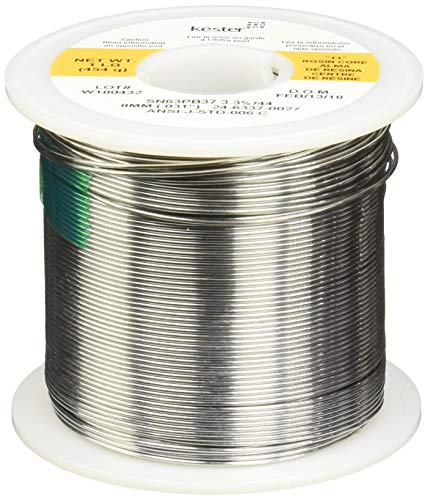
The 63/37 ratio in this Kester spool behaves like a small upgrade over the 60/40 above: it’s a eutectic alloy, meaning it transitions directly from liquid to solid at one specific temperature without a plastic (mushy) phase in between. That matters when you’re soldering parts that can’t sit still, because the joint snaps solid the moment heat is removed, preventing the disturbed connections that cause cold joints.
On a production-style workbench or a careful restoration project, the difference is noticeable, especially with multi-pin headers and fine-pitch components. The 0.031″ diameter matches the previous Kester, keeping feeding behavior familiar. For anyone who’s ever watched a joint dull because it moved during cooldown, this wire earns its reputation.
Well-Handled Touches
- ✓Eutectic 63/37 alloy solidifies instantly, reducing cold-joint risk on tricky assemblies.
- ✓Same trusted Kester flux chemistry as the 60/40 spool, so wetting stays consistent.
- ✓0.031″ diameter balances joint volume with precision for most through-hole work.
- ✓Ideal for header pins, IC sockets, and connectors where joint clarity matters.
Points To Keep In Mind
- •Slightly higher cost per spool than the 60/40 alternative for the same weight.
- •Still a leaded alloy, so fume extraction and washing habits apply as before.
Key Specs
| | Feature | Specification | Why It Matters |
|---|
| Alloy |
63% tin / 37% lead (Sn63Pb37) |
Eutectic behavior eliminates the plastic phase during cooling. |
| Wire diameter |
0.031 inch |
Standard precision gauge for through-hole pads. |
| Flux core |
Rosin, 3.3% |
Pre-fluxed for clean pad wetting during application. |
Right Fit For
Experienced builders and repair techs who want predictable, snap-solid joints on headers, sockets, and multi-pin connectors.
Look Elsewhere When
Absolute beginners may not notice the eutectic difference and could save cost by starting with the Kester 24-6040-0027 instead.
Step up to 0.050″ and the Kester 24-6040-0053 becomes a different tool entirely. This thicker wire deposits more metal per second, which is exactly what you want when filling larger pads, soldering heavier gauge wires, or working on grounding lugs and power connectors. The 60/40 alloy keeps the same flow behavior as its thinner sibling, just with greater volume per inch fed.
Auto-electrical repairs, ham radio antenna builds, and high-current LED installations all benefit from this diameter. Compare it to the 0.031″ wire reviewed above: that one excels at finesse work, while this 0.050″ version covers the heavy-lift jobs without forcing you to feed twice as much length. For bench work that swings between circuit boards and chunky wiring, many technicians keep both spools within reach.
Useful Touches
- ✓0.050″ diameter deposits more solder per inch for fast joint filling.
- ✓Same 60/40 alloy as the standard spool, so temperature settings carry over.
- ✓Reduces the number of feed passes needed on larger pads and lugs.
- ✓Reliable for grounding points, battery lugs, and power wiring repairs.
Worth Noting
- •Too thick for fine-pitch SMD pads and small through-hole components.
- •Heavier spool weight means less flexibility for delicate touch-ups on dense boards.
Feature Snapshot
| | Feature | Specification | Why It Matters |
|---|
| Alloy |
60% tin / 40% lead (Sn60Pb40) |
Familiar flow profile for technicians used to leaded solder. |
| Wire diameter |
0.050 inch |
Thick gauge suited to high-current and chassis wiring work. |
| Flux core |
Rosin, 3.3% |
Internal flux core simplifies pad preparation on most metals. |
Best Suited To
Auto electricians, ham radio hobbyists, and technicians who regularly work on power wiring, battery connections, and chassis grounds.
Consider Something Else When
Surface-mount PCB work calls for the VIRALLOY 0.3mm lead-free wire rather than this thicker gauge.
The VIRALLOY 0.3mm wire exists for jobs where the standard 0.031″ Kester feels like threading a garden hose through a keyhole. At 0.3mm (roughly 0.012″), this lead-free spool handles the smallest SMD components, fine-pitch ICs, and delicate PCB repair without flooding nearby pads. The Sn97/Ag0.3/Cu0.7 alloy (96.5% tin, 3% silver, 0.5% copper, a common lead-free formulation) requires higher iron temperatures but produces joints that meet lead-free compliance requirements.
Watchmakers, drone builders, and anyone repairing modern smartphone-adjacent boards will appreciate the precision. The rosin core keeps the flux where it belongs, around the joint itself. Compared to the heavier Kester 0.050″ roll, this VIRALLOY is the opposite end of the spectrum, trading metal volume for surgical control.
Standout Benefits
- ✓0.3mm ultra-fine diameter suits micro soldering and dense PCB layouts.
- ✓Lead-free Sn/Ag/Cu alloy meets RoHS (Restriction of Hazardous Substances) compliance for commercial work.
- ✓Rosin core supports clean wetting on small pads without external flux.
- ✓50g spool is sized for bench use without committing to a full pound.
Trade Offs
- •Requires higher iron temperature (around 700°F) than leaded wire for proper flow.
- •Small diameter means more wire length consumed per joint, so 50g covers fewer repairs.
Whose Shelf It Belongs On
SMD-focused technicians, drone and quadcopter builders, and repair shops working under lead-free compliance rules.
Skip It When
General home repairs on through-hole boards are easier with the Kester 24-6040-0027 0.031″ spool instead.
The Lesnow flux and wick bundle addresses the awkward middle of every repair: getting solder off a board cleanly. The 10cc no-clean flux paste brushes or flows onto stubborn joints, improving heat transfer, while the included 10ft desoldering braid wicks molten solder away through capillary action (the tendency of a liquid to flow into narrow spaces against gravity). Together they handle the rework jobs that pure solder wire cannot.
For a hobbyist pulling old components off a donor board or correcting a bridged pin, having flux and wick in one package removes two separate shopping trips. Owners commonly report that the braid leaves minimal non-conductive residue, which saves a post-repair cleaning step. Compared to the single-purpose wick from the same brand reviewed later, this combo gives more flexibility per purchase.
Everyday Wins
- ✓Combined flux and wick package covers both solder application and removal.
- ✓No-clean formula leaves behind non-corrosive residue that usually doesn’t need washing.
- ✓10cc flux syringe covers dozens of typical rework sessions.
- ✓Braid’s capillary structure absorbs excess solder efficiently from pad surfaces.
Honest Caveats
- •Wick width isn’t specified, so it may not fit every micro pad layout.
- •Flux syringe lacks the precision needle tip of the dedicated flux paste reviewed later.
At A Glance
| | Feature | Specification | Why It Matters |
|---|
| Flux type |
No-clean paste, 10cc |
Reduces post-solder cleanup on most repair jobs. |
| Wick length |
10 feet |
Covers many desoldering sessions before running out. |
Who Will Love This
Reuse-focused hobbyists pulling parts from donor boards, plus repair techs who frequently correct bridging and misplaced solder.
A Better Fit Elsewhere
For high-volume flux dispensing work, the Lesnow Solder Flux Paste 2-pack offers more controlled syringe delivery.
The VIRALLOY 0.8mm lead-free wire sits in the middle of the diameter range, which makes it the most versatile of the three VIRALLOY spools in this guide. At 0.8mm it feeds fast enough for general wiring but stays controllable on moderately sized PCB pads. The same Sn97/Ag0.3/Cu0.7 alloy as the 0.3mm and 0.5mm versions means consistent temperature settings across the lineup.
For a workbench that needs one lead-free spool covering most repairs, this diameter hits the practical sweet spot. Hobbyists moving away from leaded solder often land here first, and the rosin core handles most pad-prep work without extra flux. Compare it to the 0.3mm version: that one is for surgical SMD work, while the 0.8mm version covers typical project soldering without the constant refilling.
Bright Spots
- ✓0.8mm diameter balances feed speed with control for general soldering.
- ✓Lead-free Sn/Ag/Cu alloy meets common compliance standards for commercial builds.
- ✓Rosin core simplifies pad prep and joint inspection.
- ✓50g size works well for hobbyists without oversupply.
Points To Note
- •Higher working temperature than leaded options, so iron wattage matters more.
- •On very small SMD pads, switching to the 0.3mm VIRALLOY is the practical move.
Built With In Mind
Hobbyists and pros shifting to lead-free soldering who want one spool that handles PCB through-hole work and basic wiring.
Another Choice May Suit
Those sticking with leaded solder for ease-of-use should consider the Kester 24-6040-0027 0.031″ wire reviewed above.
The 0.5mm VIRALLOY lands in the gap between the micro 0.3mm spool and the heavier 0.8mm version. It’s a sensible middle diameter for mixed work: fine enough to control on smaller SMD resistors and capacitors, yet thick enough to bridge the gap to slightly larger pads. The same Sn/Ag/Cu alloy and rosin core chemistry carry over from its siblings, so the soldering feel stays consistent within the brand.
Repair benches that handle a variety of board types benefit from having 0.5mm in rotation. It’s the spool to grab when a job sits between “definitely micro” and “general purpose.” The trade-off against the 0.8mm version is slightly slower feed rate, but the win is more precision when bridging between pad sizes.
Key Advantages
- ✓0.5mm diameter handles mid-range SMD components and most through-hole pads.
- ✓Lead-free alloy supports compliance-driven work environments.
- ✓Rosin core delivers consistent flux delivery without external application.
- ✓Complements the 0.3mm and 0.8mm VIRALLOY spools for full diameter coverage.
Trade-Offs To Consider
- •Not specialized enough for either micro SMD or heavy wiring jobs.
- •Higher working temperature than the leaded Kester spools for equivalent joints.
Who Should Grab It
Technicians and advanced hobbyists who want a versatile lead-free diameter that handles both moderate SMD and through-hole work without switching spools.
Reach For A Different Pick When
Pure SMD micro-soldering jobs are easier with the 0.3mm VIRALLOY wire instead.
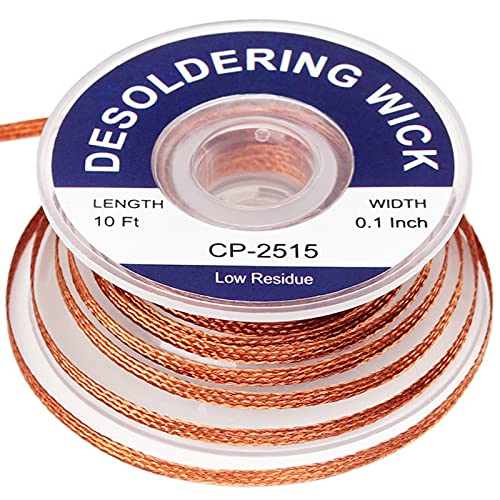
The Lesnow desoldering braid is a single-purpose tool that does one job and does it well: pulling molten solder off pads. At roughly 10ft long and 0.1 inch wide, the roll covers everything from correcting a single bridged pin to desoldering an entire through-hole component. The no-clean braid absorbs solder through capillary action and leaves minimal residue behind.
On a keyboard-switch repair, a relay extraction, or a motherboard component swap, the braid saves you from fighting with a solder sucker. The 10ft length is generous enough for months of occasional rework. Owners commonly mention the braid’s consistency as a plus: it feeds smoothly without unraveling. For more comprehensive rework, the Lesnow flux-and-wick combo reviewed earlier adds the flux side of the equation.
The Value In It
- ✓10ft length covers many rework sessions without restocking.
- ✓0.1-inch width handles both through-hole pads and small SMD cleanup.
- ✓No-clean formula leaves residue that typically doesn’t need post-cleaning.
- ✓Single-roll format stores easily in a bench drawer or parts organizer.
Points To Note
- •Requires flux addition for stubborn or oxidized joints to wet properly.
- •Wick tip darkens with use and needs trimming for best capillary performance.
Perfect Match For
Keyboard modders, vintage electronics restorers, and anyone who frequently removes components rather than just adding them.
A Better Fit Elsewhere
For first-time users who also need flux to start, the Lesnow flux-and-wick combo covers both bases in one purchase.
The Lesnow flux paste double pack arrives as two complete dispenser kits, each with a 10ml syringe, plunger, and two dispensing heads. That setup matters because flux paste applied precisely beats flux brushed on with whatever’s nearby. The no-clean formula activates under heat, helps solder wet onto stubborn pads, and leaves residue that usually doesn’t need washing off.
For rework, surface-mount work, or tinning new pads, controlled flux delivery keeps the board clean and the joint predictable. The two-pack format means you can stage one syringe at the bench and keep the other in a travel kit. Compared to the flux included in the Lesnow combo above, this standalone pack provides better dispenser control but doesn’t include any braid.
Where It Delivers
- ✓Two-pack format covers main bench and secondary workstation needs.
- ✓Plunger syringe and dual dispensing heads give controlled paste application.
- ✓No-clean formula reduces post-solder board cleaning on most repairs.
- ✓10ml per syringe is sized for ongoing project use, not single-session dabbing.
Room For Improvement
- •Doesn’t include desoldering braid, so rework-only jobs need a separate wick.
- •Paste can thicken if the syringe cap isn’t sealed between uses.
Made For
Frequent rework technicians and SMD-focused hobbyists who run through flux regularly and want syringe-level control on every joint.
Swap It Out When
First-timers who only need a single rework session should pick the Lesnow flux-and-wick combo for a more complete starter set.
What Matters Most When Picking Solder For Electrical Work
Diameter Sets The Range
Wire diameter determines where a spool fits in your workflow. 0.3mm to 0.5mm covers micro SMD pads and fine-pitch components. 0.031″ (0.8mm) is the everyday workhorse for most PCB through-hole and general wiring. Above that, 0.050″ and thicker handle high-current connections, chassis grounds, and heavier gauge wire joints. Keeping two diameters on the bench covers most situations without forcing compromise.
Alloy Choice Affects Feel
Tin-lead alloys (60/40 or 63/37) melt at lower temperatures, flow more easily, and forgive imperfect tip prep. 63/37 in particular behaves eutectically: it solidifies at a single temperature, which reduces the risk of disturbed joints. Lead-free options like Sn/Ag/Cu require higher iron temperatures, which means a stronger station, but they meet compliance requirements for commercial and consumer electronics work.
Flux Core Versus Paste
Rosin-cored solder handles most basic repair needs because flux is delivered as the wire melts. Separate flux paste or liquid becomes valuable on oxidized pads, surface-mount rework, and drag-soldering where extra activation prevents bridging. No-clean formulas leave behind minimal residue that usually doesn’t require post-solder washing.
Rework Tools Complete The Kit
Soldering is half the work; removing and correcting joints is the other half. Desoldering braid wicks excess solder away through capillary action, while flux paste improves heat transfer on stubborn connections. For anyone pulling components from donor boards or fixing bridge errors, a small wick and a syringe of flux pays for itself quickly.
Spotting The Gaps In Solder Shopping
Mistakes Worth Dodging
Buying only one diameter leaves you improvising on jobs that don’t fit. Picking a leaded spool for a commercial-compliance project creates rework when boards get rejected. Skipping flux and wick leaves you unable to correct bridge errors cleanly. Most home repair techs eventually land on a 0.031″ leaded wire plus a small flux syringe and a short braid roll. That combination covers the widest variety of real-world fixes without overbuying.
When Paying More Pays Off
Higher-priced spools from established names like Kester deliver consistent flux distribution and clean alloy chemistry, which translates to fewer cold joints and cleaner inspections. Spending up also gets you eutectic 63/37 alloy when joint snap-solid behavior matters, or pre-cut lengths that don’t tangle on the bench. For occasional hobby use, value-priced spools work fine, but for daily bench work, the consistency of premium wire saves time across hundreds of joints.







