


A clean solder joint starts with the right consumables. If you repair circuit boards, build hobby kits, or fix a cracked wire on a household gadget, the wire, flux, and tip temperature all shape the result. Picking the wrong alloy can leave you with cold joints, while a tip that’s too cool won’t flow the metal at all. This roundup walks through nine solid solders for electronics, covering leaded and lead-free wire in different diameters, plus a couple of cordless iron kits for when you need to work away from a bench. Match the pick to your project size and skill level, and the rest of the work gets a lot easier.
A Fast Comparison Of The Options

Kester 24-6040-0027 Wire Solder 0.031″ Spool
Kester 24-6337-0027 Solder Roll 63/37 .031″

Kester 24-6337-0010 44 Rosin Core 63/37 .020

VIRALLOY 0.3mm Lead-Free Rosin Core Solder 50g

Bakon Cordless Precision Soldering Iron Kit

VIRALLOY 0.8mm Lead-Free Rosin Core Solder 50g

VIRALLOY 0.5mm Lead-Free Rosin Core Solder 50g
BAKON BK210 Cordless Soldering Iron Slate Grey

BAKON BK210 Soldering Iron Kit with C210 Tip
A Breakdown Of The Leading Choices
The 60/40 tin-lead ratio (60% tin, 40% lead) on this Kester spool has been a workshop standard for decades, and the 0.031″ diameter sits in a sweet spot for most through-hole components and standard circuit-board pads. The alloy flows smoothly when you hit the right tip temperature, giving you a bright, shiny joint that holds up over time.
For hobbyists who wire up perf boards, repair radios, or tinker with vintage gear, this spool keeps going through hundreds of joints without complaint. Compared to the thinner .020″ Kester pick later in this list, the 0.031″ wire lays down more solder per second, which speeds up larger pads and terminal lugs.
Strong Points
- Classic 60/40 alloy flows cleanly at standard tip temperatures around 370°C to 400°C.
- 0.031″ diameter suits both general-purpose pad work and slightly larger joints.
- One-pound spool lasts through long repair sessions and bench builds.
- Trusted Kester quality in shops and service centers for years.
Things To Consider
- Contains lead, so ventilation and hand-washing after use still matter.
- Heavier 1 lb spool takes up more bench space than a 50g roll.
Key Specs
Made For
Workshop hobbyists and technicians handling everyday through-hole soldering, terminal lugs, and classic circuit repair.
Where Another Pick Suits Better
For very fine surface-mount work, the VIRALLOY 0.3mm Lead-Free Rosin Core Solder 50g handles tight SMD pads with much more control.
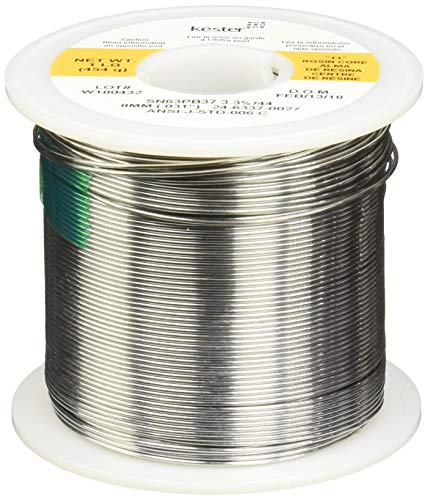
The 63/37 ratio on this Kester roll is eutectic, meaning it melts and solidifies at one sharp temperature rather than slowly transitioning through a plastic phase. That single-temperature behavior is the main reason service technicians reach for it: a joint that goes from liquid to solid in an instant is far less likely to move while you set the board down.
At the same 0.031″ diameter as the previous 60/40 spool, the wire feeds at a similar rate, but the working feel is slightly different. You may find the tip temperature needs a small bump to get full flow, since the 63/37 alloy melts a few degrees higher than 60/40.
Everyday Perks
- Eutectic 63/37 alloy solidifies instantly, reducing cold joints.
- 0.031″ diameter handles typical PCB pad sizes with ease.
- Familiar Kester flux behavior in a more compact roll format.
Trade Offs
- Roll format can tangle if you pull too fast, so a spool holder helps.
- Still a leaded alloy, so cleanup of hands and tools remains important.
Feature Snapshot
Right Fit For
Repair techs and serious hobbyists who want predictable solidification on production-style work.
Skip It When
You need a lead-free formula for compliance reasons, in which case the VIRALLOY 0.5mm Lead-Free Rosin Core Solder 50g covers a similar diameter range.
The Kester 44 rosin flux core inside this spool is one of the most recognized flux formulas in electronics work. Paired with the 63/37 eutectic alloy, the result is a wire that wets quickly, spreads evenly across copper pads, and leaves minimal residue that needs cleaning.
At .020″ (about 0.5 mm), this wire drops down a step in thickness from the 0.031″ spools earlier in the list. The thinner gauge gives you finer control on smaller pads, IC pins, and dense board layouts where a fat wire would flood the joint with too much metal.
Positive Takeaways
- Kester 44 rosin flux has a long track record on production lines and repair benches.
- Thin .020″ diameter supports fine-pitch components and dense board work.
- Eutectic 63/37 alloy reduces the risk of disturbed or cold joints.
- One-pound supply covers extended projects without frequent reordering.
Worth Noting
- Leaded alloy, so work-area cleanup and ventilation still apply.
- Some owners prefer no-clean flux, while Kester 44 may leave a light residue on certain boards.
Quick Facts
Best Suited To
Experienced hobbyists and service techs working on fine-pitch boards, vintage electronics, and dense PCB repair.
Look Elsewhere When
You need a portable iron rather than bench wire, in which case the BAKON BK210 Soldering Iron Kit with C210 Tip pairs nicely with a separate solder spool.
At 0.3 mm, this VIRALLOY spool is among the thinnest lead-free wires you’ll find for everyday electronics. The Sn97/Ag0.3/Cu0.7 alloy (97% tin, 0.3% silver, 0.7% copper) leans on a small amount of silver to help wetting, while the copper keeps the melting point workable for standard tips.
The built-in rosin core handles light oxide on older pads, though lead-free alloys in general need a slightly hotter iron than leaded wire. For smartphone boards, drone ESCs, and micro USB repairs, the fine diameter lets you place solder exactly where it needs to go without bridging nearby pins.
Key Advantages
- Ultra-fine 0.3mm wire for SMD pads, micro soldering, and dense boards.
- Lead-free Sn97/Ag0.3/Cu0.7 alloy meets common RoHS-style requirements.
- Rosin core supports smooth flow on small joints.
- 50g spool is compact enough to live in a small parts drawer.
Points To Note
- Lead-free wire needs a hotter tip (often 350°C and up) to flow well.
- 50g rolls through quickly on larger joints, so it is best kept for fine work.
Feature Rundown
Who It Suits Best
Detail-oriented repair techs and drone or phone hobbyists working on micro components where every millimeter counts.
Consider Something Else When
You mostly solder wire-to-wire or terminal lugs, in which case the VIRALLOY 0.8mm Lead-Free Rosin Core Solder 50g lays down metal faster on bigger joints.
Where the other picks in this list are spools of wire, this Bakon kit brings the iron. The 1100 mAh built-in battery runs for around 40 minutes of cordless soldering, and a Type-C port keeps the iron working when the battery runs low, switching to corded mode for longer sessions.
The integrated heating core hits working temperature in roughly 7 seconds and accepts a C210 precision tip, the same tip style you see on higher-end station irons. For field repairs, RC hobby work, or quick fixes away from a power outlet, the cordless function is the main draw.
Where It Helps
- 40-minute cordless runtime frees you from a wall outlet for short jobs.
- Type-C corded mode extends use for bench-style sessions.
- 7-second heat-up keeps idle time short during multi-point repairs.
- C210 tip compatibility opens up a wide range of replacement tips.
Practical Considerations
- Cordless max output is lower than corded, so heavier joints may take longer to heat.
- 40 minutes is enough for quick fixes, not a full day of production work.
The Main Details
Whose Shelf It Belongs On
Mobile repair techs, drone hobbyists, and anyone who needs a compact iron for quick field fixes without a bench setup.
Reach For A Different Pick When
You need longer cordless runtime for full repair days, in which case the BAKON BK210 Cordless Soldering Iron Slate Grey offers a 3200 mAh battery for extended sessions.
The 0.8 mm diameter on this VIRALLOY spool sits at the thicker end of electronics-focused wire, which makes it the practical choice for wire-to-wire joints, terminal blocks, and small bus-bar work. The same Sn97/Ag0.3/Cu0.7 lead-free alloy appears here as on the thinner VIRALLOY spools, so you can standardize your alloy across the bench while changing diameter by project.
For household AC adapters, low-voltage LED strips, and hobby motor leads, the 0.8 mm wire feeds metal fast enough to fill larger pads without sitting on the joint too long. Owners commonly report that the rosin core leaves a light residue that wipes away with isopropyl alcohol.
Useful Highlights
- Thicker 0.8 mm wire suits wire-to-wire and terminal soldering.
- Lead-free Sn97/Ag0.3/Cu0.7 alloy aligns with RoHS-style work.
- Rosin core supports clean flow on copper and tinned pads.
- Matches the alloy on the other VIRALLOY spools for consistency.
Honest Caveats
- Too thick for fine SMD work, where the 0.3mm VIRALLOY pick fits better.
- Lead-free wire demands a hotter iron than 60/40 leaded wire.
Important Details
Perfect Match For
Electricians, automotive hobbyists, and DIYers handling wire joints, ground lugs, and similar general electrical soldering.
Not Your Match When
Your work centers on phone boards or dense SMD components, in which case the VIRALLOY 0.3mm Lead-Free Rosin Core Solder 50g gives far better control.
At 0.5 mm, this VIRALLOY spool sits between the 0.3 mm micro wire and the 0.8 mm general-purpose wire from the same brand. For many hobbyists, that middle position is the most useful diameter on the bench, since it handles standard through-hole pads and slightly tighter layouts without the careful control the 0.3 mm wire demands.
The Sn97/Ag0.3/Cu0.7 alloy stays consistent across the VIRALLOY range, so you can move between diameters without retraining your iron’s temperature profile by much. Rosin core flow is similar to the other VIRALLOY spools, leaving a thin residue that cleans up with a quick wipe.
Practical Pluses
- 0.5 mm diameter covers a wide range of typical electronics work.
- Lead-free Sn97/Ag0.3/Cu0.7 alloy for compliant builds.
- Rosin core supports even wetting on most copper pads.
- Fits naturally as a second spool alongside the 0.3 mm and 0.8 mm VIRALLOY picks.
Where It Is Less Suited
- Not as precise as the 0.3 mm wire for tight SMD layouts.
- Lead-free alloys still need a hotter tip, so older low-wattage irons may struggle.
Who Should Grab It
Hobbyists who want one lead-free spool that handles most general electronics projects without juggling multiple diameters.
A Better Fit Elsewhere
For ultra-fine smartphone or drone ESC work, the VIRALLOY 0.3mm Lead-Free Rosin Core Solder 50g gives better control on tiny pads.
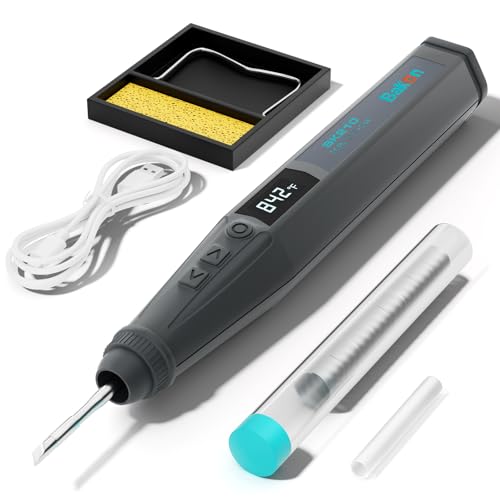
The slate grey BK210 builds on Bakon’s cordless line with a 3200 mAh battery, which stretches cordless runtime past 60 minutes in many working conditions. The Type-C charging port accepts any standard USB-C cable, so a power bank or laptop charger can top it up between jobs.
The integrated LCD shows the current tip temperature in real time, with a C/F toggle and calibration setting for those who want the readout to match a reference thermometer. The auto-sleep timer is a quiet feature, but it helps extend tip life and saves battery when the iron sits idle on the bench.
What It Does Well
- 3200 mAh battery delivers around 60 minutes of cordless use per charge.
- Real-time temperature display with C/F toggle and calibration.
- Type-C port works with common USB-C chargers and power banks.
- Auto-sleep function protects the tip and saves battery on idle.
Possible Compromises
- Body is a small step larger than the smaller Bakon cordless pick in this list.
- Tip selection is C210-based, which limits older tip inventories you may already own.
Details At A Glance
Built With In Mind
Repair techs and serious hobbyists who want a longer-running cordless iron with a real temperature readout on the body.
Swap It Out When
You prefer a smaller, lighter pen-style iron for tight bags, in which case the Bakon Cordless Precision Soldering Iron Kit is more pocket-friendly.
This BK210 kit wraps the iron in a full accessory bundle aimed at electronics repair. The C210 tip heats up in roughly 8 seconds, and the temperature range of 356°F to 842°F (180°C to 450°C) covers everything from heat-sensitive plastics to thicker lead-free joints.
The 3200 mAh battery supports around 60 minutes of cordless work, while a Type-C cable keeps the iron running for longer bench sessions. The LED display shows real-time temperature, and the child lock prevents accidental temperature changes if the iron is shared in a busy workspace.
A Few Strong Suits
- Full kit format with accessories ready for first-day use.
- 8-second heat-up keeps multi-point jobs moving quickly.
- Wide 356°F to 842°F range handles delicate and heavier joints.
- Child lock adds safety in shared or family work areas.
Things To Weigh
- Kit bundle weighs more than the bare BK210 iron, so it is less pocket-friendly.
- At full 842°F, the tip is hot enough to lift pads on a PCB, so care matters on fine work.
Who Will Love This
Beginners and intermediate hobbyists who want a complete starter kit, including an iron, tips, and safety features, without buying each piece separately.
Where A Sibling Pick Shines
For a lighter, more portable option, the BAKON BK210 Cordless Soldering Iron Slate Grey strips the kit down to a slimmer everyday carry.
What To Weigh Before Choosing Your Next Solder Wire
The right wire depends on the joint size, the alloy rules you need to follow, and the iron that will be doing the heating. Diameter, flux core, and alloy ratio each change how the solder feels under the tip and how the finished joint holds up.
Match diameter to the smallest pad on the board. A 0.3 mm wire gives control on SMD pads, 0.5 mm handles mixed projects, and 0.8 mm covers wire-to-wire and terminal work. Pulling too thick a wire through a tight pitch leads to bridges, while too-thin a wire on a large pad forces you to feed solder for a long time.
Pick the alloy that fits your environment. Leaded 60/40 and 63/37 wires flow at lower temperatures and wet well on aged copper, but they include lead. Lead-free Sn97/Ag0.3/Cu0.7 alloys meet common RoHS-style requirements and avoid lead, though they need a hotter tip and slightly longer contact time on each joint.
Check the flux core for your cleaning routine. Rosin-core wires (like Kester 44 or VIRALLOY’s rosin core) leave a light residue that may need a quick wipe with isopropyl alcohol on cosmetic or high-impedance boards. No-clean fluxes skip that step but cost more per spool.
Match the iron to the wire. Lead-free wire wants a tip that holds temperature under load, ideally a station iron or a quality cordless model with a C210 tip. A weak 8W pencil may drag on a lead-free joint, while a 60W station will feel almost effortless.
Key Considerations Across These Picks
Mistakes Worth Dodging
Buying the thinnest wire available sounds precise, but 0.3 mm solder on a thick terminal lug means feeding for ages and overheating the pad. Conversely, 0.8 mm wire on a micro USB port floods the connection before you can pull the iron away. Match wire diameter to the smallest pad you realistically expect to touch.
Another common slip is grabbing a lead-free spool and running the iron at leaded temperatures. Lead-free alloys stay slushy at 330°C, then go fully liquid closer to 350°C to 380°C. The honest read is that underheating produces cold joints that crack later, so plan for a higher setpoint from the start.
When Paying More Pays Off
The price gap between a basic spool and a pro-grade Kester usually comes down to flux consistency and alloy purity. A Kester 44 core tends to wet faster on oxidized copper than a generic rosin core, which matters on vintage boards that have sat in a drawer for years. For one-off hobby work, a budget spool is fine, but on a service bench where joint reliability is the product, the upgrade pays for itself in fewer callbacks. The same logic applies to iron kits: extra features like LCD temperature readouts, calibration, and child lock only matter if those features fit how you actually work, so weigh them against the simpler corded pencils that have served the trade for decades.
Frequently Asked Questions
What diameter solder wire should a beginner start with?
A 0.5 mm or 0.031″ rosin-core wire is the friendliest starting point. It feeds at a manageable rate on most through-hole pads, gives you a few seconds to react before the joint floods, and works with both leaded and lead-free alloys.
Is lead-free solder harder to use than leaded solder?
Yes, in practice lead-free solder demands a hotter tip, often 350°C and up, and a slightly longer contact time on each joint. The trade-off is a lead-free joint that meets common compliance rules and is safer to handle in shared workspaces.
Do I really need a separate flux when using rosin-core solder?
For most repairs, the rosin core in the wire carries enough flux for clean copper pads. A separate flux paste or pen helps on heavily oxidized pads, large ground planes, or when rework leaves old solder that refuses to wet.
How long does a 50g spool of solder typically last?
For a hobbyist soldering a few joints per week, a 50g spool can stretch for several months. For a daily service bench running production boards, the same spool can disappear in a week, which is why heavier 1 lb spools tend to be more economical in the long run.
Can I use the same tip for leaded and lead-free solder?
You can, but lead-free wire runs hotter and tends to oxidize tips faster. Wiping the tip on a damp sponge or brass wool between joints and re-tinning it before storage extends tip life regardless of alloy, so the same tip style usually works for both as long as you maintain it.




