


A good spray foam gun turns a messy can of expanding polyurethane into a controlled bead that fills gaps, seals penetrations, and locks out drafts. The wrong one leaves you wrestling with sticky residue, uneven flow, and a half-clogged barrel by the second can. Anyone tackling rim joists, window frames, or rim-board gaps for the first time quickly learns that a proper applicator matters just as much as the foam itself. The picks below cover single-gun starter setups, multi-pack kits for bigger insulation runs, and reach-extending models for attic and crawlspace work, so you can match the tool to the job rather than the other way around.
A Quick View Of The Lineup

HandiFoam HT550 Gun Foam Applicator 7 in. Barrel

Akfix 805T8 Expanding Spray Foam Insulation Application Gun

Luft Werkzeuge Expanding Foam Spray Gun with 9 Extenders
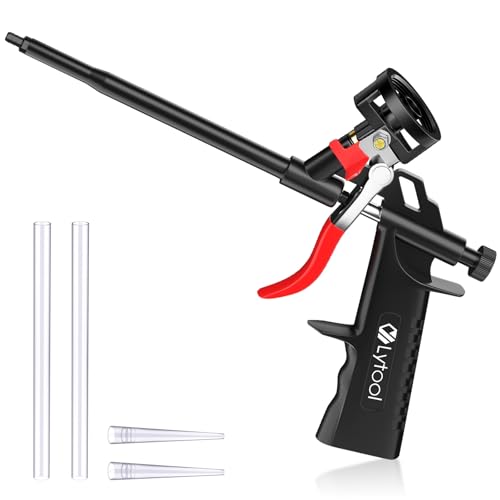
Lytool Expanding Foam Gun Professional Applicator

Lytool Spray Foam Gun with 12.6″ Extension Rod & PTFE Barrel

Luft Werkzeuge 4 Foam Guns with 36 Extenders

Luft Werkzeuge 2 Foam Guns with 18 Extenders

Lytool 2-Pack Spray Foam Gun Kit with Tubes and Brushes

Lytool 2 Pack Reusable Spray Foam Gun with Extensions and Brush
Inside Each Recommended Option
HandiFoam has long roots in the foam-contractor world, and the HT550 carries that DNA into a gun you can hand to a first-timer without worry. The 7-inch barrel, about 18 cm, gives a comfortable working length for sealing around window jambs and rim joists, while the adjustable bead control lets you throttle the output down for thin gasket-style beads or open up for filling a deeper cavity. The non-stick coated basket and needle valve are the parts that matter over time, since cured polyurethane is what ruins cheap guns.
Because it threads onto most standard gun-foam cans, the HT550 slides into a workflow without forcing you to commit to a single chemistry line. Compared to the all-plastic disposable nozzles shipped with most aerosol cans, this is a step up in control. You may find the metal body a bit cold in unheated garages during winter mornings, but the trade-off is the durability you want from a tool you expect to reuse dozens of times.
The Case For It
- Adjustable bead control supports both thin gasket beads and deeper cavity fills in the same session
- Threading fits most standard gun-foam canisters, so you avoid brand lock-in
- Non-stick coated basket and needle valve make post-job cleanup less of a fight
- Solvent-resistant body tolerates acetone flushes that shorten the life of plastic guns
Worth Noting
- Heavier than the aluminum-bodied options, which shows up during long overhead sessions
- No included extension tubes, so deep gap access requires a separate add-on
Key Specs
Right Fit For
Contractors and serious DIYers running multiple cans per job who want a gun they can hand to anyone on the crew and trust to lay a clean bead.
Consider Something Else When
Homeowners sealing a single window gap should look at the budget-friendly Lytool Expanding Foam Gun, which covers the same basic job without the contractor price.
The Akfix 805T8 sits in that comfortable middle of the lineup: lighter than the HandiFoam, more refined than the cheapest all-plastic nozzles. Its Teflon-coated aluminum body keeps the weight down, which matters when you spend an afternoon foaming the perimeter of a basement rim joist with your arm overhead. The advertised bead range of roughly 1/8 to 3 inches is unusually wide, giving you room to switch from thin window-bead work to filling a wider gap without swapping guns.
One of the most useful pieces is the integrated check valve, which blocks cured foam from creeping back into the line between cans. Compared to the HandiFoam HT550 above, the Akfix feels more like an everyday homeowner-plus-DIY tool than a contractor workhorse, but the same Teflon (PTFE) coating, a non-stick fluoropolymer, is the right idea for keeping the barrel from gluing itself shut. If you only run a few cans a year, this is a sensible fit.
A Few Highlights
- Lightweight aluminum build reduces fatigue on long, overhead sealing runs
- Teflon coating inside the barrel slows cured-foam buildup and speeds cleaning
- Wide 1/8 to 3 inch bead range covers both thin gasket work and larger gap fills
Trade Offs
- Aluminum body is lighter but can dent if dropped on a concrete slab
- No extension wand included, so you will need to buy one for attic and crawlspace use
Built With In Mind
Homeowners and remodelers who run several cans per project and want a comfortable, light gun for overhead rim-joist and soffit work.
Where Another Pick Suits Better
Anyone filling deep wall cavities on a tight budget will get better value from the Luft Werkzeuge single gun plus 9 extenders, which throws the reach tools in for the same money.
The Luft Werkzeuge single-gun kit is built around a simple idea: if you are going to buy a foam gun, you should also have the small nozzles that get into the gaps the gun alone cannot reach. You get one Teflon-coated gun, a copper nozzle on the front, and nine plastic extender tubes. That matters when you are sealing around pipe penetrations, behind outlet boxes, or in a tight stud-bay where a standard barrel simply will not fit.
The non-stick PTFE coating covers both the inside and outside of the barrel, so cured foam wipes off with a cloth instead of needing aggressive scraping. A spring-loaded trigger and lock valve let you lock the gun open for long bead runs, which is a quieter way to work than holding the trigger the whole time. Compared to the Akfix above, this kit is less refined in feel but more practical for the homeowner who mostly needs reach, not raw precision.
Positive Points
- Teflon coating on both inner and outer barrel cuts cleaning time and extends service life
- Copper nozzle resists wear better than plastic alternatives when you scrape off cured foam
- Lock valve frees your hand during long continuous bead runs
- Included extender tubes reach gaps a standard barrel cannot, such as behind box covers
Some Limits To Know
- Plastic extender tubes can clog with cured foam if left attached between sessions
- Single-gun setup leaves you without a backup if the gun fails mid-project
Feature Snapshot
Who Will Love This
DIYers sealing pipe penetrations, gaps behind outlet boxes, and other tight spots where a bare barrel simply will not fit.
Skip It When
Runners doing whole-house insulation should grab the Luft Werkzeuge 4-gun crew kit instead, since the single-gun version means you are stuck waiting on the gun to clear between canisters.
The Lytool single-gun applicator is the most stripped-down option in the roundup, and that is exactly the point. It is an all-metal gun with a PTFE-coated barrel, sold at the kind of price that makes sense for someone who needs to seal a few gaps in the garage or around a new window, not someone running cans every day. The full metal body gives it a more solid feel than the disposable plastic nozzles that ship with most foam cans.
The key compatibility note matters here: this gun is not designed to fit Great Stuff cans, so check your canister threading before ordering. The brand recommends emptying residual foam from the barrel after use instead of relying on foam cleaner, which can be a real cost saver. Compared to the Luft Werkzeuge single kit above, you give up the bundle of extender tubes, but you get a slightly lower entry price and the same basic PTFE barrel concept.
Bright Spots
- All-metal body holds up better to drops and acetone flushes than plastic-nozzle setups
- PTFE-coated barrel reduces foam sticking, so cleanup often just means emptying the line
- Entry-level price fits one-off sealing jobs without overbuying for the use case
Soft Spots
- Not compatible with Great Stuff cans, which limits which foam chemistries you can use
- No extension tubes included for deep cavity or behind-the-box work
Right Fit For
Homeowners sealing a handful of gaps in the basement, garage, or around new windows who want a real metal gun at a minimal cost.
Look Elsewhere When
Attic and crawlspace projects need reach that this single barrel cannot provide, so the Lytool Spray Foam Gun with the 12.6-inch extension rod is the smarter match.
Most foam-gun frustrations show up when you need to reach the gap, not lay the bead. The Lytool long-reach model ships with a 12.6-inch detachable extension rod that pushes the nozzle into ceiling corners, attic perimeters, and rim-joist cavities without dragging a ladder in. The PTFE non-stick barrel uses the same fluoropolymer coating as the rest of the line, which keeps cured foam from gluing the working parts together between sessions.
Where this gun really earns its slot is in jobs where the can itself cannot get close to the target. You can leave the canister on the floor and steer just the rod, which is a quieter way to work than climbing around with a full can held above your head. Compared to the standard Lytool applicator above, the addition of the rod is what justifies the bump in cost, and you may find the long reach useful even for ordinary tasks once you have it.
Why It Works Well
- 12.6-inch extension rod reaches ceiling and rim-joist gaps without a ladder in most cases
- PTFE non-stick barrel makes routine cleaning faster and reduces clogs
- Detachable rod stores flat and adapts to shorter jobs by removing it
Honest Caveats
- Longer rod makes the tip slightly harder to control for fine detail work like door-frame beads
- Same Great Stuff compatibility limit as the standard Lytool gun
Best Suited To
Anyone sealing attic perimeters, soffits, and high rim-joist runs where keeping the canister on the floor is a real safety plus.
Not Your Match When
Detail-oriented interior trim work is better served by the HandiFoam HT550, whose adjustable bead control and shorter barrel give you finer aim.
The four-gun kit is the right size for whole-house insulation days when a single applicator cannot keep up. You get four Teflon-coated guns, each with the same copper nozzle and lock valve as the single-gun kit, plus 36 extender tubes. That is enough spares to lose a few to cured-foam clogs without bringing the project to a halt, which is honestly the most realistic way to run foam work.
The case for buying a multi-pack is less about price per gun and more about workflow. Multiple guns let you swap a clogged barrel out in seconds instead of waiting for acetone to work, and you can pre-load cans while another gun is in use. Compared to the 2-pack from the same brand, the difference is essentially how many people you want to be able to foam at once. For one person running a long job, the 2-pack is usually enough.
Practical Pluses
- Four guns mean you can swap a clogged barrel in seconds rather than pause to clean
- 36 extender tubes cover the realistic amount of nozzle clogs you will see in a multi-day run
- Lock valve and copper nozzle are the same proven combination as the single-gun kit
Where It May Fall Short
- Storing four guns plus 36 tubes takes more shelf space than a one- or two-gun setup
- More pieces to keep track of, so a labeled storage bin is worth having
Feature Snapshot
Whose Shelf It Belongs On
Small insulation crews or ambitious homeowners wrapping a full attic or rim-joist insulation pass in a weekend.
Swap It Out When
Solo DIYers working through a single weekend will be just as well served by the Luft Werkzeuge 2-pack with 18 extenders, which costs less and still covers the realistic clog rate.
The 2-pack sits in the practical middle: enough redundancy for a one-person shop to keep moving when a barrel clogs, without the storage footprint of a four-gun kit. Each gun uses the same Teflon-coated barrel, copper nozzle, and lock-valve trigger as the rest of the Luft Werkzeuge line, so the feel is identical across the family. Eighteen extender tubes is a comfortable number that absorbs a few clogs without being wasteful.
For most solo DIYers, two guns is genuinely the right count. You can leave one attached to the can in use, while the second sits loaded and ready, and the included tubes cover most of the deep-cavity work the bare barrel cannot reach. Compared to the four-gun kit above, you give up the ability to have a real crew working in parallel, but you rarely need that on a home project.
Everyday Wins
- Two guns give you a hot spare when one barrel clogs mid-job
- Eighteen extender tubes handle the typical clog rate on a multi-can project
- Identical internals to the larger kit, so cleaning and parts stay consistent
Practical Considerations
- Same brand, same chemistry, so Great Stuff cans will not thread on without an adapter
- Plastic extender tubes are the most likely failure point, even with care
Made For
Solo homeowners and remodelers planning a multi-day insulation run who want a backup gun without overbuying crew-scale gear.
A Better Fit Elsewhere
Anyone doing exclusively attic or ceiling work should step up to the Lytool 2 Pack with 12.6-inch extension rods, which solves the reach problem the plastic tubes only partly address.
The Lytool 2-pack is the kit designed around the part of foam work people forget about: cleanup. Each gun uses a PTFE-coated barrel, but the bundle also ships with dedicated cleaning brushes sized to the nozzle, which is a quietly useful detail. The brushes let you clear cured-foam residue from the small passages where a cloth just smears things around, so the gun stays usable across more cans before it needs deep cleaning.
You also get a second gun, which is the same backup-guns logic as the Luft Werkzeuge 2-pack but with the included brushes tilting the value toward homeowners rather than crews. Compared to the standard Lytool single gun, the 2-pack is a more complete starter set, and you may find the brushes alone justify the upgrade for the way they extend the working life of the barrel.
A Few Strong Suits
- Included cleaning brushes reach into small passages that a cloth cannot clear
- PTFE-coated barrel helps maintain consistent flow as foam residue builds up
- Two-gun setup covers the realistic scenario of a clogged barrel mid-project
Details To Watch
- Brushes wear out faster than the guns themselves, so replacements will be needed eventually
- Still not compatible with Great Stuff cans without an adapter
Who Should Grab It
First-time foam gun owners who want the full kit, including the small cleaning tools that most listings skip.
Another Choice May Suit
Anyone whose work is mostly attic and ceiling reach should consider the Lytool 2 Pack with 12.6-inch extension tubes, since brushes are less useful when the working tip is at the end of a long rod.
The 9th pick pulls together the two most useful extras from the line, a pair of reusable all-metal guns, two 12.6-inch extension tubes for reach, and a cleaning brush, into one bundle. The “reusable” framing matters: the metal body and PTFE barrel are designed to be flushed and stored, not thrown out when the can is empty. The included brush targets the same small-passage cleaning that the 2-pack brush kit covers, so you are not trading that capability for the reach upgrade.
For two-person sealing days, having a second gun ready to go is the difference between a smooth workflow and a stop-and-start one. Compared to the single Lytool long-reach model, the 2-pack adds a partner, plus a brush you would otherwise buy separately. The honest read is that this is the most complete Lytool bundle for homeowners who want reach and redundancy in one box.
What Earns Its Place
- Two reusable all-metal guns support a two-person sealing day without sharing
- 12.6-inch extension tubes add reach for attic and high rim-joist gaps
- Included cleaning brush helps keep the small passages clear between cans
A Few Limitations
- Extension rods are not adjustable, so fine work at close range still requires removing them
- Same Great Stuff compatibility caveat as the rest of the Lytool line
Perfect Match For
Two-person DIY teams sealing attic perimeters or rim-joist runs, where having a matched pair of long-reach guns keeps both people moving.
Reach For A Different Pick When
Single-person projects are better served by the Luft Werkzeuge 2-pack with 18 short extender tubes, which costs less and is easier to manage solo.
Picking The Right Applicator For Your Project
A foam gun only earns its slot when it matches the work in front of you. Start with the scope, then the chemistry, then the ergonomics, in that order.
Match The Gun To The Can Chemistry
Not every gun threads onto every foam can. Several picks on this list are explicitly not compatible with Great Stuff cans, which use a particular valve style. Before buying, confirm the threading matches the foam you already own, or buy the gun and the can together. Mixing and matching across brands without checking the valve is the single most common reason a new gun fails to seal properly on the first can.
Weight And Reach Matter More Than Spec Sheets
A gun that feels light in the store can feel heavy after forty minutes overhead. The Akfix 805T8 and the Lytool models lean toward lighter aluminum builds, while the HandiFoam HT550 is the heaviest of the standard options. For ceiling and rim-joist work, a long-reach model like the Lytool 12.6-inch extension rod or the Lytool 2 Pack with rods lets you leave the canister on the floor and steer only the tip, which is a quieter way to work and a real safety plus on ladders.
Plan For Cleanup Before You Start
The fastest way to ruin a foam gun is to leave cured foam in the barrel between sessions. PTFE-coated barrels slow the buildup, but they do not eliminate it. The kits that include cleaning brushes or extra extender tubes exist because nozzle clogs are a normal part of the work, not a defect. Budget for acetone or a dedicated foam cleaner, and empty the barrel at the end of every session.
What To Watch Before You Buy
Common Shopping Slip Ups
The most frequent mistake is buying a gun for the price tag alone and assuming any applicator will thread onto any can. A close second is underestimating how often extender tubes clog, so a single-gun kit with no spares can stall a project within a can or two. The third slip is ignoring weight: a heavier gun feels fine in the store but turns into a forearm workout after a rim-joist loop. Match the gun to the chemistry first, the reach second, and the weight third.
Where The Extra Money Goes
Higher-tier guns like the HandiFoam HT550 cost more because the valve tolerances are tighter, the non-stick coatings hold up to more acetone flushes, and the bodies tolerate being dropped on a jobsite floor. You also get broader can compatibility, which keeps you from being locked into a single foam brand. For DIYers running a few cans a year, the mid-tier picks cover the same use cases; for anyone running cans monthly, the smoother valve action and longer service life of a premium gun are worth the bump.
Frequently Asked Questions
What is PTFE coating and why does it matter on a foam gun?
PTFE is polytetrafluoroethylene, a fluoropolymer sometimes branded as Teflon. It creates a non-stick surface that keeps cured polyurethane from bonding to the inside of the barrel, which means faster cleanup and longer gun life. Most picks on this list use a PTFE-coated barrel for exactly that reason.
Can a single spray foam gun work with multiple foam can brands?
In most cases, yes, but you need to check the threading and valve type before swapping brands. Several Lytool models on this list are explicitly not compatible with Great Stuff cans, while the HandiFoam HT550 is designed to work with most gun-foam canisters. When in doubt, confirm compatibility with the foam manufacturer before buying.
How do I keep a foam gun from clogging between uses?
Empty the residual foam from the barrel at the end of every session, then either leave a can attached or seal the nozzle. A dedicated cleaning brush, like the ones in the Lytool 2-pack brush kit, helps clear small passages that a cloth cannot reach. Periodic acetone or foam-cleaner flushes also extend the working life of the barrel.
How long should an extension tube be for attic work?
For most attic perimeters and high rim-joist runs, a 12-inch extension rod covers the typical reach without making the tip too floppy to control. Longer rods exist for specialized cases, but in a standard residential attic, the 12.6-inch rods on the Lytool long-reach models are usually enough.
Is it worth buying a multi-pack kit for a one-person project?
For one-time sealing jobs, a single gun covers the basics. For multi-day projects, a 2-pack gives you a hot spare when a barrel clogs, and that small redundancy often pays for itself in saved downtime. A 4-pack really only makes sense for a small crew working in parallel, not a solo homeowner.




