


A weathered fence panel is one of those projects that looks simple in your head and turns into a full Saturday once the brush comes out. Rolling stain on cedar pickets works, but it eats hours and leaves lap marks. Picking the right spray gun changes that math: thinner coats, faster coverage, and a finish that actually looks intentional. This roundup covers nine spray guns and accessories built for fence work, from quick stain touch-ups to whole-yard refinishing. Whether you tackle a single side or a long property line, there’s a tool here tuned to the job.
The Essentials At A Glance

Graco 221411 Reversible Airless Spray Tip (RAC IV, 411)

Wagner Control Pro 130 HEA Paint & Stain Sprayer

Graco 60-Mesh Spray Gun Filter (SG2/SG3)

RRJ R500 LVLP Automotive Paint Spray Gun Kit

RRJ R500 LVLP Spray Gun with Air Regulator
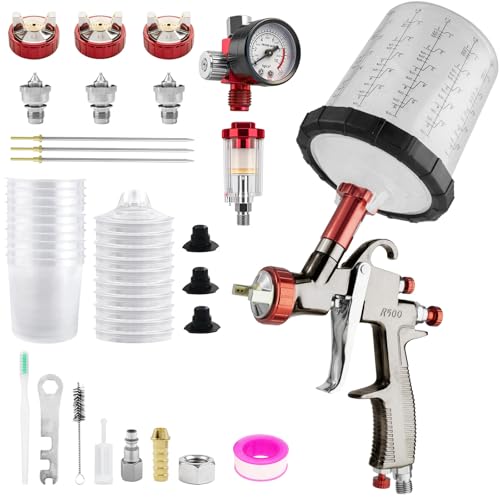
RRJ R500 LVLP Spray Gun (1.3/1.5/1.7mm Nozzles)

RRJ R500 LVLP Spray Gun (1.3/1.7/2.0mm Nozzles)

Wagner Control Spray QX2 HVLP Stain Sprayer

Wagner FLEXiO 570 HVLP Paint & Stain Sprayer
The Details Behind The Selections
You already own a Graco airless rig and you’re staring down a fence full of semi-transparent stain. Before you think about a whole new sprayer, look at the tip. Airless tips live a hard life, and swapping a worn 411 for a fresh one is often the difference between a clean fan pattern and a spitting mess.
The 411 designation tells you two things: an 8 to 10 inch spray fan and a 0.011 inch orifice, which suits thinner coatings like penetrating stains and sealers. For cedar or pine fencing that soaks up the first coat, that smaller opening lays down material the wood can actually absorb rather than flooding the surface.
Benefits That Matter
- Eight to ten inch fan width suits the narrow run between fence rails, reducing masking work on adjacent landscaping.
- 0.011 inch orifice is well matched to thin stains and sealers that would clog a wider tip.
- Reverse-A-Clean design lets you twist the tip and clear clogs without disassembly, a real time saver mid-coat.
- Tool-free swap onto compatible Graco guard assemblies means you can change patterns in seconds.
Things To Consider
- Useless without an airless sprayer already in the garage, so this is an upgrade part, not a starter tool.
- Tip wear is inevitable with abrasive stains, so budget for replacements if you fence every year.
Feature Snapshot
Right Fit For
Owners of Graco airless rigs staining cedar privacy fences who want a tuned tip without buying a new sprayer.
Consider Something Else When
You’re starting from scratch and have no airless unit, in which case the Wagner Control Pro 130 HEA is a more complete package.
For property-line fences that stretch past fifty running feet, a handheld HVLP unit will leave you refilling constantly. The Control Pro 130 steps up to a stationary airless platform that pushes unthinned paint and stain through a high-efficiency airless pump, so you spend your afternoon spraying instead of stirring.
HEA stands for High Efficiency Airless, which is Wagner’s way of saying lower pressure at the tip with the same coverage. Less bounce-back on a chain-link or picket face means less wasted material on the grass behind you. The trade-off is the wheeled cart footprint, which matters if you have limited storage.
Where It Excels
- Airless pump handles unthinned latex and oil coatings straight from the can.
- Lower overspray output compared to traditional airless rigs keeps drift off nearby cars and siding.
- Continuous flow design means fewer trigger pulls to maintain a wet edge on long runs.
- Suited to medium and large projects like whole-house exteriors alongside the fence work.
Worth Noting
- Cart and hose take up real floor space, so apartment dwellers may struggle to store it.
- Cleanup involves flushing the pump, which is more involved than rinsing a handheld cup.
Right Fit For
Homeowners with a long fence line plus a deck or siding on the to-do list who want one machine for both paint and stain.
Reach For A Different Pick When
You’re staining a short run of six panels and a handheld like the Wagner FLEXiO 570 will be quicker to deploy.
Spray tip clogs rarely start at the tip. The usual story is a chunk of dried latex skinned off the can rim, riding through the line, and lodging where you can’t see it. A 60-mesh filter sits in the gun handle, catching that debris before it reaches the orifice and ruins your finish.
If you already run a Graco SG-series gun, this is the kind of part you toss in your cart the second the old one looks tired. Skipping it works until the day your stain has been sitting on a shelf for a season, and then you’ll wish you hadn’t skimped.
Real-World Strengths
- Stops debris that would otherwise clog tips and force mid-job disassembly.
- Direct compatibility with the Graco SG10, SG20, and SG Pro handguns.
- Reaches the 20 percent clog threshold before flow drops, an easy visual cue for replacement.
Some Limits To Know
- Only useful with the right Graco gun model, so double-check your handle before ordering.
- Disposable design means routine replacement, especially when spraying older paint that has begun to settle.
Feature Snapshot
Right Fit For
Existing Graco SG gun owners who want to extend pump life and reduce tip-clog frustration across multiple fence projects.
A Better Fit Elsewhere
You don’t yet own a Graco airless gun, in which case starting with the Wagner Control Pro 130 HEA makes more sense than accessorizing a rig you don’t have.
LVLP stands for Low Volume Low Pressure, and the R500 kit leans into that promise with a stack of four nozzle sizes: 1.3, 1.5, 1.7, and 2.0 millimeters. That spread covers everything from a fine mist on thin stains to a wetter fan for primers and solid color coats. If your shop has a compressor already, this is a fence-painting rig disguised as an auto body tool.
You get a 600 ml reusable cup plus a pack of 650 ml disposable liners, so cleanup between colors is genuinely fast. A separate air regulator in the bundle lets you dial in pressure without walking back to the compressor.
A Few Strong Suits
- Four interchangeable nozzles match thin stains through to thick primers without swapping guns.
- Disposable cup liners cut solvent use and make color changes nearly painless.
- Included regulator gives precise control over inlet pressure right at the gun.
Points To Note
- Requires a compressor producing at least 3.0 to 3.9 CFM, which rules out small pancake units.
- Teflon-coated body holds up to solvent cleaners, but the seal gaskets still benefit from regular inspection.
Feature Card
Right Fit For
Shed and fence finishers who already own a compressor and want a multi-nozzle gun that doubles for car or furniture work.
Not Your Match When
You want a one-button self-contained system, in which case the Wagner FLEXiO 570 is a friendlier starting point.
Where the previous R500 kit ships with both reusable and disposable cups, this variant trims the bundle down to a single gun and a regulator. For someone who only wants the core tool and plans to buy mixing cups locally, that’s a leaner entry into LVLP spraying.
Working pressure sits in the 28.8 to 51 PSI window, well below the 100 PSI ceiling where overspray turns into a problem. The forged aluminum body with a Teflon surface shrugs off solvent baths, and the stainless steel fluid nozzle takes the kind of punishment a fence season dishes out.
Practical Advantages
- Low pressure window keeps overspray controlled, useful near gardens and pavement.
- Teflon-coated aluminum body cleans up quickly between stain and paint sessions.
- Four-nozzle set covers fence stain through to varnish top coats without buying extras.
Worth Bearing In Mind
- No disposable cup liners in the box, so budget for those or plan on hand-washing.
- Air consumption in the 3.0 to 3.9 CFM range still rules out the smallest hobby compressors.
Right Fit For
Compressor owners who want the gun and regulator only, with the freedom to source their own cup system.
Swap It Out When
You’d rather have cups and liners in the same box, in which case the RRJ R500 kit with the 1.3/1.5/1.7 mm nozzles bundles everything.
This R500 trim ships with a 650 ml mixing cup, ten disposable cup liners, and the 1.3, 1.5, and 1.7 mm nozzles. The 2.0 mm head is dropped to keep the package focused on stain and finish work rather than heavy primer spraying. For most fence owners, that’s the right call: you almost never need a 2.0 mm nozzle on fence stain anyway.
The Teflon-coated body and nickel-plated internals are built for the kind of repeated solvent exposure that comes with weekend after weekend of projects. Quick-disassembly design gets you to the fluid path without tools, which matters at the end of a long day when the last thing you want is a fiddly teardown.
Positive Takeaways
- Ten disposable liners mean you can swap colors or clean up in minutes without washing cups.
- Three smaller nozzles hit the sweet spot for thin stains and top coats.
- Low 2.0 to 3.5 bar working pressure keeps bounce-back manageable on windy days.
Honest Caveats
- Without the 2.0 mm nozzle, this is less suited to spraying thick latex paints straight from the can.
- Compressor requirement still applies, so factor in the cost if you don’t already own one.
Right Fit For
Fence finishers who cycle through several stain colors and want disposable liners to skip the cleanup marathon.
Skip It When
You plan to spray heavy primer coats, in which case the RRJ R500 with the 1.3/1.5/1.7/2.0 mm bundle is the better match.
The mirror image of the previous R500: this version keeps the 2.0 mm nozzle and drops the 1.5 mm, shifting the focus toward thicker coatings. If your fence project involves solid color stains or latex paint over previously painted surfaces, that larger orifice flows more material per pass.
Same Teflon-coated forged aluminum body, same nickel-plated internals, same ten disposable liners, and the same 650 ml mixing cup. The only real choice is which nozzle spread matches your typical coating.
Points In Its Favor
- 2.0 mm nozzle moves thicker latex and solid stains without constant thinning.
- Disposable liner system keeps color swaps and cleanup straightforward.
- Stainless steel internals resist corrosion from water-based and solvent coatings.
Trade Offs
- Skips the 1.5 mm head, which is the sweet spot for many sealers and thin stains.
- Heavier flow rates demand a compressor that can sustain the listed CFM without pressure sag.
Right Fit For
Coaters laying down solid color stains or latex paint on previously sealed fences who need higher flow.
Look Elsewhere When
Most of your work is transparent stain or thin sealer, where the 1.3/1.5/1.7 mm variant fits the bill more cleanly.
HVLP stands for High Volume Low Pressure, and the QX2 is built from the ground up for staining outdoor wood. Three spray patterns give you a horizontal fan for fence rails, a vertical fan for pickets, and a narrow round pattern for trim or lattice tops. That pattern control is the kind of detail you stop noticing once you have it.
Set up takes about the same time as brewing coffee: fill the cup, snap on a nozzle, prime, and you’re off. Compared to the Control Pro 130 we covered earlier, this is the tool for fences, lattice, and small deck sections rather than whole-house jobs.
Strengths Worth Knowing
- Three interchangeable spray patterns adapt to rails, pickets, and lattice without changing guns.
- Handheld form factor is easy to carry around a yard and store in a closet.
- Tuned specifically for stain flow, so atomization suits thinner coatings out of the can.
Where It Is Less Suited
- Cup capacity is small relative to airless rigs, so long fence runs mean frequent refills.
- Not the right call for thick latex paint, which the system is not designed to atomize cleanly.
Right Fit For
Homeowners with a single fence section or deck to stain who value simple setup and pattern flexibility.
Where Another Pick Suits Better
Property-long runs with hundreds of linear feet, where the Wagner Control Pro 130 HEA will save you refill trips.
The FLEXiO line sits in that sweet spot between casual handheld units and full airless rigs. The 570 carries an iSpray nozzle tuned for broad outdoor coverage, plus a detail nozzle for trim and tight corners. The X-Boost turbine gives it enough airflow to push unthinned paint, which a basic HVLP can’t manage.
Cleanup is the part owners mention first. Removable parts and a simple fluid path mean you can rinse and be done in under ten minutes, depending on coating type. Compared to the QX2 above, you trade some pattern precision for raw power.
The Practical Payoff
- Handles unthinned paint and stain, removing the guesswork from prep.
- Two nozzles cover broad fence faces and detail work in one kit.
- Adjustable flow and air caps let you tune output for the coating in use.
A Few Limitations
- Heavier than a basic handheld, so long sessions may tire out your trigger hand.
Feature Snapshot
Right Fit For
Homeowners juggling indoor and outdoor projects who want one sprayer for the fence, the kitchen cabinets, and everything in between.
Where Another Pick Suits Better
Pure stain work on short fence runs, where the lighter QX2 is easier to carry around the yard.
How To Choose The Right Setup For Your Fence
Match The Tool To The Coating
Thin penetrating stains want lower pressure and a smaller orifice, like the 411 tip on the Graco airless or the 1.3 mm head on the RRJ R500. Solid color stains and latex paint push more volume, so a 2.0 mm nozzle or a higher-flow airless rig like the Wagner Control Pro 130 HEA keeps the fan pattern wet. Picking the wrong tool leads to orange peel, dry spray, or coats that never quite cure.
HVLP Versus Airless For Fence Work
Handheld HVLP units (the Wagner QX2 and FLEXiO 570) are quiet, light, and easy to store. They shine on small fence runs and stain-only projects. Airless rigs trade convenience for raw flow, cutting job time on long property lines but adding cleanup steps. A homeowner with under 200 linear feet of fence often never needs to leave the handheld category.
Air Supply And Compressor Needs
Any LVLP gun (the RRJ R500 family) needs a compressor producing around 3.0 to 3.9 CFM at working pressure. A small 6-gallon pancake compressor will bog down mid-coat. Check your compressor’s CFM rating against the gun’s spec before you commit, since underpowered airflow shows up as spatter and pattern breakup.
Maintenance And Filter Habits
Every gun on this list benefits from a quick post-job flush and a tip check. The Graco 60-mesh filter exists because debris finds its way into every line eventually, and replacing it before flow drops below 80 percent keeps the rest of the system healthy. Owners who clean their guns the same day they use them generally get years of service without tip wear becoming a real problem.
Key Considerations Across These Picks
Where Shoppers Go Wrong
The most common fence-painting mistake is buying a gun tuned for auto body work and expecting it to push heavy fence stain without thinning. Check coating viscosity before purchase, not after the gun arrives. A second trap is forgetting about the air supply. LVLP and HVLP both need consistent CFM, and an undersized compressor turns a clean pattern into a sputtering mess halfway through the second coat.
What The Higher Tier Buys
Stepping up from a basic handheld to an airless rig buys continuous flow, less overspray, and the ability to handle unthinned paint straight from the can. For most homeowners with a single weekend fence project, the handheld tier is the right spend. For anyone maintaining rental properties or tackling multi-surface jobs year after year, the Wagner Control Pro 130 HEA earns its keep through sheer time savings on every project after the first.
Frequently Asked Questions
What size spray tip is best for fence staining?
For thin penetrating stains on cedar or pine, a 0.011 inch orifice like the Graco 411 works well, giving an 8 to 10 inch fan that fits between fence rails. Thicker solid stains benefit from a 0.013 to 0.015 inch tip. The right size depends on coating viscosity, so check the stain can’s thinning guidelines before settling on a tip.
Can I use a regular paint sprayer on a fence?
Yes, but match the sprayer type to the coating. Airless rigs handle latex paint and solid stains without thinning, while HVLP and LVLP guns are tuned for thinner stains and sealers. Using an HVLP on thick latex usually results in orange peel and dry spray, while pushing thin stain through an airless can produce heavy runs.
How do I prevent overspray when spraying a fence?
Work on calm days with wind under about 10 mph, hold the gun 10 to 12 inches from the surface, and use the narrowest fan that still covers the area. Drop cloths on the grass and cardboard shields behind the fence catch stray mist. Lower pressure settings on HVLP and LVLP guns also reduce drift compared to wide airless fans.
Do I need to thin my stain before spraying?
Most store-bought fence stains are formulated to spray at factory viscosity, but older cans that have sat for a season may need light thinning. Strain the stain through a fine mesh before pouring it into the cup to remove skin and dried bits. Run a test spray on scrap wood first, and thin in small increments until the pattern lays down smoothly without runs.
How long does it take to spray a fence versus brushing?
A handheld sprayer typically cuts staining time by half or more compared to a brush, especially on privacy fences with many pickets. A full airless rig on a 150 foot fence line can finish in a couple of hours, where brushing the same run might eat a full day. The actual time depends on the number of coats and the fence’s complexity, but spraying almost always wins on coverage speed.




